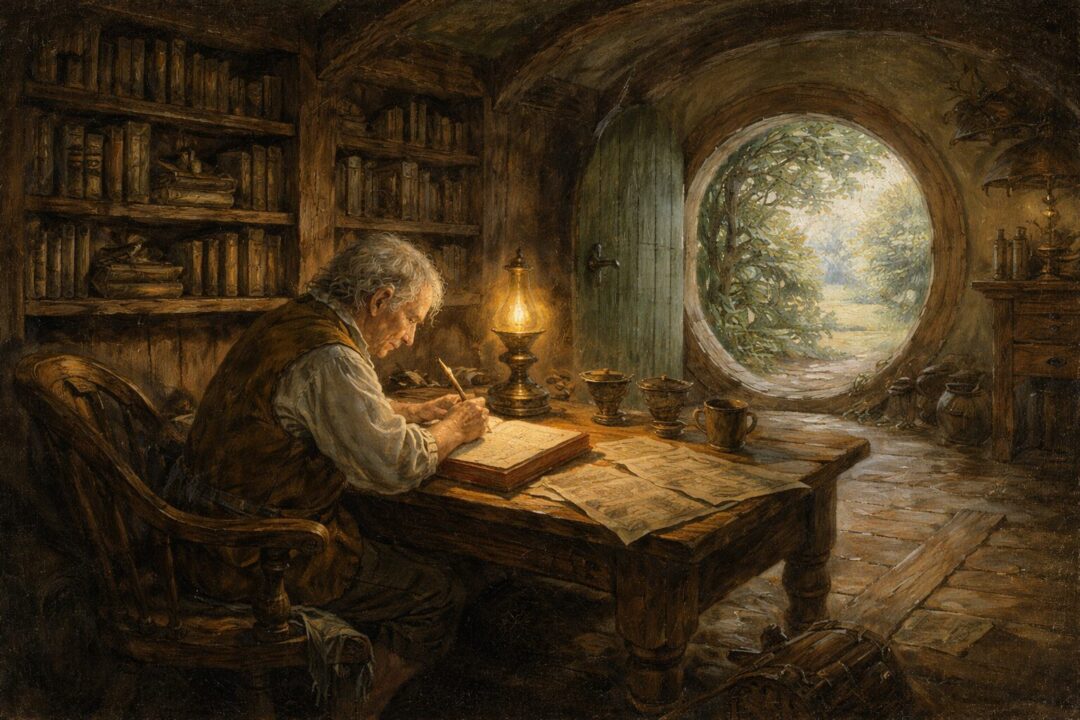
In The Hobbit, the moment passes almost casually.
Bilbo, lost in the dark beneath the Misty Mountains, finds a small gold ring lying on the tunnel floor.
He slips it into his pocket.
Nothing explodes.
No voice speaks.
No prophecy is declared.
Yet that unnoticed choice becomes the hinge of the Third Age.
So what if it never happened?
What if Bilbo never found the Ring?
To answer that, we must separate what the texts state clearly from what can only be cautiously inferred.
The Ring Remains with Gollum
Canon gives us firm ground here.
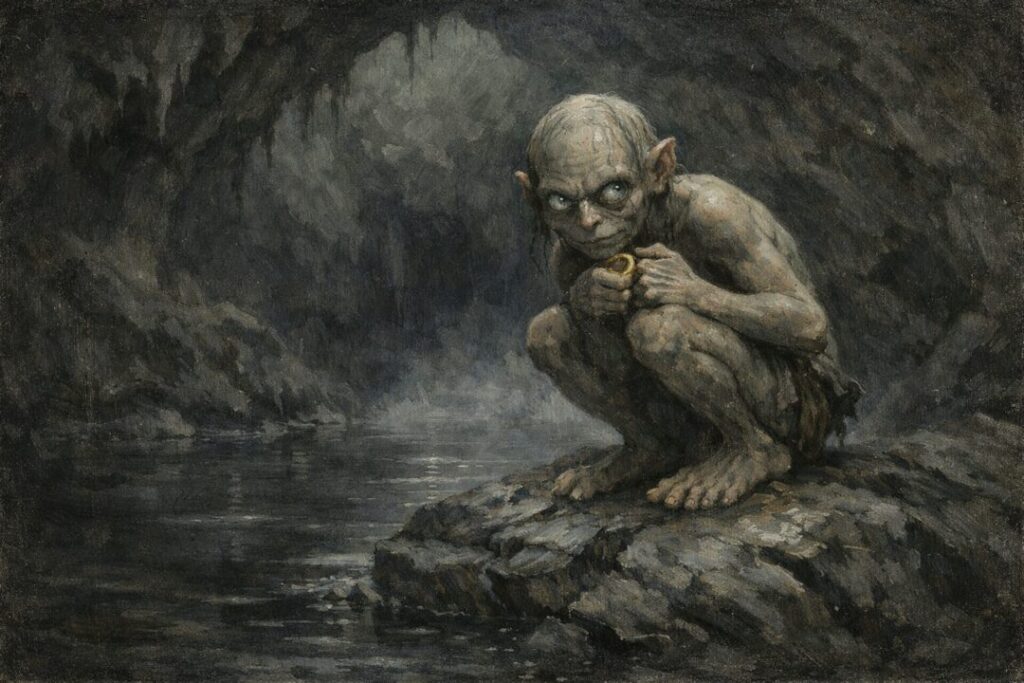
Sméagol murdered Déagol in T.A. 2463 and took the Ring. He possessed it for nearly five centuries beneath the Misty Mountains until Bilbo found it in T.A. 2941.
If Bilbo never takes it, Gollum keeps it.
Nothing in the text suggests he would willingly surrender it.
However, we also know the Ring had begun to abandon Gollum. Gandalf later suggests it “left him” because he was no longer useful to its purposes. This implies agency—not conscious thought in a human sense, but a directed will aligned with Sauron.
If Bilbo does not pick it up, the Ring remains hidden unless it chooses otherwise.
Whether it would eventually abandon Gollum anyway is speculative. The texts do not state this explicitly. They only imply that it slipped from him at a moment convenient to its designs.
Without Bilbo, that design may unfold differently—or not at all.
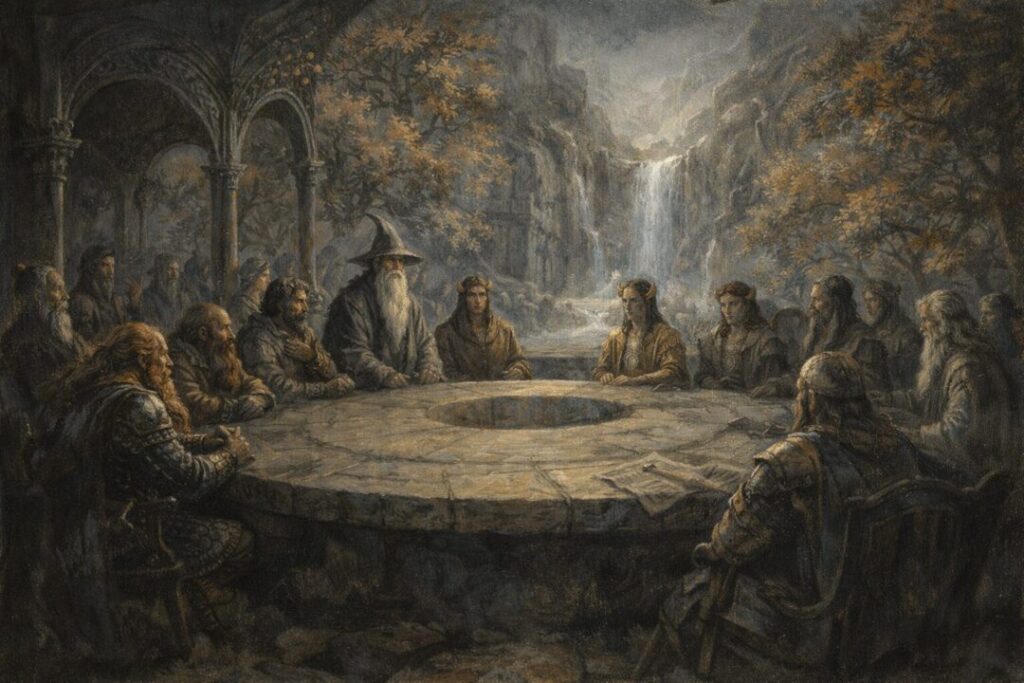
Gandalf Never Investigates
Gandalf’s suspicion about Bilbo’s ring grows slowly.
He observes Bilbo’s unusual longevity.
He hears Gollum’s story.
He eventually seeks confirmation in Minas Tirith, discovering Isildur’s account.
Without Bilbo possessing the Ring, none of this investigation occurs.
There is no unusually preserved hobbit.
No strange reluctance to part with a trinket.
No need for Gandalf to test fire against inscription.
The Ring’s identity might remain unknown to the Wise indefinitely.
The White Council and Dol Guldur
This part requires care.
The White Council attacked Dol Guldur in T.A. 2941, the same year Bilbo found the Ring. However, this assault was not triggered by Bilbo’s discovery. It was driven by long suspicion that “the Necromancer” was Sauron returned.
Therefore, even in this alternate history, the attack on Dol Guldur would still occur.
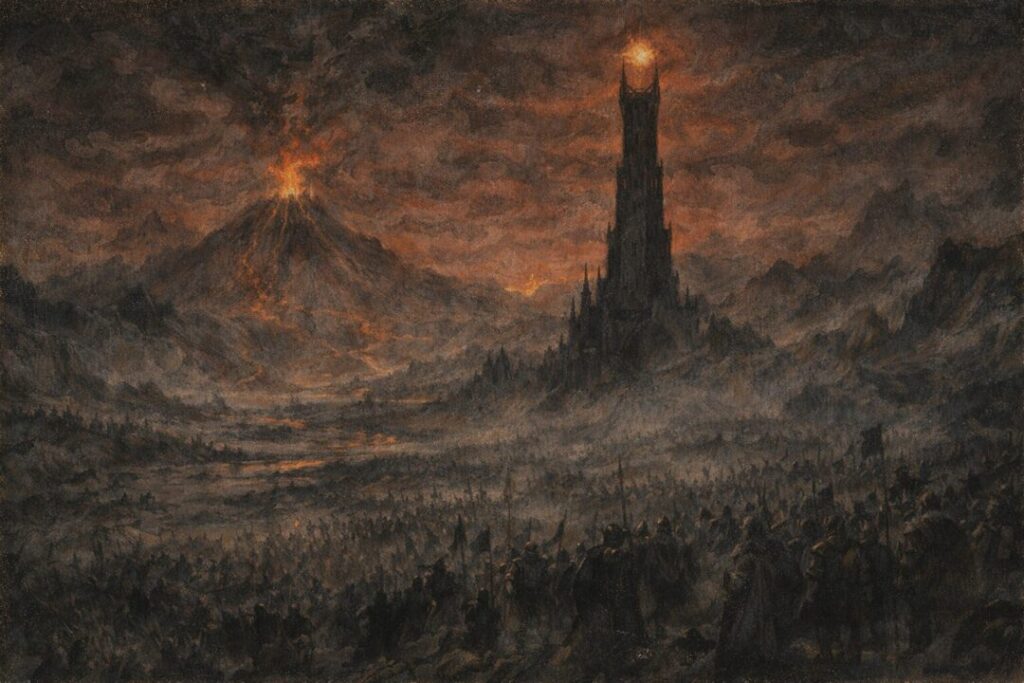
Sauron would still retreat to Mordor, as he does in the canonical timeline.
This is important: Bilbo’s discovery did not cause Sauron’s return to Mordor.
That event proceeds unchanged.
The Quest of Erebor
Bilbo’s role in the Quest of Erebor is partly dependent on the Ring.
He uses it to escape goblins.
He uses it in Mirkwood.
He uses it to enter Smaug’s lair.
He uses it to steal the Arkenstone.
Without invisibility, several moments become uncertain.
Would he survive the goblins? Possibly not.
Would he succeed in entering the Mountain? Unlikely.
Would Thorin receive the Arkenstone as leverage in negotiations? Almost certainly not.
However, the text does not provide an alternate scenario. Any conclusion here must be labeled speculative.
What we can say is this: without the Ring, Bilbo’s effectiveness is dramatically reduced.
That alone could alter the political outcome of the North.
Frodo Never Becomes Ring-bearer
This is the clearest ripple effect.
Bilbo passes the Ring to Frodo in T.A. 3001.
Without that inheritance, Frodo never bears it.
There is no journey to Rivendell.
No Council debating its fate.
No Fellowship.
And this leads to one of the most significant canonical truths:
Sauron never imagines that anyone would attempt to destroy the Ring.
Elrond explicitly states this. Sauron assumes any possessor would attempt to wield it.
If the Ring remains hidden with Gollum, Sauron’s strategy remains focused on military conquest and recovery—not on defense against destruction.
Would Sauron Eventually Find It?
This is where the scenario becomes uncertain.
In canon, Sauron learns of “Baggins” and “Shire” under torture of Gollum. That information triggers the Nazgûl’s hunt.
Without Bilbo ever taking the Ring, Gollum is never captured while searching for it.
Therefore, Sauron never learns of the Shire.
The Nazgûl would not ride north in 3018.
However, Sauron still seeks the Ring. His servants scour the Anduin. He believes it may have been lost in the river.
Whether he would eventually locate Gollum beneath the mountains is unknown.
The texts do not say.
This remains speculation.
Bilbo’s Natural Life
Without the Ring, Bilbo ages normally.
He would not live to 131.
He would not feel “stretched.”
He would not require the mercy of sailing West.
Hobbits are mortal. Death is their fate, as with Men.
Bilbo’s story would likely end quietly in the Shire.
No Grey Havens.
No passing over Sea.
No special grace granted to a Ring-bearer.
His life becomes smaller.
But perhaps more peaceful.
The Greatest Difference: Mercy
The most profound change may not be strategic.
It is moral.
Bilbo spares Gollum.
That act—unnecessary, irrational, merciful—ultimately enables the Ring’s destruction. Gollum’s final fall into Orodruin occurs because he was allowed to live.
If Bilbo never meets Gollum, he never chooses mercy.
And without that mercy, even if someone later bore the Ring, the ending would change.
This is not speculation.
Gandalf explicitly says that Bilbo’s pity “may rule the fate of many.”
Remove that pity—and the moral structure of the story shifts.
Would the War Still Happen?
Almost certainly.
Sauron was already rebuilding.
Gondor was already weakening.
The Age of Men was already dawning.
But without a quest to destroy the Ring, victory becomes unlikely.
Middle-earth’s survival in the canonical timeline depends not on strength—but on an act Sauron cannot conceive.
Refusal.
Destruction instead of domination.
If the Ring remains hidden, that refusal may never occur.
A Smaller World
Without Bilbo’s finding of the Ring:
• The Wise may never know it survives.
• Frodo never leaves the Shire.
• Aragorn’s kingship becomes uncertain.
• The destruction of the Ring may never take place.
None of this is written in the texts.
But the structure of the story makes one thing clear:
Bilbo’s accidental discovery is not small.
It is the beginning of the only path Sauron never anticipated.
And that may be the most unsettling truth of all.
Because if a hobbit had not reached down in the dark—
The Age of Men might have begun in shadow.