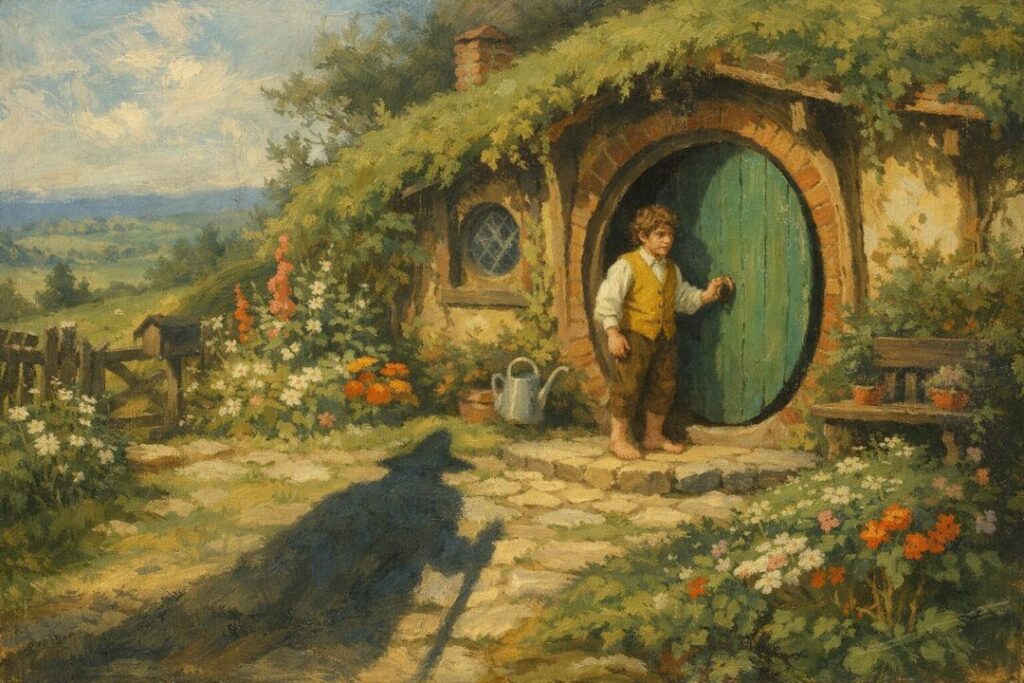
When Thorin Oakenshield arrives at Bag End, history stands on a knife’s edge.
The scene feels domestic. Almost humorous. A flustered hobbit. Dwarves filling the pantry. A wizard smiling quietly to himself.
It does not feel like the turning point of an age.
And yet, within the wider legendarium, this meeting is anything but accidental.
If Bilbo Baggins had refused the quest to reclaim Erebor, the consequences would have rippled outward through the entire Third Age. The fall of Smaug, the discovery of the One Ring, the Council of Elrond, even the journey to Mount Doom — all trace backward to that single decision.
What, then, would the texts allow us to say if Bilbo had never left the Shire?
Let us proceed carefully.
Gandalf’s Choice Was Deliberate
In Unfinished Tales, in the account titled “The Quest of Erebor,” Gandalf later explains why he chose Bilbo for Thorin’s company.
He had observed that Bilbo was not entirely content with a settled life. There was Tookish blood in him — a latent courage, a curiosity about the wider world. Gandalf also believed that Smaug would not recognize the scent of a hobbit, which might prove useful for stealth. And perhaps just as importantly, he hoped Bilbo’s presence might restrain Thorin’s pride and prevent rash heroics.
Most strikingly, Gandalf admits that he “had a feeling that a Hobbit should be involved.”
No alternative candidate is named.
There is no hint that Gandalf had another burglar prepared if Bilbo declined. The expedition, as conceived, depended upon a small, unobtrusive companion capable of entering Erebor unnoticed.
If Bilbo refuses, the Company has no burglar.
The quest might have been abandoned entirely. Or it might have proceeded without stealth — which, given Smaug’s power, would likely have ended in disaster. Gandalf himself expresses concern about Thorin’s potential recklessness.
This conclusion is not explicitly stated in the text. But it is a conservative inference based on Gandalf’s own explanation: the plan required Bilbo.
Without him, the structure collapses.
Erebor Without a Burglar
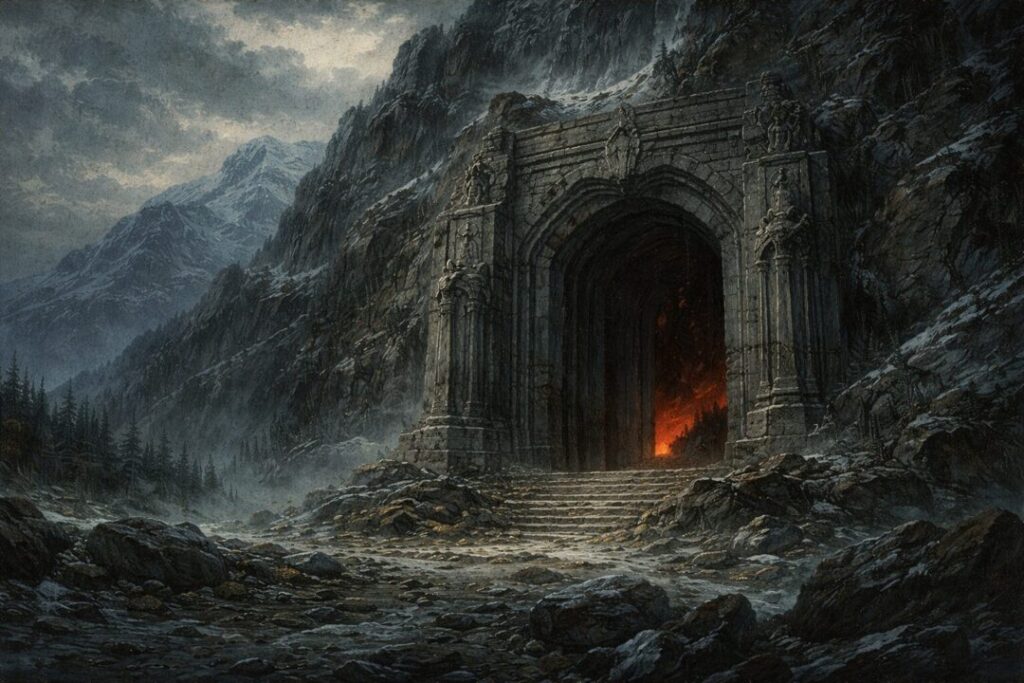
Bilbo’s role inside the Lonely Mountain is not decorative.
He enters the dragon’s lair alone.
He converses with Smaug.
He observes the weak place in the dragon’s armor.
He steals the Arkenstone.
He later uses it to negotiate peace between Dwarves, Men, and Elves.
Each of these acts shifts the outcome of events.
Smaug’s attack on Lake-town occurs after Bilbo’s intrusion. Bard slays him only because the dragon leaves Erebor. The Battle of Five Armies follows the struggle over the treasure hoard.
Without Bilbo:
- Smaug may remain undisturbed in Erebor.
- Lake-town may never be attacked in that manner.
- Bard may never rise as king.
- The political alignment of the North may remain fractured.
We must be careful not to overstate. The texts do not describe an alternate timeline. It is possible Thorin might have attempted another strategy. It is possible Smaug might eventually have been provoked by some other force.
But nothing in the canon suggests such an event.
What is clear is this:
Bilbo is the hinge upon which Erebor turns.
The Ring Beneath the Mountains
The most far-reaching consequence of Bilbo’s journey does not occur in Erebor at all.
It happens in darkness.
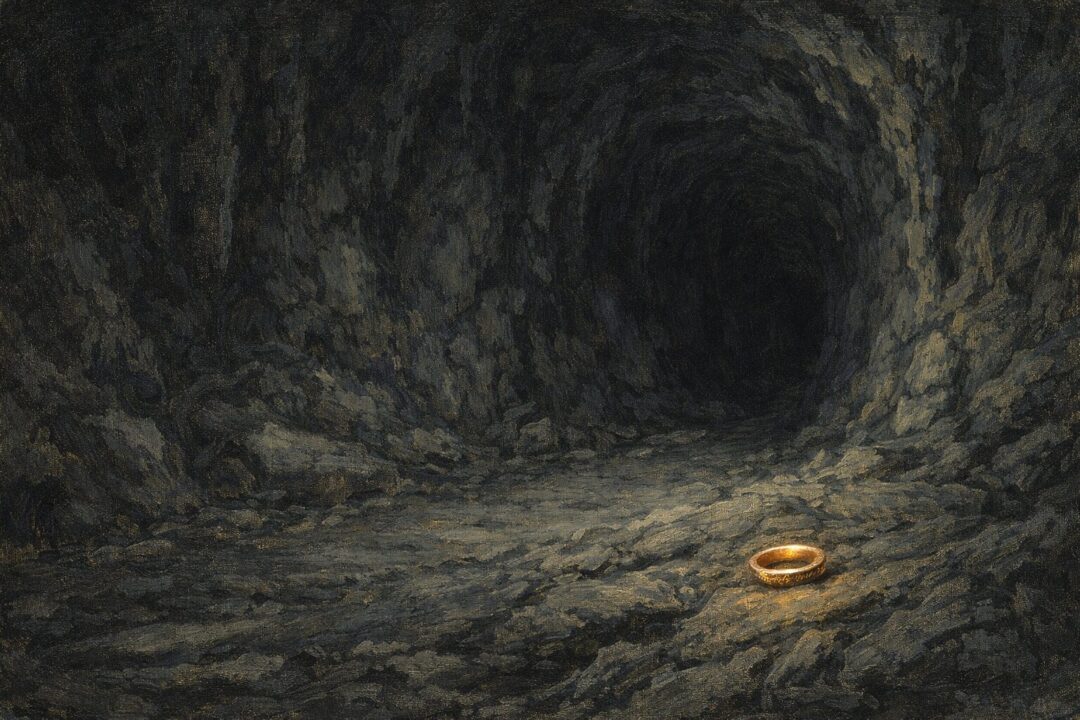
Separated from the Company in Goblin tunnels, Bilbo stumbles upon a small golden ring lying on the floor. This is not the result of a quest. It is accident — or what appears to be accident.
In The Council of Elrond, Gandalf later remarks that Bilbo found the Ring in the same year that Sauron was driven from Dol Guldur, calling it “a suspicious coincidence.”
The narrative does not elaborate.
But the suggestion of providence — or design beyond the characters’ understanding — is difficult to ignore.
If Bilbo never joins the Company, he never enters those tunnels. He never encounters Gollum. He never acquires the Ring.
And so the Ring remains with its previous bearer.
Gollum’s Continued Possession
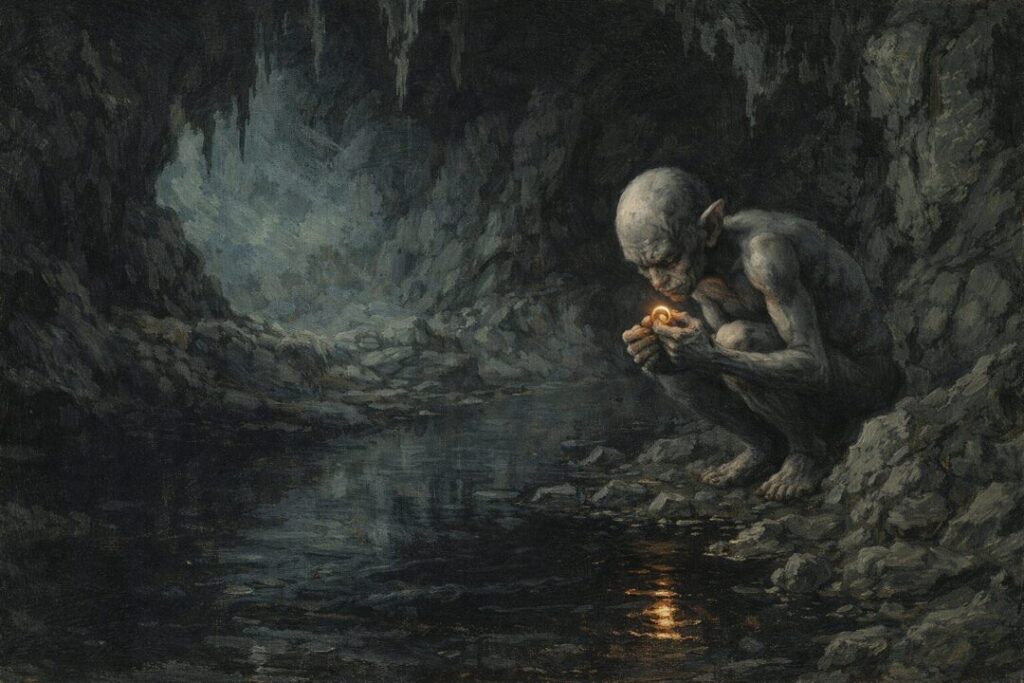
We know from Gandalf’s account that Gollum had possessed the Ring for centuries — far beyond the natural lifespan of his people. The Ring prolonged his life unnaturally, but also twisted him.
Nothing in the text suggests Gollum would willingly abandon it.
If Bilbo never takes it, Gollum remains beneath the Misty Mountains.
For how long?
The Ring lay lost in the Anduin for over two thousand years before Déagol found it. After Déagol’s death, Gollum kept it hidden in darkness for nearly five centuries.
The precedent suggests concealment can last a very long time.
There is no textual evidence that the Ring would inevitably resurface.
Would Sauron Eventually Recover It?
Here caution becomes essential.
Sauron later learns the words “Shire” and “Baggins” through Gollum’s capture and torture in Mordor. But Gollum only leaves his cave because Bilbo takes the Ring. His search for “Baggins” eventually leads him into the wider world.
If Bilbo never takes the Ring:
- Gollum never leaves to seek it.
- He is not captured in the same way.
- Sauron does not learn of “Baggins.”
The Nazgûl do not ride to the Shire.
However, it would be inaccurate to conclude that Sauron’s rise depends entirely on recovering the Ring.
The texts emphasize that Sauron regains power in Mordor regardless. His military strength grows. His alliances strengthen. The War of the Ring is not triggered solely by the Ring’s rediscovery — though that rediscovery shapes its urgency.
It is possible that without the Ring resurfacing, Sauron would wage open war when he deemed himself ready.
Whether he could sense the Ring’s presence if it remained with Gollum is never confirmed.
Any claim beyond that enters speculation.
Would Another Ring-Bearer Arise?
Nowhere in The Hobbit, The Lord of the Rings, or related texts is another potential Ring-finder identified.
Frodo becomes Ring-bearer only because Bilbo brings the Ring home and later surrenders it.
Without Bilbo:
- Frodo remains an ordinary hobbit of the Shire.
- There is no inheritance of the Ring.
- The Council of Elrond never gathers to decide its fate.
- The Fellowship does not form.
Some readers suggest that another traveler might eventually encounter Gollum. But this possibility has no textual support.
The evidence of history within the legendarium suggests the Ring can remain hidden for millennia.
Bilbo’s discovery is treated not as inevitability — but as extraordinary.
The White Council and the North
There is another layer often overlooked.
Gandalf’s concern about Smaug was not merely about treasure. In “The Quest of Erebor,” he expresses fear that Sauron might ally with the dragon. A dragon in the North could serve as a devastating weapon against Rivendell or Lórien.
If Smaug remains in Erebor, that threat continues.
It is plausible — and supported by Gandalf’s fears — that Sauron might have sought to use Smaug strategically.
This is not confirmed as inevitable.
But it is clearly presented as a danger Gandalf wished to prevent.
Bilbo’s participation leads to Smaug’s death. Without it, a powerful and independent dragon remains near the borders of Sauron’s growing influence.
That alone could alter the balance of power in the North.
Bilbo’s Own Fate
One of the quieter consequences concerns Bilbo himself.
At the end of the Third Age, Bilbo sails West from the Grey Havens alongside Frodo, Gandalf, Elrond, and Galadriel.
In Letter 154, it is stated that mortals who bore great burdens in Elvish affairs — Frodo explicitly, and by implication Bilbo and Sam — were granted passage to the Undying Lands for healing.
This is not immortality.
It is rest.
If Bilbo never bears the Ring, there is no textual reason to assume he would receive this grace.
He would likely live and die in the Shire as other hobbits do.
His story would not extend beyond its borders.
Would Evil Still Rise?
The deepest question remains.
If Bilbo stays home, does the War of the Ring never happen?
The answer, according to the internal logic of the legendarium, is almost certainly no.
Sauron’s ambition does not depend entirely on the Ring’s recovery. He grows in strength regardless. His armies gather. His will to dominate remains constant.
War would likely come.
But the form of resistance would be different.
Without the Ring resurfacing:
- There is no quest to destroy it.
- There is no Fellowship.
- There is no journey to Mount Doom.
Sauron might wage war believing the Ring lost forever.
Or he might eventually attempt to recover it through other means.
The texts do not tell us.
But they make one thing clear:
Bilbo’s choice does not eliminate evil.
It changes the way evil is confronted.
The Fragility of History
What makes this counterfactual powerful is not certainty.
It is fragility.
The fall of Smaug.
The rise of Bard.
The restoration of Erebor.
The exposure of the Ring.
The Council of Elrond.
The destruction at Mount Doom.
All trace back to a hobbit answering a door.
Bilbo nearly refuses.
He hesitates.
He trembles.
He considers staying inside.
The War of the Ring stands on that hesitation.
In a world of kings, wizards, dragons, and Dark Lords, history turns first on the smallest figure in the room.
If Bilbo had never left the Shire, Middle-earth would still face shadow.
But the road through that shadow would be unrecognizable.
And that is what makes the question so unsettling.
Because it reminds us that in the legendarium, destiny does not thunder from the sky.
It knocks politely at a round green door — and waits for someone small to answer.