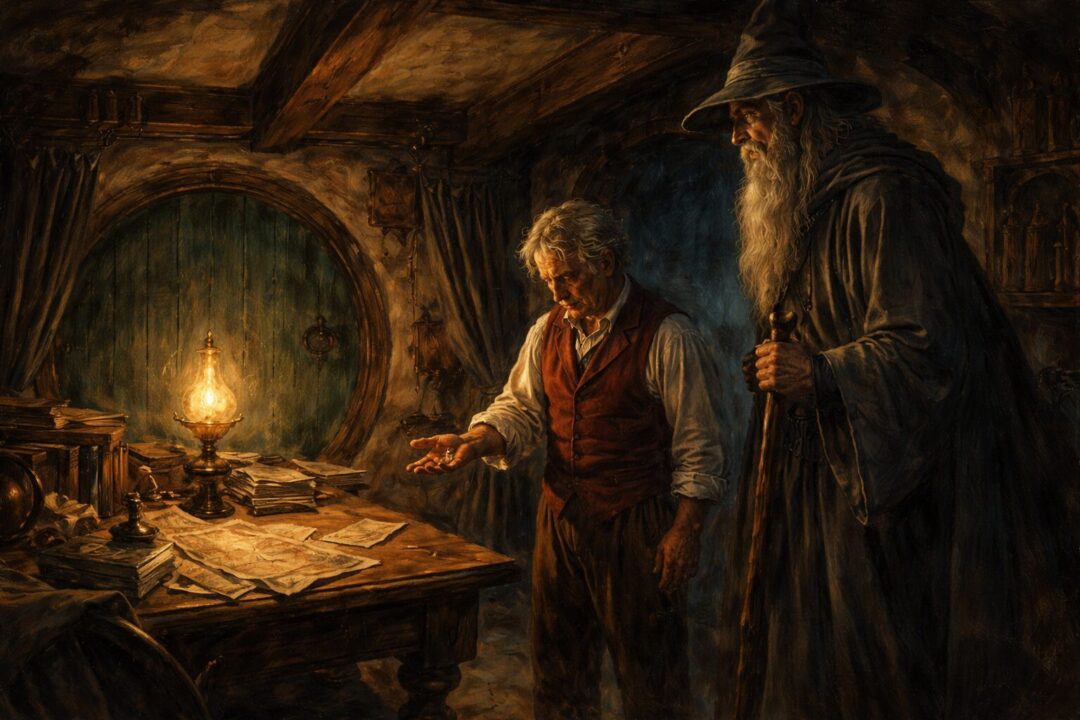
The night Bilbo leaves the Shire is often remembered as a tidy transfer.
A birthday party.
A vanishing trick.
A will.
A new owner.
But the book does not write it as tidy.
It writes it as resistance.
Bilbo does not simply hand over a trinket. He delays. He minimizes. He tries to laugh it away. He calls the Ring by pet names and speaks as if it is part of himself. And Gandalf—who is gentle with Hobbits when he can be—still has to become hard for a moment to stop the thing that is happening.
Bilbo later describes himself as feeling “thin,” “stretched,” like butter scraped over too much bread. That line is usually quoted as melancholy.
In context, it is also diagnostic.
It is what a Ring does to a bearer who will not release it.
So here is the more precise what-if—the one that sits right inside the scene Tolkien actually gives us:
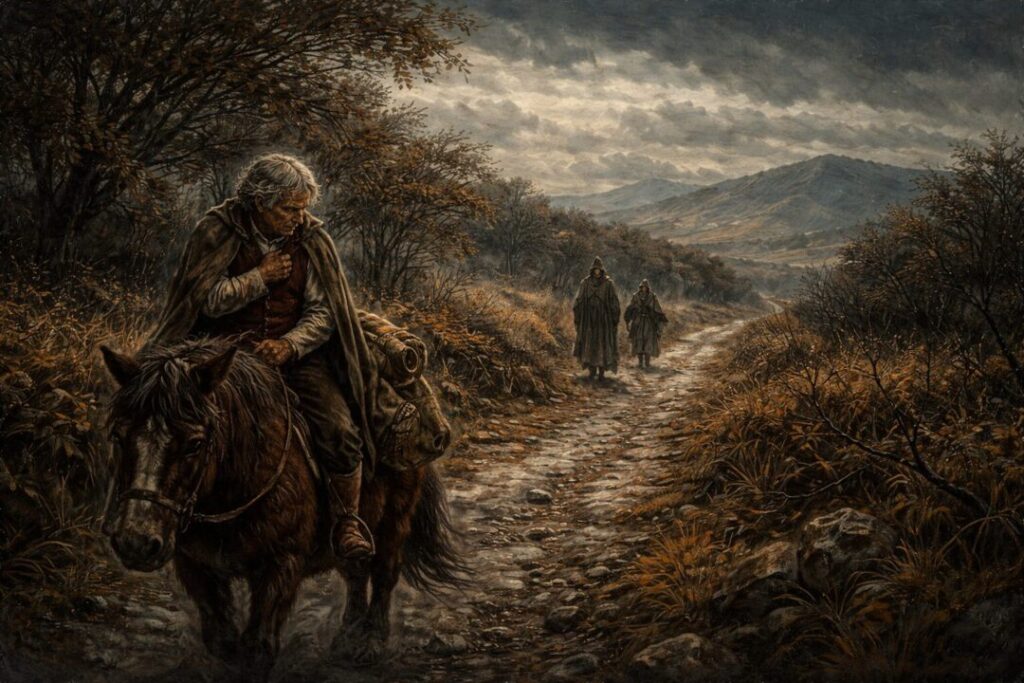
What if Bilbo carried the Ring with him to Rivendell in 3001?
Not forever. Not into the War of the Ring. Just across the threshold into the one house in the North where the story of the Rings is not rumor, but memory.
To answer it cleanly, you have to hold three things in view:
- what the text says about Bilbo’s struggle in 3001,
- what Rivendell is and what Elrond represents,
- what Sauron actually knows (and does not know) at that time.
And then you have to be careful—because the biggest consequence is not the one people reach for first.
3001 is not “the Nazgûl year”
When readers imagine the Ring on the road, they often jump straight to pursuit.
Black Riders.
Ambush.
A disaster before Bree.
But in 3001, the pursuit narrative is not yet in motion.
In the chronology given in The Lord of the Rings (Appendix B), Bilbo leaves and Frodo inherits the Ring in 3001. The crisis—Gandalf’s certainty, the command to leave, the first appearance of the Riders—does not arrive until much later.
And the reason matters: Sauron does not yet have the crucial pair of words.
“Baggins.” “Shire.”
That knowledge comes through Gollum, who is captured and questioned in Mordor long after Bilbo has left the Shire. Only then does the Enemy have the thread that leads his servants west.
So if Bilbo takes the Ring to Rivendell in 3001, the most lore-faithful assumption is not a Nazgûl attack on the East Road.
The road would still be dangerous—wolves, weather, ordinary violence—but it would not yet be hunted for that specific reason.
Which means the most important change happens after arrival.
Quietly.
In a house built to remember.
What Rivendell changes is not safety — it’s clarity
Rivendell is not simply a refuge.
It is a repository.
Elrond is not merely a kindly host; he is one of the chief remaining keepers of the Elder Days. He has lived through the end of Gil-galad, the war in which Sauron was thrown down, and the moment when Isildur refused the final destruction. The Rings are not abstract to him.
They are history with teeth.
So if Bilbo enters Rivendell still bearing the Ring, the first consequence is not a battle.
It is that the Ring is now in a place where its nature could be recognized sooner—if the right person dares to name it.
That “if” is the hinge.
Because The Fellowship of the Ring is explicit about something many adaptations blur:
Gandalf does not begin in perfect certainty.
He suspects. He worries. He watches Bilbo. He becomes increasingly uneasy over years. And only after later research does he return to the Shire with proof.
So a Ring in Rivendell in 3001 creates a pressure-cooker of knowledge:
- Bilbo is present, and the Ring is present.
- Elrond is present, and the lore of Rings is present.
- Gandalf’s suspicion is present—but not yet his proof.
The question becomes: would anyone force the moment of naming early?
And Tolkien’s world is full of characters who delay naming dreadful things until they must.
Not out of cowardice, but out of responsibility.
Because once you name a thing, you accept the duty it creates.
Would Elrond “take the Ring” from Bilbo?
This is where many what-if threads drift into invention.
The texts never say Elrond has the authority to seize it. In fact, the moral texture of the story runs the other direction: the Ring is not safely handled by force.
Even in 3001, Gandalf does not simply confiscate it.
He argues. He presses. He appeals to friendship and to Bilbo’s better self. And when Bilbo finally yields, it is an act of will—painful, but chosen.
That is consistent with what the Ring is.
It binds to desire, to claim, to ownership. A seizure might remove it physically, but it also risks forging a new “right” in the mind—either in the taker, or in the one taken from. That is the kind of moral crack the Ring uses.
So if Bilbo arrives in Rivendell with it, the lore-faithful expectation is not that Elrond simply takes it and locks it away.
A more conservative reading is this:
- Bilbo would continue to possess it unless he surrendered it freely,
- and the longer he kept it, the more “reasonable” it would feel to him to keep it.
In other words, Rivendell might become the stage for a second version of the Bag End struggle.
Except the audience would be different.
The most dangerous outcome: the Ring becomes “kept” instead of “hidden”
There is a subtle distinction in the book between hiding the Ring and keeping it.
After Bilbo leaves, Frodo does not use the Ring much. He keeps it quiet, and for a time it lies almost dormant in the Shire.
That quiet is not only luck.
It is also distance.
The Ring is far from the great centers of power. Far from councils, far from ambitious rulers, far from places where wise people might feel tempted to “use it for good.”
If Bilbo takes the Ring to Rivendell in 3001, you bring it closer to the very kind of mind the Ring is designed to ensnare—not because Elrond is weak, but because greatness itself is leverage.
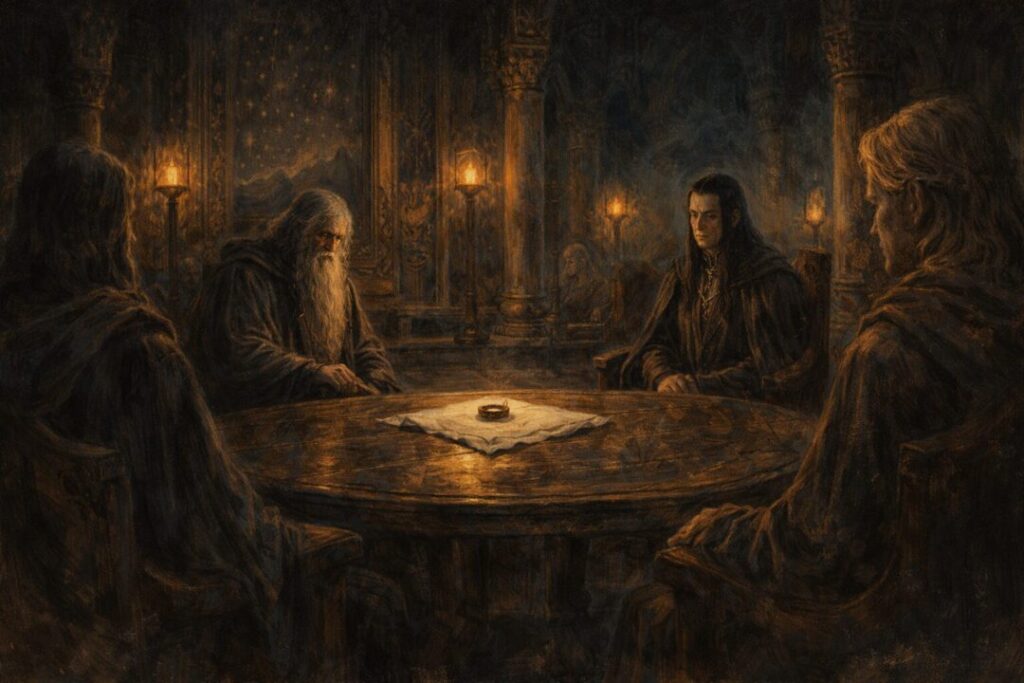
The book later makes this principle plain when the Ring is offered in Rivendell and refused, and again when it is offered elsewhere and refused. The Ring’s great trick is not merely corruption by ugliness.
It is corruption by purpose.
So the danger is not that Elrond would suddenly become a villain.
The danger is that the Ring—present, known, discussed—would become an object of deliberation.
And deliberation is time.
Time is what the Ring uses.
If Bilbo keeps it in Rivendell, it could slip into a new category: not a hidden trinket in a Hobbit-hole, but a grave matter “kept” among the Wise, watched, studied, postponed.
That sounds responsible.
It is also exactly how disasters mature in Tolkien: not always through rashness, but through postponement.
Would Gandalf discover the truth sooner?
Possibly—but it is not guaranteed.
Here we have to mark the boundary between text and inference.
What we can say from the book:
- Gandalf does not immediately prove the Ring’s identity in 3001.
- He only returns later with decisive confirmation.
- He consults records and seeks certainty before he acts.
What we cannot say as fact:
- that Elrond would identify it on sight in 3001,
- or that Gandalf would immediately obtain the proof he later seeks.
However, inference is reasonable in a limited way:
If the Ring is in Rivendell, Gandalf’s conversations with Elrond could intensify sooner, and the question might become unavoidable earlier. Rivendell is a place where the memory of the Last Alliance is not distant. Elrond’s counsel is available. And Bilbo’s visible attachment to the Ring would be harder to dismiss when observed at close range.
So: earlier recognition is plausible. Earlier certainty is not certain.
A twist most people miss: Sauron’s timeline might not change at all
Here is the strangest part of this what-if.
Even if the Ring reaches Rivendell in 3001, Sauron’s discovery of “Baggins” and “Shire” still depends on Gollum.
Unless you invent a new chain of events—and we won’t—Sauron still spends years without that thread.
So you could end up with a situation that is more dangerous than the canon, precisely because it feels safer.
- The Ring is in Rivendell.
- The Wise are near it.
- There is no immediate hunt.
- Time passes.
And the Ring remains exactly where it wants to be: near power, near purpose, near the kind of minds that might someday decide they can wield it.
The Shire, in canon, is not just an accidental hiding place.
It is a kind of insulation.
Removing that insulation early might not summon the Riders sooner—but it might intensify temptation sooner.
What happens to Bilbo?
Bilbo is the human core of this scenario, and the text gives us the key.
In Rivendell, Bilbo is still capable of goodness, humor, and self-knowledge. But he is also still capable of sharp possessiveness when the Ring is mentioned later. Tolkien lets you see that the struggle in 3001 did not erase the Ring’s hold; it only ended Bilbo’s ownership.
So if Bilbo arrives still owning it, the most conservative expectation is:
- his reluctance to surrender would harden, not soften,
- and the longer it remains “his,” the harder it becomes to make it not his.
This is why the Bag End scene matters so much.
It is not a footnote.
It is the moment Tolkien shows you that Bilbo’s mercy and decency are real—but also that the Ring’s grip is real.

The likeliest outcome, text-faithful
If we stay strict—no invented rescues, no sudden coups, no Nazgûl attack years early—the most text-consistent answer is not a flashy alternate war.
It is a slower, graver distortion:
The Ring becomes a known burden in Rivendell seventeen years earlier than in the canon… and that knowledge itself becomes a danger.
In the canon, Frodo’s long quiet possession delays the crisis but also delays the temptation of the great. The Ring sits in a place where it cannot easily be “used.”
If it sits in Rivendell, it sits among the very people who would most passionately refuse to use it—yet would also feel most obligated to do something with it.
And that pressure to “do something,” in Tolkien’s world, is often where tragedy begins.
So the real open question isn’t “Would the Nazgûl find it?”
It’s this:
Would Rivendell have the courage to treat the Ring as something that must be destroyed—before the proof is comfortable, before the timing is perfect, before everyone feels ready?
Because if they don’t… the Ring does what it always does.
It waits.
And it makes waiting feel wise.