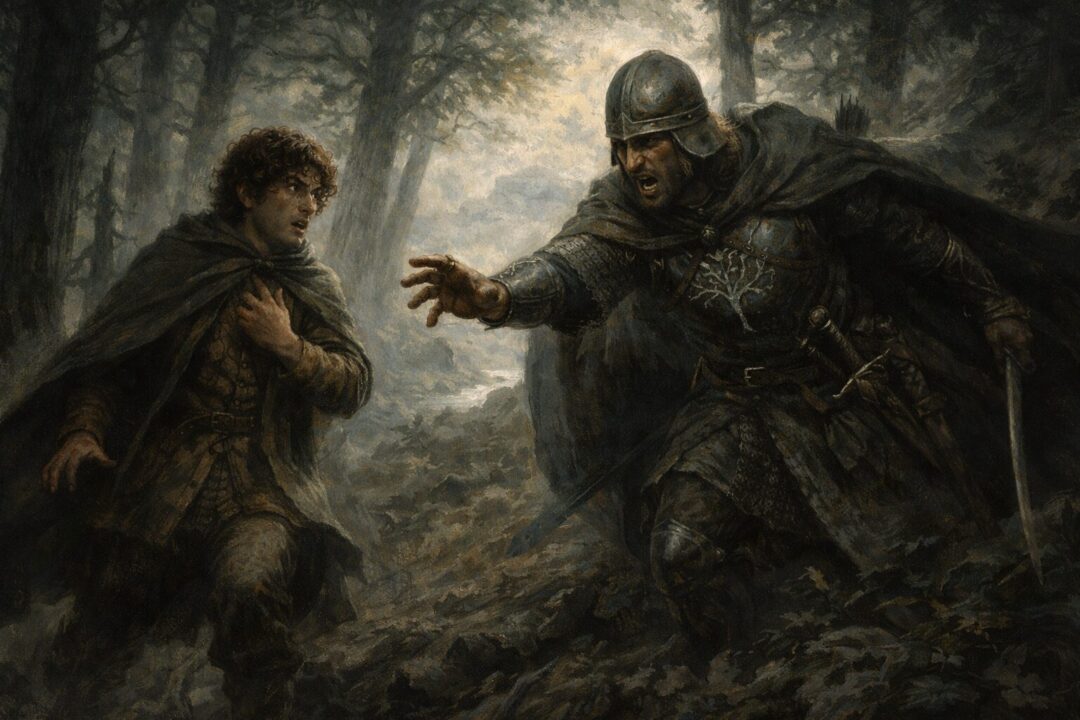
At the Council of Elrond, Boromir of Gondor becomes one of the Nine Walkers.
It is a moment that feels natural: Gondor is at war, Minas Tirith stands under threat, and Boromir arrives in Rivendell as the most immediate representative of that struggle. He speaks with urgency, with pride, and with a soldier’s logic. The Ring, he argues, might be used.
Yet behind Boromir’s presence is a detail the narrative gives us almost quietly—one that matters because it reveals that the Fellowship’s membership was not the only possible arrangement.
Faramir would have gone.
In the account given later, the dream that pointed the brothers toward Imladris came more often to Faramir than to Boromir. Faramir wanted to answer it. But Boromir insisted on taking the perilous journey in his stead, despite Denethor’s objections.
So the question is not purely imagined. A different choice was already near at hand:
What if Faramir had taken Boromir’s place among the Nine?
To explore this, we have to separate what the text states clearly from what can only be suggested.
The Fixed Points: What the Text Actually Gives Us
Some things are stable no matter which brother goes.
- The Council concludes that the Ring cannot be used as a weapon of good without corruption. The only viable path is destruction.
- The Fellowship’s goal is still to bring Frodo toward Mordor.
- The Ring’s power still works upon those near it—especially over time, and especially under fear, exhaustion, and need.
Those are the boundaries.
Within them, the brothers differ in a way the story itself highlights.
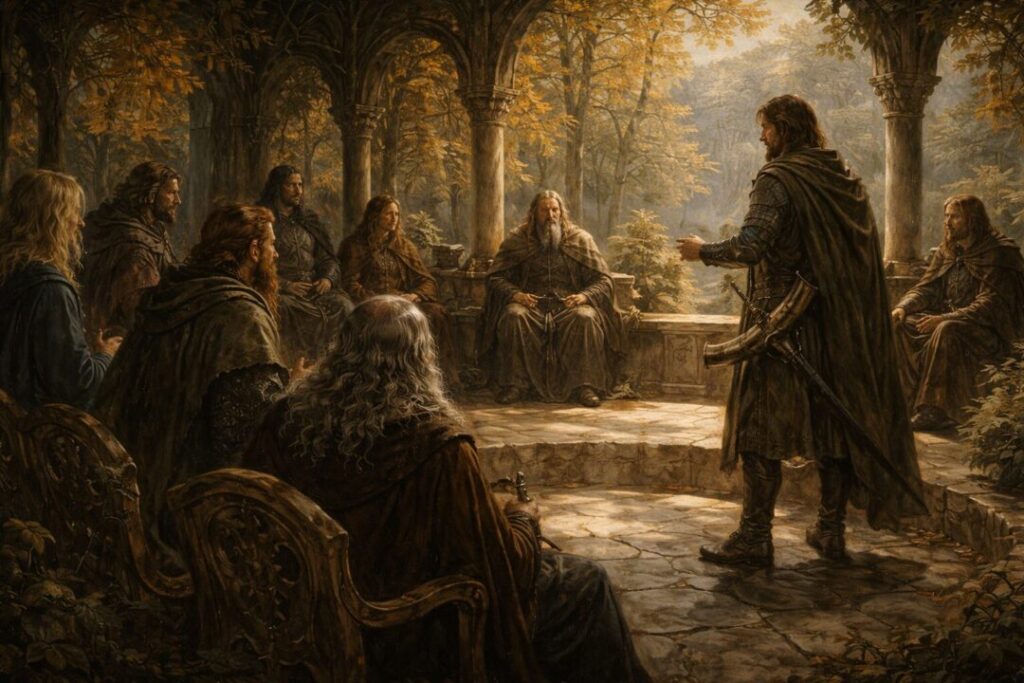
Boromir’s Temptation Begins in Plain Sight
Boromir is not portrayed as evil. He is portrayed as pressured.
At the Council, he voices a thought that many would have had: Gondor is bleeding, and here is a weapon of unimaginable power. Why not wield it against the Enemy?
That line of reasoning is rejected—not because Boromir is uniquely flawed, but because the Ring is uniquely deceitful. It does not offer power without a price. The will that uses it is reshaped by it.
Boromir accepts the Council’s decision. But he does not stop wanting the Ring to become the answer Gondor needs.
That desire—protective, patriotic, desperate—is what makes his later fall believable.
At Amon Hen, the pressure breaks through. He tries to seize the Ring from Frodo, and then repents almost at once. His end is heroic. His failure is tragic.
And that tragedy is not private: it fractures the entire Quest.
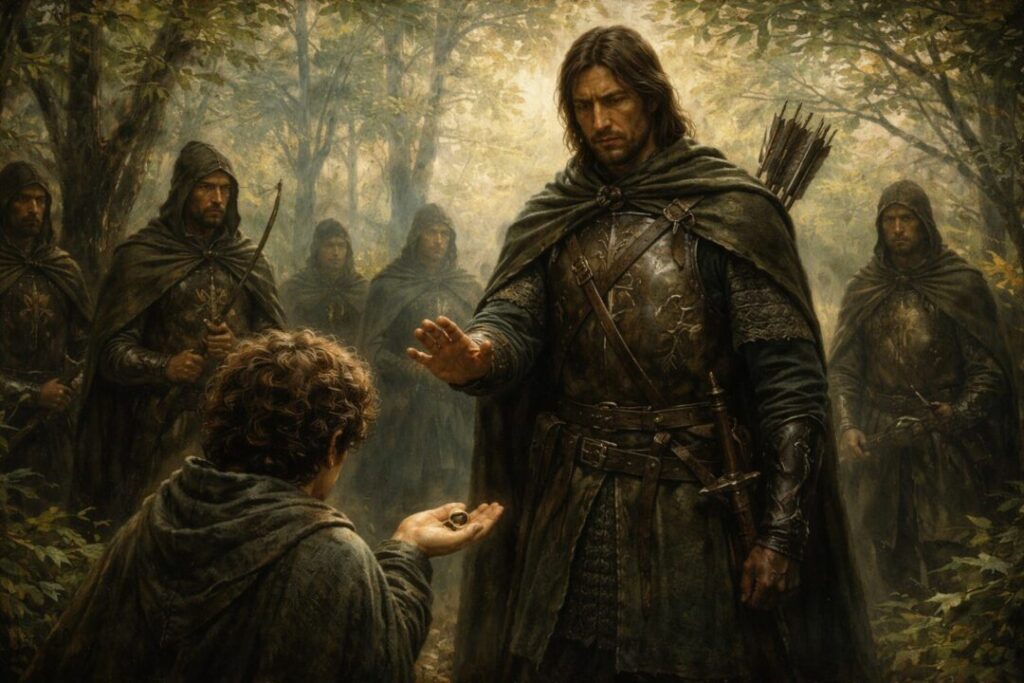
Faramir’s Defining Moment: Refusal
Faramir’s most important scene comes later, in Ithilien.
He meets Frodo and Sam as strangers. He questions them carefully. He learns enough to suspect the truth. Then the truth is revealed plainly: Frodo bears the One Ring and intends to destroy it.
Faramir’s response is one of the most startling acts of restraint in the story.
He declares that he would not take the Ring even if it lay by the highway.
He proves it by releasing the Hobbits and letting them continue their Quest—despite the fact that the Ring could, in theory, be used to defend Gondor in its hour of need.
This is the textual foundation for most “Faramir in the Fellowship” speculation.
If he refuses the Ring when it is directly in front of him—when he understands what it is—then it is reasonable to think he might have resisted earlier as well.
But we still have to be careful.
The text shows that temptation is not a simple test you pass once. It can intensify with proximity to danger, with despair, with the slow erosion of will. Faramir’s refusal is strong evidence of character, but it is not a guarantee against every possible pressure.
So we move into interpretation—but grounded interpretation.
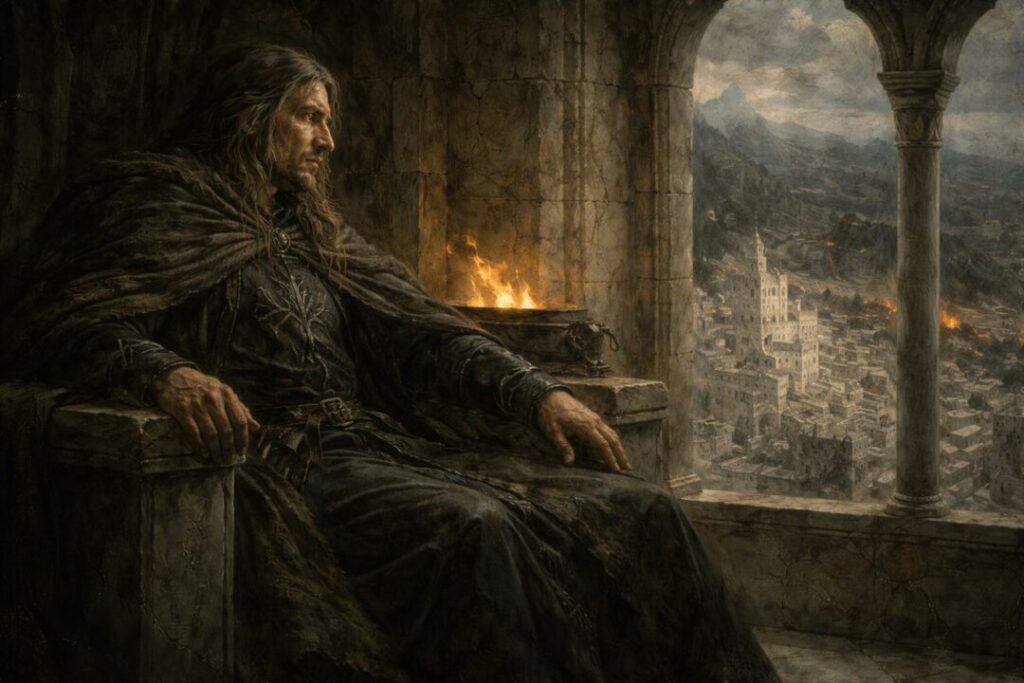
The Breaking of the Fellowship: Would It Still Happen?
This is the central hinge.
If Faramir replaces Boromir, the most obvious change is that Boromir’s attempt to take the Ring at Amon Hen might not occur.
If that attempt does not occur, Frodo may not feel the same immediate need to flee.
However, this is where the story becomes complicated.
Even without Boromir, Frodo is increasingly isolated by the burden of the Ring. He feels watched. He feels the weight of decision. He begins to believe that the Quest is his alone.
So two possibilities remain plausible:
- Interpretation A (conservative): The Fellowship still strains and fractures, but in a different way and perhaps at a different moment, because Frodo’s burden continues to grow regardless of which Gondorian is present.
- Interpretation B (more optimistic, still speculative): With Faramir present—calmer, more cautious, less driven to claim power—Frodo might trust the company longer and delay leaving.
The text supports the idea that Faramir’s presence would reduce one major threat inside the Fellowship: an internal grab for the Ring.
It does not fully answer whether Frodo would still choose solitude.
Merry and Pippin: The Ripple Effects
Boromir’s final stand buys time, creates a trail, and fixes the Fellowship’s next decision: Aragorn, Legolas, and Gimli pursue the captives.
If Boromir is not there, the encounter with Saruman’s Orcs could still happen—but the details become unstable.
Would Merry and Pippin still be taken? Possibly.
Would the pursuit unfold the same way? Not necessarily.
And if Merry and Pippin do not meet Treebeard, then the Ents’ assault on Isengard becomes less likely—at least in the same form and timing.
Here, the chain reaction is real, but the specifics are speculative.
Gondor’s Cost: Two Brothers, One War
Your deep-research summary includes the most important balancing point:
Even if Faramir strengthens the Fellowship, Gondor is weakened by his absence.
In the actual story, Gondor’s defense depends on a handful of leaders acting at the right moments—often with very little margin for error.
If Faramir is gone, Gondor loses one of its captains. If Boromir stays behind, Gondor gains a warrior—but the story shows that Boromir’s temperament is oriented toward force and decisive victory. That may help in battle, but it also risks the very mindset the Ring preys upon.
And Denethor?
The text strongly indicates Denethor’s favor fell more openly on Boromir, and Boromir’s loss hits him hard. If Boromir lives, Denethor’s emotional collapse could be altered—but how far it changes cannot be asserted as fact without stepping beyond the page.
The Uncomfortable Possibility: Boromir Alive Means the Ring’s Danger Returns
This is the twist many “what if” discussions miss.
If Boromir does not go, he does not fall at Amon Hen.
That sounds like a clean improvement—until we remember what Boromir wanted from the Ring in the first place: a weapon to save Gondor.
If Boromir remains in Minas Tirith while the Ring is still abroad in the world, his desire to claim it does not disappear. It simply relocates closer to Gondor’s crisis.
This is speculation—but it is speculation that follows directly from Boromir’s stated reasoning at the Council and from the Ring’s nature.
So the change may shift temptation away from the Fellowship… and toward Gondor’s center of power.
What the Scenario Reveals
This “what if” does not merely compare two brothers.
It highlights a deeper pattern:
- Boromir shows how love of one’s people can become a doorway for the Ring.
- Faramir shows that wisdom can refuse power even when it is useful.
If Faramir walks with Frodo, the Fellowship may hold longer.
But that does not automatically make the world safer.
It simply moves the stress points.
And that is exactly what makes the question compelling: the story is not built on “better choices create easy victories.” It is built on the idea that every choice carries a cost, and even good intentions can be used by the Shadow.
So if Faramir had been in the Fellowship, the journey might have looked more stable—at least for a time.
But the war outside the Fellowship would still burn.
And the Ring would still seek the weakest moment.
The real question becomes not “would it all be better?” but:
Where would the breaking happen instead?