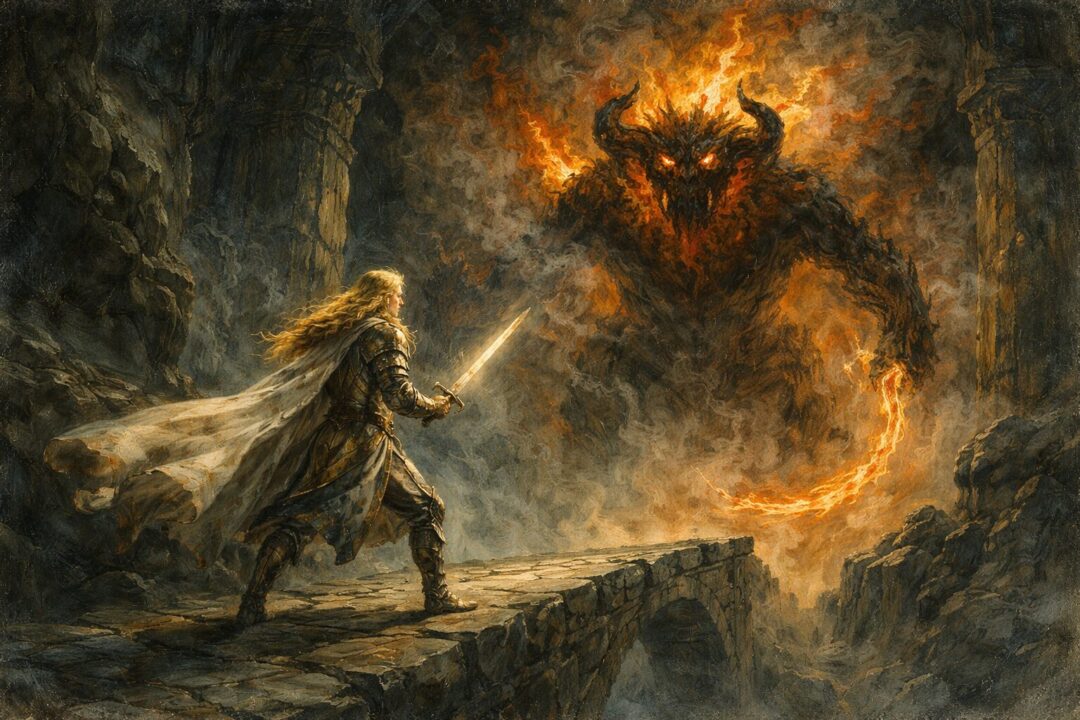
In the year T.A. 1980, the Dwarves of Khazad-dûm delved too deeply.
The mithril veins had grown scarce. Their desire for the precious metal drove them downward, ever closer to forgotten depths.
And there they awakened something that had fled the ruin of the First Age.
A Balrog of Morgoth.
The Appendices record the outcome with stark brevity: King Durin VI was slain. The following year, his son Náin I was killed. The Dwarves abandoned Khazad-dûm, and the ancient kingdom became a place of dread.
This Balrog would later be known as Durin’s Bane.
That is the history.
But what if it had ended differently?
The Balrog in Moria: What We Know
The creature Gandalf faced in T.A. 3019 is explicitly described as a Balrog of Morgoth—one of the Maiar corrupted in the service of the Dark Power in the First Age.
By the end of that Age, most Balrogs had been destroyed in the War of Wrath. But the texts state that some fled and hid in deep places beneath the earth.
Durin’s Bane was one such survivor.
For nearly two thousand years of the Second and early Third Age, it remained hidden beneath the Misty Mountains. It did not attack. It did not seek dominion. It slept.
Until the Dwarves disturbed it.
The fall of Moria was not caused by invasion—but by awakening.
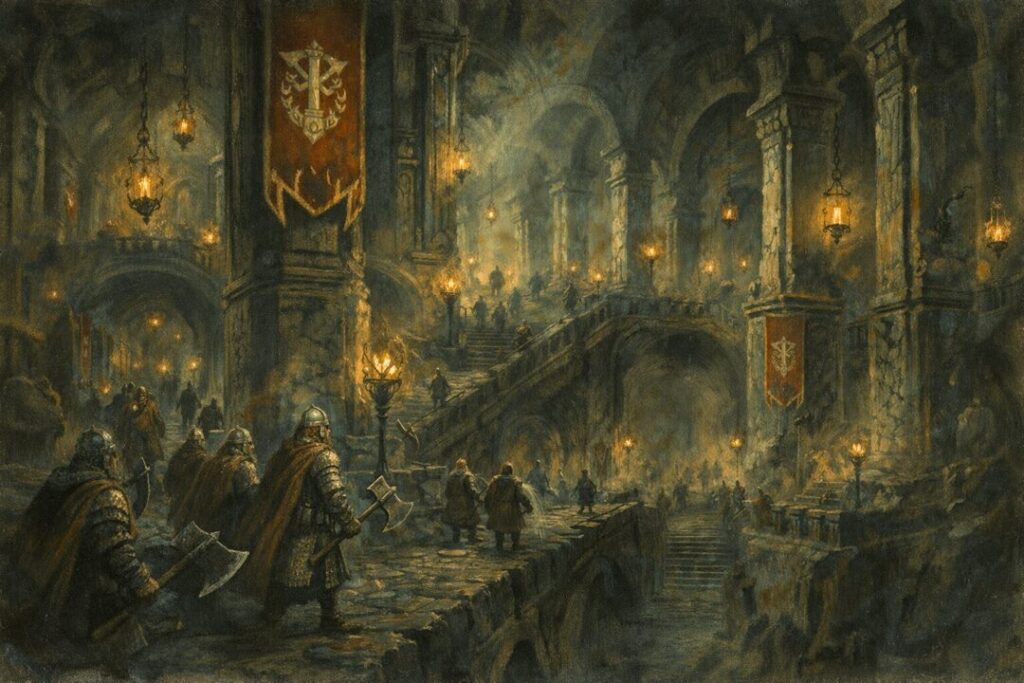
Could the Dwarves Have Defeated It?
On their own, the Dwarves could not.
The text makes this clear. Durin VI was slain, and even after his death the creature remained unconquered. Within a year, the kingdom was abandoned.
But Dwarves are not weak. In earlier Ages they fought dragons and armies of Orcs. Their endurance is legendary.
So why did they fail here?
Because a Balrog is not merely a powerful beast. It is a Maia—an immortal spirit in physical form, wielding fire and shadow. Gandalf himself—also a Maia—barely defeats it after a battle that lasts from the depths of Moria to the peak of Zirakzigil.
That comparison matters.
If Gandalf required that much effort, the Dwarves alone stood little chance.
But what if they had not stood alone?
Elrond and Glorfindel: A Plausible Intervention?
At the time of Moria’s fall, Elrond ruled in Rivendell.
The texts do not state that he knew immediately what had occurred beneath Khazad-dûm. Communication between realms was slow. It is possible that by the time news reached him, the Dwarves had already fled.
However, if we allow a speculative scenario—clearly marked as such—one possibility emerges.
Elrond had at his side Glorfindel.
Glorfindel is explicitly recorded as having slain a Balrog in Gondolin during the First Age, though he died in the act. He later returned to Middle-earth, and by the Third Age he was one of the mightiest Elves remaining.
This is not fan embellishment. It is textually supported.
So could Glorfindel have helped destroy Durin’s Bane?
Possibly.
But at cost.
Balrogs are not easily defeated. Even Gandalf perished in his battle before being sent back. Glorfindel’s previous victory also required self-sacrifice.
If Glorfindel had faced Durin’s Bane again, it is reasonable—though speculative—to assume the fight would have been devastating.
Victory was not impossible.
But it would not have been easy.
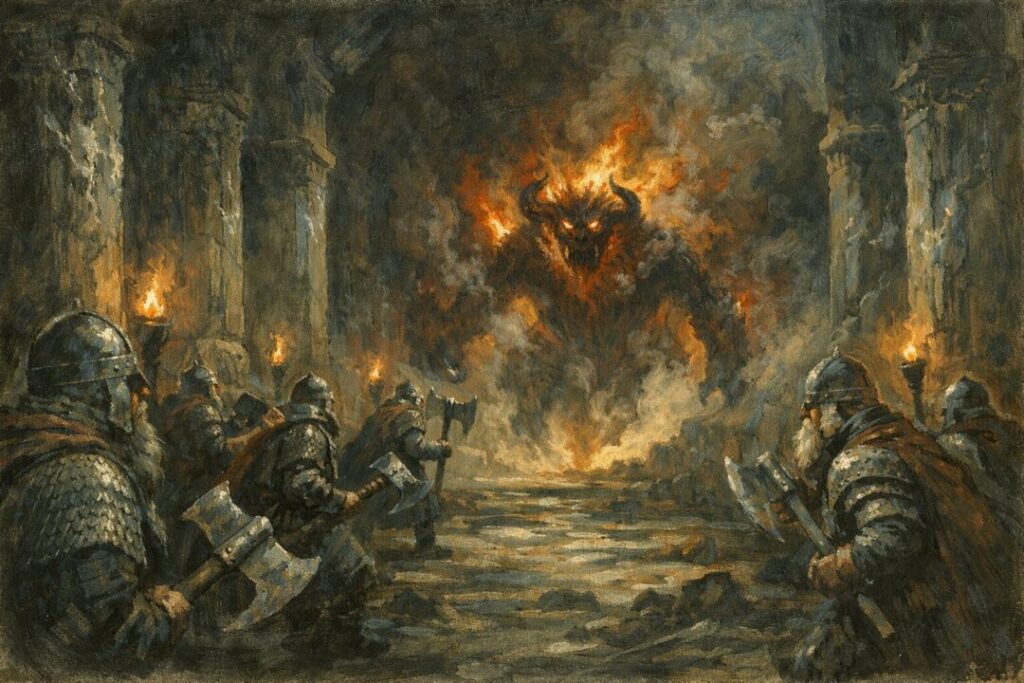
If the Balrog Fell in T.A. 1980
Let us assume, for the sake of analysis, that Dwarves and Elves together destroyed Durin’s Bane.
What changes?
First: Moria remains inhabited.
Without the Balrog’s presence, Orcs would have lacked their greatest terror and champion. Historically, Orcs later infested Moria in large numbers. It is implied that the Balrog became a rallying power for them.
Without it, the halls of Khazad-dûm might have remained a Dwarven stronghold.
Second: The Line of Durin remains centered in Moria rather than Erebor.
After Moria’s fall, many Longbeards went north, eventually strengthening Erebor. This shift shaped later events—including the Quest of Erebor and the political geography of the late Third Age.
If Moria had endured, the balance of Dwarven power might have remained in the Misty Mountains.
Third: The War of the Ring changes subtly.
When the Fellowship left Rivendell, they first attempted the Pass of Caradhras. After that failed, they chose Moria.
Why?
Because Balin’s colony was thought to have reclaimed it.
If Moria had never fallen—or had remained secure—there would have been no haunted ruin to cross. The Fellowship might have passed through a living Dwarven realm instead of dark halls filled with Orcs and a Balrog.
And most significantly—
Gandalf would not have faced Durin’s Bane.
The Fate of Gandalf
This is where the consequences deepen.
Gandalf’s confrontation with the Balrog leads to his death and return as Gandalf the White.
Without that battle, would he have remained Gandalf the Grey?
The texts never say that his transformation depended exclusively on that event. But the narrative presents the battle as the moment of sacrifice and renewal.
Without it, the leadership of the Free Peoples may have unfolded differently.
Would Saruman have been overthrown as swiftly?
Would Rohan have rallied as decisively?
Would Aragorn have revealed himself when he did?
These questions move firmly into speculation—but they arise naturally from the change.
Would Sauron’s War Have Been Altered?
Perhaps less than we imagine.
The Balrog did not serve Sauron. It is never depicted as answering to him. It remained in Moria, acting independently.
Its earlier destruction would not directly weaken Mordor.
However, a strong and unified Dwarven kingdom in the heart of the Misty Mountains would alter strategic geography. The mountains were a natural barrier between east and west.
A fortified Khazad-dûm might have limited Orc movement long before the War of the Ring.
This is inference—but reasonable inference grounded in geography and political patterns described in the Appendices.
Why the Balrog Remained
There is another question beneath all of this.
Why did Durin’s Bane remain hidden for so long?
The text implies it fled after the War of Wrath and concealed itself.
It did not seek conquest. It did not attempt dominion. It waited.
Its awakening was not destiny—it was accident.
Which means the fall of Moria was not inevitable. It was contingent.
And that is what makes this “what if” compelling.
A Victory That Changes Everything—and Nothing
If the Dwarves, aided by Elves, had slain the Balrog in T.A. 1980, Middle-earth would look different.
Moria might stand.
Gandalf might not fall.
The Fellowship’s path might change.
And yet—
Sauron would still rise.
The One Ring would still resurface.
The War of the Ring would still come.
The Balrog’s survival shaped the journey of heroes. But it did not shape the ultimate fate of the Ring.
In that sense, the fall of Moria was tragic—but not central.
It altered lives.
It did not alter destiny.
And perhaps that is the quiet truth beneath this speculation:
Even if Durin’s Bane had fallen centuries earlier, the great struggle of the Third Age would still hinge on smaller hands—in a land far from the depths of Khazad-dûm.