
Few ideas in discussions of The Lord of the Rings feel as persistent—or as deceptively simple—as the suggestion that the War of the Ring could have been solved by flying the Ring straight to Mordor.
The Eagles exist.
They are fast, powerful, and intelligent.
They appear at crucial moments, often just when hope seems lost.
From a modern storytelling perspective, it feels like an obvious solution. Why send a small creature on foot across thousands of miles of hostile land when the skies are open and wings are available?
But Middle-earth does not operate on modern assumptions of efficiency.
Tolkien’s world is not governed by shortcuts, optimization, or clever hacks around danger. It is governed by moral consequence, spiritual visibility, and the slow, grinding weight of choice.
The reason the Eagles did not carry the Ring has very little to do with distance, physical danger, or even willingness. It has everything to do with how power functions in Middle-earth—and how evil responds to it.
To understand why the Eagles could not take the Ring, we must first understand what the Eagles actually are.
The Eagles Are Not a Taxi Service
The Great Eagles of Middle-earth are often mistaken for animals with unusually high intelligence. In truth, they are something far older and far more deliberate.
They are ancient beings, bound to the shaping of the world itself, with purposes that extend beyond the affairs of Elves and Men. They are not possessions, allies on demand, or servants of Wizards. Even Gandalf—who enjoys a unique friendship with them—does not command them. He asks, and they choose.
This distinction matters.
The Eagles act rarely, and when they do, they act openly. They do not skulk, sneak, or disguise their movements. They are creatures of the open sky, associated with height, clarity, and watchfulness.
More importantly, the Eagles exist on a higher spiritual “register” than most beings still active in the Third Age. Their presence is not merely physical. It is felt.
And in Middle-earth, power that can be felt is power that can be noticed.
Open Power Draws the Eye
In Tolkien’s legendarium, strength is never neutral.
To act with great power is to reshape the unseen world around you. This is why figures such as Elrond, Galadriel, and Gandalf exercise restraint. Their strength is real—but so is its cost.
Open power announces itself.
It leaves ripples.
And those ripples are precisely what the Enemy is trained to notice.
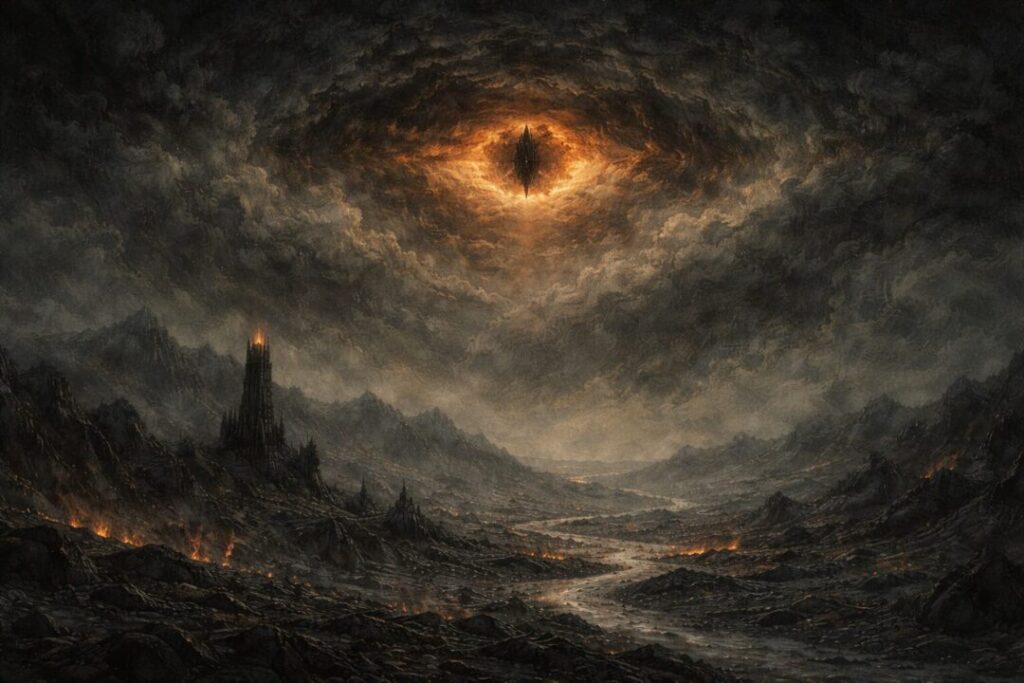
Mordor Watches the Skies
By the late Third Age, Sauron is not sitting idly in Barad-dûr, ignorant of the world beyond his borders. His attention is fixed outward—on armies, movements, and anything that resembles a direct challenge to his dominion.
The skies are not empty.
Winged creatures already serve him. The Nazgûl patrol the air, carrying fear across vast distances. Messengers fly between fortresses. Smoke signals rise. Watchfulness is constant.
A flight of Eagles heading east would not be subtle.
It would be unmistakable.
Such a movement would raise alarm long before the Black Land came into view. And once suspicion is raised, secrecy is lost forever.
This is the heart of the Ring-quest: its success depends on the Enemy never imagining that the Ring would be carried into Mordor deliberately.
Flying it there would confirm the exact opposite.

The Ring Seeks Power — And Power Is Its Weakness
The One Ring does not corrupt all beings in the same way or at the same speed.
It is not merely an object of domination; it is a device of temptation, tuned to the desires of its bearer. The greater the strength, authority, or certainty of the one who carries it, the more readily the Ring finds purchase.
This is why the Ring tempts Gandalf with visions of order and wisdom.
Why it offers Galadriel a beautiful, terrible queenship.
Why it promises Boromir the power to save his people.
The Eagles, ancient and proud, would not be immune to this dynamic.
They are mighty, long-lived, and conscious of their place in the world. Even if they resisted outright domination, the Ring would still exert pressure—subtle, patient, corrosive.
And the Ring does not need betrayal to succeed.
It only needs delay.
A moment of hesitation.
A debate.
A decision to turn aside “just for a while.”
That would be enough.
Why Smallness Was the Only Shield
Again and again, Tolkien returns to a single, quiet idea: evil expects strength.
That expectation is its blind spot.
Hobbits are overlooked precisely because they do not matter—at least, not in the way power understands mattering. They do not command armies. They do not blaze in the unseen world. They leave no great wake behind them.
They walk.
They rest.
They endure.
This is why the Ring-bearer must travel on foot.
Every dramatic gesture draws attention. Every shortcut tightens the Enemy’s focus. The longer and slower the journey becomes, the less plausible its true purpose appears.
Walking is not inefficiency.
It is camouflage.

Secrecy Is Not About Hiding — It Is About Being Unthinkable
One of the most important misunderstandings about the Ring-quest is the belief that it relies on concealment alone.
It does not.
It relies on unthinkability.
Sauron cannot imagine anyone seeking to destroy the Ring. He assumes it will be used against him, wielded as a weapon of power. His gaze is therefore fixed on strongholds, kings, and would-be rivals.
A small figure walking into Mordor does not fit his model of the world.
An Eagle certainly does not.
The Eagles Act at the End — Not the Beginning
It is not accidental that the Eagles appear only after the Ring is destroyed.
By that point, the Eye has fallen. Sauron’s will is broken. The structures of his power collapse inward, no longer capable of watchfulness or control.
Only then can open power move freely again.
The Eagles do not solve the central problem of the story. They respond once the moral test has already been passed.
That timing is deliberate—and deeply consistent.
Middle-earth does not reward power that skips the test. It rewards endurance that survives it.
The Question That Misses the Point
Asking why the Eagles didn’t take the Ring assumes the story is about efficiency.
It is not.
It is about humility.
About burden.
About choosing to carry something unbearable without certainty of success.
If the Eagles had taken the Ring, Middle-earth might have gained speed—but it would have lost its only protection.
The Ring was destroyed not because someone was strong enough to challenge the Dark Lord directly…
…but because someone was small enough to go unnoticed long enough to finish the journey.
That is not a flaw in the story.
It is the story.
And it is exactly the kind of victory Tolkien believed in.