What Is Something in the Hobbit Trilogy That You Actually Love?
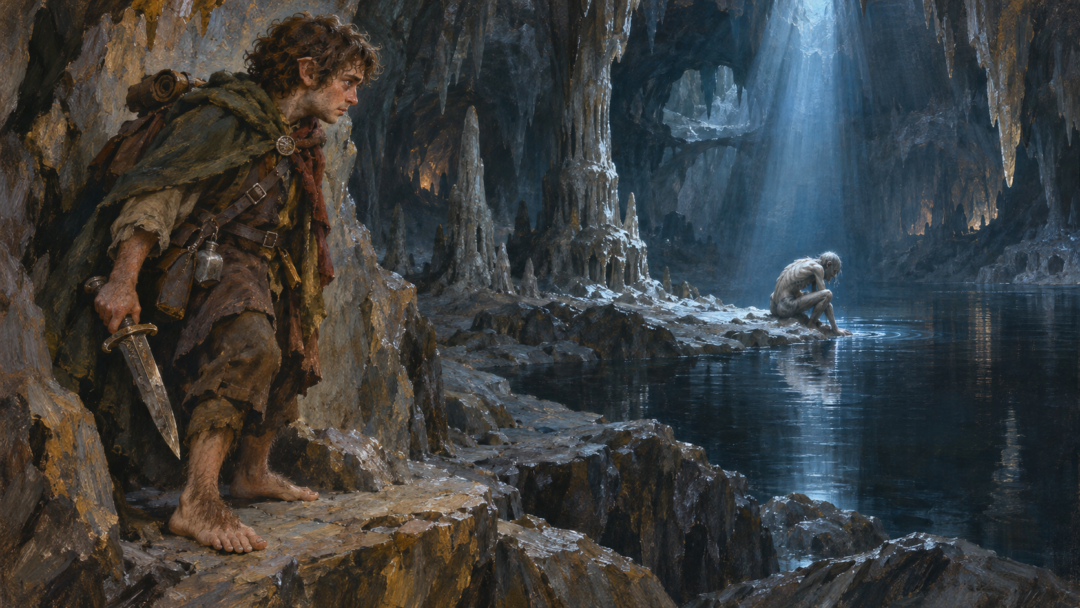
There is a scene in The Hobbit: An Unexpected Journey that comes remarkably close to capturing Tolkien’s moral imagination. It does not involve a battle, a dragon, or an ancient prophecy. It takes place beneath the Misty Mountains, where Bilbo Baggins has the opportunity to kill Gollum and chooses not to.
Bilbo has found the Ring, discovered that it makes him invisible, and realized that he can escape the goblin tunnels. Only Gollum stands between him and the passage out.
Bilbo draws Sting. Gollum cannot see him. A single thrust would remove the obstacle.
Then Bilbo looks at him.
For a moment, Gollum is no longer merely the creature who threatened to eat him. He is frightened, lonely, and helpless. Bilbo lowers his sword and leaps over him instead.
It is one of the finest moments in Peter Jackson’s Hobbit trilogy, and one of the most faithful adaptations of Tolkien’s moral vision across all six Middle-earth films.
The scene understands something essential about Bilbo: his greatest achievement is not learning how to fight, but recognizing when he must refuse.
The moment that matters
In Chapter V of The Hobbit, “Riddles in the Dark,” Bilbo finds himself behind Gollum near the exit from the goblin tunnels. The Ring has made him invisible, giving him an advantage over a creature who has threatened his life.
Tolkien does not make the dilemma artificially simple. Gollum is dangerous. He has pursued Bilbo and would almost certainly kill him if he could. Bilbo is frightened, lost, and desperate to escape.
Yet when he considers using his sword, another feeling interrupts his calculations.
“A sudden understanding, a pity mixed with horror, welled up in Bilbo’s heart.”
Bilbo imagines Gollum’s existence: years spent beneath the mountains, without sunlight, companionship, or the ordinary comforts of life. His pity does not make Gollum innocent or harmless. It means that Bilbo recognizes suffering in someone who has threatened him.
Tolkien makes the distinction explicit. Killing Gollum from behind, while invisible, would not be a fair fight. Bilbo cannot bring himself to do it.
Instead, he jumps over him.
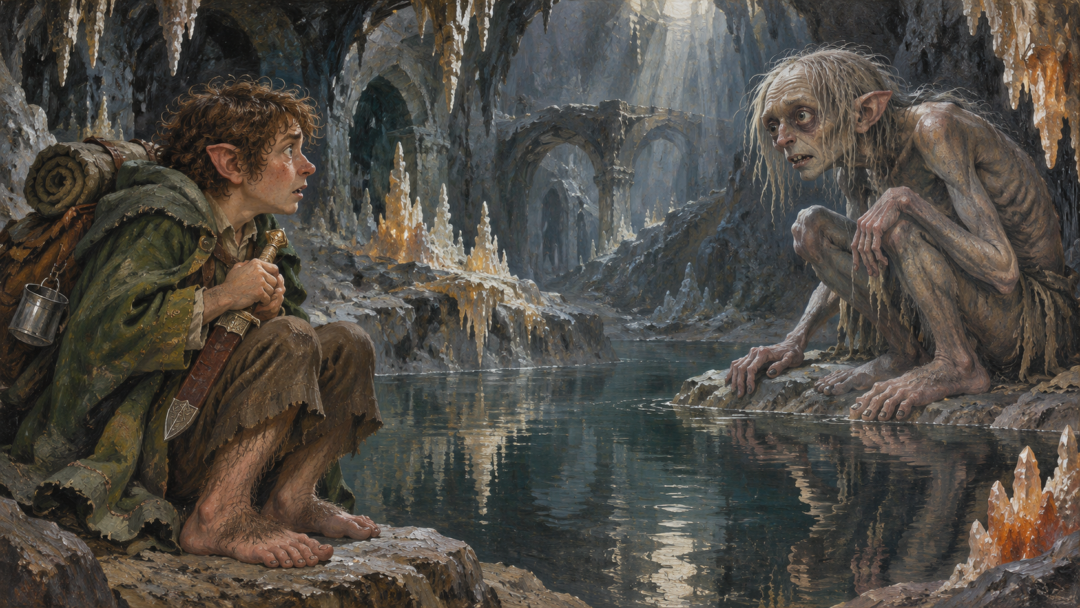
Jackson preserves the essential action while translating Tolkien’s narration into performance. Martin Freeman’s Bilbo raises his sword, studies Gollum, hesitates, and decides to escape without killing him. Andy Serkis gives the hesitation its emotional force, briefly revealing the vulnerability beneath Gollum’s grotesque appearance.
The film does not need to explain everything Bilbo thinks. His expression and his decision communicate the change.
This is adaptation at its most effective: the filmmakers identify what matters in the original passage and find a cinematic way to preserve it.
Why Martin Freeman’s Bilbo makes it work
Freeman’s casting is among the trilogy’s strongest decisions.
Rather than imitating Ian Holm’s older Bilbo from The Lord of the Rings, Freeman creates a character defined by irritation, politeness, stubbornness, and unexpected tenderness.
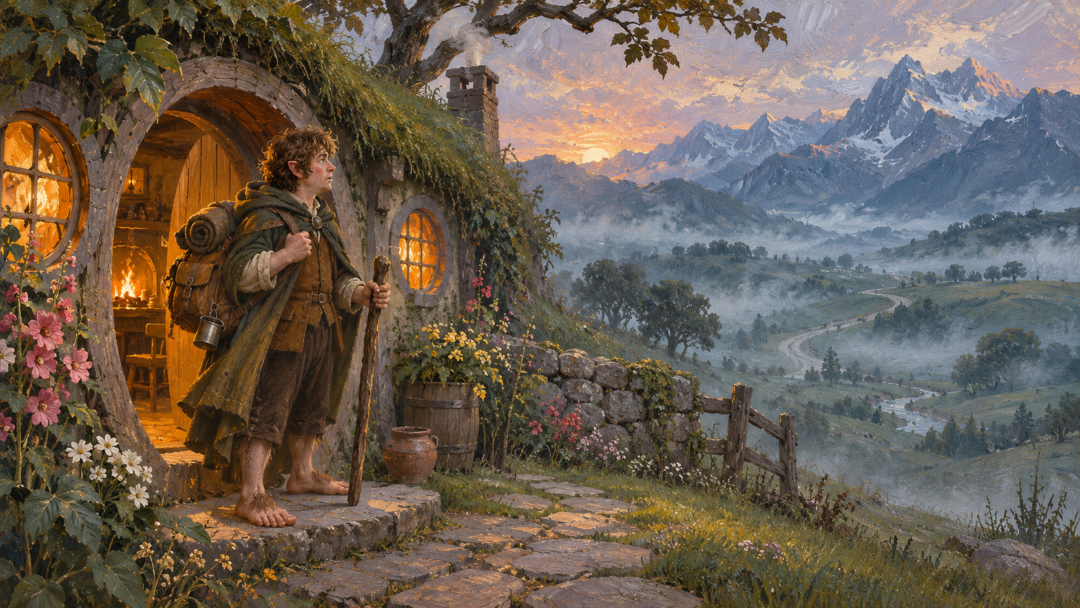
Early in An Unexpected Journey, Bilbo is preoccupied with the invasion of his home. He worries about his furniture, his pantry, and the dwarves who have arrived without invitation. His objections are often funny because they remain entirely reasonable from his perspective.
This is close to Tolkien’s introduction in Chapter I, “An Unexpected Party.”
The Baggins family prides itself on respectability and predictability. Its members do not seek adventures. Bilbo has inherited their attachment to familiar surroundings and regular meals, although his Took ancestry suggests a capacity for curiosity and recklessness.
Both sides of his character are genuine. He loves comfort, but he also possesses courage that his comfortable life has never required him to discover.
Freeman understands that contradiction. His Bilbo frequently appears offended by danger, as though Middle-earth has violated an agreement about how civilized people ought to behave. Yet his exasperation never makes him merely ridiculous.
That combination is particularly important in the encounter with Gollum.
A conventional hero might spare a defeated enemy with an expression of noble certainty. Freeman does something subtler. His Bilbo appears frightened, disgusted, uncertain, and moved almost simultaneously.
The choice seems to surprise him.
He has not entered the caves hoping to demonstrate his moral superiority. He wants to survive. But when killing Gollum becomes possible, he discovers a boundary he is unwilling to cross.
Freeman makes that discovery visible without a speech or a heroic declaration.
For a character whose strength emerges from beneath ordinary habits, the restraint is exactly right.
The Ring is present, but it does not make the choice
The scene places Bilbo’s moral decision beside the object that will eventually determine so much of Middle-earth’s history.
The Ring has given him a decisive advantage. He could strike Gollum without being seen, then escape. Instead, he refuses to use that advantage to kill a helpless enemy.
In The Fellowship of the Ring, Book I, Chapter II, “The Shadow of the Past,” Tolkien returns to this decision.
After learning about the Ring, Frodo wishes that Bilbo had killed Gollum when he had the chance. Gandalf disagrees.
“It was Pity that stayed his hand.”
Gandalf explains that many living people deserve death, while some who have died deserved life. Since Frodo cannot restore life to the dead, he should be cautious about dealing out death in judgment.
This becomes one of the central moral principles of The Lord of the Rings.
At the Cracks of Doom, Frodo ultimately fails to surrender the Ring. He claims it for himself. Its destruction follows Gollum’s intervention, when Gollum takes the Ring and falls into the fire.
Gollum is present because Bilbo spared him, because Frodo later allowed him to live, and because mercy repeatedly interrupted what appeared to be the practical solution.
Bilbo could not have anticipated any of this. He knew nothing of the Ring’s true history or its importance to Sauron.
That ignorance makes his decision more significant, not less. He acted out of pity without knowing that mercy might eventually help save Middle-earth.
Jackson had already dramatized Gandalf’s explanation in The Fellowship of the Ring. When An Unexpected Journey shows Bilbo’s original decision, the audience can connect the two moments.
Unlike some of the Hobbit trilogy’s more conspicuous attempts to establish continuity with the earlier films, this connection feels earned. Tolkien himself made it fundamental to the story.
Gollum is frightening because he is pitiable
Andy Serkis deserves considerable credit for making Bilbo’s decision believable.
Gollum could easily have become another spectacular digital creature. His appearance invites grotesque comedy, while his sudden changes of voice make him threatening and unpredictable.
Serkis nevertheless gives him a recognizable emotional life.
During the riddle contest, Gollum is playful, suspicious, hungry, and desperate. He treats the exchange as a game, although his interest in eating Bilbo ensures that the danger never disappears.
When he discovers that the Ring is missing, his behavior changes abruptly.
He searches frantically, cries out, and suspects Bilbo of taking it. His distress is not simply the frustration of losing a valuable object. The Ring has become the center of his existence. Without it, he seems to have lost the one thing around which his identity revolves.
There is an important textual history behind this portrayal.
In the original 1937 edition of The Hobbit, Gollum behaves differently during the riddle contest. He is more willing to honor the rules, and the Ring is presented as a prize he might give Bilbo.
Tolkien revised Chapter V for the second edition, published in 1951, to reconcile Gollum’s behavior with the Ring’s nature as developed in The Lord of the Rings.
Jackson follows the revised version.
Consequently, the film’s Gollum draws upon a characterization Tolkien himself had deepened. His obsession makes him dangerous, but it also makes his loss devastating.
When Bilbo raises Sting, the audience has already seen both sides of him. Gollum might kill Bilbo without hesitation. He is also a miserable creature whose existence has been consumed by something he cannot bear to lose.
The film never asks us to excuse his cruelty. It asks whether cruelty is the only truth about him.
Bilbo recognizes that it is not.
A small act of mercy in a very large film
The sequence becomes more impressive when contrasted with the trilogy surrounding it.
Jackson expanded Tolkien’s relatively short novel into three lengthy films filled with battles, additional confrontations, and elaborate escapes. Expansion itself was not necessarily a mistake.
Adaptations must make structural decisions, and Tolkien leaves room for some events to be developed visually. In Chapter XVII, “The Clouds Burst,” Bilbo experiences only part of the Battle of Five Armies before being knocked unconscious. Showing more of the battle could reasonably serve a film adaptation.
The problem is that the trilogy frequently alters what makes an event important.
In the novel, Bilbo’s smallness is central to his achievement. He is inexperienced, physically vulnerable, and rarely the strongest person present. He succeeds by noticing things others overlook, exercising judgment, or questioning assumptions that more powerful characters accept.
The films sometimes preserve these qualities. Elsewhere, they seem determined to make every important event enormous.
The barrel escape becomes an extended pursuit involving orcs and increasingly improbable stunts. The confrontation with Smaug expands into a chase through Erebor’s forges, culminating in the invented scheme involving a gigantic quantity of molten gold.
These sequences emphasize movement, danger, and spectacle.
The scene with Gollum depends on something much smaller: a decision.
There is no army, no elaborate mechanism, and no miraculous rescue. The Ring has given Bilbo the opportunity to escape, but how he treats Gollum remains his responsibility.
The entire moral conflict is expressed through a face, a sword, and a hesitation.
Nothing more is required.
What the trilogy understands about courage
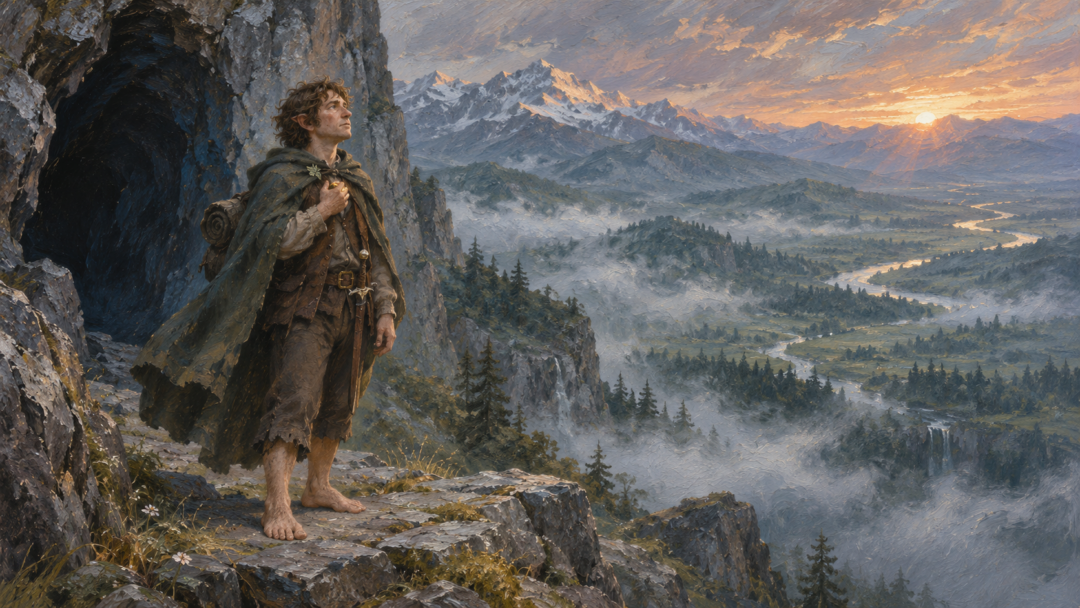
Bilbo’s mercy belongs to a larger pattern in Tolkien’s novel.
His development does not consist of replacing fear with permanent bravery. He remains frightened throughout much of the adventure, even as he discovers that fear need not determine his actions.
In Chapter VIII, “Flies and Spiders,” Bilbo fights the giant spiders of Mirkwood without Gandalf or Thorin directing him. His first successful confrontation changes his understanding of himself, and naming his sword Sting marks that growth.
Learning to defend himself matters. But physical courage is not the final measure of his character.
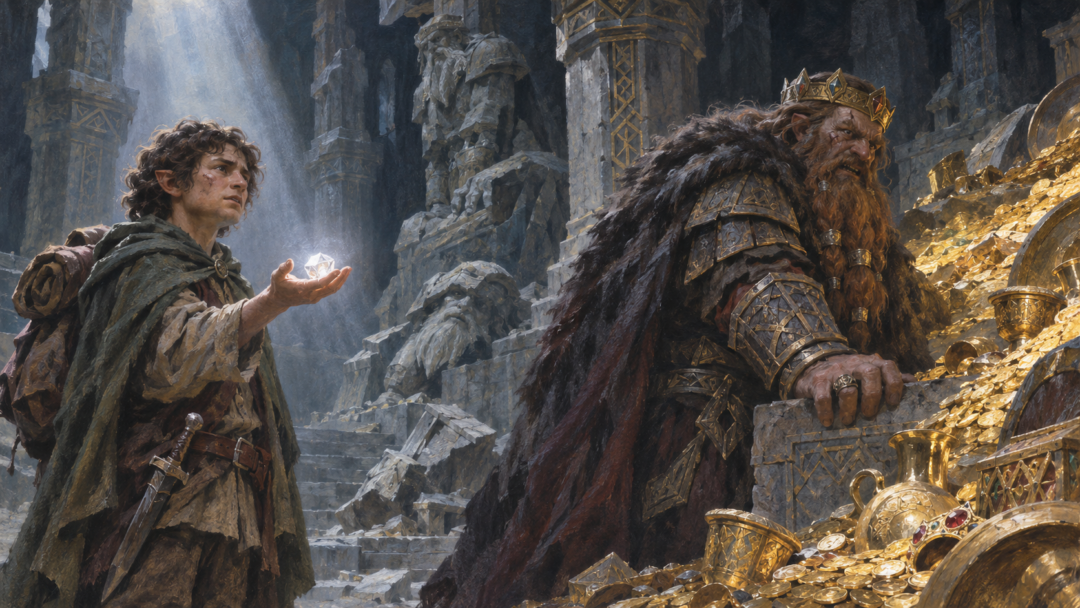
In Chapter XVI, “A Thief in the Night,” Bilbo secretly gives the Arkenstone to Bard and the Elvenking in an attempt to prevent war. He knows Thorin will consider the action a betrayal. He also recognizes that Thorin’s possessiveness has become dangerous.
Bilbo risks his standing among the dwarves because he believes preventing bloodshed matters more than satisfying Thorin.
The decision resembles his earlier encounter with Gollum. In both cases, he refuses to accept violence merely because it appears convenient, justified, or inevitable.
Neither choice produces an immediate, uncomplicated victory. Gollum remains dangerous. Thorin reacts furiously to the loss of the Arkenstone. Bilbo’s moral judgment does not protect him from consequences.
That is part of what makes his courage meaningful.
Jackson’s trilogy does not always understand this as clearly as Tolkien does. Its emphasis on escalating action sometimes pushes Bilbo away from the center of his own story.
Yet the encounter beneath the Misty Mountains gets the essential relationship between courage and mercy exactly right.
Bilbo is afraid. He has every reason to flee. He also possesses the means to eliminate a threatening creature without much risk to himself.
He chooses not to.
The scene is particularly moving because Gollum offers him no gratitude. There is no reconciliation, no acknowledgment of Bilbo’s kindness, and no immediate assurance that his choice was wise.
Bilbo simply leaves him alive.
Across Tolkien’s larger story, that apparently insignificant act becomes indispensable. Mercy preserves the possibility of an outcome that strength, foresight, and determination cannot achieve on their own.
For all the spectacle of Peter Jackson’s Hobbit trilogy, one of its finest moments is a hobbit lowering his sword in the dark.
It is the moment when the films remember that Bilbo Baggins does not have to become a great warrior to change the fate of Middle-earth.
Sources & Notes
This article is based on close reading and interpretation of Tolkien's published works and related source material where relevant.