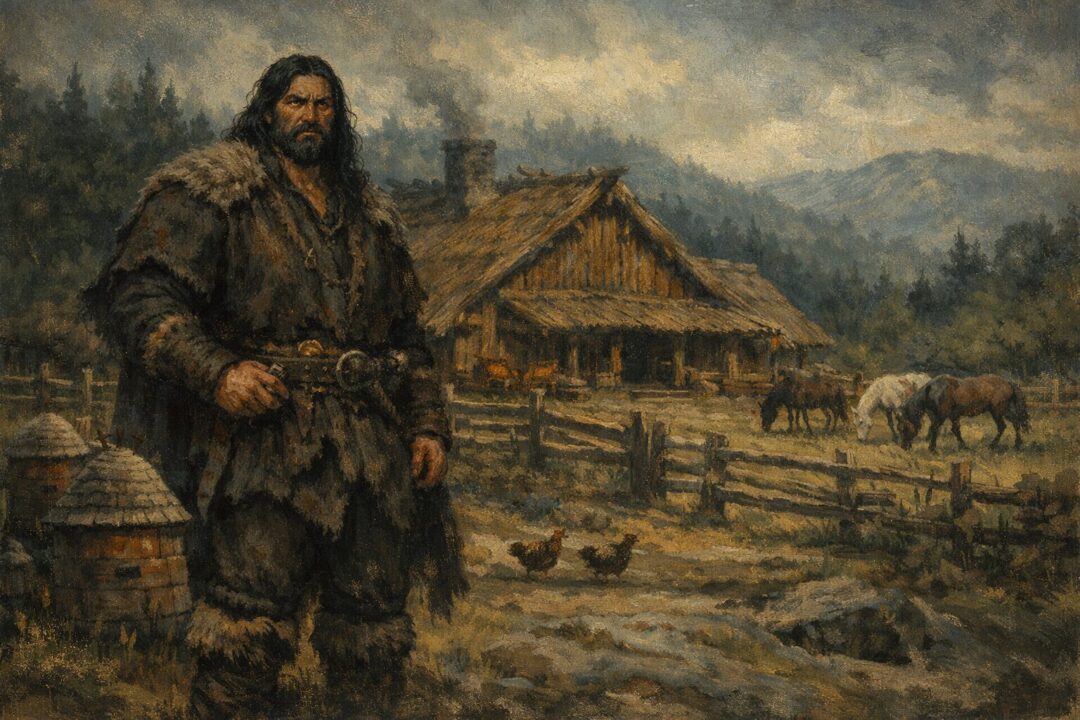
Beorn enters the story abruptly.
There is no ancient prophecy announcing him. No genealogical table in the appendices. No mythic preface explaining his people.
He simply stands there — vast, black-haired, suspicious — on the edge of Wilderland.
And then we are told the impossible: he can change his skin.
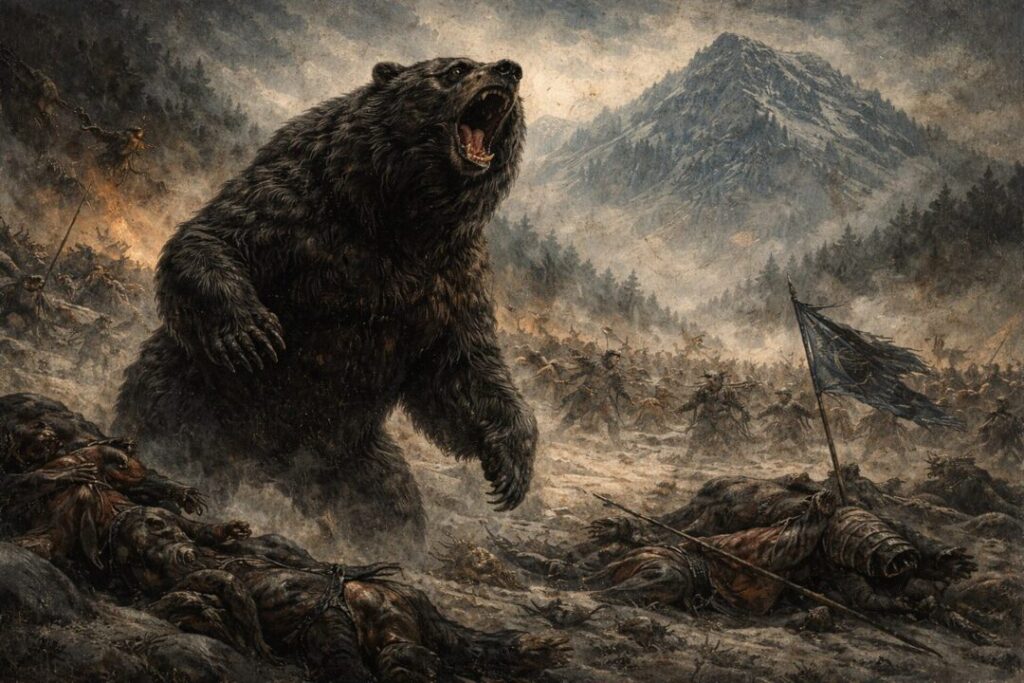
In The Hobbit, Gandalf describes him plainly as a “skin-changer.” By day he is a man; at other times he takes the form of a great black bear. During the Battle of Five Armies he appears in that shape, roaring across the field, scattering goblins and wolves, and bearing Thorin Oakenshield’s body from the fight.
The narrative presents this as fact. Not rumor. Not legend.
But it never explains how.
So what is Beorn?
To answer that, we have to begin carefully — with what the texts actually say, and what they do not.
Beorn Is a Man — But Not an Ordinary One
In The Hobbit, Beorn is described as a Man. He lives in a wooden house, speaks the Common Tongue, and later fathers a line known as the Beornings.
In The Lord of the Rings, the Beornings are mentioned as a people dwelling between the Misty Mountains and Mirkwood. They are described as strong and sometimes grim, and it is said that “some” among them still have the power to change their skin — though none are said to equal Beorn himself.
This is important.
The ability is not unique to him alone. It appears hereditary.
That alone tells us something crucial: Beorn is not presented as a Maia in disguise, nor as a solitary supernatural anomaly. He belongs to a lineage.
Yet no origin story is attached to that lineage.
What Does “Skin-Changer” Mean?
The term used is “skin-changer.” Nowhere is a mechanism described. No spell is mentioned. No curse. No Valar-given gift.
The transformation is presented as physical and literal.
Beorn in bear-form is not a projection. He fights, kills, and carries weight. His strength in that form exceeds that of ordinary Men, and even in human shape he is described as immensely powerful.
But the text never associates his power with sorcery.
He is not described as practicing magic.
He is not linked to Sauron.
He is not described as “enchanted.”
In fact, Beorn despises goblins and wolves intensely — a hatred aligned firmly against the servants of the Shadow.
So the ability appears neither corrupt nor sinister.
Is There a Connection to Bëor of the First Age?
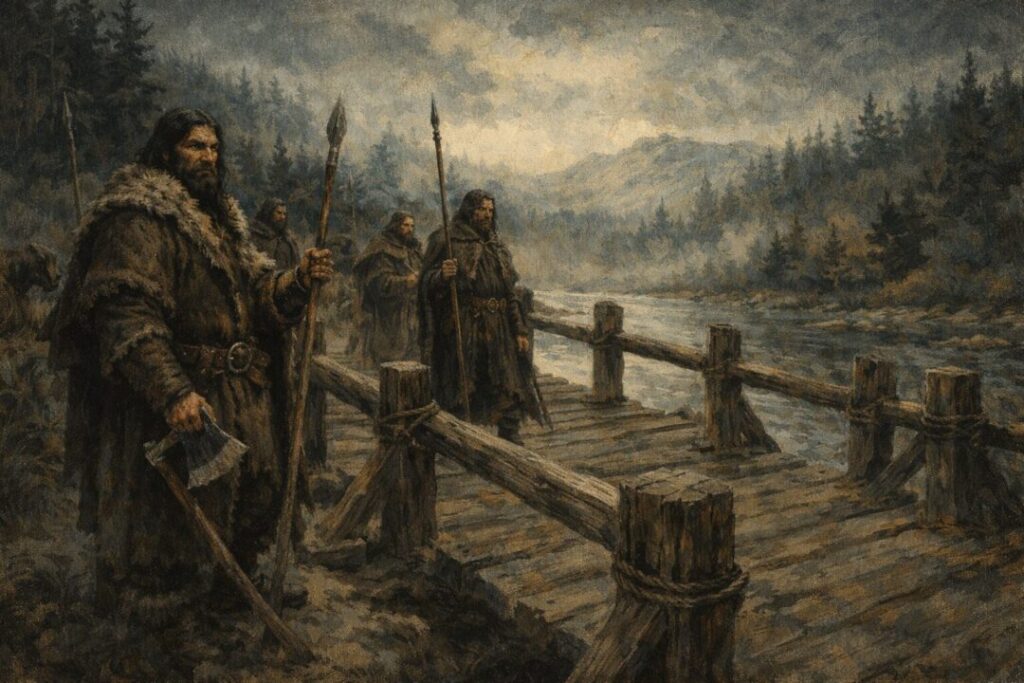
Because of the similarity of names, some readers have speculated that “Beorn” may connect linguistically to Bëor, the leader of the First House of Men in Beleriand.
But the texts provide no evidence of genealogical connection.
The House of Bëor descends through known lines, culminating in figures such as Beren and later the Númenóreans. Nothing in the canonical genealogies links them to skin-changing or to Wilderland in the Third Age.
The similarity of names is interesting, but it remains linguistic resemblance — not textual proof.
It is worth noting that in Old English (a linguistic inspiration for Rohirric), the word “beorn” can mean “warrior” or “man,” and is also associated etymologically with “bear.”
This suggests the name is thematically appropriate.
But that is linguistic flavor, not lineage.
Are There Other Shape-Changers in Middle-earth?
Beorn is not entirely alone in the wider legendarium in possessing animal transformation.
In earlier Ages, Sauron takes the form of a wolf and a vampire. Lúthien and Beren assume disguises through magical means, though these are achieved through spells and enchanted skins, not innate transformation.
However, these examples differ in key ways.
Sauron is a Maia.
Lúthien is half-Maia and uses explicit enchantment.
Beorn is presented as neither.
There is no indication that he learned the skill.
No scene of instruction.
No reference to a teacher.
The power seems native.
The Beornings in the Third Age
After the Battle of Five Armies, Beorn becomes a leader among Men in the region.
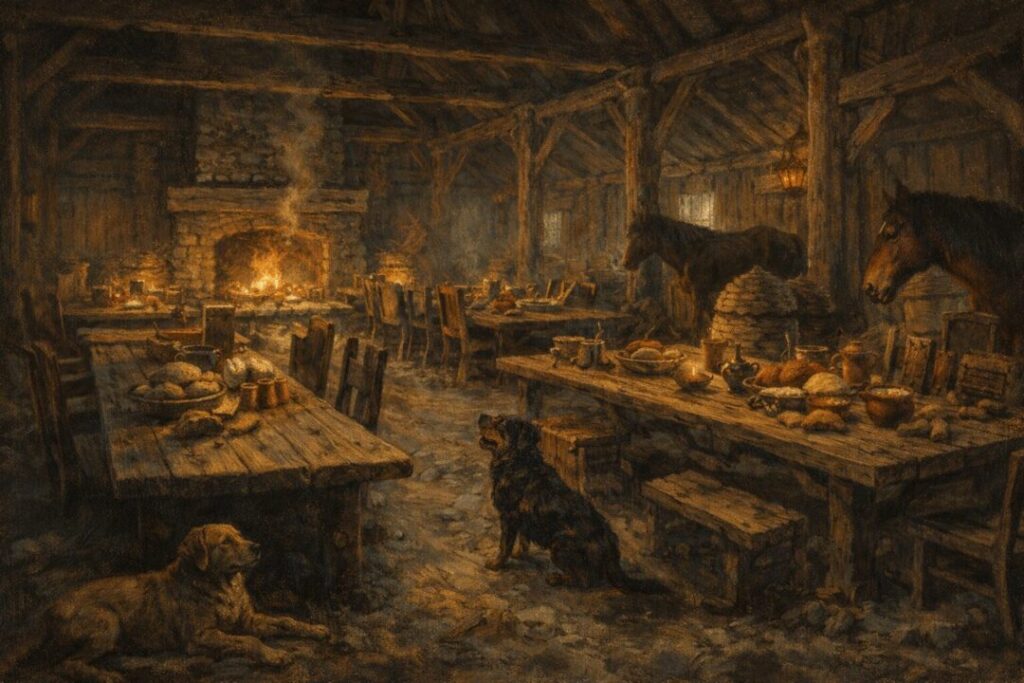
By the time of the War of the Ring, his descendants — the Beornings — guard the crossings of the Anduin. They are described as valiant and strong, and they maintain a toll on travelers.
It is said that some can change their skins, though fewer perhaps possess the full power Beorn displayed.
This detail is easy to overlook, but it answers one major question.
Beorn is not a one-time anomaly.
He is the head of a people.
And that places him within the category of Men — albeit a very unusual branch.
So What Is His Origin?
Here we reach the boundary of certainty.
The texts do not provide a creation story for the Beornings.
They are not listed among the Edain of the First Age.
They are not said to descend from Númenóreans.
They are not described as related to the Drúedain.
They are not assigned to any named House of Men.
What we can say, conservatively, is this:
Beorn is a Man of the North in the late Third Age, belonging to a people with inherited skin-changing abilities. The origin of that ability is not explained in the surviving texts.
Anything beyond that becomes interpretation.
Some readers suggest the ability may reflect remnants of older Mannish traditions or powers that diminished over time. But the texts do not explicitly confirm this.
Others see Beorn as a deliberate echo of ancient Northern folklore — but that belongs to literary analysis, not in-world genealogy.
Within Middle-earth itself, he simply is.
And sometimes that is the point.
Why the Mystery Matters
Beorn stands at the edge of the map — geographically and conceptually.
He lives between the Wild and the Civilized.
Between the Mountains and the Forest.
Between Man and Beast.
He is not integrated into Gondor’s lineage.
Not tied to Elven realms.
Not explained by Wizard lore.
He belongs to Wilderland.
And Wilderland, even late in the Third Age, still contains remnants of things older and less categorized than the great kingdoms of the West.
The fact that the narrative does not explain him may be deliberate.
Middle-earth is not a catalog of everything that exists within it. It is a history with gaps.
Beorn is one of those gaps — not contradictory to the lore, but not fully illuminated by it.
What We Can Say with Confidence
From the primary texts:
• Beorn is a Man called a skin-changer.
• He can physically transform into a great bear.
• He fights in bear-form at the Battle of Five Armies.
• He founds a lineage known as the Beornings.
• Some among his descendants retain the ability.
• No canonical text explains the origin of this power.
That is the firm ground.
Everything else is interpretation.
And perhaps that restraint is fitting.
Beorn is not meant to be dissected like a genealogical puzzle.
He is meant to feel older than explanation — like something surviving at the edge of memory.
Not every mystery in Middle-earth is solved in an appendix.
Some are simply left standing, watching the borders of the Wild.