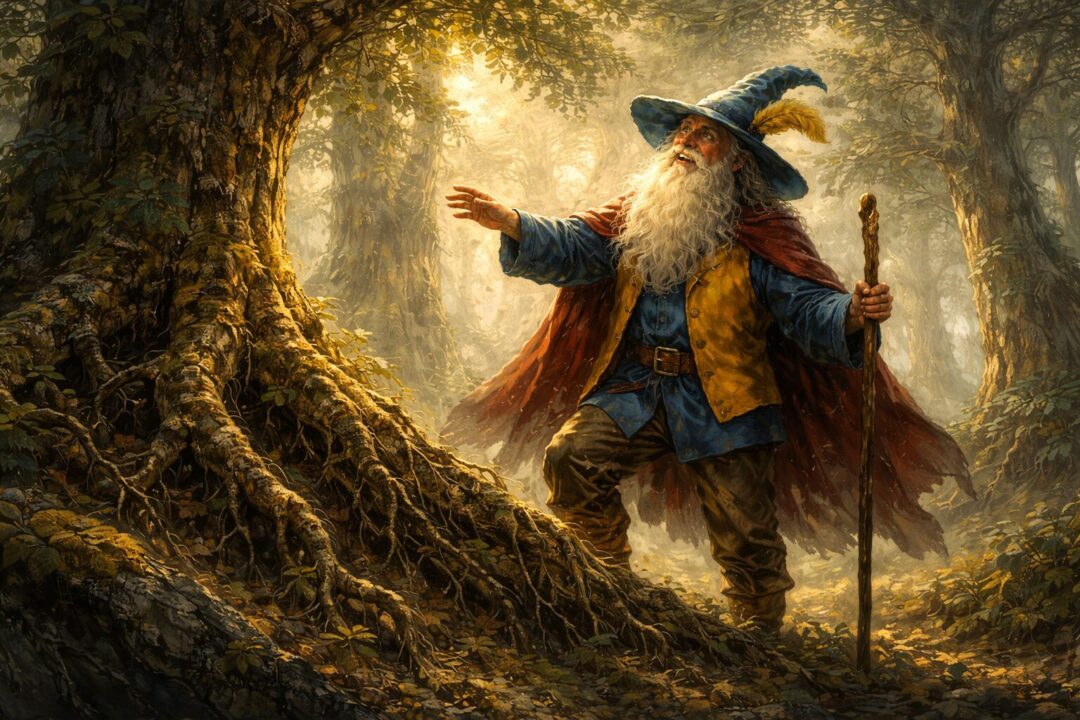
Few figures in The Lord of the Rings unsettle readers as much as Tom Bombadil.
He appears early in the story, interrupts the narrative with songs and laughter, solves dangers that nearly destroy the Hobbits—and then vanishes completely, without consequence or explanation. No lineage. No cosmology. No clear category into which he fits.
And that absence of explanation is not a flaw in the story.
It is the point.
Tom Bombadil is not a puzzle meant to be solved. He is a boundary—a deliberate limit placed inside the world of Middle-earth, beyond which explanation no longer applies.
What We Know—and What We Are Not Told
The text of The Fellowship of the Ring is unusually careful about Tom Bombadil. It gives us just enough information to make him impossible to ignore, and then refuses to go any further.
We are told that:
- Tom calls himself Eldest
- He was in the world before the Dark Lord came from Outside
- He remembers the first raindrop and the first acorn
- The One Ring has no effect on him
These are not casual details. They place Tom outside normal history and outside the power structures that govern the rest of Middle-earth.
But just as importantly, the text refuses to tell us certain things.
There is no origin story.
No role in the Music of the Ainur.
No identification as Elf, Maia, Vala, or spirit.
No explanation in appendices or genealogies.
Even at the Council of Elrond—where the Wise gather and deep knowledge is openly discussed—Tom remains undefined. Elrond admits that Tom is beyond their understanding, and that they do not know what he ultimately is.
When the suggestion is raised that the Ring could be entrusted to him, the idea is dismissed almost immediately.
Not because Sauron could overcome Tom.
But because Tom would not care.
Tom Is Not Above the World—He Is Bound to It
One of the most common misunderstandings about Tom Bombadil is the assumption that he must be some kind of hidden god or supreme being.
But gods in Middle-earth act.
They intervene, shape events, issue judgments, withdraw with purpose, or enter the world with intention. Even when they are distant, their absence is meaningful.
Tom does none of these things.
His power does not extend beyond his own land. Outside the Old Forest, he has no authority. He does not command the Barrow-wights because he rules them, but because his presence disrupts them. He does not conquer darkness—darkness simply cannot remain where he is.
This is a crucial distinction.
Tom’s strength is not dominance.
It is complete non-possession.
He owns nothing—not land, not power, not even responsibility in the way other beings understand it. He has no ambition, no fear of loss, no desire to preserve or control. Goldberry belongs to him only in the sense that water belongs to the riverbank. There is no hierarchy, no mastery.
Tom does not stand above the world.
He exists within it, without attempting to shape it.
Why the Ring Has No Power Over Tom
The Ring is not simply a magical object. It works by exploiting something very specific: the desire to dominate, to preserve, to control outcomes.
The Ring amplifies will.
Tom Bombadil has none.
When Frodo puts on the Ring in Tom’s house, Tom sees him anyway. When Tom himself puts the Ring on, nothing happens—not invisibility, not temptation, not distortion.
This is not because Tom is stronger than the Ring.
It is because the Ring has nothing to attach to.
Tom does not desire power, security, victory, or permanence. He does not seek to impose meaning on the world. He does not fear loss. And because the Ring can only corrupt through desire, Tom is functionally immune.
But immunity is not the same as suitability.
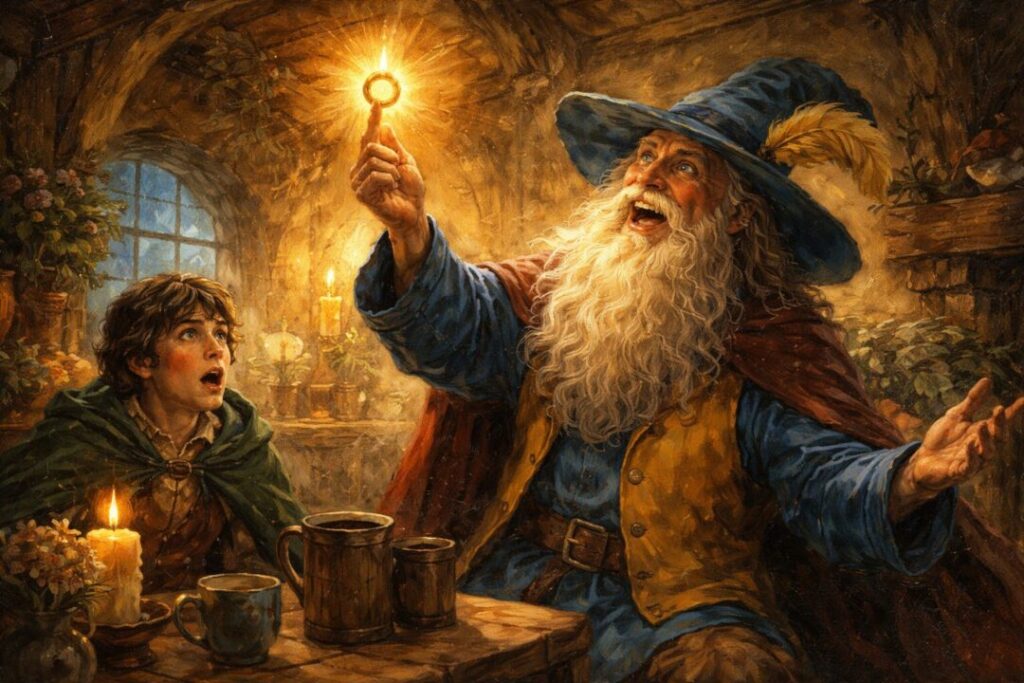
Why the Ring Cannot Be Left With Tom Bombadil
At the Council of Elrond, the reasoning against giving Tom the Ring is quiet—and devastating.
Tom would not guard the Ring, because guarding implies concern. Concern implies priority. Priority implies the possibility of loss.
Tom would not be corrupted—but neither would he protect the Ring as the fate of the world collapses around him.
If all of Middle-earth outside his borders fell, Tom would remain unchanged.
This is why he is unsuitable for the quest.
Not because he lacks power—but because he exists outside moral struggle.
The War of the Ring is not a contest of strength. It is a test of endurance, humility, sacrifice, and the willingness to carry a burden that can destroy you.
Tom cannot carry such a burden.
Nothing is at stake for him.
He cannot fall—but he also cannot triumph.
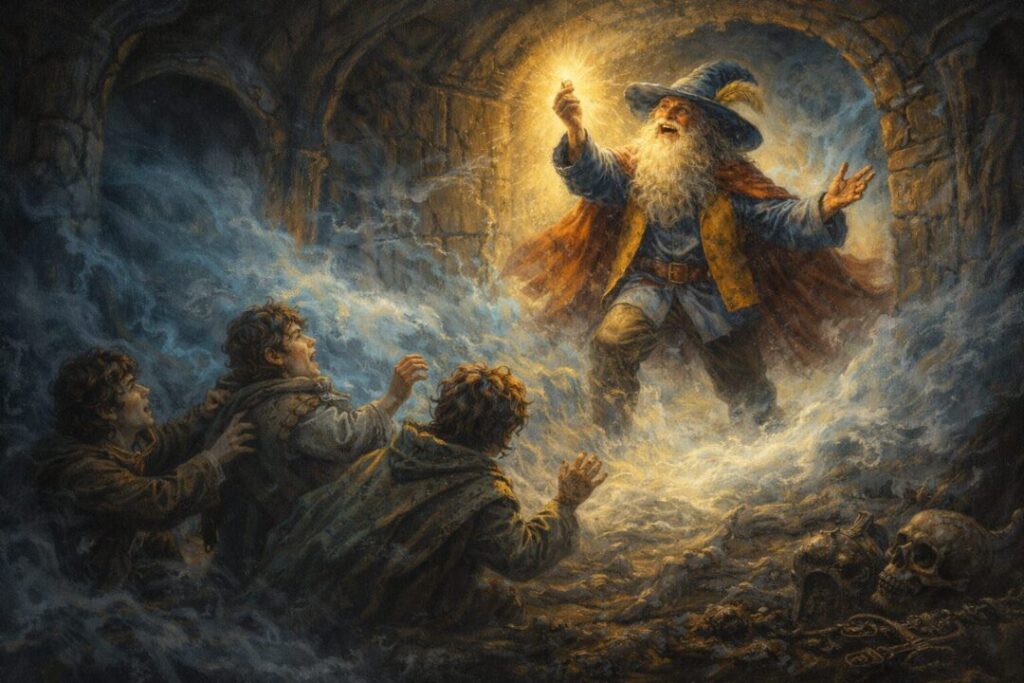
Why Tom Has No Origin Story
Every other major being in Middle-earth is defined by entry.
Elves awaken at Cuiviénen.
Men are given mortality.
Maiar descend into the world.
Even evil has a beginning, a corruption, a turning away.
Tom does not enter.
He has no beginning because beginnings imply purpose, and Tom has none. He is not a tool of history, not a servant of any design, not a participant in cosmic plans.
He is not for anything.
Tom Bombadil is best understood not as a character in the conventional sense, but as a state of existence—the world simply being, without domination, ownership, or teleology.
He represents Arda as it was before power became the central problem.
That is why he sings nonsense songs.
That is why he laughs at danger.
That is why he refuses explanation.
To explain Tom would be to place him inside the very systems of meaning that he exists to stand apart from.
And Tolkien refuses to do that.
Why Tom Bombadil Disappears—and Why He Must
Once the Hobbits leave Tom’s land, he never appears again. He does not ride to war. He does not advise kings. He does not return at the end.
Not because he stops existing.
But because the story moves into a realm where he does not belong.
Middle-earth is passing into an age of Men—an age of choice, loss, responsibility, and consequence. Tom belongs to something older: a world where existence itself was enough, before history became a moral struggle.
He does not fade because he is weak.
He fades because the world no longer revolves around what he represents.
And that is the quiet tragedy at the heart of his character.
Not a Mystery—A Reminder
Tom Bombadil is not a riddle waiting for the right theory.
He is a reminder.
A reminder that not everything exists to serve power.
A reminder that domination is not the natural state of the world.
A reminder of a joy that predates conflict—and cannot survive within it.
Middle-earth needs Tom Bombadil precisely because he cannot be explained.
And once the story passes beyond the land where such a being can exist, he must be left behind.
Not forgotten.
But unreachable.
Tom Bombadil is not what Middle-earth is becoming.
He is what it has already lost—and can never fully return to.