Rhûn, Hildórien, and the Land of the Sun in the Texts
Most maps of Middle-earth are shaped by narrative necessity.
They follow the Shire.
They trace the Anduin.
They center Gondor, Rohan, and Mordor.
And then they fade.
But the world described in the texts does not end at Mordor’s eastern mountains. It stretches far beyond—into regions named but rarely described: Rhûn, Hildórien, and, in earlier cosmological traditions, the Land of the Sun.
These places are not inventions of adaptation or fan speculation. They are part of the legendarium. But understanding them requires restraint. The texts give us fragments—not atlases.
Let’s begin where the maps do not.
Rhûn: The Vast East
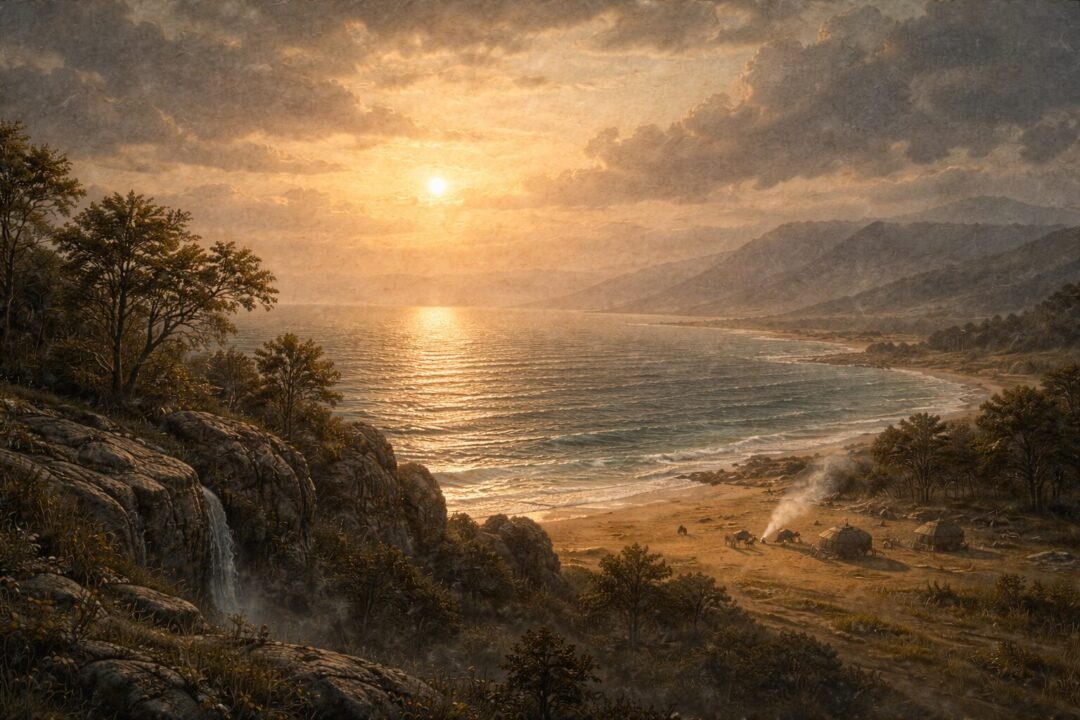
“Rhûn” simply means “east” in Sindarin. In common usage it refers especially to the lands surrounding and beyond the inland Sea of Rhûn.
We know several firm things from the primary texts:
- The Sea of Rhûn lies east of Rhovanion.
- Easterling peoples come from lands beyond it.
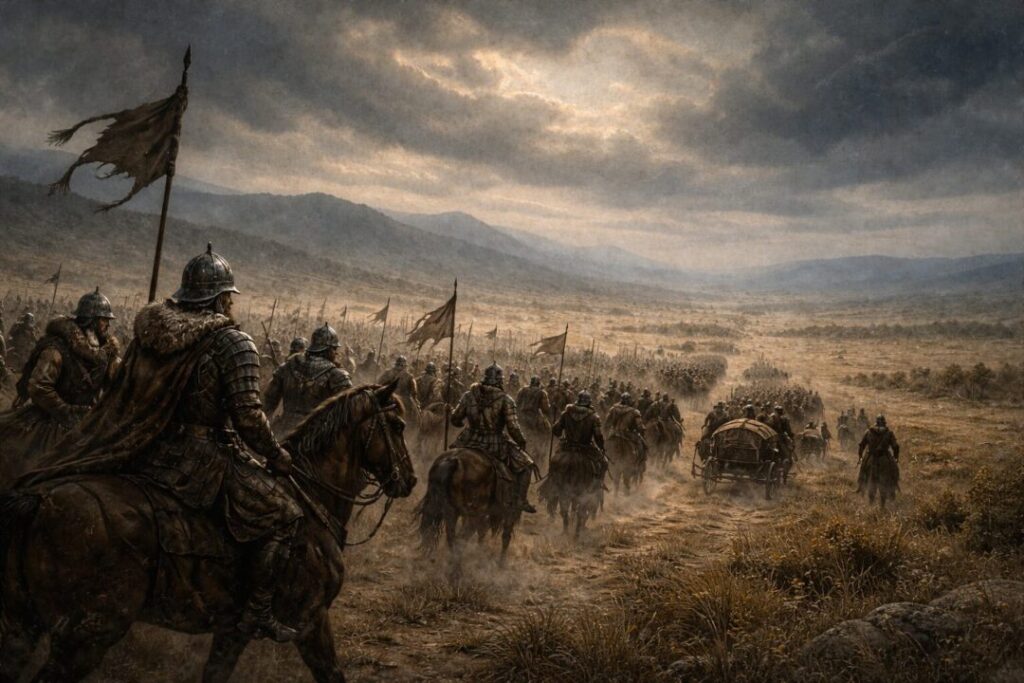
- In the Second and Third Ages, some Easterlings serve Sauron.
- Others resist him (notably during the War of the Ring, where not all Easterlings are uniformly aligned).
What we do not receive is a political or cultural map of Rhûn. No capital city is named. No eastern kingdom is described in detail. The Blue Wizards (Alatar and Pallando), according to later notes preserved in Unfinished Tales and other writings, journeyed into the East in the Second Age. Their purpose, in one tradition, was to hinder Sauron’s influence among eastern peoples. But the texts do not narrate their deeds there directly.
This absence matters.
Rhûn is not presented as empty wilderness. It is populated. Armies march from it. Cultures develop there. But the West does not record them fully.
The result is a structural silence: Middle-earth’s history is written from a western perspective.
Hildórien: Where Men Awoke
If Rhûn is historically shadowed, Hildórien is mythically foundational.
In The Silmarillion, it is stated plainly that Men first awoke in Hildórien, “in the east of Middle-earth.” This awakening occurs after the Elves have already stirred beside Cuiviénen.
Unlike the Elves—who begin their story near waters later tied to Beleriand—Men begin their existence beyond the narrative centers of the First Age.
This is not a minor geographic footnote.
It means:
- The origin of humanity lies far to the east.
- The migrations westward represent a later movement.
- Entire early histories of Men occur off-stage.
The Edain who eventually enter Beleriand are only a fraction of humanity. Many Men remain in the East. Some fall under Morgoth’s shadow in the First Age. Later, their descendants appear as Easterlings in various wars.
The texts do not describe Hildórien’s geography in detail. No mountain ranges are named. No rivers charted. But its theological and narrative importance is immense: it is the cradle of the Secondborn.
If you remove Hildórien, you remove the origin of Men.
And yet we never see it.
The Land of the Sun: A Cosmological Memory
Further east still lies something even more elusive.
In earlier cosmological conceptions preserved in The Silmarillion, the world was once flat. Aman lay in the West. The Sun rose in the East after the destruction of the Two Trees. In that cosmology, references are made to eastern regions beyond Middle-earth proper—sometimes referred to as the “Land of the Sun.”
Here caution is required.
The Land of the Sun is not described as a developed kingdom or mapped continent. Rather, it appears in connection with the cosmology of Arda before its reshaping. It is part of the broader structure of the world as imagined in early Ages.
After the Downfall of Númenor, the world is bent, Aman is removed from ordinary reach, and the physical geography shifts. The texts do not provide detailed updates about what becomes of extreme eastern lands in the reshaped world.
So we are left with layered tradition:
- A mythic eastern shore tied to the rising Sun.
- The historical eastern lands of Rhûn.
- The awakening place of Men in Hildórien.
They overlap conceptually—but are not explicitly merged in the texts.

Why the East Remains Unmapped
It is tempting to fill the silence.
To imagine vast empires.
Hidden cities.
Lost Elven kingdoms.
But the texts themselves are restrained. They give names and functions, not fantasy atlases.
Why?
Because the story of Middle-earth is not meant to be geographically complete. It is shaped like memory: centered, partial, inherited.
The Elves who record much of early history dwell in the West. The Númenóreans sail westward. Gondor’s archives preserve what touches their borders.
The East exists—but as distance.
This narrative distance also serves a moral purpose. The Easterlings are not described as inherently evil peoples. They are Men—subject to influence, allegiance, and fear. In some accounts, eastern resistance to Sauron’s dominion is implied, especially in later notes about the Blue Wizards’ mission.
So the East is not a monolith. It is simply less told.
A World Larger Than the Map
The most important thing about the lands beyond Mordor is not what we know—but what their existence implies.
It means Middle-earth is not a closed stage set.
When armies march from Rhûn, they are not coming from nowhere. When Men awaken in Hildórien, humanity begins outside the borders of the “main story.” When references are made to lands further east in early cosmology, the world itself stretches beyond the edges of parchment.
The War of the Ring does not encompass all of Arda.
It is a regional climax in a far larger world.
This perspective reframes the scale of the legendarium. The struggle against Sauron is immense—but it does not define every land or every people. There are histories unfolding beyond Gondor’s sight.
And that may be the point.
The East is not empty.
It is unwritten.
What Lies There Now?
Here we must stop carefully.
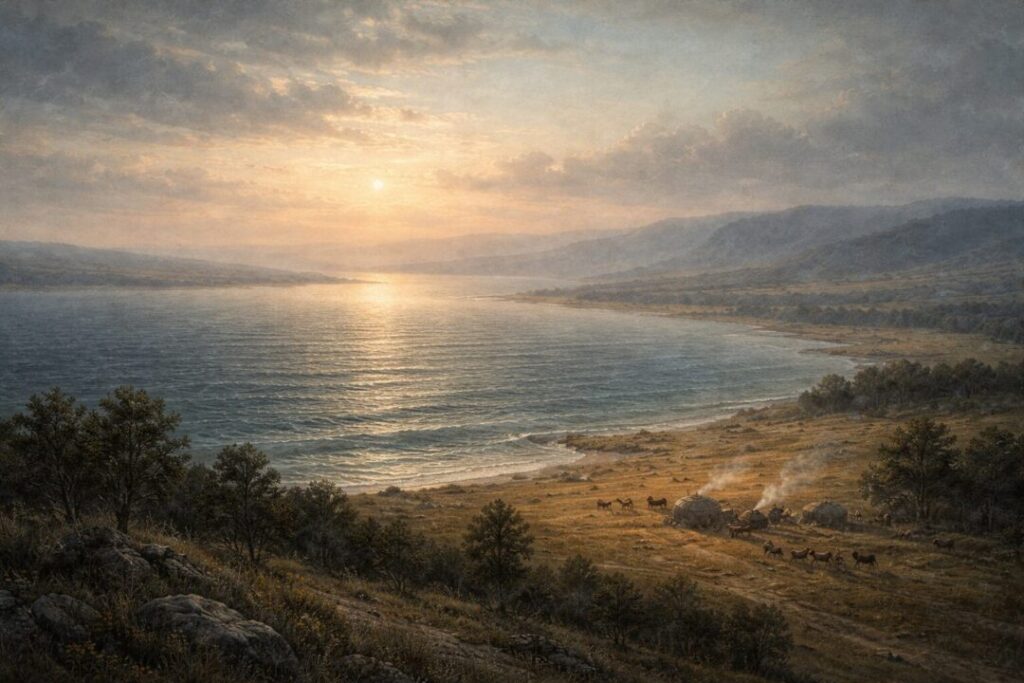
The texts do not describe the political state of Rhûn after the fall of Sauron in detail. We may reasonably infer that eastern lands, like the rest of Middle-earth, enter the Fourth Age under changed conditions. But no canonical chronicle walks us through those changes.
The Blue Wizards’ ultimate fate is uncertain in the primary narratives. Some late writings suggest they may have founded secret cults or failed in their mission; others imply they significantly hindered Sauron in the East. These traditions are debated and not uniformly presented.
So we end where the texts end: with names.
Rhûn.
Hildórien.
The Land of the Sun.
Three eastern horizons.
Not blank—but distant.
And perhaps the most revealing thing about them is this:
Middle-earth was never meant to feel small.