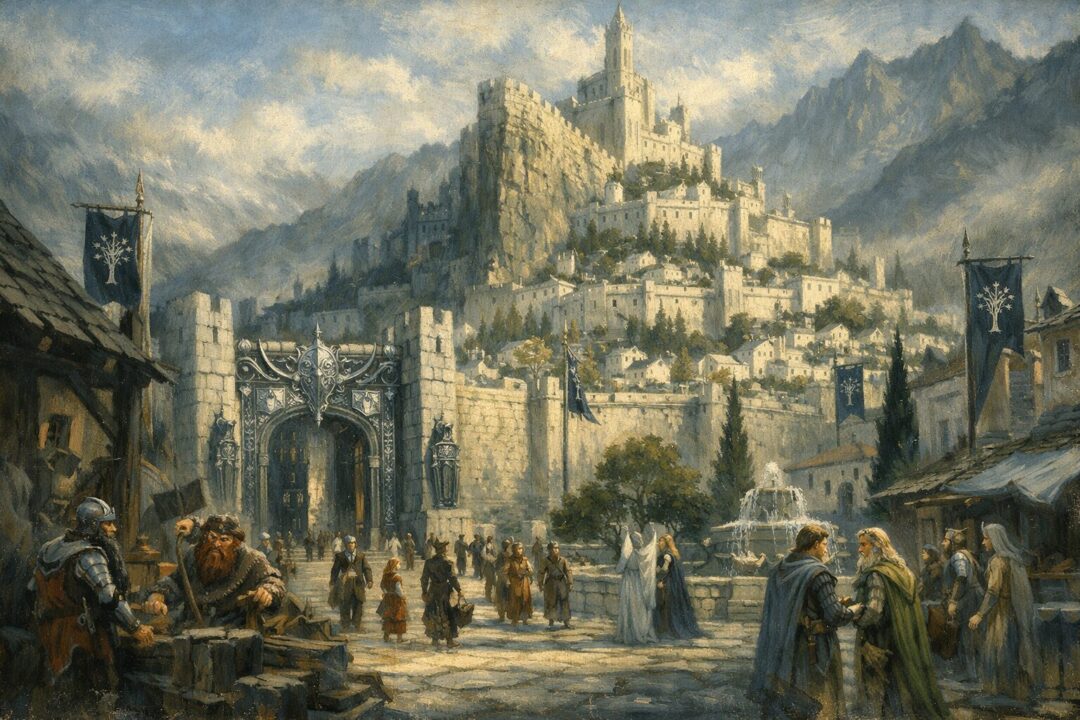
When the War of the Ring ends, Gondor appears to stand at the summit of restoration.
The Shadow is broken.
The White City still stands.
The Heir of Isildur is crowned at last.
The White Tree blooms again in the court of the kings.
On the surface, it feels like a completed ending.
But the texts point to something far more demanding.
Aragorn does not inherit a realm that only needs a rightful ruler. He inherits a kingdom worn down by long decline, reduced population, damaged borders, ruined cities, and generations of life organized around defense. Even before the siege of Minas Tirith, Gondor had already endured centuries of contraction and loss. By the time the crown returns, the realm is not simply waiting to be celebrated. It is waiting to be rebuilt.
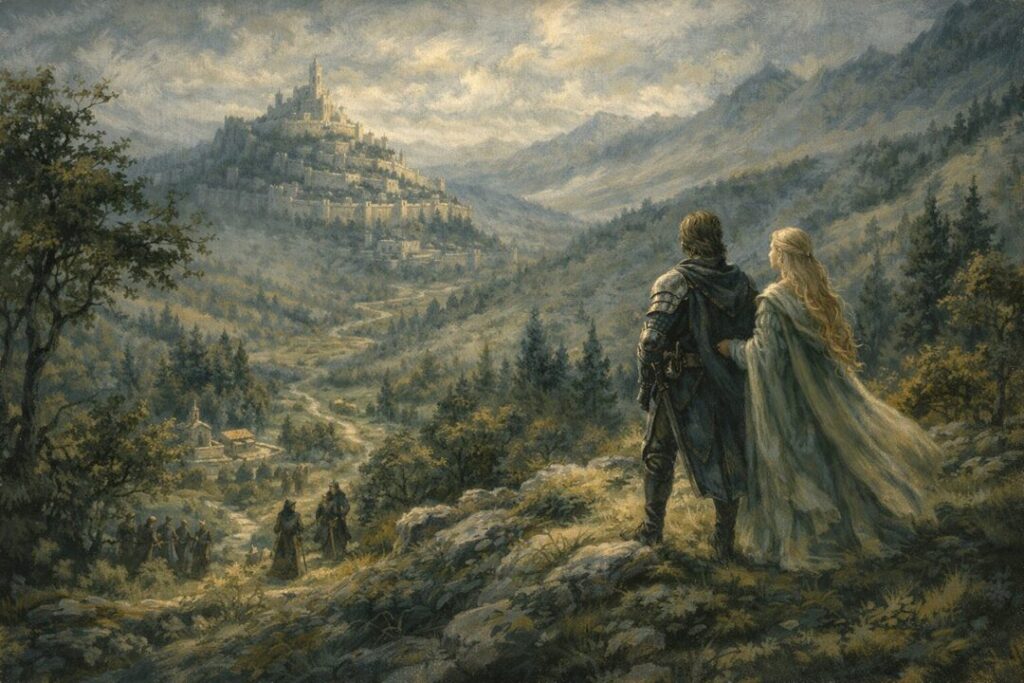
Victory Does Not Mean Immediate Wholeness
One of the easiest mistakes to make is to imagine the fall of Sauron as the moment Gondor becomes whole again.
The narrative does not treat it that way.
Yes, the war ends in triumph. Aragorn is crowned. A sapling of the White Tree is found and planted. Hope returns to the city. But even in that moment, the deeper work has barely begun. The war has just passed through Osgiliath, the Pelennor, Minas Tirith, and Ithilien. Crossings have been broken, outer defenses overrun, and entire regions have been shaped for generations by fear of Mordor.
This matters because Gondor’s crisis is not only military.
It is civilizational.
A kingdom can win a war and still remain thinly peopled, economically strained, politically unsettled, and geographically exposed. The return of the king solves the question of legitimacy. It does not, by itself, fill empty towns, restore agriculture, reopen secure movement across the realm, or heal lands long scarred by occupation and dread.
That is why the most revealing wording about Aragorn’s reign is so simple: he “restored Gondor and repeopled it.” That phrase suggests a long process, not a single event.
Gondor Had Been Declining Long Before the Ring Was Destroyed
To understand what rebuilding would really look like, the scale of Gondor’s prior decline has to be kept in view.
By the end of the Third Age, Gondor is not a young kingdom interrupted by one bad war. It is an old realm carrying the consequences of plague, depopulation, civil strife, abandoned outposts, and centuries of pressure from enemies to east and south. Osgiliath, once the great capital, had long been left in ruin. The watch on Mordor had failed in earlier centuries from lack of strength. Even Minas Tirith had become a city whose grandeur outlasted its numbers.
So when Aragorn enters Minas Tirith as king, he is not returning Gondor to the condition it held in the early Third Age or in its ancient height.
He is beginning a renewal after a very long contraction.
That changes how the whole Fourth Age opening should be imagined. Rebuilding Gondor would not mean pressing a reset button and restoring every old possession at once. It would mean deciding what could be strengthened first, what territories could be safely resettled, and what symbols of old greatness could become living centers again rather than empty monuments.
Minas Tirith Would Be Renewed First
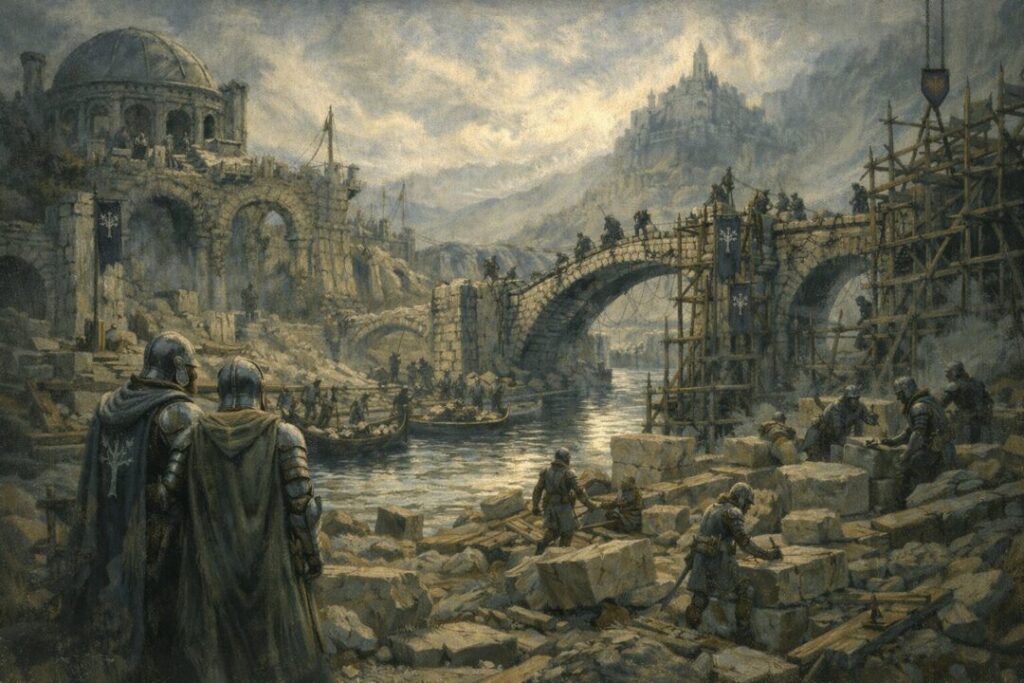
The texts are unusually clear that Minas Tirith itself was restored and beautified under King Elessar.
Its Great Gate was reforged by Gimli and the Dwarves of the Glittering Caves.
Its streets were paved with white marble.
It was filled with trees and fountains.
Dwarves came there to labor, and Elves delighted to visit it.
That description tells us something important.
The first face of rebuilding is not military hardness alone. It is civic renewal.
Minas Tirith is not merely patched. It is made fair again. The city becomes a visible statement that Gondor is no longer surviving from siege to siege. The return of beauty matters because beauty in Gondor is political as well as cultural. A renewed capital announces that the age of pure emergency has ended.
But this restoration should not be imagined as detached from practical needs. Minas Tirith had to remain the chief city of Gondor. That means administration, provisioning, roads, storage, defense, and population all matter. Beauty comes in the texts alongside craft, settlement, and public life. It is a city becoming inhabitable in fullness again.
Ithilien Would Be One of the Great Tests
If Minas Tirith is the heart of restored Gondor, Ithilien is the great question of its future.
This land had once been fair, but under the shadow of Mordor it became a dangerous border country. By the end of the war, it is not enough to proclaim it Gondorian again. It must actually be lived in, governed, guarded, and healed. That is why Faramir’s appointment matters so much. Aragorn not only confirms him as Steward; he also makes him Prince of Ithilien. Beregond is sent with him, and Faramir is later charged with cleansing the evil of Minas Morgul and the Morgul Vale.
That is not ceremonial language.
It suggests that rebuilding Gondor after the war would involve deliberate frontier restoration. Ithilien would need settlements, patrols, households, roads, and stable lordship. It would need people willing to dwell again within sight of lands that had for generations represented terror. Faramir and Éowyn dwelling in Emyn Arnen fits that pattern perfectly: rule returns not as abstraction, but as habitation.
At the same time, caution is necessary.
The texts support cleansing and resettlement in Ithilien. They do not support a simplistic idea that every part of the former eastern frontier instantly became normal. Minas Morgul especially remains associated with corruption so deep that the texts treat it with exceptional reserve. So the rebuilding of Gondor is not the same thing as total recovery of every damaged place. Some places must be guarded, some slowly reclaimed, and some perhaps never truly made ordinary again.
Osgiliath Would Matter, But Not as a Simple Return to the Past
Osgiliath is one of the clearest examples of how rebuilding Gondor must be imagined carefully.
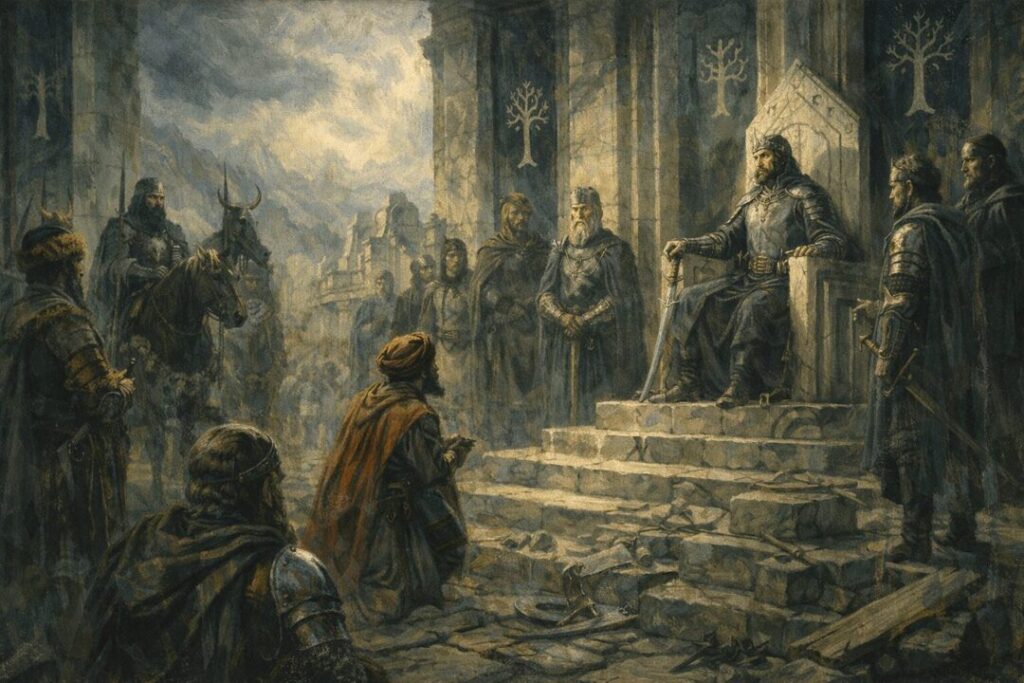
It was once the chief city of the South-kingdom, but by late Gondorian history it had long stood in ruin. During the war, Aragorn’s forces repaired the crossing-point there before marching toward the Morannon. That tells us Osgiliath still mattered strategically. But the texts do not say that Aragorn restored it as the chief city again. In fact, Minas Tirith explicitly remains the chief city of Gondor.
So the likely picture is not a complete reversal to an older political map.
Rather, Osgiliath would have remained symbolically and strategically important, and at least partially recoverable as a crossing, strongpoint, and inhabited place, while Minas Tirith continued as the seat of rule. That is a more conservative reading of the evidence, and it fits the broader pattern of Elessar’s reign: restoration, yes, but restoration adapted to the new age rather than a perfect recreation of the past.
Rebuilding Gondor Would Also Mean Rebuilding Government
The return of the king does not erase Gondor’s institutions.
It reorders them.
Faramir lays down the rod of the Steward and receives it back. Aragorn restores kingship, but the Stewardship remains as a hereditary office and chief counsellorship. In later notes, Aragorn is also said to have re-established the Great Council of Gondor. That implies that a rebuilt Gondor is not simply personal rule by a heroic king. It is a realm with restored hierarchy, counsel, delegated authority, and continuity between old structures and new legitimacy.
This is easy to miss because coronation scenes tend to dominate memory.
But the long-term survival of Gondor would depend on administration as much as glory. Taxes, levies, local authority, justice, settlement policy, reconstruction of damaged regions, and coordination with the fiefs all belong to the real work of restoration. The texts do not itemize these things in bureaucratic detail, but they strongly imply a kingdom becoming governable in peace, not merely victorious in war.
Peace Would Have To Be Secured Beyond Gondor’s Walls
Another common simplification is the idea that Sauron falls and all external threats vanish.
The texts do not present so easy a world.
Aragorn pardons Easterlings who surrender. He makes peace with the Haradrim. Elsewhere, he and Éomer later campaign beyond the Sea of Rhûn and in the South, while the threat of the Corsairs is finally subdued in his reign. He also frees the slaves of Mordor and gives them the region around the Sea of Núrnen.
This is crucial for understanding what rebuilding Gondor would really require.
A stable Fourth Age order cannot be built only by repairing Minas Tirith. It requires new political settlements on Gondor’s borders and beyond them. Some enemies are reconciled. Some hostile powers are defeated or contained. Formerly oppressed peoples in Sauron’s realm are not simply absorbed into Gondor but given room to live. This is not endless vengeance. It is postwar ordering.
In other words, Gondor’s restoration is outward-facing as well as inward-facing.
The Reunited Kingdom Changes the Scale of the Task
Aragorn does not become merely King of Gondor.
He restores the Reunited Kingdom of Arnor and Gondor. Minas Tirith remains the chief city in the south, but Annúminas is rebuilt in the north, and Aragorn rules there when he goes north.
That means rebuilding Gondor after the war is part of an even larger project: the restoration of the realms in exile under one crown.
This makes the achievement greater, but it also makes the labor more complex. Population must be redistributed or encouraged. Northern and southern centers must be linked under one kingship. Old roads and old claims regain meaning. The kingdom is not becoming smaller and more defensible. It is becoming broader and more ordered.
That scale matters because it shows Elessar’s reign is not a local cleanup after one battle.
It is a re-founding.
The Real Reconstruction Is Human
What finally makes Gondor rebuilt is not stone alone.
It is people.
The texts repeatedly point toward repopulation, habitation, return, and renewed civic life. Minas Tirith is filled again. Ithilien is given a prince. Councils are restored. Borders are settled. Former enemies are handled through both strength and mercy. The city becomes beautiful, but also lived in. That is the real sign that Gondor has entered a new age.
So what would rebuilding Gondor after the war really look like?
Not a single triumphant moment.
Not a crown solving everything.
Not a kingdom snapping back into perfection.
It would look like years of labor after the songs.
It would look like masons and road-builders, soldiers turned wardens, empty lands slowly filled, damaged frontiers cautiously reclaimed, law restored, alliances stabilized, and ordinary households returning to places that had long lived under the expectation of ruin.
That is what makes Gondor’s ending more powerful than a simple fairy-tale restoration.
It is not only that the king returns.
It is that under the king, the world becomes habitable again.