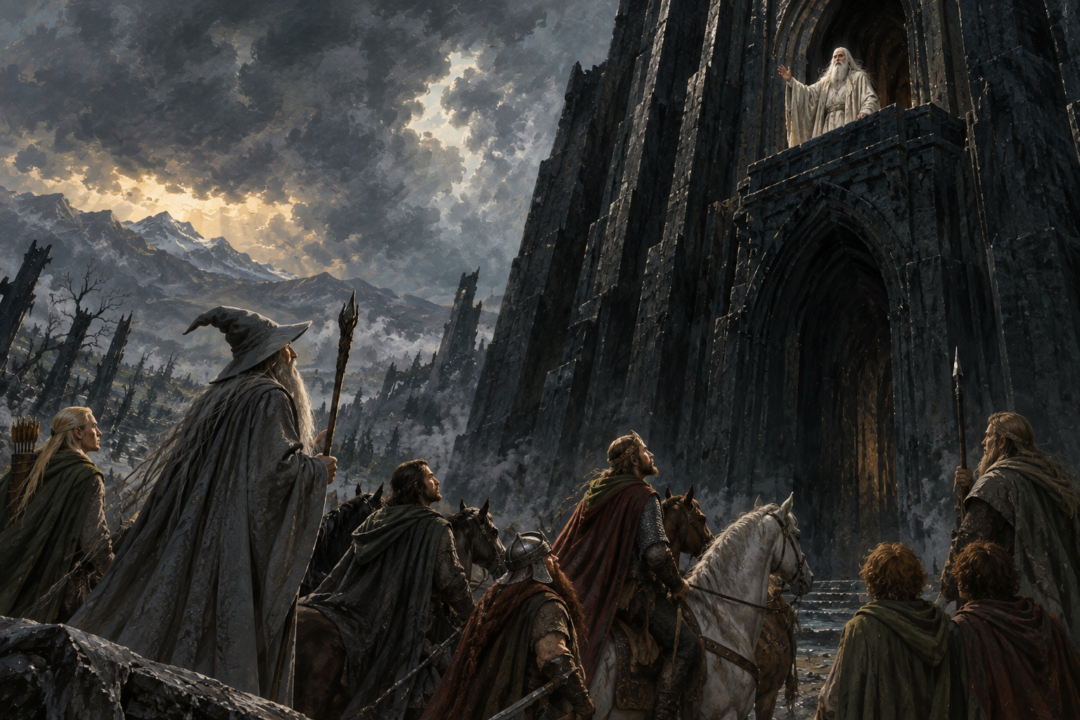
When the waters settle around Isengard, Saruman appears to have lost everything that made him dangerous.
His Orcs and Men are gone. His machinery has been wrecked. The walls of Isengard have been broken by the Ents, and the great industrial power he built beneath Orthanc lies flooded. Rohan has survived the assault that was meant to destroy it. Even Saruman's claim to leadership among those opposing Sauron has collapsed.
Yet when Gandalf, Théoden, Aragorn, and their companions come to Orthanc, they do not treat the defeated wizard as harmless.
They are right not to.
Saruman's last weapons reveal something important about power in Middle-earth. Once his armies disappear, what remains is not merely magic in the obvious sense. He still possesses his voice, his intelligence, his knowledge of other people's fears, and his ability to turn resentment into obedience.
His decline therefore becomes more revealing after Isengard falls, not less.
Saruman loses the ability to command thousands.
What remains is his ability to control people one at a time.
The Army Was Only One Form of Saruman's Power
Saruman's military strength at Isengard is immense by the standards of the surrounding lands. He has armed forces, fortified defenses, workshops, servants, and plans extending across Rohan.
But none of these things is the original source of his authority.
Saruman is one of the Istari, sent to Middle-earth to aid resistance against Sauron. His wisdom, knowledge, and persuasive abilities existed long before he transformed Isengard into a war machine.
That distinction matters after his defeat.
When Treebeard and the Ents destroy Saruman's works, they eliminate much of his material power. They can break gates, flood tunnels, and imprison him inside Orthanc.
They cannot simply erase what Saruman knows or what he can do with words.
This is why Gandalf remains cautious.
Saruman has become a prisoner, but a prisoner capable of influencing those standing outside his prison.
The Voice of Saruman Survives Isengard
The clearest demonstration comes during the confrontation at Orthanc in The Two Towers.
Saruman speaks from above to Gandalf, Théoden, and the others. His voice does not function merely as eloquence in the ordinary political sense. The narrative describes an extraordinary persuasive quality in it. Listeners can find his words reasonable, attractive, and difficult to dismiss, even when they know they have reason to distrust him.
Its danger is psychological.
Saruman does not need to prove that he is innocent. He needs listeners to begin doubting their own judgment.
He approaches different people differently. To Théoden, he attempts to reshape the meaning of their conflict and present himself as someone with whom reconciliation remains possible. His manner encourages listeners to regard opposition to him as unreasonable or needlessly hostile.
The effect is not equally irresistible to everyone, and the text does not establish the Voice as absolute mind control. People can resist it. Context, knowledge, character, and Saruman's own declining position matter.
But resistance requires clarity.
That makes the Voice especially appropriate to Saruman. His characteristic power is not simply forcing people to act against their wills. It is making submission sound like wisdom.
Gandalf Defeats Him by Stripping Away Authority
The confrontation ends with one of the most significant reversals in Saruman's story.
Gandalf offers him an opportunity to leave Orthanc and assist against Sauron. Saruman refuses.
Then Gandalf casts him from the order and the Council and breaks Saruman's staff.
The scene is important because Gandalf does not merely defeat a rival wizard in a contest of spectacular magic. He formally strips Saruman of an authority Saruman has already betrayed.
Saruman remains alive. He can still speak. He can still scheme.
But he can no longer convincingly stand as Saruman the White, leader of the Istari and head of the White Council.
His external position has finally caught up with his internal fall.
What follows is almost an experiment in subtraction.
Remove the army.
Remove Isengard.
Remove official authority.
Remove the staff.
Remove the possibility of openly competing with Sauron.
What remains?
Saruman's answer is manipulation.
Gríma Shows the Smallest Scale of Saruman's Dominion
Gríma Wormtongue becomes one of the clearest measures of what Saruman still controls.
Before the fall of Isengard, Gríma had served Saruman's purposes in Rohan, working close to Théoden while the king's strength and confidence declined. After Saruman's greater schemes collapse, Gríma remains attached to him.
Their relationship becomes increasingly miserable.
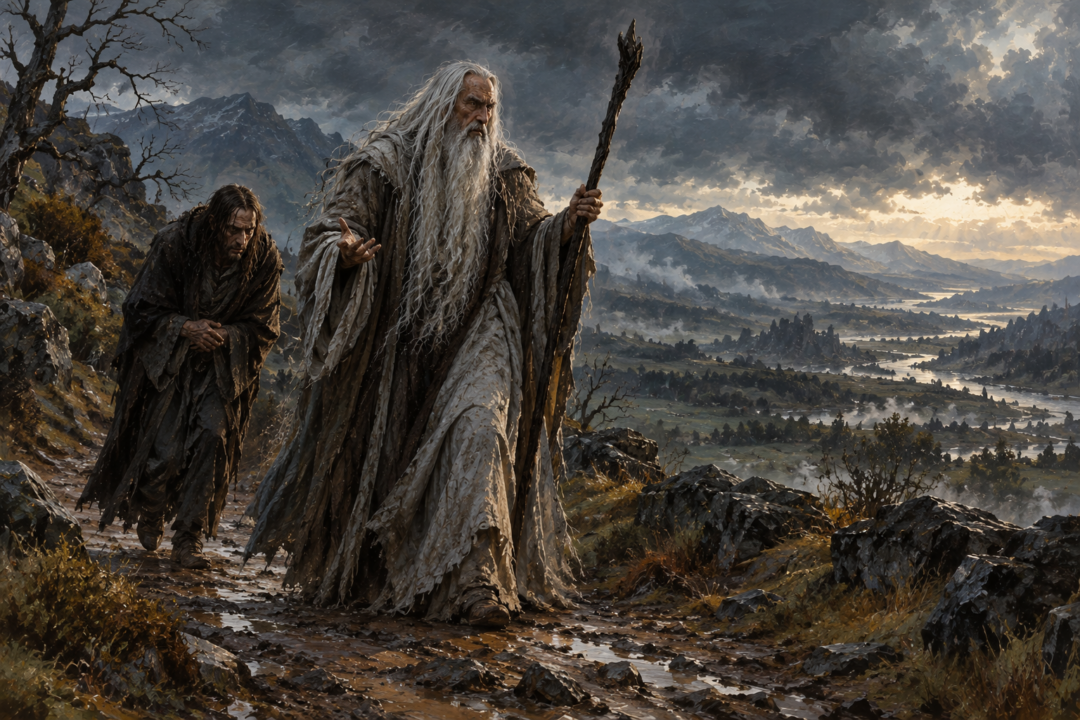
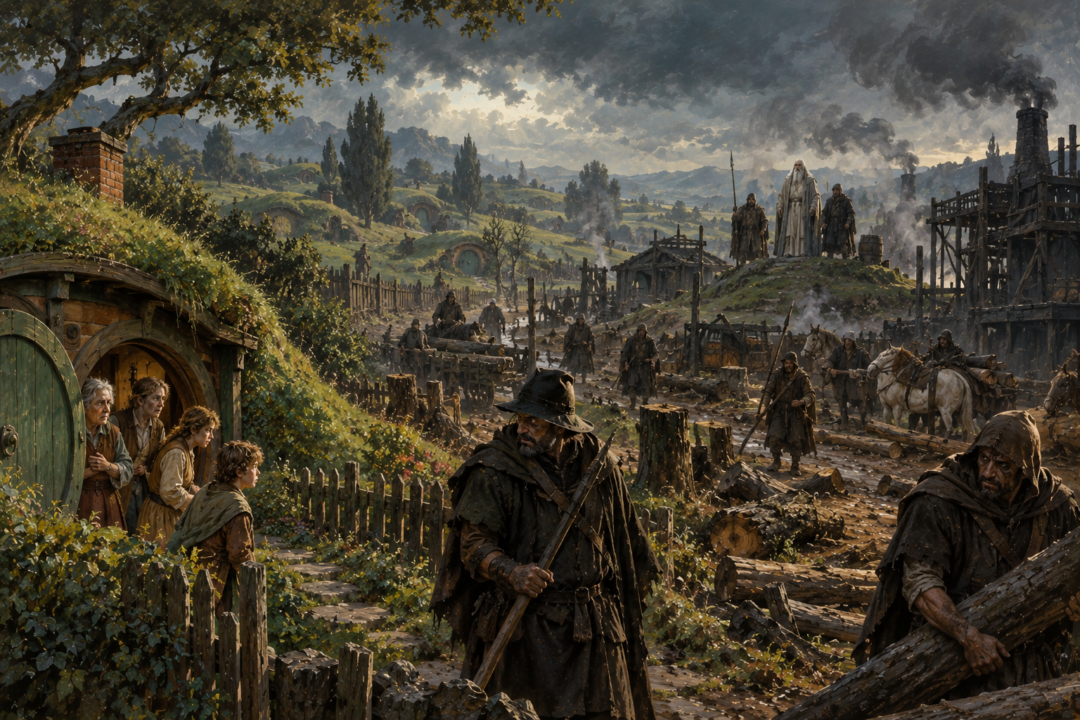
By the time they are encountered as wanderers, Saruman no longer resembles the master of a rising power. Yet he continues to dominate Gríma through contempt, humiliation, and psychological pressure.
This is Saruman's empire reduced to two people.
He no longer controls companies of Orcs.
He controls the man walking beside him.
The scale has changed, but the pattern has not. Saruman identifies weakness and uses it. His power increasingly depends upon making another person feel unable to escape him.
That relationship also exposes something his armies once concealed.
Saruman does not merely want useful servants. He seems increasingly driven by the desire to exercise mastery itself.
Why Saruman Goes to the Shire
Saruman's final destination makes his fall even more revealing.
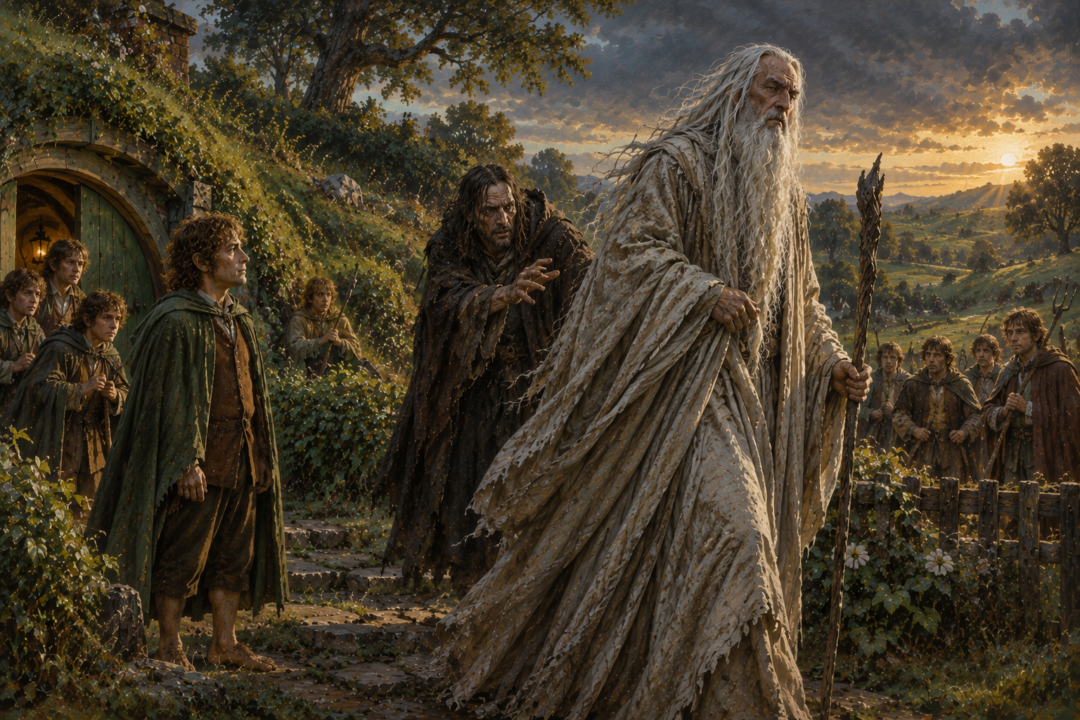
He reaches the Shire and becomes the power behind the regime the returning hobbits discover in “The Scouring of the Shire.” By then he possesses nothing comparable to the military machine of Isengard.
Yet he still manages to damage an entire community.
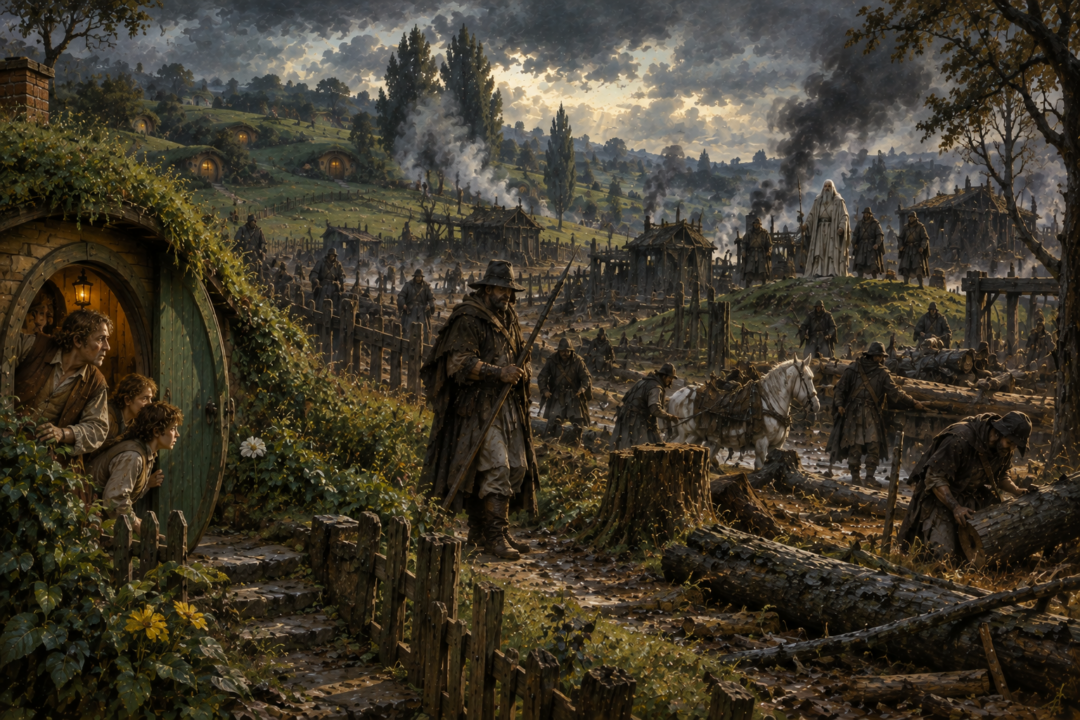
The Shire has accumulated rules, restrictions, confiscations, intimidation, imprisonment, and armed outsiders. Trees have been cut down. Buildings and mills have altered familiar places. The destruction is not simply accidental damage produced by war.
Saruman has brought his habits of domination into a place that once seemed far removed from the great struggles of Middle-earth.
There is also a deeply personal element in his behavior.
Saruman admits that part of what he has done is connected to revenge against the hobbits, particularly because of their association with those who helped bring about his humiliation. His remaining power is therefore increasingly vindictive.
He cannot build a new Isengard capable of challenging kingdoms.
He can still spoil somebody else's home.
The Shire Reveals the Limits of His Control
Saruman's rule in the Shire is frightening precisely because it operates on a smaller, recognizable scale.
People obey rules because other people are enforcing them. Some are frightened. Some have been imprisoned. Ruffians possess weapons and use intimidation. A structure of control has been created in which compliance helps produce further compliance.
But Saruman's position is much weaker than it appears.
Once the returning hobbits organize resistance, the system begins to collapse. Merry and Pippin have returned from the War of the Ring with experience far beyond anything the Shire's occupiers expect. The hobbits can organize themselves, confront the ruffians, and restore collective courage.
Saruman cannot replace what he lost at Isengard.
There is no second vast army waiting behind the Shire's hills.
His authority survives only while enough people behave as though resistance is impossible.
Once they stop doing that, his final political structure disintegrates rapidly.
Frodo Refuses Saruman's Final Game
The most striking response to Saruman comes from Frodo.
After the fighting in the Shire, Saruman is defeated and vulnerable. The temptation to answer cruelty with vengeance would be understandable.
Frodo refuses.
He does not permit Saruman to be killed simply because killing him has become possible.
This mercy has an unusual effect because it denies Saruman one of the last forms of control available to him: the ability to determine what his enemies become in response to him.
If Saruman can provoke hatred, retaliation, and needless killing, then he can still shape the moral behavior of those he has harmed.
Frodo will not give him that victory.
The scene does not make Saruman grateful. Quite the opposite. Mercy does not reform him.
But that is precisely why Frodo's choice matters.
Mercy is not offered because Saruman has earned it. It is a refusal to let Saruman dictate the terms on which others act.
Saruman Cannot Stop Controlling Gríma
The final tragedy comes almost immediately afterward.
Saruman again turns his cruelty on Gríma. Frodo offers Gríma the possibility of remaining behind rather than continuing with his master.
Saruman responds with contempt and reveals Gríma's responsibility for the death of Lotho Sackville-Baggins.
Gríma finally breaks.
He kills Saruman and is then himself killed by hobbit archers before Frodo can prevent it.
The end is brutally small compared with Saruman's former ambitions.
No armies clash.
No fortress falls.
No kingdom is at stake.
There is only a ruined master and the servant he could not stop tormenting.
Saruman's final act of domination helps produce his own death.
The Last Thing Saruman Loses
After Saruman dies, the narrative gives his passing a supernatural dimension appropriate to what he truly is. A grey mist rises from his body, looks toward the West, and is dispersed by a cold wind.
The moment suggests a final rejection, though the precise metaphysical implications should not be pushed beyond what the text actually states.
What is unmistakable is the physical image left behind.
Saruman, who once sought enormous power, ends as a diminished body on the road in the Shire.
His decline has moved steadily inward.
First he loses the wider war.
Then his army.
Then Isengard.
Then his staff and institutional authority.
Then his ability to command even a small occupied land.
At last, he loses control of the single person who has remained beside him.
That progression is what makes Saruman's ending more than the defeat of another villain.
His story reveals that domination does not disappear merely because its grand machinery has been destroyed. It can survive in persuasion, humiliation, fear, resentment, bureaucracy, and relationships built around dependency.
Saruman remains dangerous after his army is gone because the army was never the whole of his power.
But his ending reveals the limit of that power too.
He can persuade people.
He can frighten them.
He can organize others into systems of coercion.
He can make a weaker person miserable enough to remain at his side.
What he cannot ultimately control is what happens when people cease granting him obedience.
The Ents take his fortress. Gandalf rejects his claims. Théoden refuses his persuasion. The hobbits resist his petty regime. Frodo refuses his hatred. Finally, Gríma refuses him in the most catastrophic way possible.
By the end, Saruman possesses almost nothing.
And that is when Middle-earth shows most clearly what he had been trying to possess all along: not merely land, armies, or victory, but the wills of other people.
Sources & Notes
- Tolkien Gateway — The Voice of Saruman (chapter synopsis): https://tolkiengateway.net/wiki/The_Voice_of_Saruman
- Tolkien Gateway — Gríma (service under Saruman after Isengard's fall): https://tolkiengateway.net/wiki/Gr%C3%ADma
- Tolkien Gateway — The Scouring of the Shire (Saruman as Sharkey): https://tolkiengateway.net/wiki/The_Scouring_of_the_Shire
Sources on Saruman's persuasive voice at Orthanc, his treatment of Gríma, and his later control of the Shire.