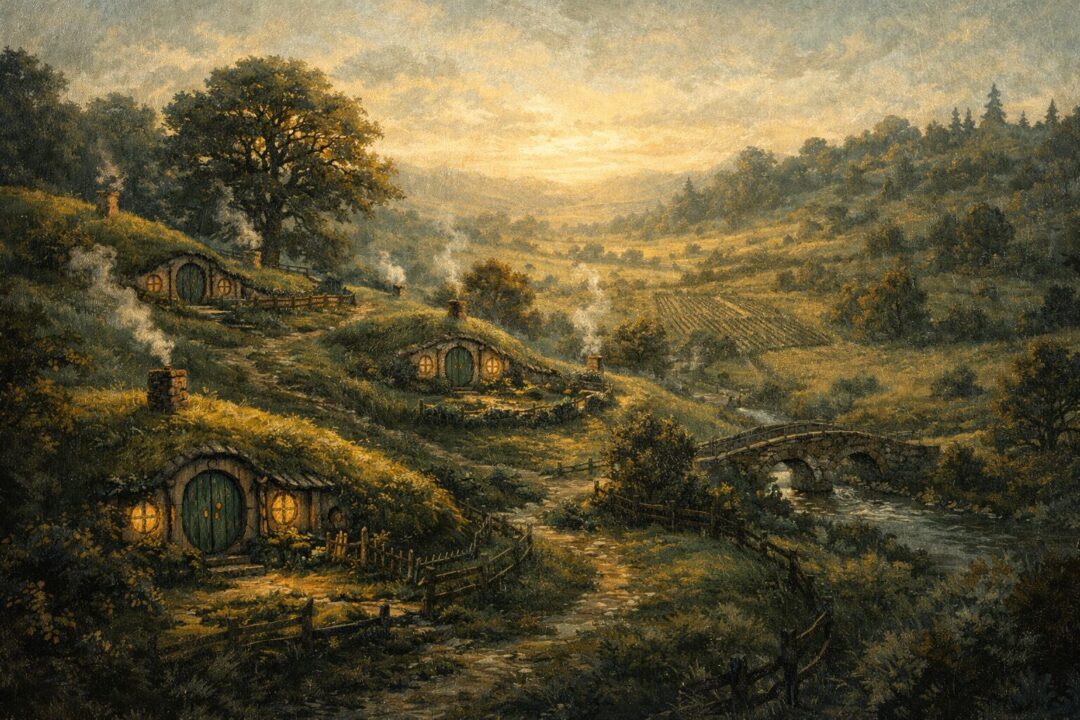
Sauron’s ignorance of Hobbits is one of those details that seems almost comic until you look at it closely.
This is the ruler who rebuilt Mordor, gathered the Nine, bent vast armies to his will, and reached outward across Middle-earth through fear, rumor, spies, and long memory. He is not careless. He is not uninformed in any ordinary sense. And yet the people who end up carrying the fate of the Ring are, for most of his long story, barely inside his field of vision at all.
That matters, because the texts do not present Hobbits as a secret race hidden by magic. They were obscure, yes; provincial, certainly; but not wholly unknown. Men had names for them. Some of their older movements were dimly remembered. Gollum himself came from hobbit-kind near the Gladden Fields. The point is not that Hobbits were literally undiscoverable.
The point is that they did not seem important enough for Sauron to care until the Ring led back toward them.
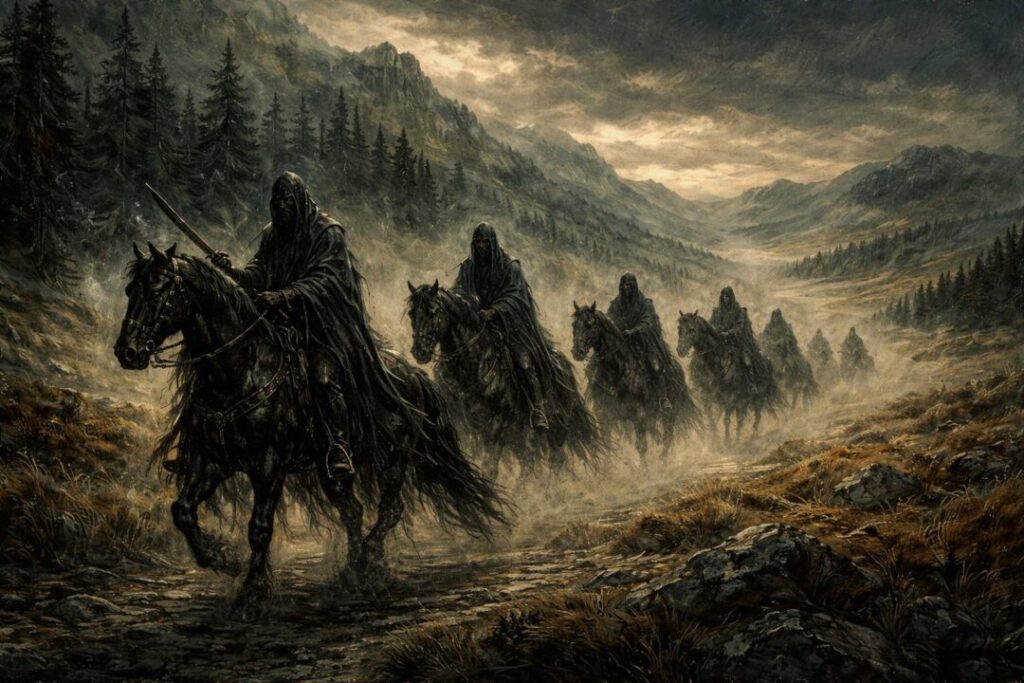
Before Bilbo, the texts give Sauron no strong Hobbit focus
The safest way to begin is with restraint.
The primary texts do not give us a scene in which Sauron studies Hobbits before Bilbo’s finding of the Ring. They do not show him building policy around the Shire. They do not show him naming Hobbit clans, tracing their settlements, or marking them as a strategic problem. What they show instead is a much later realization: by the time of the War of the Ring, Sauron had to ask what Hobbits were and where they lived. That is an extraordinary clue to what had come before.
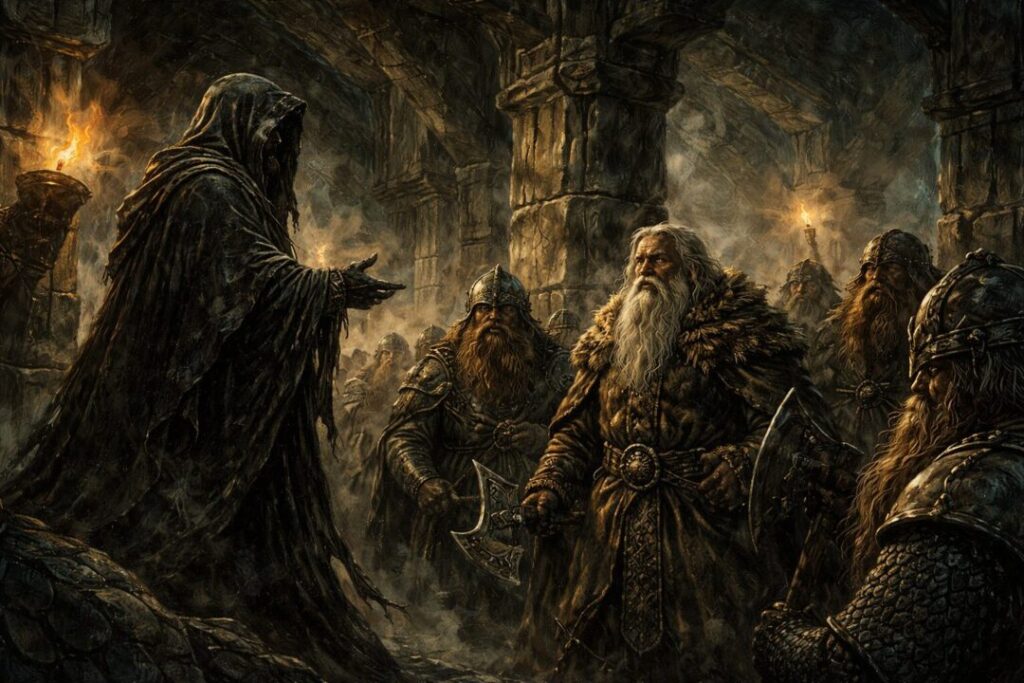
At the Council of Elrond, Glóin reports that a messenger from Mordor came to Erebor asking after “Hobbits”: what they were and where they dwelt. That question tells you something important immediately. Sauron had heard enough to know the word mattered. But he had not known enough beforehand to make the answer obvious.
And the Prologue to The Lord of the Rings supports the same picture from the other side. Hobbits had long been overlooked by the “Big People,” and even when larger powers knew of them, they tended not to take them seriously. That general neglect is not a side note. It is part of the structure of the story. Hobbits survive partly because the powerful do not read them correctly.
Sauron may have known of halflings in a broad sense
This is where many retellings get too definite.
It is reasonable to say that Sauron may not have been wholly ignorant that such small folk existed somewhere in the North. “Halfling” was not an invented word of the very last years of the Third Age, and Gollum himself was of hobbit-kind, descended from Stoors who had once lived near the Gladden. Once Sauron captured Gollum, he was able to infer that “Baggins” was likely a creature similar in kind to him. But that is not the same thing as saying Sauron had long maintained a serious understanding of the Shire and its people. The texts do not support that stronger claim.
So the careful conclusion is this: before Bilbo, Sauron may have had at most a vague or incidental awareness of halflings as an obscure people on the margins of wider history. What the texts do not show is targeted attention. Hobbits were not yet central to the Ring story from his point of view.
That changes only when Gollum breaks.
What Sauron learned from Gollum
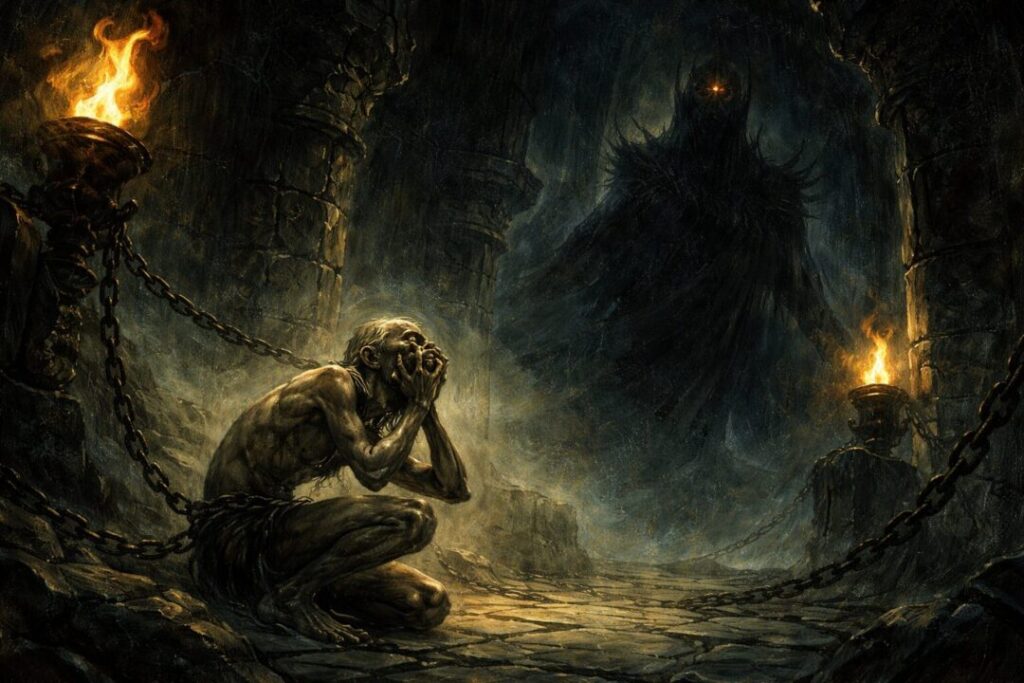
In “The Shadow of the Past,” Gandalf tells Frodo the essential fact plainly: the Enemy found Gollum first, and under torment discerned two words from him—“Shire” and “Baggins.” That is the decisive turning point in Sauron’s Hobbit knowledge.
Notice what is missing.
Gollum does not hand over a full geography lesson. He does not provide a military survey of Eriador. He does not explain Hobbit politics, roads, borders, or watches. He gives Sauron what amounts to a trail of fragments: a place-name and a name connected to the theft of the Ring. That is enough to alarm Sauron. It is not enough to make the hunt easy.
This is one reason the later search is so revealing. Readers sometimes imagine that once Sauron heard “Shire,” the Nazgûl should have ridden straight there. But Unfinished Tales shows that this is not how it worked. The information had to be interpreted. Worse for Sauron, it had to be interpreted by minds accustomed to dealing with power in the usual places: strongholds, courts, keeps, towers, roads, borders, ambitious rulers. The Shire was none of these things.
Why “Shire” was not enough
A place-name is useful only if you know where to place it.
The most important limit on Sauron’s knowledge is simple: the word “Shire” did not immediately tell him where the Shire lay. That is why the Hunt for the Ring sprawls through uncertainty. The Nazgûl do not begin with direct certainty in the West. Their early search is shaped by inference from Gollum’s origin and from the path of the Ring after Isildur’s loss. In other words, they grope backward through the Anduin story before the trail bends toward Eriador at all.
This is a crucial distinction.
Sauron does not miss the Shire because he is too weak to seize it. He misses it because intelligence is not the same as understanding. He knows the Ring has resurfaced. He knows “Baggins.” He knows “Shire.” He even suspects that the thief was akin to Gollum. But he still lacks the lived political map that would make those clues immediately usable.
And that makes sense in-world. The Shire was not a throne-centered realm. It was not a major battlefield. It was not one of the pressure points through which Sauron habitually read Middle-earth. It was quiet, inland, local, and easy for great powers to underestimate.
Why Sauron’s own mindset worked against him
There is also a deeper reason the Shire remained hard for him to grasp.
Sauron understands domination. He understands pride. He understands the desire to use power. Again and again, the story shows him reasoning in those terms. He expects rivals to behave like rivals. He expects the Ring to be used, claimed, hidden by strength, or wielded in challenge. This is exactly why the Wise conclude that he will not easily imagine his enemies seeking to destroy it.
That same limitation applies to Hobbits.
The Shire is not just geographically obscure. It is conceptually obscure to Sauron. A land with no great armies, no imperial ambition, no obvious hunger for dominion sits outside the habits of mind by which he interprets the world. Even after learning the name, he does not automatically understand the significance of the society behind it.
So the Dark Lord’s ignorance is not merely about maps.
It is about scale.
He can notice power. Hobbits do not advertise it.
Saruman, not Sauron, knew the Shire better
Another quiet irony sharpens the whole episode.
By the late Third Age, Saruman had taken a private interest in the Shire and in pipe-weed, and he had also watched Gandalf’s concern for Hobbits. Unfinished Tales makes clear that Saruman possessed information about the Shire that Sauron did not yet fully possess. This matters because it means Sauron’s path toward the Shire eventually runs through a rival intelligence network rather than through his own prior mastery of the subject.
That is humiliating in its own way.
The ruler who imagines himself the center of all ordering knowledge must, in practice, send the Nazgûl into uncertainty and then press Saruman for what he knows. The hunt becomes a contest not just between Sauron and the Free Peoples, but also between Sauron’s limited clues and Saruman’s half-hidden local advantage.
And by then, time matters.
The Shire is still vulnerable. But it is no longer untouched. Rangers are watching its borders. Gandalf has already been moving around the problem for years. Once Sauron finally points hard toward the right land, he is already late.
So what did Sauron actually know before Bilbo?
If we strip away exaggeration, the answer becomes surprisingly narrow.
Before Bilbo’s finding of the Ring, the texts do not give evidence that Sauron had any substantial, focused knowledge of Hobbits as a strategic people. At most, he may have been dimly aware of halflings in the wide ethnographic sense in which small northern folk were known among Men, but there is no sign that the Shire itself stood high in his mind or that Hobbits mattered to his plans.
After Bilbo—but still before the Nazgûl reached the Shire—his knowledge sharpens abruptly and incompletely. Through Gollum he learns “Baggins” and “Shire.” Through deduction he connects the thief to a similar kind of creature. Through further searching and pressure on Saruman he moves closer to the truth. But even then, the search is delayed precisely because his information is fragmentary and his assumptions are wrong-footed.
That is why he still misses the Shire for so long.
Not because the clue was worthless.
Because he did not yet know how to read it.
Why this matters to the larger story
This is not a minor logistical detail.
It reveals one of the central patterns of The Lord of the Rings: evil is not defeated only by superior force, but also by what it cannot properly value. Hobbits are overlooked not because they are unreal, but because they are underestimated. Sauron’s power is immense, yet his imagination is narrow in exactly the wrong places.
That is why the Shire matters so much.
It is not just Bilbo’s home, or Frodo’s point of departure, or a pastoral contrast to Mordor. It is the place that escapes the Dark Lord’s full notice until the last possible moment because it embodies a mode of life he does not understand. He can terrify kingdoms. He can corrupt the mighty. But he is slow to see the historical force of the small, the local, the unimperial, and the content.
And that, more than mere secrecy, is why he missed it.
The Shire was never simply hidden from Sauron.
It was beneath the notice of the kind of mind he had become.