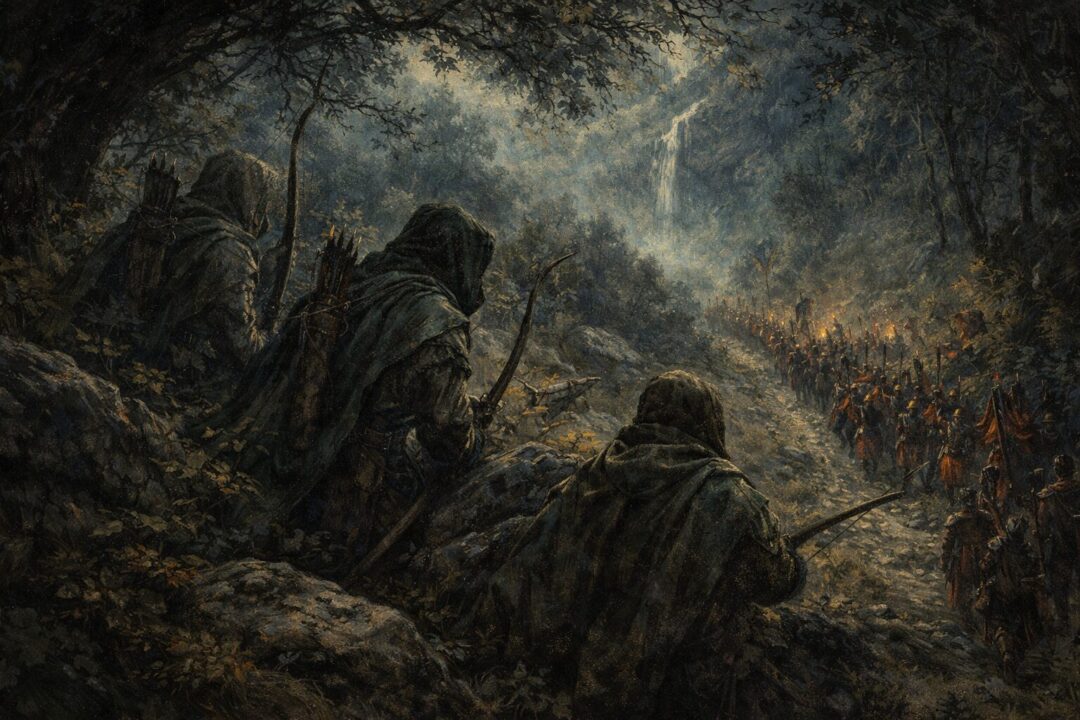
Scouting in Tolkien is not a class fantasy
When people imagine “scouting” in fantasy, they often picture a very specific type of character: fast, lightly armored, sneaky, and conveniently good at seeing danger before anyone else does. Tolkien’s Middle-earth is less tidy than that.
In his world, scouting is not usually presented as a neat professional specialty with a fixed look. Instead, it appears as a set of hard practical skills used by different peoples in different ways: tracking, concealment, route-finding, terrain knowledge, observation, quiet movement, message-carrying, and survival. Sometimes the scout is a Ranger. Sometimes it is a burglar. Sometimes it is a captain with a small hidden company. Sometimes it is simply the person forced to go first because there is no safer option. That pattern shows up again and again in The Hobbit and The Lord of the Rings.
What makes Tolkien’s version feel real is that scouting is rarely glamorous. It is uncomfortable, slow, and dangerous. It depends on judgment more than bravado. And it matters because in Middle-earth, good information can be more valuable than force.
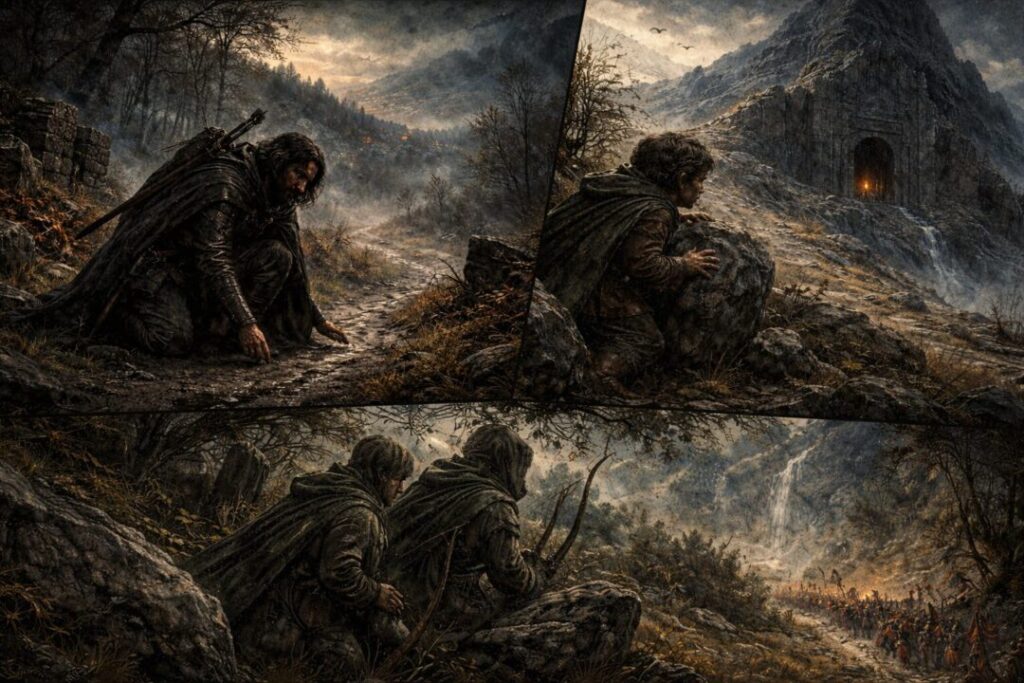
Aragorn shows that a scout is first of all a reader of signs
Aragorn is one of Tolkien’s clearest examples of what real scouting looks like. He is not just a swordsman or hidden king. He is a man who survives by reading land, tracks, weather, movement, and danger.
The Rangers of the North protected Bree and the Shire for years without recognition from the people living there. That alone tells us something important: their work was not about dramatic confrontation. It was about watchfulness, patrol, and preventing threats before ordinary people even knew they existed. Aragorn’s role in guarding the roads and seeking Frodo after the Black Riders entered the region fits that same pattern.
In other words, Tolkien’s scout is often someone who understands the landscape as evidence. A bent blade of grass, a strange movement on the road, a disturbed campsite, or the absence of normal life can all matter. Aragorn’s value is not simply that he can fight when necessary. It is that he notices what others miss and makes decisions from it.
That is much closer to historical reconnaissance than to modern fantasy shorthand. The scout is not just “the sneaky one.” He is the one who can interpret incomplete signs and keep others alive.
Bilbo proves that scouting is often reluctant work
One of the best examples in all Tolkien is Bilbo.
He is chosen as a “burglar,” but in practice a great deal of that job becomes reconnaissance. He is sent to investigate sounds, creep toward danger, gather information, and return with something useful. Sometimes that means approaching trolls. Sometimes it means slipping through hostile territory. Most clearly, it means approaching the Lonely Mountain and learning what can be learned about Smaug and Erebor before anyone tries anything more ambitious. Thorin’s company did not march east with a full military plan. They needed eyes, timing, and facts.
That matters because it shows a very Tolkienian truth: scouts are not always eager experts. Sometimes they are simply the people who must go where the larger group cannot. Bilbo is brave, but much of his bravery is unwilling bravery. He goes forward because information has to be gained somehow.
This is exactly why Tolkien’s treatment works so well. The point is not that Bilbo becomes an assassin or commando. The point is that he becomes useful in the most difficult scouting sense: he observes, survives, returns, and changes the company’s understanding of the situation.
In Middle-earth, that is often enough to alter the entire shape of a quest.
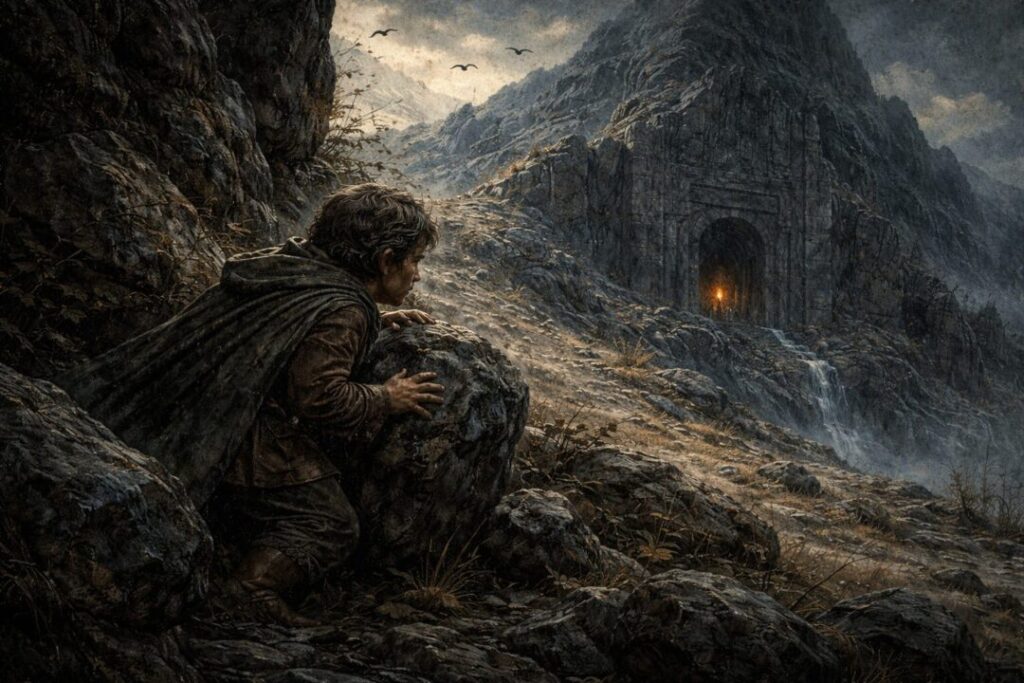
Faramir’s Rangers show the military side of scouting
If Aragorn shows the wandering and protective side of scouting, Faramir’s men show its organized military form.
The Rangers of Ithilien were a force drawn from the descendants of the people who had once lived in Ithilien. They operated in a land that Gondor could no longer openly hold, using secrecy, camouflage, hidden movement, and ambush. They were associated with Henneth Annûn, a concealed refuge behind a waterfall, and they crossed the Anduin in secret to harry enemy forces in a region under growing Shadow. Their clothing in green and brown is not just flavor. It points to their mode of war: concealment first, open display last.
This is probably the clearest answer to the question in the title. In Middle-earth, actual scouting often looks like:
watching roads,
knowing where the enemy moves,
staying hidden in broken country,
choosing ground carefully,
and striking only when the odds and purpose justify it.
Faramir’s men are not roaming adventurers. They are a disciplined hidden force working with limited numbers in dangerous terrain. That makes them feel much more like real reconnaissance and irregular warfare than the simplified “one scout ahead of the party” version many stories use.
Scouting in Middle-earth depends on terrain and secrecy
A major reason scouting matters so much in Tolkien is that geography matters.
Forests, river crossings, ruined roads, mountain passes, marshes, and broken hills are not background decoration. They shape what can be seen, how quickly messages move, where armies can pass, and which small groups can hide. The Rangers of Ithilien can function because Ithilien’s land allows concealment and secret refuge. The Rangers of the North can protect wide territories because they know empty lands others barely understand. Bilbo becomes useful because a small unseen figure can go where a company cannot.
This also means scouting is never only about eyesight. It is about movement in relation to terrain. A good scout knows where to stand, where not to silhouette himself, when to avoid roads, when to trust cover, and when a retreat path matters more than a good view.
Tolkien’s world rewards that kind of wisdom repeatedly.
The enemy scouts too
One detail people sometimes forget is that scouting is not only a Free Peoples activity.
Saruman uses crebain as watchers, and hostile observation is a real danger in the story. In The Hobbit, even seemingly ordinary birds near the Lonely Mountain are treated with suspicion during a sensitive approach. That does not mean every bird is literally a deliberate spy, but it does show the mindset Tolkien gives to dangerous-country movement: if you are near the enemy, you assume eyes may already be on you.
This is one reason secrecy matters so much in Middle-earth. A scout’s job is not complete when he sees the enemy. He must also avoid being seen, avoid revealing his people’s intentions, and avoid triggering a response too early.
That is especially important in the War of the Ring, where small pieces of knowledge can have enormous consequences.
Scouting is about information, not heroics
The most important thing Tolkien gets right is simple: the purpose of scouting is information.
Not kills.
Not glory.
Not the satisfaction of looking impressive in danger.
Aragorn protects by watching and tracking. Bilbo helps by finding out what is really there. Faramir’s men survive by learning enemy movement and acting from concealment. Again and again, the decisive advantage is knowledge gathered at risk and used wisely.
That makes scouting in Middle-earth feel grounded. It is not romanticized as a separate mystic talent. It is practical intelligence work done by capable people under pressure.
And Tolkien also understands the emotional cost. Scouts are often alone or nearly alone. They must be patient when others want action. They are the first to meet fear and the last people who can afford panic. Often, success means nobody notices what they prevented.
So what does scouting actually look like in Middle-earth?
It looks like the Rangers guarding borders in obscurity.
It looks like hidden men in Ithilien wearing the colors of the land.
It looks like secret refuges, silent movement, and sharp eyes on the road.
It looks like Bilbo going forward when no one else can.
It looks like reading signs correctly and living long enough to report them.
Most of all, it looks like understanding that in Middle-earth, seeing clearly is a form of power.
Not the corrupting kind.
The saving kind.
And that is why scouting matters so much in Tolkien’s world: before the battle is fought, before the plan is chosen, before the company moves, somebody has to go first and come back with the truth.