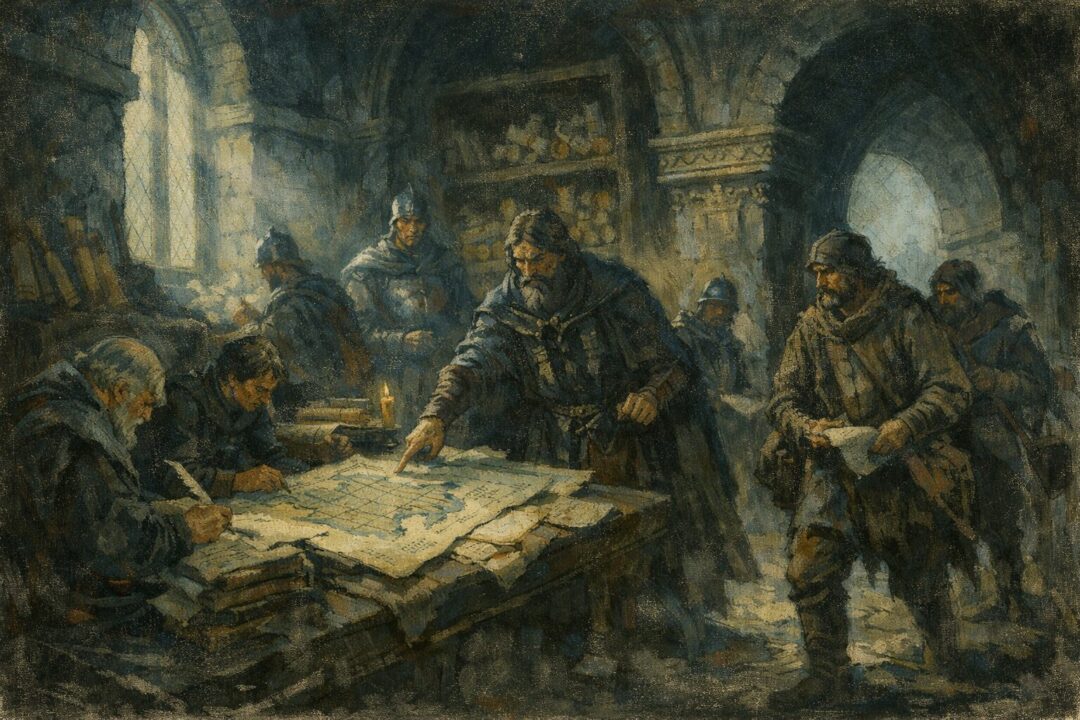
Most people imagine kingship in Middle-earth in grand images.
A white crown.
A high seat.
A city of stone.
Banners over the walls.
And once that picture is in mind, another modern assumption often follows without being noticed:
Surely a king must also mean taxes.
Ledgers.
Collectors.
Regular payments in coin.
A central authority reaching into every household.
But the texts never really show Middle-earth working like that.
That is what makes the question so interesting.
If we ask what taxation under a Steward of Gondor or a restored king might really look like, the answer is not “none at all.”
Yet it is probably not what most modern readers mean by taxation either.
The evidence points toward something older, looser, and more personal.
Less like a modern state.
More like a web of law, land, service, maintenance, dues, and military obligation.
And the clearest way to see that is to begin somewhere deceptively small.

The Shire Shows What Legitimate Rule Feels Like
The Shire is not Gondor.
It is smaller, gentler, and far less formal.
But it preserves one of the most revealing memories of lawful rule in all the legendarium.
When the Hobbits speak of the old king, they do not describe endless collection. They remember that they were required to acknowledge his lordship, keep the roads and bridges, and speed his messengers.
That matters.
Because it shows a pattern.
The obligations tied to kingship are real, but they are concrete and practical. They are not presented as a permanent machine for draining private life into a distant capital. They are attached to movement, order, and public maintenance.
A road must be kept.
A bridge must stand.
A messenger must pass quickly.
That already suggests something important.
In Middle-earth, rightful authority often appears first as the maintenance of common things.
Not abstract revenue.
Not bureaucratic reach.
But the conditions that make settled life possible.
Even more telling is the way the Shire remembers these duties after the northern kingdom has long vanished. The Hobbits still keep “the Rules” largely of their own free will because they regard them as ancient and just.
That is not how people usually think about oppressive taxation.
It is much closer to inherited obligation that has become part of the moral order of ordinary life.
Gondor Is Larger, But the Structure Still Looks Feudal
Gondor is not a village commonwealth.
It is a great realm.
It has fortified cities, long roads, outlands, river traffic, ancient law, and a political order elaborate enough that even outside the narrative proper, we are told its economy could be worked out from the hints given.
That scale means some kind of revenue and support system must exist.
The texts do not leave us with an empty kingdom running on symbolism.
But what they do show is revealing.
Gondor is divided into fiefs.
Those fiefs are ruled by local lords who owe allegiance to the king or, in the king’s absence, to the Ruling Steward.
That is a very different picture from a centralized modern treasury directly managing every field and workshop in the land.
The logic seems layered.
Land sustains local lordship.
Local lordship sustains the realm.
The realm, in turn, sustains defense, law, roads, garrisons, and royal authority.
In other words, the structure looks less like “the crown taxes individuals” and more like “the kingdom rests on obligations that rise through ranks and territories.”
That does not mean money is absent.
It means coin is unlikely to be the whole story, or even the primary one.
Ancient Law Matters More Than Personal Decree
One of the most important clues is easy to overlook.
The king of Gondor is described not as the maker of law in the modern legislative sense, but as the administrator and interpreter of ancient law.
That sets a limit on how we should imagine royal power.
A king in Gondor is not simply a ruler who invents whatever demands he pleases and sends officials out to enforce them.
He stands inside an older framework.
That matters because taxation in a strongly modern sense usually expands where the state claims a broad right to redefine its own needs at will.
Gondor does not feel like that.
Even Denethor, proud and severe as he is, holds council with the lords of the fiefs and the captains of the forces in matters of great importance.
That suggests a political order where obligations are not merely imposed downward from a solitary center, but mediated through rank, inheritance, custom, and consultation.
So when we ask what subjects “owed” a Steward or King, the safest answer is not a single tax category.
It is a network of customary obligations under ancient law.
What the Kingdom Clearly Has to Support
The texts do not give us a tax code.
They do give us visible expenses.
And those expenses are substantial.
Gondor maintains cities.
It keeps fortifications.
It supports soldiers.
It sends and receives messengers.
It sustains roads and communications.
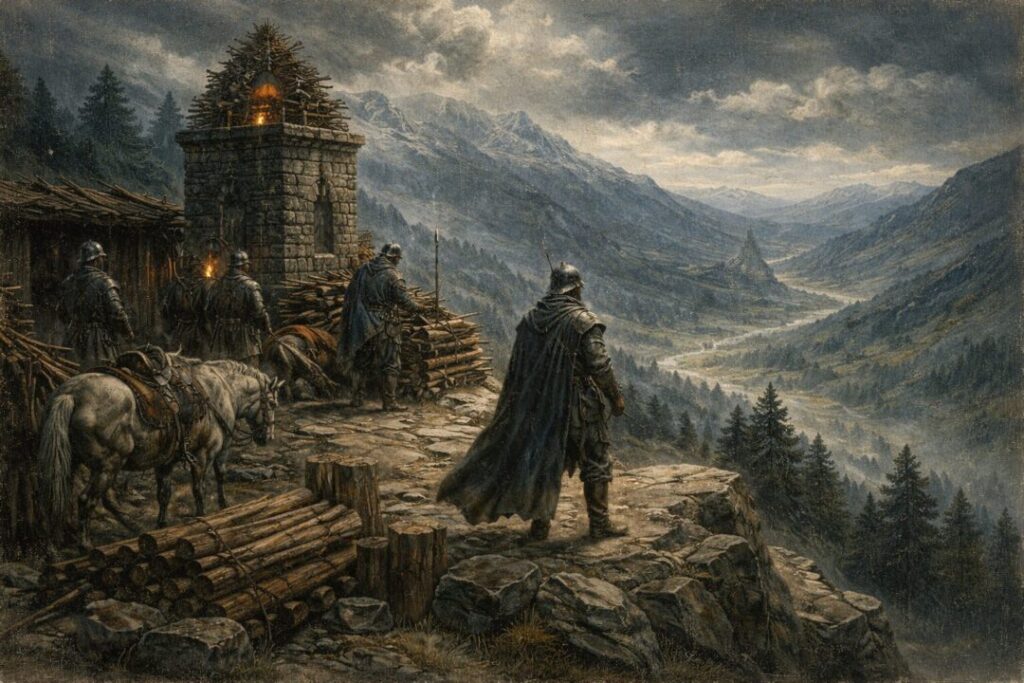
It mans beacon-stations on distant heights, with signal fires ready and fresh horses kept for couriers.
None of that is free.
So where does the support come from?
The texts do not spell it out in accounting language, but the shape of the answer is fairly clear.
A realm like Gondor would have to draw support from land, produce, labor, local lordship, and military service.
Coin surely has a place in trade and payment. Yet the visible machinery of the kingdom points repeatedly to obligations in kind and in service.
Food for garrisons.
Horse-keeping.
Road work.
Provisioning.
Arms and men supplied by regions.
Local responsibility for maintaining what lies within a lord’s domain.
That is interpretation, not an explicit canon formula.
But it is the interpretation most consistent with the political and material world the texts actually show.

Military Obligation Is Probably Central
If there is one area where Gondor’s system becomes easiest to imagine, it is war.
The fiefs do not seem ornamental.
When Minas Tirith stands in peril, the outlands send men.
Princes, captains, and regional lords arrive with forces from their own territories.
That strongly suggests that one of the chief “costs” of belonging to the realm is not merely payment, but contribution to defense.
In a pre-modern kingdom, that is often more important than direct taxation anyway.
A ruler needs men, horses, food, stores, ships, and fortified places more urgently than he needs universal personal accounting.
Middle-earth fits that pattern remarkably well.
The question, then, may not be “How much tax did Gondor pay?”
It may be closer to:
Who maintained what?
Who supplied whom?
Which lands owed soldiers?
Which lords owed provisions?
Which regions supported roads, beacons, and strongholds?
That is not a smaller question.
It is simply an older one.
The Shire Also Shows What Corruption Looks Like
One of the best ways to see rightful rule is to compare it with wrongful rule.
And the Scouring of the Shire gives exactly that contrast.
Under Sharkey’s system, rules multiply.
Control tightens.
Goods are taken.
The sense of ordinary life being squeezed by authority becomes unmistakable.
This is crucial because the story does not present that atmosphere as the natural face of government finally becoming efficient.
It presents it as degradation.
Something has gone wrong.
The same is true on a larger historical scale in Númenor’s decline. There, heavy tribute and wealth extraction from lesser peoples belong to an imperial and morally fallen phase, not to the healthiest form of rightful kingship.
That does not prove that every kingly due is unjust.
Far from it.
But it does help us distinguish between obligation and exploitation.
Middle-earth accepts the first far more readily than the second.
So Would There Be “Taxes” at All?
Yes, probably.
But the word needs caution.
If by taxes we mean that subjects owe material support to public order, infrastructure, and rule, then the answer is almost certainly yes.
A kingdom cannot maintain roads, couriers, defenses, and cities on sentiment alone.
If by taxes we mean a modern, universal, centrally administered system of quantified personal payment reaching evenly into every household, the texts do not really point that way.
Instead, they point toward mixed obligations.
Some would be local.
Some would be tied to land.
Some would be owed by lords rather than collected directly from every peasant or townsman.
Some would be paid in produce or labor.
Some would appear as military service.
Some might involve tolls, rents, or customary dues.
And some, especially in larger urban settings, may well have involved money.
That last part is inference.
But it is restrained inference, and probably safer than imagining Gondor with no fiscal structure at all.
What a Steward Probably Collected Was Support, Not Just Coin
The title “Steward” itself can mislead modern readers.
It sounds administrative, and it is.
But in Gondor it is also political, hereditary, military, and deeply embedded in the old order of the realm.
A Steward ruling in the king’s absence would still need the kingdom fed, guarded, connected, and supplied.
So the most plausible picture is not of Denethor sending out anonymous tax clerks with yearly forms.
It is of a ruler drawing on an existing hierarchy of obligation:
fiefs rendering what is due,
lords answering summons,
storehouses being maintained,
roads kept usable,
beacons staffed,
messengers sped,
and military strength raised from the land.
That is taxation only in the broadest sense.
In spirit, it is closer to stewardship over obligations already woven into the structure of the kingdom.
Why Modern Readers Picture It Wrong
Part of the confusion comes from the word “king.”
Modern imagination tends to flatten very different kinds of rule into one image.
So people hear “kingdom” and unconsciously import the machinery of a later state.
But Middle-earth is not built that way.
Its political imagination is older.
Authority is personal before it is impersonal.
Territorial before it is statistical.
Customary before it is bureaucratic.
Moral before it is procedural.
That does not make it vague.
It makes it differently organized.
And once that becomes clear, the question changes.
We stop asking, “What was the tax rate?”
We begin asking, “What obligations made the realm hold together?”
That is a better question.
And the texts, though fragmentary, do answer it.
The Real Burden of Kingship in Middle-earth
So what would taxation under a Steward or King really look like?
Probably not a modern tax system.
Probably not no taxation either.
It would look like people and lands owing support according to rank, place, and custom.
It would look like bridges repaired because the king’s peace requires passage.
It would look like messengers sped because rule depends on communication.
It would look like fiefs sustaining local power that in turn sustains the realm.
It would look like soldiers sent when the city calls.
It would look like stores, horses, roads, and watch-stations maintained before anyone ever speaks of coin.
And perhaps most importantly, it would be judged not only by what it takes, but by whether it feels just.
That may be the deepest clue of all.
In the Shire, old obligations are remembered without bitterness when they are ancient and fair.
In the Scouring, extraction becomes hateful the moment it turns arbitrary, swollen, and unanswerable.
Middle-earth does not deny that rule costs something.
It insists that the difference between rightful burden and corruption matters.
And once you see that, “taxation” under a true king no longer looks like a spreadsheet.
It looks like the price of keeping a world in order.
Sources & Notes
- J.R.R. Tolkien, The Lord of the Rings, Prologue, ‘Concerning Hobbits’ — the Shire’s old obligations to the king are remembered as keeping roads and bridges and speeding royal messengers, a useful baseline for lawful dues rather than modern taxation.
- J.R.R. Tolkien, The Lord of the Rings, Book V, Chapter 1, ‘Minas Tirith’ — Gondor’s outland fiefs and their captains show a realm supported through regional lordship and military obligation.
- J.R.R. Tolkien, The Lord of the Rings, Book V, Chapter 3, ‘The Muster of Rohan’ — the Red Arrow, beacon system, and horse-relays make the costs of communication, roads, and readiness visible.
- J.R.R. Tolkien, The Letters of J.R.R. Tolkien, Letter 244 — Tolkien’s comments on Gondor’s kingship and ancient law support reading royal authority as bounded by inherited legal and customary order.
- J.R.R. Tolkien, The Lord of the Rings, Book VI, Chapter 8, ‘The Scouring of the Shire’; and J.R.R. Tolkien, The Silmarillion, ‘Akallabêth’ — Sharkey’s takings and Númenórean tribute mark extraction as corruption, distinct from rightful customary obligation.