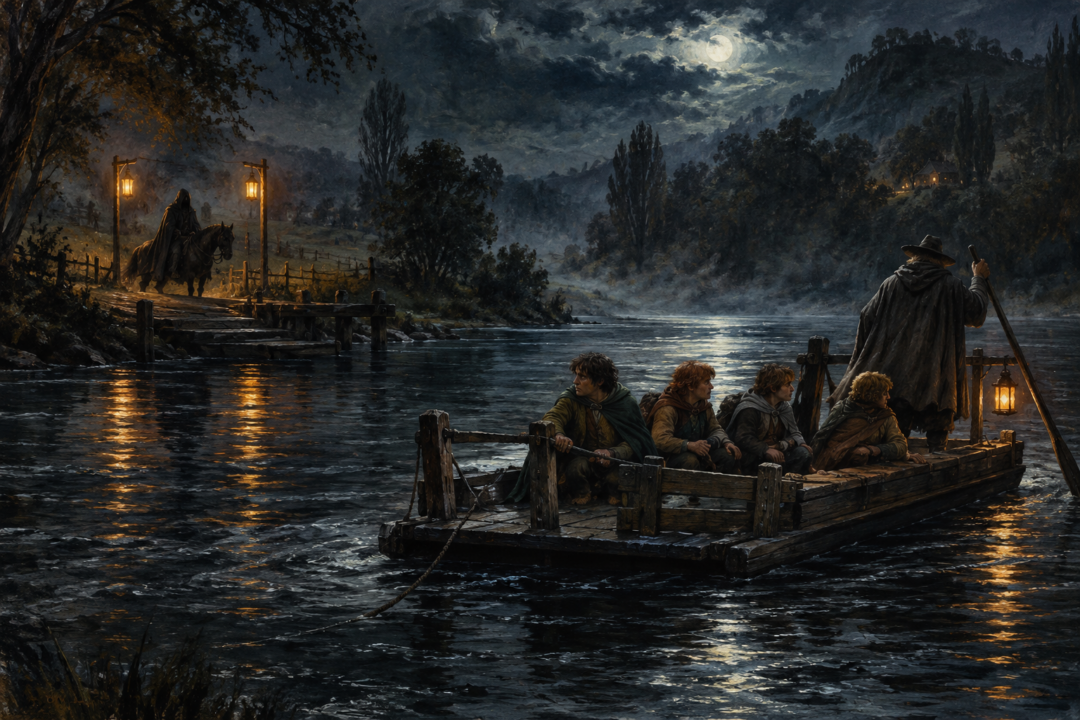
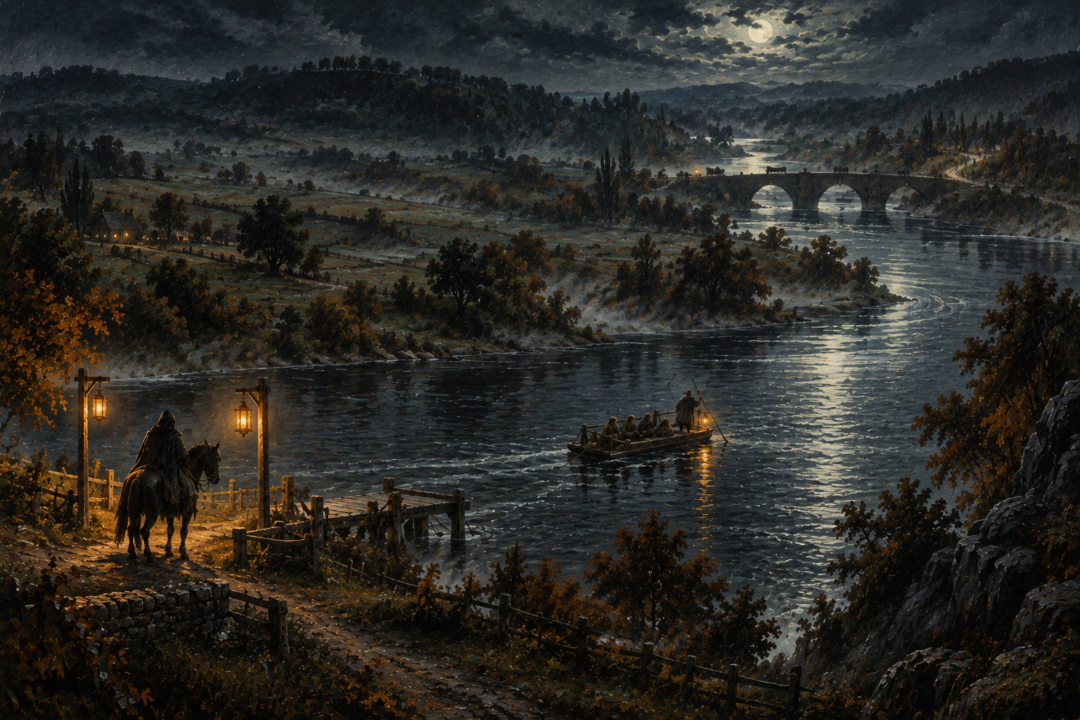
The Bucklebury Ferry looks like one of the smallest pieces of infrastructure in The Lord of the Rings: a flat ferry-boat, wooden landing-stages, lanterns beside the Brandywine, and a crossing used by ordinary hobbits going between the Marish and Buckland.
Yet on the night Frodo Baggins crosses the river, that humble ferry does something the great Brandywine Bridge cannot.
It creates a boundary that can be crossed by the hunted but not immediately by the hunter.
Nothing supernatural happens. No spell seals the river. No warrior stands guard. The Black Rider who reaches the western landing is simply confronted with an inconvenient fact: the ferry is already on the other side, and there are no other boats available on that bank.
That small practical detail buys Frodo something desperately valuable.
Time.
And the contrast between ferry and bridge reveals an overlooked principle running through the opening of The Fellowship of the Ring: the safest road is not always the strongest or grandest road. Sometimes survival depends upon a path whose weakness is precisely what makes it useful.
Two Ways Across the Brandywine
The Brandywine is one of the defining geographical boundaries of the Shire. Buckland lies east of the river, while most of the Shire lies west of it.
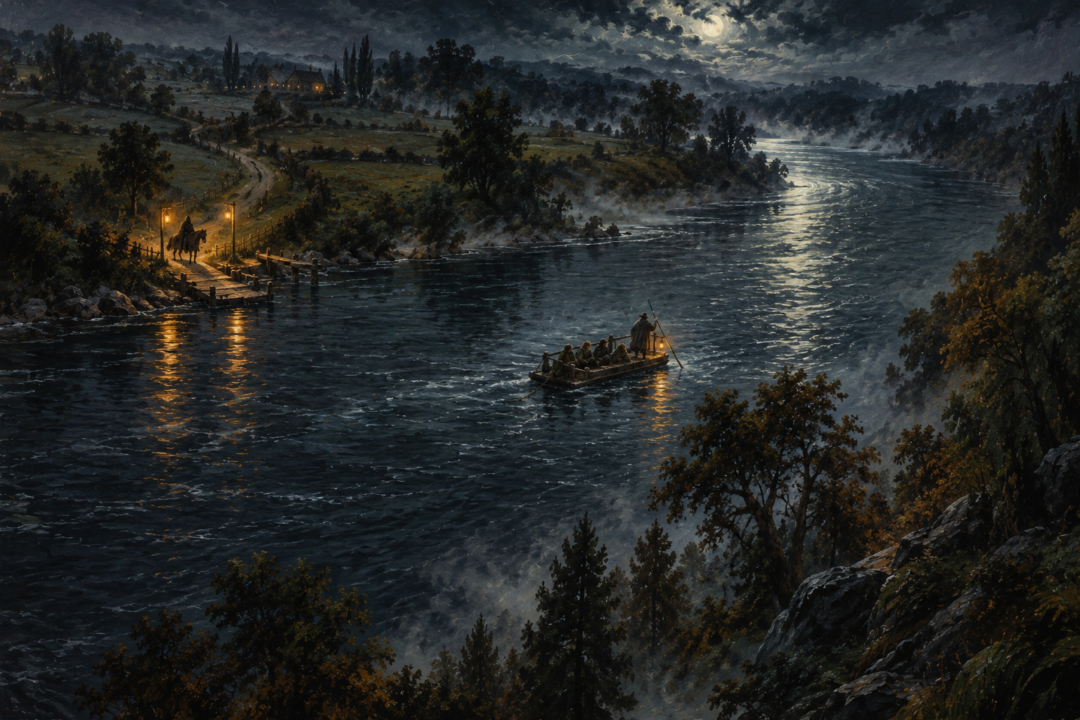
There are two especially important crossings in Frodo's immediate world: the Brandywine Bridge on the East Road and the Bucklebury Ferry farther south.
The bridge is permanent. A traveller can approach it, cross it, and continue along the road without needing a boat or ferryman.
The ferry works differently.
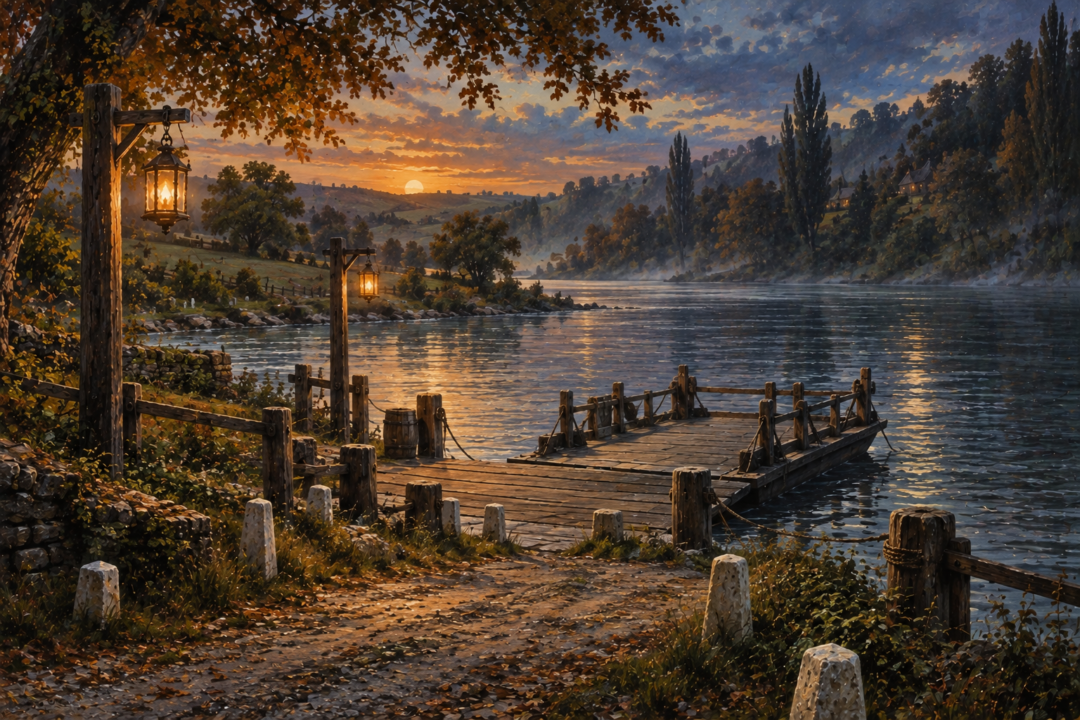
When Frodo, Sam, and Pippin reach it after travelling with Farmer Maggot, Merry is waiting for them. The ferry itself is a large flat boat. The crossing is part of a maintained hobbit landscape: there are landing-stages, posts, and lamps. It is not a secret wilderness route.
But unlike a bridge, the crossing itself can move.
That distinction becomes crucial almost immediately.
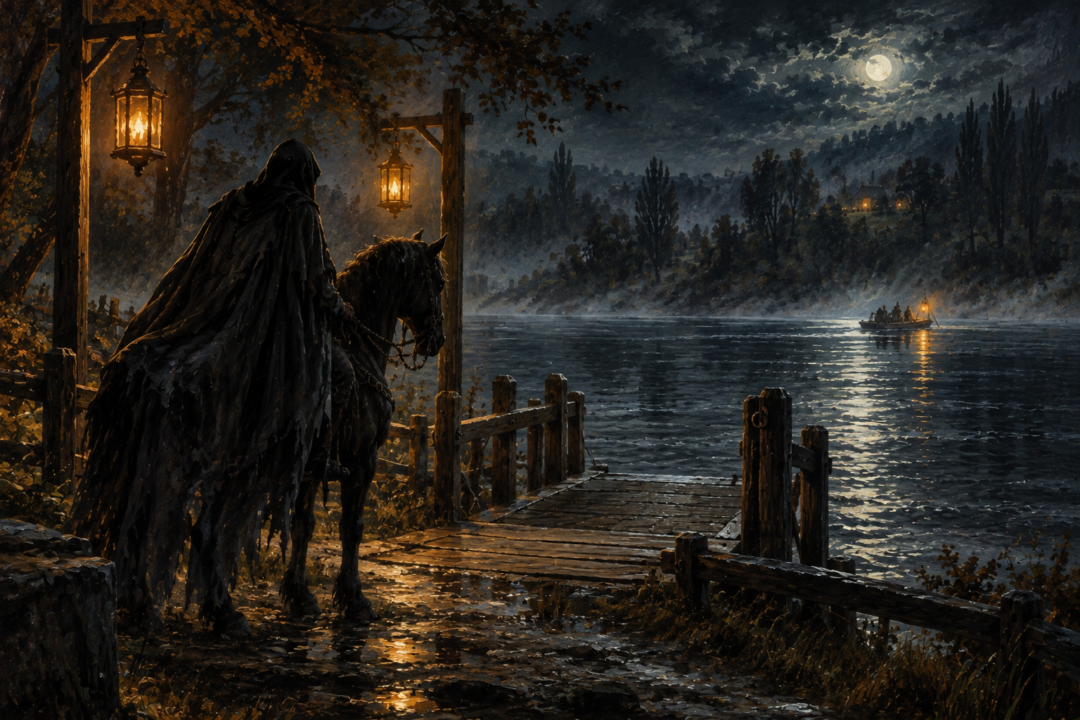
After the hobbits push away from the western bank, Frodo notices a dark figure beneath the lamps they have left behind. The Black Rider has reached the landing.
But he has reached it too late.
The ferry is now carrying Frodo eastward.
The Rider is still west of the river.
The Ferry Turns Geography Into Delay
The importance of the scene is easy to underestimate because there is no battle.
Frodo does not defeat the Rider. Merry does not destroy anything. The hobbits do not even know the full nature of their pursuers.
They simply put water between themselves and the enemy.
The text makes the practical difficulty clear. Merry explains that there are no other boats left on the western side and that horses cannot cross the river there. The Rider therefore cannot simply continue after them.
He must seek another crossing.
That means going to the Bridge.
Later editions place the Brandywine Bridge roughly ten miles north of the ferry; the originally printed text gave a greater distance, subsequently corrected. Whatever the publishing history of the number, the narrative function is unmistakable: the Rider cannot reproduce the hobbits' crossing at the place where they crossed.
A bridge would have failed in exactly this respect.
If Frodo had crossed a bridge with a mounted pursuer behind him, the same structure that carried Frodo to safety would also have carried the Rider after him.
A ferry is different.
Once the boat leaves one bank, the crossing temporarily ceases to exist for anyone stranded behind.
The weakness of the ferry—its dependence on a movable platform—is what makes it defensible without fortifications.
A Barrier Nobody Intended as a Fortress
There is no indication that Bucklebury Ferry was designed to stop servants of Sauron.
That matters.
This is ordinary hobbit infrastructure doing something unexpectedly important.
The Shire is not a military society. Its roads, lanes, hedges, bridges, inns, farms, and ferries exist largely for peaceful purposes. The ferry belongs to that same domestic landscape.
Yet when danger enters the Shire, peaceful geography begins acquiring strategic consequences.
Farmer Maggot's knowledge of the countryside helps Frodo avoid exposure. The lanes and fields allow the travellers to move away from obvious roads. The Brandywine becomes an obstacle to mounted pursuit. Buckland itself has stronger defensive customs than much of the Shire, especially because of its proximity to the Old Forest.
None of these things alone can defeat the Nazgûl.
Together, however, they create friction.
And friction is exactly what Frodo needs.
The Black Riders are terrifying partly because they seem relentless. They search roads, question inhabitants, and steadily narrow the distance between themselves and the Ring-bearer.
The ferry proves that relentless pursuit is not the same thing as instantaneous pursuit.
Middle-earth still has distances.
It still has rivers.
It still has doors, hedges, roads, gates, and inconvenient detours.
Even servants of immense evil must sometimes deal with geography.
Why the Bridge Favors the Pursuer
A bridge is usually considered superior infrastructure because it removes uncertainty.
That is precisely the problem.
A permanent bridge creates a permanent route.
Anyone capable of reaching it can use it unless someone actively controls the crossing. The Brandywine Bridge is part of the East Road, the great east-west route passing through the Shire. It connects rather than separates.
For commerce and ordinary travel, that is its virtue.
For escape, it can become a liability.
The Bucklebury Ferry introduces what might be called controlled discontinuity. When the ferry is on one side of the river, travellers on the other side cannot necessarily cross.
Frodo benefits from that discontinuity by chance and timing rather than by some elaborate plan.
The Ringwraith reaches the landing only after the hobbits have departed. The same river that barely inconveniences the hobbits, because they possess the ferry, becomes a meaningful obstacle to their pursuer because he does not.
This is one of the quietest examples in the story of unequal access shaping events.
Frodo and the Rider stand beside the same river.
But they do not possess the same route across it.
The Black Riders Are Powerful, Not Omnipotent
The scene also establishes something important about the Nazgûl.
They are frightening, but they are not without limitations.
At this stage of the story, Frodo knows very little about them. Their presence is conveyed through dread, secrecy, strange behaviour, and the instinctive fear they create.
That atmosphere could easily make them seem almost unstoppable.
The ferry scene quietly corrects that impression.
The Rider cannot simply leap the Brandywine.
He cannot command the ferry back.
He cannot make his horse cross where it cannot cross.
He must adapt his pursuit to the physical world.
This does not make him harmless. Quite the opposite: the Riders eventually penetrate Buckland and attack the house at Crickhollow after Frodo has already departed.
But the delay matters.
The enemy's power is real without being unlimited.
That distinction becomes increasingly important throughout the larger story. Sauron's servants can dominate, terrify, deceive, pursue, and destroy, but they do not possess absolute control over events.
At Bucklebury Ferry, that truth appears on an almost domestic scale.
A wooden ferry is enough to inconvenience a Ringwraith.
The Crossing Is Also a Threshold for Frodo
The river has another function beyond delaying pursuit.
Crossing the Brandywine marks a stage in Frodo's departure from his old life.
He has already left Bag End, but his journey has been deliberately disguised. The sale of Bag End and purchase of a house at Crickhollow provide a plausible explanation for his movements.
Buckland therefore occupies an unusual position.
It is still hobbit-country and closely connected to the Shire, yet it lies across the river and has its own character. Its inhabitants are regarded by many western Shire-hobbits as somewhat peculiar, not least because Bucklanders use boats and live beside the dangerous Old Forest.
Frodo's crossing is therefore not yet an escape from familiar civilization.
But it is a step toward its edge.
Behind him lies the Shire through which the Black Riders have already begun searching.
Ahead lies Crickhollow, the revelation that his friends know far more about his plans than he expected, and then the Old Forest.
The ferry sits precisely between concealment and open adventure.
Once Frodo reaches the eastern bank, pretending that this is merely a move to a new home becomes increasingly difficult.
The Irony of the Safer Crossing
There is a deeper irony here.
The great road and its bridge look like the civilized, dependable route.
The ferry looks smaller and less efficient.
Yet for Frodo, the inferior crossing is safer precisely because it is incomplete.
A bridge abolishes the river as an obstacle.
A ferry negotiates with it.
That difference changes the pursuit.
The bridge says: the road continues.
The ferry says: the road continues only when the means of crossing is available.
For ordinary travellers, the first arrangement is obviously preferable.
For someone being hunted, the second can be lifesaving.
This pattern appears repeatedly during Frodo's journey out of the Shire. The obvious road is often dangerous because roads are predictable. Knowledge of lesser paths, local terrain, and unexpected refuges repeatedly matters.
The Bucklebury Ferry belongs to that pattern without needing to become a symbol explicitly identified by the text.
Its practical function is enough.
The Small Things That Keep Frodo Moving
The escape from the Shire is not accomplished by a single heroic act.
Frodo survives through an accumulation of modest advantages.
Gildor and his Elves frighten away a pursuing Rider and give Frodo counsel. Farmer Maggot gives the hobbits food, information, and transport. Merry has preparations waiting. Frodo's friends have quietly understood his danger and organized themselves to accompany him.
And the ferry happens to be where it needs to be.
None of these things destroys the enemy.
Each merely prevents the enemy from closing his hand.
That is enough.
The Bucklebury Ferry therefore accomplishes something a bridge could not: it lets Frodo use a route without automatically granting the same route to the power pursuing him.
For one night, a few yards of moving timber transform the Brandywine from a line on a map into a genuine barrier.
The Black Rider stands beneath the distant lamps.
Frodo moves into the darkness on the opposite bank.
The enemy has not been defeated.
But he has been delayed.
And at this stage of the journey, delay is a form of victory.
Sources & Notes
- Tolkien Gateway — Bucklebury Ferry: location, landing stages, movable raft, Black Rider encounter, and the corrected ten-mile distance to the Bridge. https://tolkiengateway.net/wiki/Bucklebury_Ferry
- Tolkien Gateway — Brandywine Bridge: the permanent East Road crossing and eastern boundary of the Shire. https://tolkiengateway.net/wiki/Brandywine_Bridge
- Tolkien Gateway — Ferry Lane: the marked lane, broad landing-stage, and the Rider’s arrival after the hobbits had crossed. https://tolkiengateway.net/wiki/Ferry_Lane
Sources on the ferry’s layout and operation, its role in delaying the Black Rider, and the contrast with the permanent Brandywine Bridge crossing.