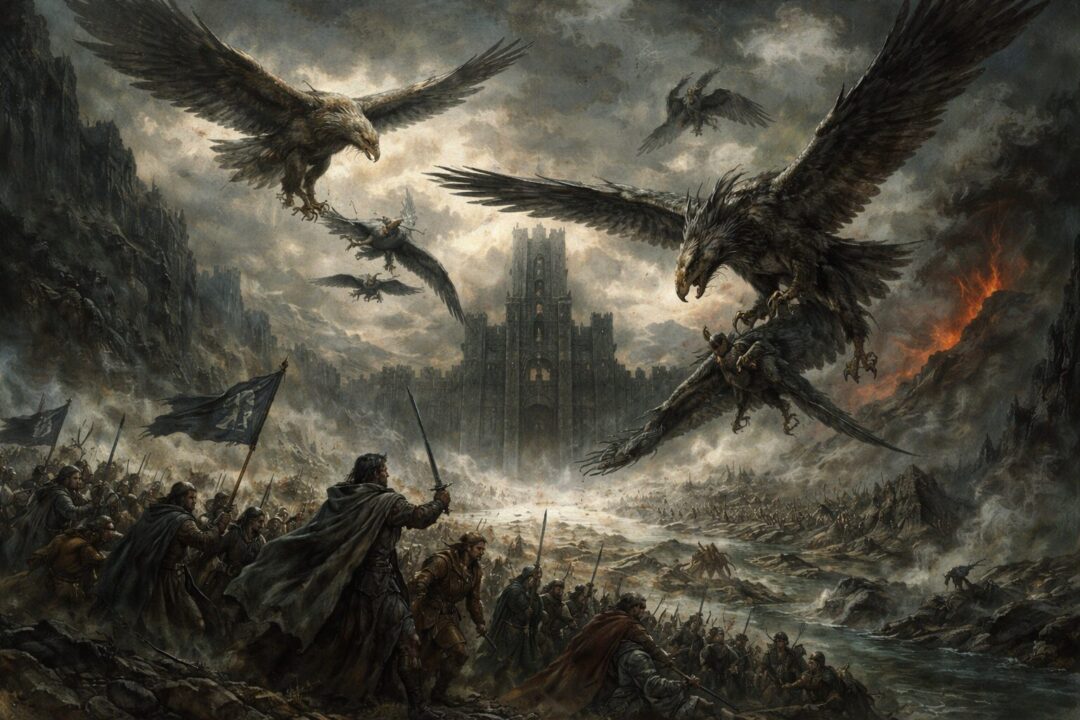
The Great Eagles are often treated as the simplest unanswered problem in Middle-earth.
If they can cross vast distances in the sky, if they are mighty enough to fight Nazgûl, and if they ultimately rescue Frodo and Sam from the slopes of Orodruin, then why were they not used from the beginning?
Why not fly the Ring straight into Mordor and end the matter quickly?
At first glance, it feels like the cleanest question in the story.
And that is exactly why it can be misleading.
Because the Eagles are not written as a standing military asset, nor as a convenient transport service waiting just beyond the horizon. They appear rarely, decisively, and under conditions that are almost never as simple as readers imagine. When the texts are read closely, the issue is not that the story forgot the Eagles.
It is that the Eagles belong to a different logic than the one this question assumes.
The Eagles Are Not Ordinary Creatures
The first thing to clear away is the idea that the Great Eagles are merely very large birds.
They are far more than that.
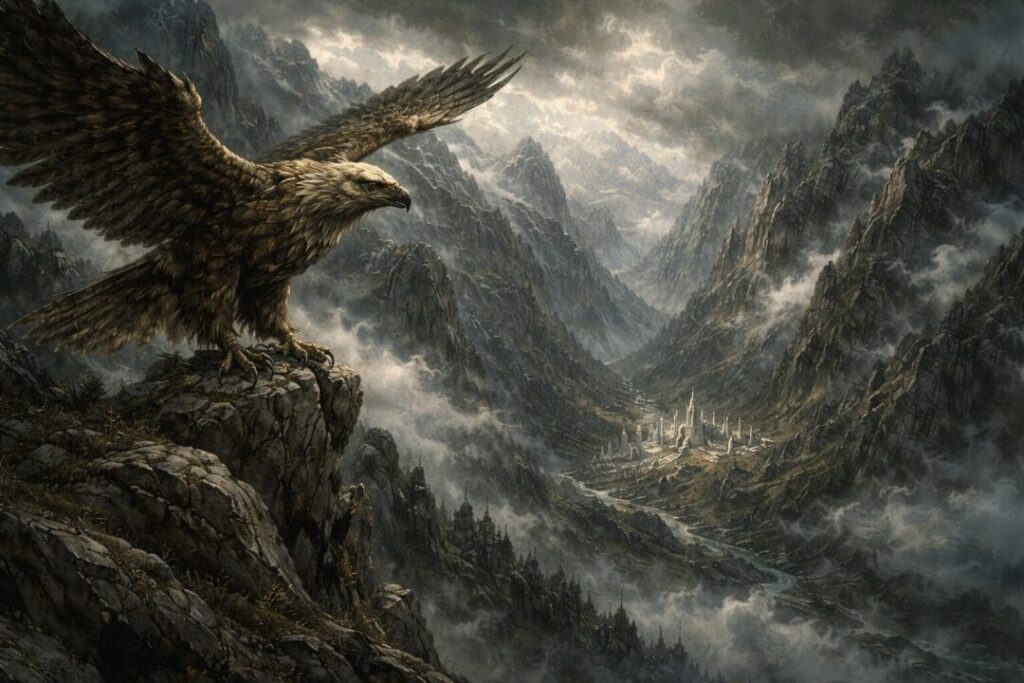
Throughout the legendarium, they are associated with Manwë, lord of the airs and winds. In the older stories, they are his messengers and watchers. Thorondor, the greatest of them in the Elder Days, watches over the north, aids the hidden realm of Gondolin, rescues the body of Fingolfin from Morgoth’s desecration, and appears in moments that feel less like random wildlife behavior and more like deliberate intervention.
That pattern continues later.
The Eagles are intelligent. They speak. They judge. They choose. They are not beasts to be harnessed in the ordinary sense.
A late text even describes the “mighty speaking eagles” as Maiar in eagle-form. That should be handled carefully, because it comes from a later note rather than the main narrative texts. But even without pressing that point too hard, the central fact remains unchanged: the Eagles are beings of unusually high order, tied to powers beyond the ordinary strategies of Elves, Men, or Hobbits.
That is why the common question already begins from the wrong assumption.
You do not simply command the Eagles.
You do not assign them a route, a timetable, and a mission as though they were mounts.
They help when they help.
And the story never suggests that anyone possesses them as an available answer on demand.
Their Role Is Help, Not Ownership of the Quest
Once that is understood, a second pattern becomes easier to see.
The Eagles intervene, but they do not take over the central burden.
This is true again and again.
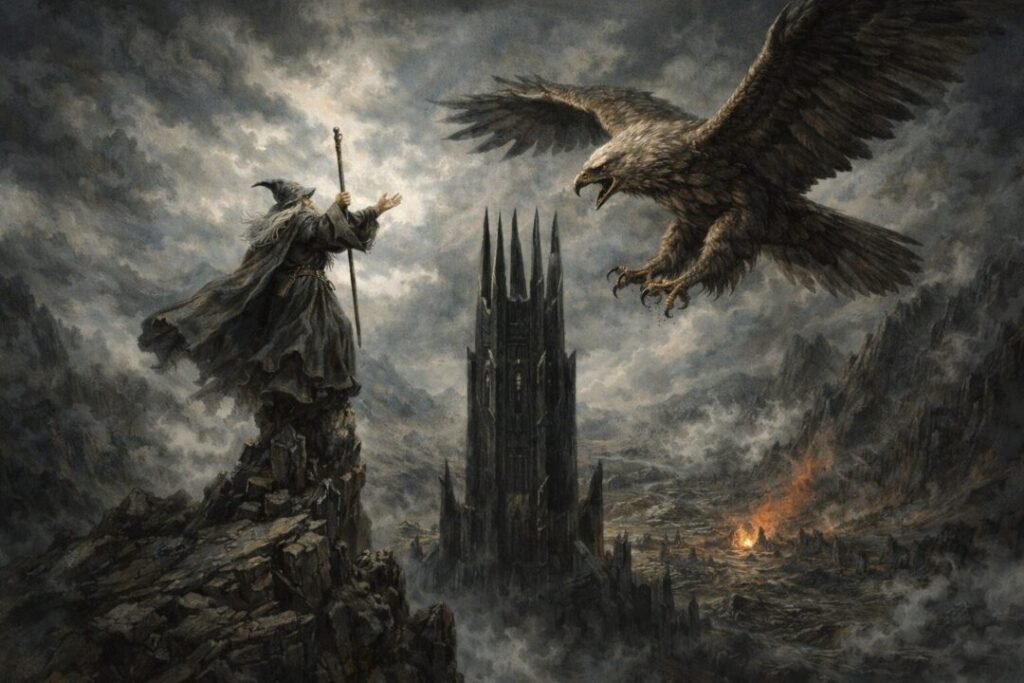
In the Elder Days, Thorondor aids, watches, rescues, and protects. In The Hobbit, the Eagles save Bilbo and the Dwarves from disaster and later arrive at the Battle of Five Armies when defeat is close. In The Lord of the Rings, Gwaihir rescues Gandalf from Orthanc. At the Morannon, the Eagles engage the Nazgûl during the last battle. And after the Ring is destroyed, they save Frodo and Sam from the fire.
These are not trivial interventions.
But notice what they are not.
They are not the long carrying of the burden from beginning to end.
The Eagles do not take possession of the Quest. They do not become its primary agents. They enter at moments of turning, often when another task has already been endured by those who were meant to bear it.
That distinction is essential.
Middle-earth is full of help. It is not full of substitutions.
The Ring must be carried by those willing to accept weakness, obscurity, and moral cost. That burden belongs to the small hands that accept it, not to the greatest wings that might seem more efficient.
The Real Obstacle Was Secrecy
The strongest practical answer is also the one most readers underestimate.
The Quest depended on secrecy.
Not strength. Not speed. Not force.
Secrecy.
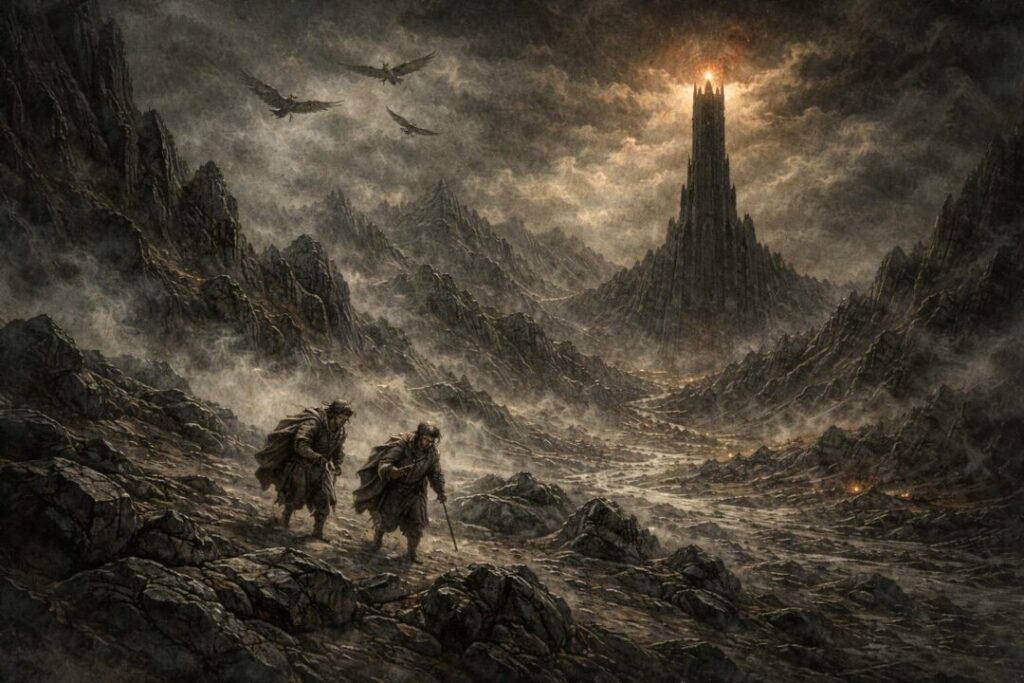
This is stated openly in the structure of the Council’s decision, and everything that follows confirms it. The West does not have the power to overthrow Sauron by direct assault. Even the march on the Black Gate at the end is not a true attempt at military victory. It is bait. Aragorn leads the Host of the West there precisely to draw Sauron’s eye away from Frodo and Sam.
That only works because Sauron still does not fully understand the plan.
He cannot imagine that anyone would seek to destroy the Ring rather than wield it.
Now place a company of Great Eagles into that situation.
A direct flight toward Mordor would not preserve secrecy. It would destroy it.
The skies are open. The Enemy watches constantly. The Nazgûl command the air in the final phase of the war. Sauron is already deeply suspicious, searching, and prepared for challengers of power. If the Ring were borne visibly above the lands toward his realm, the movement would not be hidden at all. It would announce itself.
And once the Ring neared Mordor, the danger would sharpen, not lessen.
The whole strategy rests on arriving unnoticed at the one place where the Ring can be destroyed. The Eagles, mighty as they are, are almost the opposite of a secret approach.
Power Is Exactly What the Ring Distorts
There is a deeper reason the Eagle question feels persuasive.
It sounds like a more powerful solution.
And that is precisely what the story teaches readers not to trust.
Again and again, the War of the Ring refuses the logic of obvious force. The great are tempted. The wise are cautious. The strong cannot simply overpower evil by using its own scale against it. Every apparently efficient answer conceals a moral trap.
The Ring itself feeds this illusion.
It constantly suggests that power, properly wielded, could resolve the crisis. That is what tempts Boromir. That is what Galadriel refuses. That is what Gandalf will not touch.
So when readers imagine the Eagles as a superior tactical answer, they are often still thinking inside the same pattern: find the largest power available, apply it directly, and end the problem.
But the story is built against that instinct.
The Ring is not defeated by maximizing visible strength. It is brought to its end through pity, endurance, concealment, failure, providence, and the willingness of small people to carry a burden no one stronger could safely bear in the same way.
The Eagles can assist that story.
They cannot replace its moral structure.
The Eagles Also Face Limits
There is another common exaggeration worth removing.
The Eagles are mighty, but they are not omnipotent.
Gwaihir himself says, when rescuing Gandalf from Orthanc, that he is not a burden-bearer for men in that manner and cannot carry him endlessly wherever he wishes. That moment is easy to overlook, but it matters. It reminds readers that even Eagle aid has boundaries, purpose, and cost.
The Eagles can fight, scout, and rescue.
That does not mean they can transport the Ring-bearer unchallenged into the heart of the Enemy’s realm, through a sky increasingly haunted by Nazgûl, and place him unhindered at the Cracks of Doom.
Nor does the text ever suggest they were asked to do so and refused.
That silence is telling.
The Wise do not debate the Eagles as the obvious lost option because, within the logic of the story, they are not one.
Why They Appear at the End
So why do the Eagles rescue Frodo and Sam in the end?
Because by then the central obstacle has changed.
Secrecy is no longer the issue. The Ring is destroyed. Sauron has fallen. The Quest is complete.
At that point, rescue becomes possible in a way earlier transport was not.
This is why the final appearance of the Eagles does not expose a contradiction. It actually confirms the rule. They arrive when the hidden work is done and when open intervention no longer ruins the plan.
The same is true of their coming at the Morannon.
There, too, they do not solve the story by ending the Quest themselves. They enter as part of the last great crisis while the true burden is still elsewhere, unseen, inside Mordor.
The Eagles can aid the final turn.
They cannot become the method by which the Ring is secretly brought to destruction.
What the Eagles Really Represent
In the end, the Great Eagles matter most not as military assets, but as signs.
They are signs of watchfulness beyond the narrow sight of ordinary peoples. Signs that the world is not closed. Signs that help may come suddenly, but not predictably, and not in a form anyone can control.
That is why they often feel almost vertical in the story.
They do not move like ordinary political powers inside Middle-earth’s struggles. They descend into them.
Not to remove the need for courage.
Not to spare the burden-bearers from suffering.
But to mark certain moments of rescue, witness, mercy, and sudden reversal.
This is also why they can feel almost dangerous to the shape of the tale if overused. If the Eagles became ordinary logistics, their symbolic weight would collapse. They would stop feeling like rare interventions and start feeling like neglected transportation.
The story protects against that.
And so the Eagles remain what they were always meant to be: real, powerful, active, but not available in the casual way modern readers often imagine.
Why They Never Solve the Story
The Great Eagles never solve the story because the story was never about finding the fastest possible route.
It was about who could bear the burden without claiming mastery.
It was about the weakness Sauron could not understand.
It was about secrecy, pity, endurance, and the strange truth that the road most likely to succeed would look, from the outside, almost absurd.
In that kind of story, the Eagles still matter greatly.
But only in their proper place.
They are not the missed answer.
They are the reminder that help exists without becoming control, that power can serve without possessing, and that the deepest victories in Middle-earth are almost never won in the most obvious way.
Once that becomes clear, the old question changes.
It is no longer, “Why did they not use the Eagles?”
It becomes something more interesting.
Why do readers keep expecting Middle-earth’s greatest burdens to be solved by the most visible power in the sky, when the story keeps insisting the real answer was carried on foot?