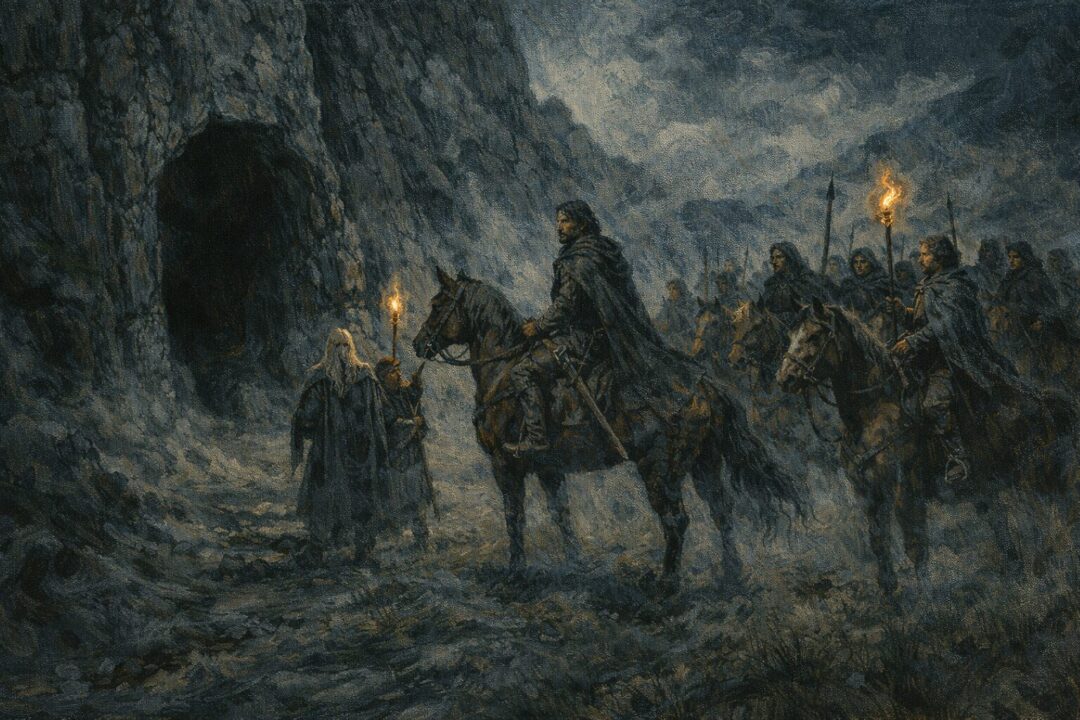
The Grey Company is one of those details in The Lord of the Rings that can look smaller than it really is.
They do not arrive with trumpets and a great northern host.
They do not come with the restored crown already on Aragorn’s head.
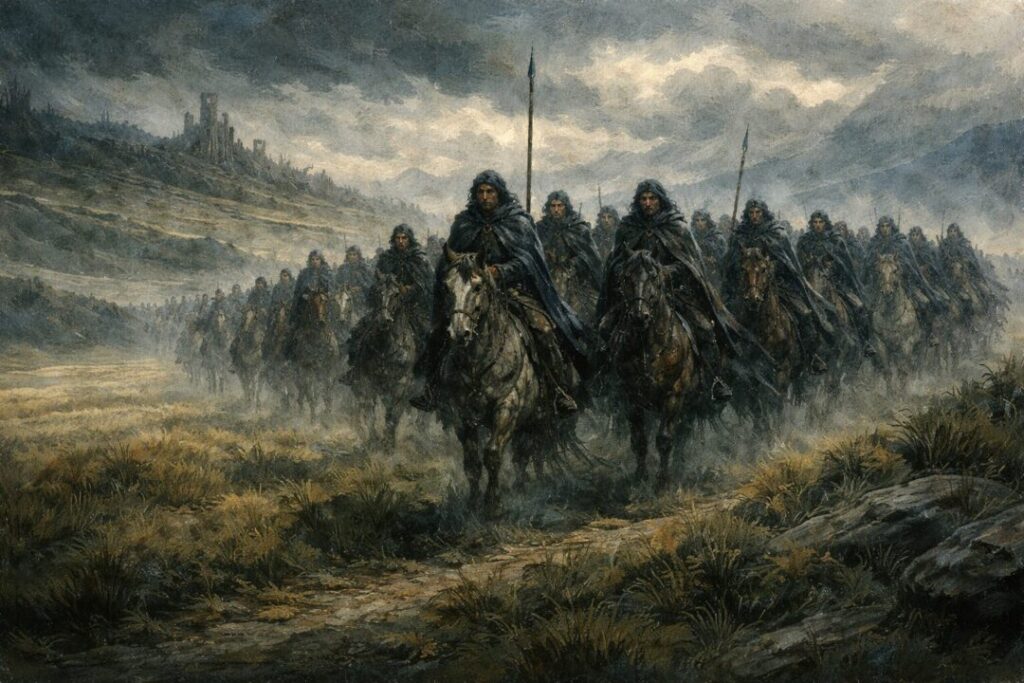
They appear suddenly, almost quietly, on the road in Rohan: grim riders in grey, weathered, silent, unmistakably important.
And because the story is moving fast at that point, many readers remember only their immediate plot function. They bring Aragorn counsel. They bring him a standard. They ride with him on the dark road. They help carry him toward the great turning of the war.
But if you stop over the detail Tolkien gives them, the Grey Company becomes more than an escort.
They become a revelation.
Not because the text says outright, “this is the last echo of Arnor’s war.” It does not. That part is interpretation. But the material Tolkien does give is enough to support that reading with care: the Grey Company is a tiny but potent manifestation of the northern Dúnedain, the surviving remnant of the lost kingdom of Arnor, stepping out of long obscurity at the very moment Aragorn moves toward kingship.
They are small on purpose
The first striking fact is numerical.
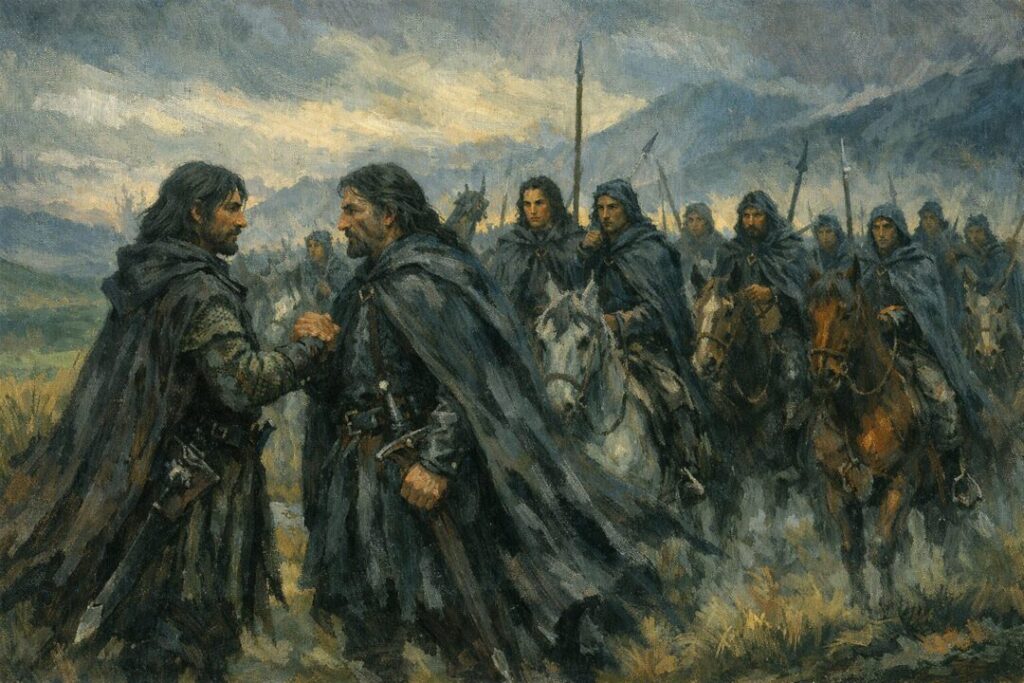
When Aragorn meets Halbarad, Halbarad says: “I have thirty with me. That is all of our kindred that could be gathered in haste.” Théoden immediately answers that thirty such men will be a strength “that cannot be counted by heads.” The text lingers on their quality, not their quantity. That matters. Tolkien wants the reader to feel both things at once: they are few, and they are formidable.
That number is not the mustering of a healthy northern kingdom.
It is the opposite.
If Arnor still existed in anything like its old form, Aragorn would not be greeted by thirty hidden kinsmen gathered in haste. He would be joined by captains, levies, banners, and open allegiance. Instead he receives a weathered remnant: elite men, yes, but drawn from a people reduced to secrecy and survival. The force is small because the people behind it are small. That is not invention; it is exactly the condition Appendix A gives to the northern Dúnedain after the fall of their kingdom.
The shadow of Arnor still lives in them
Appendix A is the key to understanding what these riders really are.
After the fall of the North-kingdom, the line of the kings continues through the Chieftains of the Dúnedain, beginning with Aranarth son of Arvedui. From that point on, Tolkien says, the Dúnedain “passed into the shadows” and became a “secret and wandering people,” and their deeds and labours were seldom sung or recorded. He also says plainly that their people had dwindled.
That phrase—passed into the shadows—does enormous work.
It means the history of Arnor does not simply end. It contracts. The kingdom disappears as a political reality, but its line, memory, and burden survive in diminished form. The heirs of Isildur do not vanish. They endure without throne, city, or public power. The Rangers are what the northern Dúnedain become when kingdom has failed but duty has not.
So when the Grey Company rides south, they are not just “Rangers” in the loose, wandering sense many readers imagine.
They are the visible edge of a much longer history.
They carry in themselves the collapse of Arnor, the survival of Isildur’s line, the hidden labor of generations, and the old northern war against evil in Eriador that never fully ended. Even after the kingdom was gone, the Dúnedain still fought Orcs, guarded the land, and remained linked to Rivendell through the fostering of their heirs. Their obscurity was not retirement. It was endurance.
Why Galadriel’s message matters
This reading becomes even stronger when you remember that the Grey Company is foretold before it appears.
In Galadriel’s message to Aragorn, delivered through Gandalf, she says: “Near is the hour when the Lost should come forth, / And the Grey Company ride from the North.” That line is one of the clearest signals that their arrival is meant to be seen as more than a practical reinforcement. The “Lost” in context is commonly understood as the hidden northern Dúnedain coming forth at the decisive hour. That is a reasonable reading, though the line’s full resonance remains interpretive.
What matters most is the movement of the image.
They have been hidden.
Now they come forth.
That is exactly the arc of Arnor’s remnant in the larger history: a people long reduced, scattered, and half-forgotten, stepping briefly back into the centre of events. Their ride from the North is not merely geographic. It is historical. The lost kingdom does not return yet as a restored state—but it returns as presence, allegiance, and claim.
They come with more than swords
The Grey Company also brings signs of kingship.
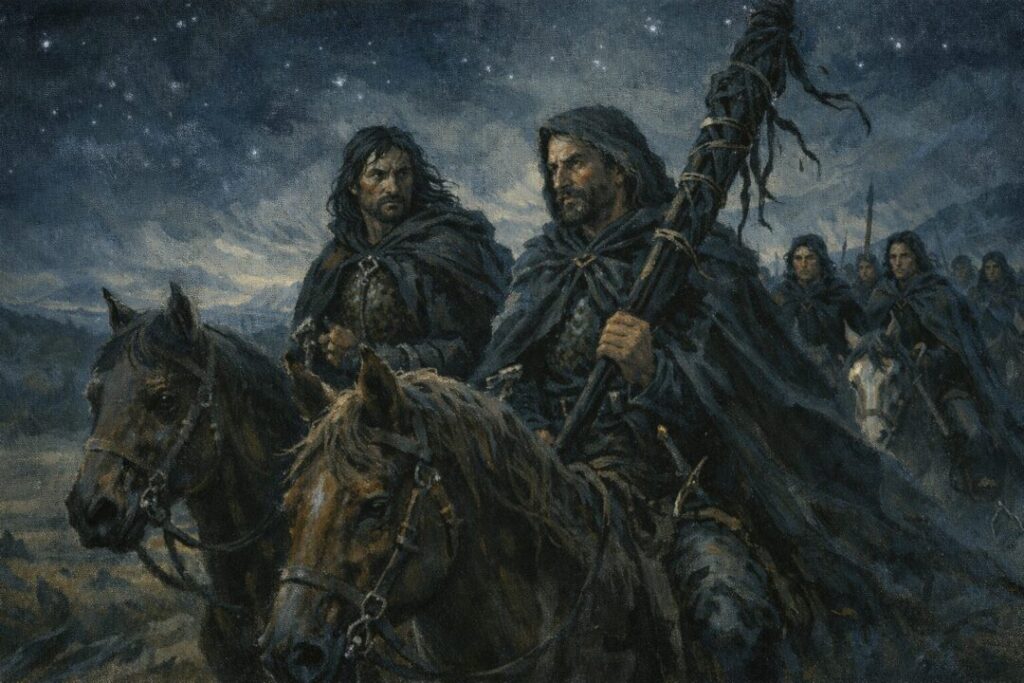
Elrohir delivers Elrond’s message to remember the Paths of the Dead. Halbarad bears the standard that Arwen has made in secret for Aragorn. This is one of the most important symbolic moments in Aragorn’s story. Before the crown is won, before the city receives him, before the banner is revealed on the black ships, the signs of the restored line of Elendil are already gathering around him.
That is why the Grey Company should not be reduced to bodyguards.
They are a bridge between hidden lineage and public kingship.
They come from the old northern world where Aragorn’s line survived in obscurity. They bring with them both counsel and emblem. In other words, they do not merely help Aragorn reach Gondor. They help carry the last concealed inheritance of Arnor into the open, toward recognition.
The Paths of the Dead are not the whole point
Because their most famous chapter is “The Passing of the Grey Company,” readers often remember them mainly in connection with the Dead Men of Dunharrow.
That road matters, of course. It is one of the darkest and most memorable movements in the book. Legolas sees the Dead following behind; Aragorn summons them; the terror of that passage spreads before the Company as they ride south. But if we focus only on the supernatural element, we miss what is happening beside it: the hidden northern Dúnedain are present at the hinge-point where Aragorn moves from chieftain to claimant in action, not only by blood.
The Grey Company is therefore doubly liminal.
They ride out of the long twilight of Arnor’s ruin.
And they ride with Aragorn into the threshold of restored kingship.
That is why their role feels larger than their page-count. Tolkien uses them at exactly the moment when private inheritance becomes public destiny.
Halbarad makes the cost personal
Halbarad is crucial to this meaning.
He is not a random captain added for color. He is Aragorn’s kinsman, leader of the Grey Company, and the one who physically bears the hidden standard for a time. In later accounts of the story, Halbarad falls in the Battle of the Pelennor Fields. Even without pressing beyond what the text explicitly emphasizes in the main narrative, his role is clear: he stands as one of the last visible representatives of the northern Dúnedain in the war that will end with Aragorn’s coronation.
That gives the Grey Company a tragic edge.
They do not simply arrive so that Aragorn can become king and everyone from the old life can stand beside him in triumph. Their presence reminds us that restoration in Middle-earth is never clean. The remnant that endured the long defeat must spend itself in the war that finally restores what was lost.
So what does the Grey Company actually represent?
As far as the text allows us to say confidently, the Grey Company represents the surviving northern Dúnedain in concentrated form: the remnant of Arnor, the line of hidden labor after the kingdom’s fall, and the old loyalty of Isildur’s people answering Aragorn at the decisive hour. The claim that they are “the last echo of Arnor’s war” is an interpretation—but it is a careful one, grounded in the fact that Arnor is gone, its people are diminished, and yet these thirty riders emerge from that long shadow to stand with their chieftain when the line of Elendil is about to return openly to history.
That is why they feel so powerful.
They are not a kingdom.
They are what remains when a kingdom has been broken, forgotten by most, reduced to wandering, and still refuses to die.
The Grey Company is Arnor after ruin: no longer a realm, still a people.
And for one brief ride south, the shadow of the North becomes visible again.