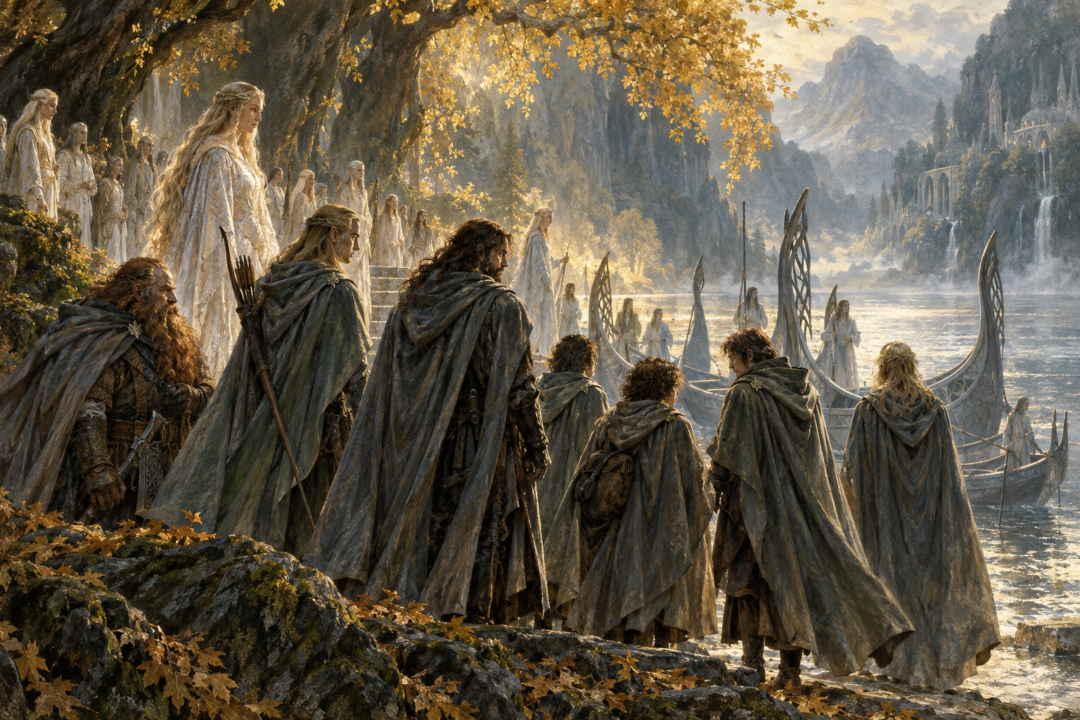
Among all the gifts carried out of Lothlórien, the cloaks are easy to underestimate.
They are not as dramatic as Galadriel’s phial, not as precious as the three strands of hair given to Gimli, and not as obviously essential as the lembas that keeps the travellers moving when ordinary provisions would fail. They look, at first, like beautiful travelling clothes: hooded cloaks of strange, shifting colour, fastened with leaf-shaped brooches.
Yet once the Fellowship leaves Lórien, those cloaks repeatedly become exactly what frightened travellers need.
They hide without making anyone invisible. They protect without functioning as armour. They help their wearers survive heat, cold, open country, hostile eyes, and eventually even Mordor itself.
More importantly, their nature reveals something fundamental about Elvish craft. When Pippin wonders whether the cloaks are “magic,” the question does not quite fit the way the Elves understand what they have made.
The Cloaks Are Not Invisibility Cloaks
When the surviving members of the Fellowship prepare to leave Lórien, the Galadhrim provide each traveller with a cloak and hood made to fit.
Their appearance is deliberately difficult to define.
In twilight they seem grey. Under different light or in motion they can appear green like shadowed leaves, brown like fields at night, or silvery like water beneath stars. Each is fastened with a brooch shaped like a green leaf and veined with silver.
That description immediately suggests camouflage, but Pippin asks the obvious question: are these “magic cloaks”?
The answer is revealing.
The Elves do not claim that the garments make their wearers literally invisible. Nor do they claim the cloaks can stop weapons. Instead, they explain that the cloaks are light, useful against changes of temperature, and particularly effective at keeping their wearers from unfriendly eyes.
That distinction matters.
The cloaks do not erase a person from sight. They make the wearer extraordinarily difficult to distinguish from the surrounding landscape.
It is concealment rather than disappearance.
And the books repeatedly show the difference.
Their First Great Advantage Is That They Adapt
Ordinary camouflage works only when its colour matches its surroundings. A green cloak might be useful in a forest and conspicuous on bare stone.
The Lórien cloaks are different.
Their colour cannot easily be fixed because their appearance changes with light and surroundings. That makes them useful across the varied landscapes through which the Fellowship must travel: riverbanks, fields, hills, stones, woodland and darkness.
They also solve another practical problem.
The Galadhrim describe them as light to wear but sufficiently warm or cool according to need. The precise mechanism is never explained, and there is no reason to turn that description into a detailed supernatural rule that the text does not provide. What matters is that they are exceptionally effective travelling garments.
That is important because the Fellowship is not marching with a great baggage train.
After Lórien, its members increasingly survive with whatever they can carry. Weight, warmth and concealment are not minor conveniences. They can determine whether someone can keep moving.
The cloaks combine all three.
The Fellowship Quickly Learns How Hard They Are to See
The camouflage is not merely something the Elves promise.
The narrative demonstrates it.
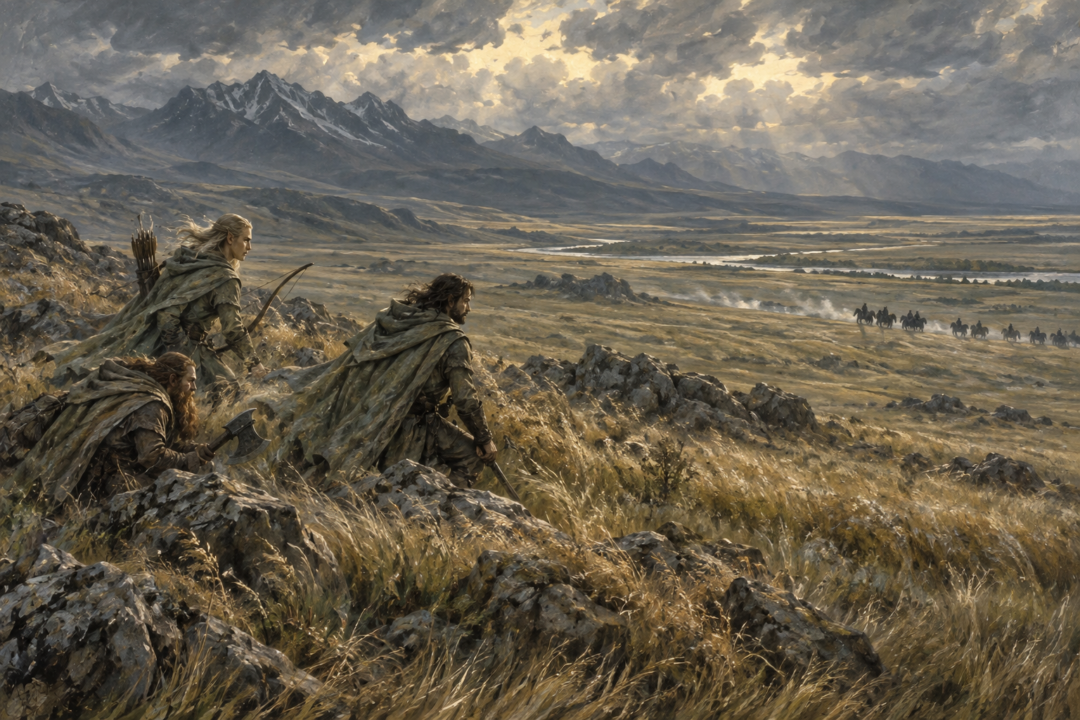
During Aragorn, Legolas and Gimli’s pursuit of the Orcs across Rohan, their cloaks fade against the grey-green country so effectively that the text indicates that few eyes other than Elvish ones would have noticed them until they were near.
That is an extraordinary advantage in open terrain.
The three hunters are crossing country where they do not yet know who may be friend or enemy. Remaining unnoticed allows them to observe before being observed.
The same quality appears elsewhere in more dramatic circumstances.
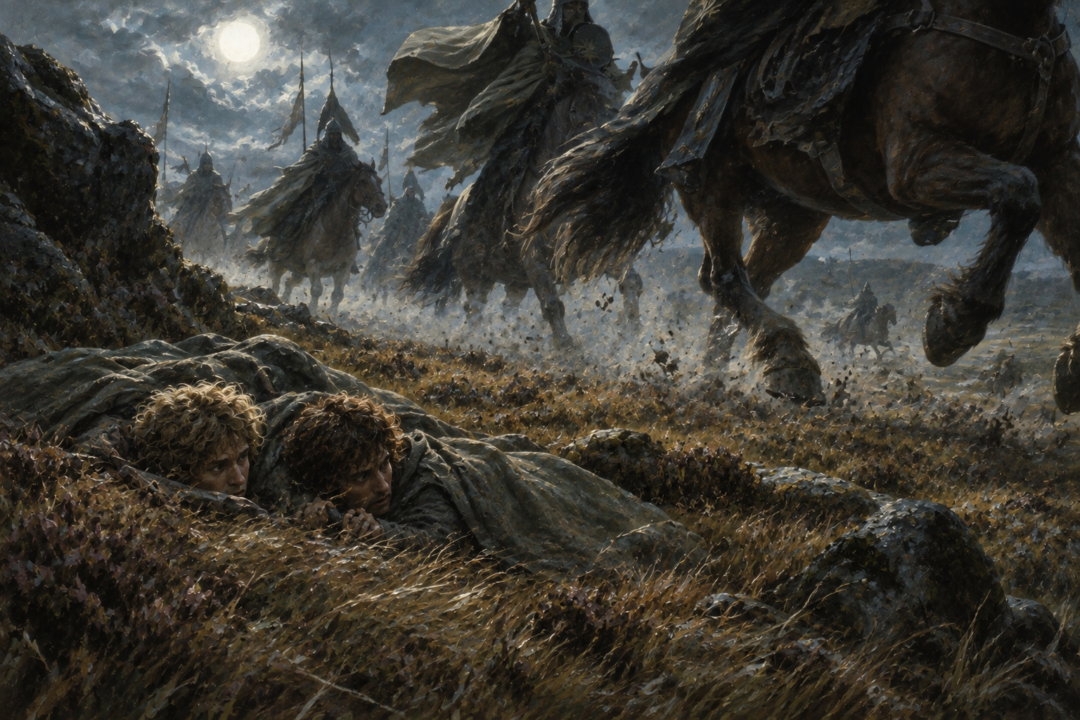
After Grishnákh is killed and Merry and Pippin lie on the ground during the chaos surrounding the Orc-band, the hobbits remain unseen as mounted Riders pass dangerously close. Their grey cloaks help them disappear against the ground.
Later, at ruined Isengard, Merry and Pippin can again be difficult to notice among the stones while wearing their grey Elvish garments.
The pattern is consistent: the cloaks do not produce a theatrical vanishing act. They make their wearers belong visually to whatever landscape surrounds them.
They Even Complicate an Enemy Archer’s Aim
One of the clearest demonstrations comes while the Fellowship is still travelling together down the Anduin.
Near Sarn Gebir, they come under attack in darkness.
The cloaks help frustrate the hostile archers attempting to shoot them. This is exactly the sort of protection the Galadhrim had described: not armour capable of turning an arrow, but concealment that makes the target harder to identify and strike.
That difference captures the character of the gift.
A coat of mail protects after an enemy successfully attacks you.
The Lórien cloak helps prevent the enemy from making that successful attack in the first place.
It is defensive power expressed through subtlety rather than force.
For a quest whose greatest hope depends upon secrecy, that is remarkably appropriate.
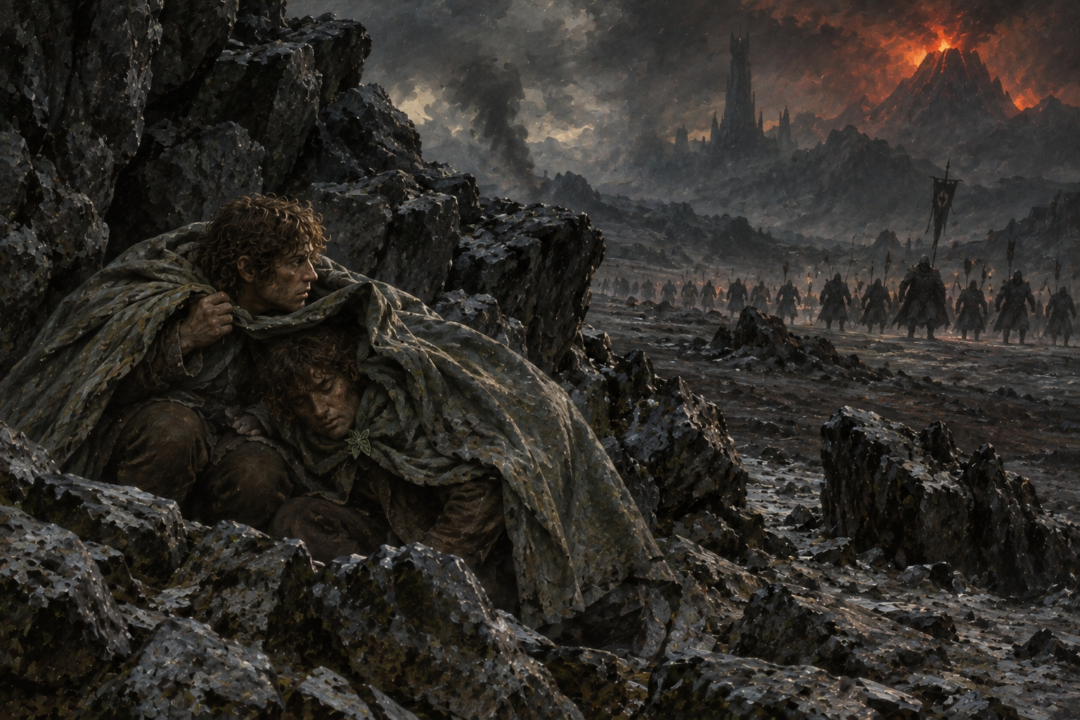
Frodo and Sam Carry Lórien Almost to Mount Doom
The most poignant use of the cloaks comes much later.
By the time Frodo and Sam are deep inside Mordor, nearly everything associated with safety has been stripped away. Their journey has become a struggle against exhaustion, thirst, exposure and discovery.
Yet Lórien is still physically present with them.
At one point Sam covers Frodo and himself with the grey cloak of Lórien while hostile forces move nearby. Sam hopes that the cloth made by Elvish hands may still possess enough virtue to conceal them in that terrible country.
The text does not pause to declare that the cloak miraculously saves them at that exact moment, so it would be too strong to claim that it certainly does. But Sam’s instinct is significant.
He trusts the cloak because he has already seen what it can do.
There is also a striking contrast in the image.
A garment created in one of Middle-earth’s fairest remaining Elvish realms is carried into the wasteland of Sauron. Lórien cannot follow Frodo and Sam with armies. Galadriel cannot fight their final battles for them.
But something made there can still cover them.
The Brooches Become Useful in a Completely Different Way
The cloaks themselves are only part of the gift. Each is fastened by a green leaf-shaped brooch veined with silver.
One of those brooches becomes crucial during the pursuit across Rohan.
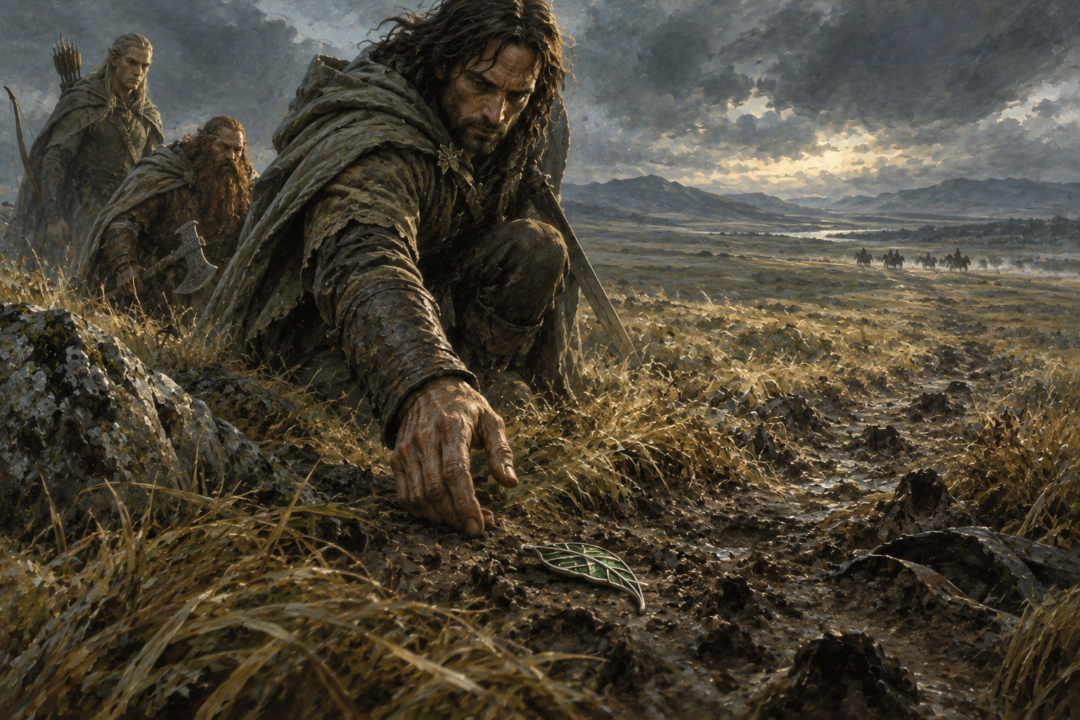
While being driven onward by the Orcs, Pippin manages to leave his brooch behind as a sign. It is a desperate act: a tiny object deliberately dropped into an enormous landscape in the hope that someone following might notice it.
Aragorn does.
The brooch confirms that the hunters are following the correct trail and that at least one of the captured hobbits had enough freedom and presence of mind to leave a clue.
The cloak was designed to prevent its wearer from being noticed.
Its brooch, separated from the cloak, does almost the opposite.
It becomes a message.
Later, Frodo’s Elven brooch also helps support his account when speaking with Faramir, who recognizes the connection between Frodo’s possessions and the strange Elvish workmanship associated with Boromir’s last journey.
These small objects become evidence of where the Fellowship has been and of bonds formed along the way.
The Cloaks Cannot Protect Their Owners From Everything
Their limits are just as important as their abilities.
The cloaks do not prevent capture. Merry and Pippin wear them and are still seized by Orcs. Frodo wears his and is eventually taken after the encounter with Shelob and the Orcs of Cirith Ungol.
They cannot block swords or arrows.
They cannot fool every sense.
When Frodo and Sam consider whether their cloaks might conceal them from Gollum, they recognize the problem: even if he cannot easily see them, he may hear or smell them.
This prevents the cloaks from becoming an all-purpose solution to danger.
They improve the travellers’ chances. They do not remove danger from the story.
That limitation is probably why their effectiveness can be easy to miss. Their greatest successes often look like nothing happening: an enemy does not see someone, an arrow does not find its intended target, a traveller blends into the landscape.
Their power is measured in disasters that fail to occur.
The Cloaks Show What Elvish “Magic” Often Looks Like
Pippin’s question about magic points toward a larger theme.
For outsiders, Elvish craftsmanship can be difficult to separate into ordinary skill and supernatural power. The Elves themselves do not always draw the boundary in the same way.
The cloaks are woven objects. They are the result of craft.
But they perform beyond what ordinary clothing can reasonably accomplish: shifting subtly with their surroundings, providing unusual comfort, and concealing their wearers remarkably well.
The text does not give a technical explanation, and it does not need one.
The important point is that their exceptional qualities are bound up with their making.
That places the cloaks alongside several other Elvish works encountered during the journey: objects that are beautiful, practical and extraordinary at the same time.
Their power is not primarily destructive.
It preserves.
A Gift Perfectly Suited to the Quest
Galadriel gives spectacular individual gifts to members of the Company, but the cloaks are communal. Every surviving member leaving Lórien receives one.
That makes them a kind of final shared uniform for a Fellowship that is about to break apart.
Soon Boromir will be dead. Merry and Pippin will be captives. Aragorn, Legolas and Gimli will race across Rohan. Frodo and Sam will turn toward Mordor.
The Company will no longer travel as one.
Yet the grey cloaks keep appearing on different roads.
On the plains of Rohan, among the stones of Isengard, and eventually in Mordor, they remain visible reminders of the brief period when the Fellowship rested beneath the trees of Lórien.
That may be their deepest significance.
The Fellowship cannot remain in places of refuge. Rivendell and Lórien must both be left behind. The quest requires its members to carry what help they have received into landscapes where that help seems impossibly distant.
The cloaks embody that idea perfectly.
They do not make the road safe.
They simply give the travellers a better chance of surviving it.
Sources & Notes
- Tolkien Gateway, “Elven cloaks” — https://tolkiengateway.net/wiki/Elven_cloaks
- Tolkien Gateway, “Farewell to Lórien” — https://tolkiengateway.net/wiki/Farewell_to_L%C3%B3rien
- Tolkien Gateway, “Elven brooches” — https://tolkiengateway.net/wiki/Elven_brooches
These secondary reference entries identify the relevant Tolkien texts and document the characters, events, and objects discussed. Explanations of motives and practical consequences remain interpretation unless explicitly stated in the cited texts.