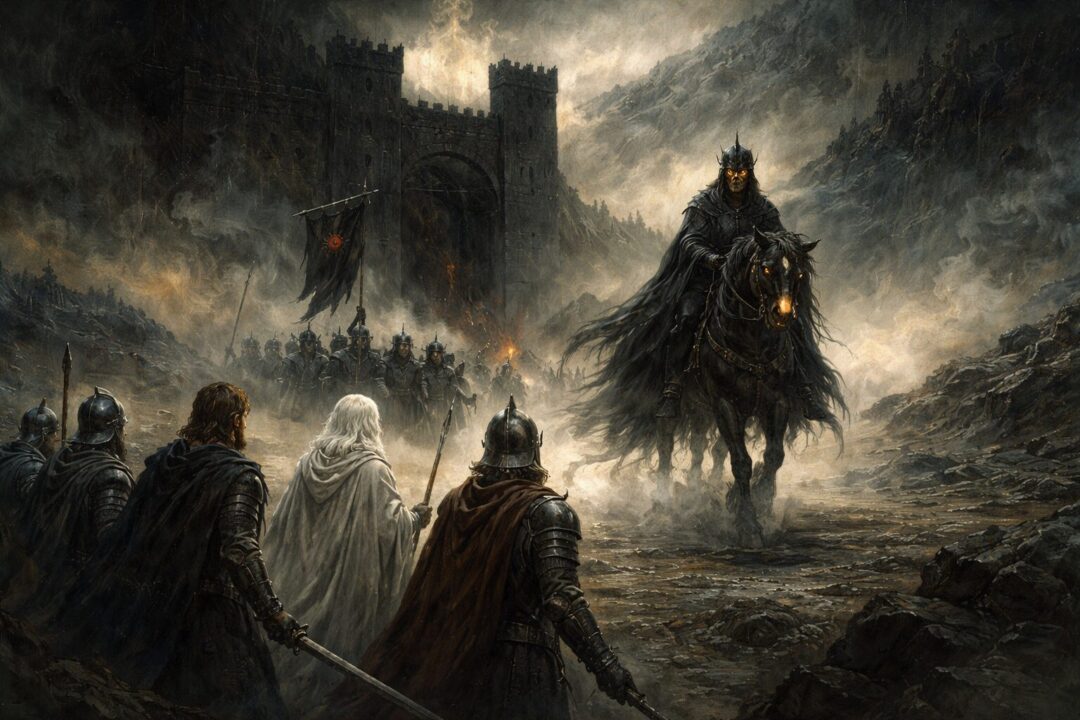
The Mouth of Sauron appears for only a brief stretch of the narrative, and yet the scene at the Black Gate carries a weight that is easy to miss if you treat it as mere “negotiation before the final battle.”
Because it is not negotiation.
It is theatre—weaponized.
And in The Return of the King, that matters, because by the time the Captains of the West stand before the Morannon, they are not truly trying to win a conventional military victory. They are trying to hold the Enemy’s attention long enough for something else—something unseen—to reach its end.
That is why the story pauses here, on a parley that feels almost ceremonial. It is the last moment before the trap snaps shut.
And Tolkien’s text makes sure you understand exactly what kind of power Mordor wants to exercise in that pause.
An “embassy” is not an olive branch
The Gate does not open to offer peace. It opens to display control.
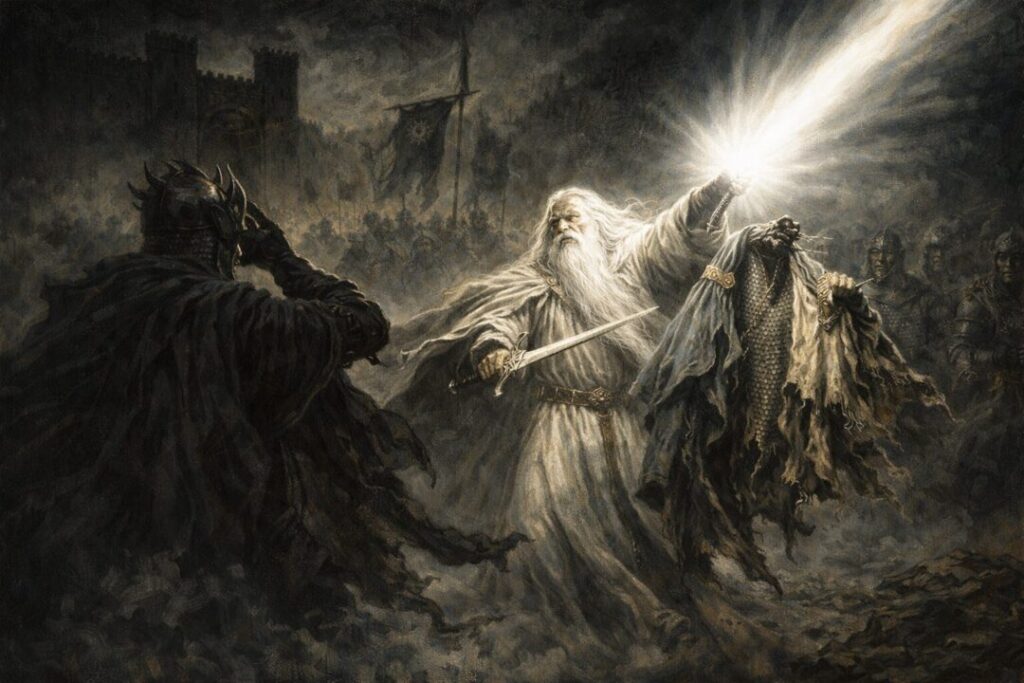
There is a long silence after the challenge is shouted up at the battlements. The leaders of the West are about to turn away when the quiet breaks: drums roll “like thunder in the mountains,” horns bray, and the doors swing wide.
Out comes not a host, but an embassy from the Dark Tower.
At its head rides a figure described like a nightmare of pageantry: tall, robed in black, wearing a lofty helm, mounted on something huge and hideous, with a face like a skull-mask and flame burning in the hollows.
And then comes the key clarification: this is no Ringwraith. It is a living Man.
That matters because it tells you what the Dark Tower has done to a human being.
He introduces himself as the Lieutenant of Barad-dûr, a renegade of the Black Númenóreans, so submerged in service that even his original name has been forgotten—by history, and by himself. He does not speak as a person. He speaks as an instrument.
When he says, “I am the Mouth of Sauron,” the title is not simply sinister. It is thematic.
This is what Sauron prefers: not presence, but projection. Not dialogue, but domination through a voice that carries his will.
The first target is not the army—it is the King
The Mouth’s opening move is immediate contempt.
He looks the Captains up and down and laughs. Then he asks whether anyone there has authority to treat with him, or even the wit to understand him.
And he turns his scorn toward Aragorn.
This is not accidental. The West has begun proclaiming the return of the King as they march, and Mordor answers by attempting to reduce that kingship to costume and accident: “It needs more to make a king than a piece of Elvish glass.”
The insult is designed for one purpose: to make Aragorn respond rashly.
If Aragorn can be provoked into violence against a herald, the moral shape of the confrontation changes. The West becomes something uglier—something closer to Mordor’s own methods. And the Mouth, safe behind “law,” can cry outrage while secretly achieving exactly what he came to achieve.
But Tolkien refuses him that victory.
Aragorn does not answer. He does not reach for a weapon. He simply looks—and holds that look—until the Mouth himself quails, stepping back as though struck.
The result is almost paradoxical: the Mouth has come to dominate, but the first crack appears in him instead.
And when he panics and cries that he is a herald and may not be assailed, Gandalf answers with the real moral spine of the scene:
Where such laws hold, ambassadors should use less insolence. No one has threatened him. He has nothing to fear—until his errand is done.
That line matters because it shows what the West is defending even here, at the edge of annihilation.
Not just borders.
Not just lives.
A standard.
The “tokens” are psychological warfare, not evidence
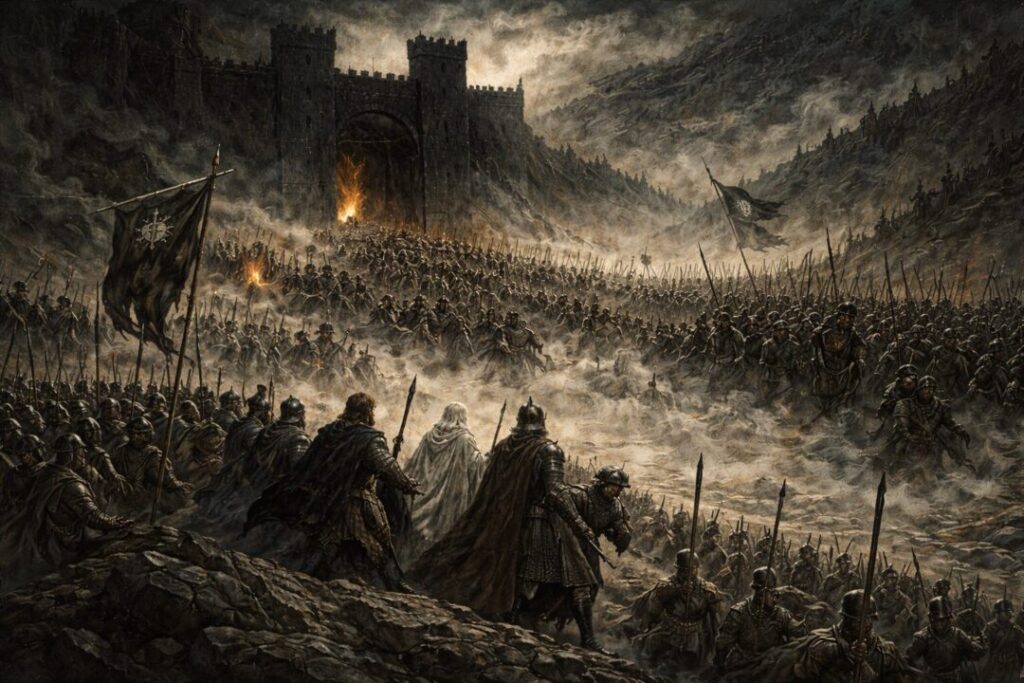
Then the Mouth reveals what he calls “tokens” he was bidden to show—especially to Gandalf.
A guard brings forward a bundle swathed in black cloth.
And the items are displayed with deliberate sequencing:
First, the short sword Sam carried.
Then, the grey cloak with the Elven-brooch.
And last, the coat of mithril-mail Frodo wore, wrapped in tattered garments.
This is not a random handful of loot. It is a crafted shock.
Each object is meant to collapse a different pillar of hope:
- The sword: proof that the small companion is disarmed.
- The cloak and brooch: proof that secrecy and Elvish aid have failed.
- The mithril coat: proof that even miraculous protection did not save the Ring-bearer.
The text tells you what happens in the hearts of the onlookers: a blackness comes before their eyes; in the silence it seems the world stands still; their last hope is gone.
The Mouth watches their faces and laughs, because to him this is success. He believes despair is final. He believes grief ends action.
That is exactly what the scene is doing thematically: it shows you Mordor’s core assumption about human (and hobbit) hearts.
And then it shows you that assumption break.
Gandalf’s anguish is real—and still not the end
One of the most effective choices in the chapter is that the Mouth’s “tokens” do not bounce harmlessly off heroic certainty.
They hurt.
Gandalf steadies Pippin, but the text also lets nearby people see something else: anguish in Gandalf’s face, and later, when the Mouth demands surrender terms, Gandalf seems “old and wizened,” crushed, defeated at last.
The narrative allows you to feel the weight of the lie (or half-truth) Mordor is selling.
But it does not allow that weight to become destiny.
Because Gandalf does the one thing the Mouth does not anticipate: he refuses to treat pageantry as proof.
He asks the only question that matters if you are being coerced by objects:
Where is the prisoner?
Bring him forth, yield him, and then the demands can be considered. Until then, the “tokens” are theatre—designed to force compliance without verification.
And for the briefest breath, the Mouth falters. The text describes it like a fencing match: he is at a loss for just a moment.
That tiny hesitation is enormous.
It tells you he does not possess the thing he is pretending to possess: control over the Ring-bearer’s fate.
The scene is a test of what kind of victory the West will accept
When Gandalf finally answers the ultimatum, the turn is not a clever speech. It is a moral refusal.
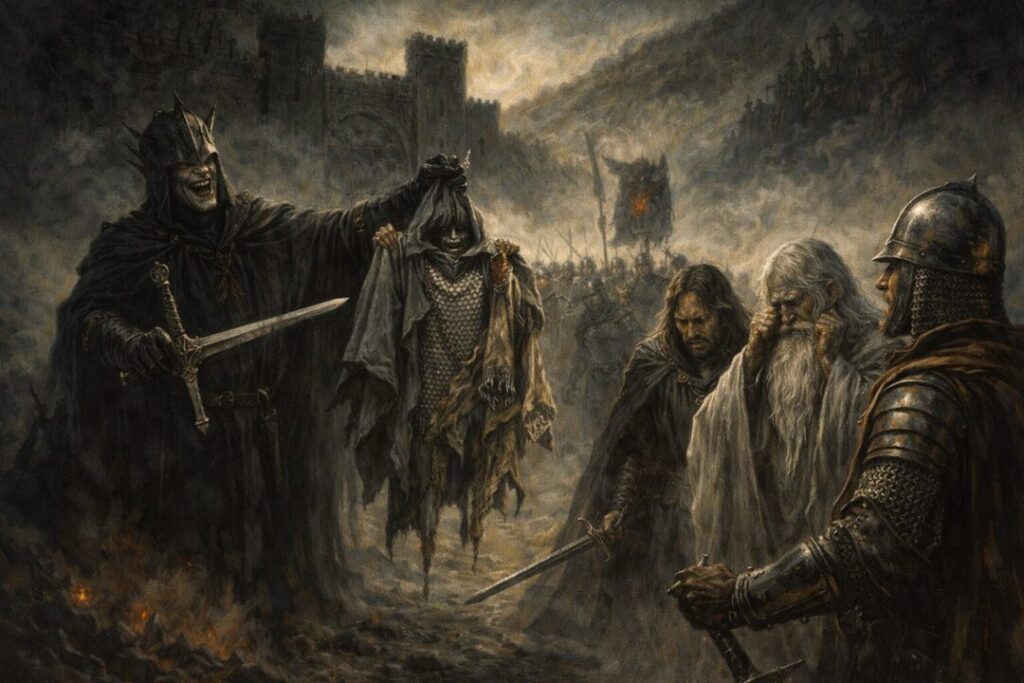
He takes back the tokens—coat, cloak, sword—and declares they will take them “in memory of our friend,” but they reject the terms utterly.
Then comes the line that seals the tone:
They did not come to treat with Sauron. Still less with one of his slaves.
The Mouth’s face twists with rage, then fear overcomes it, and he flees back to the Gate—his embassy ended.
And then the trap springs: signals, drums, fires, doors flung wide, hosts pouring out, enemies ten times their match hemming them in.
So what was the Mouth of Sauron scene for?
It was never there to create suspense about whether the West might surrender.
It was there to reveal two incompatible philosophies of power:
- Mordor believes control can be achieved by breaking the mind first.
- The West believes there are things you do not do, even when the world is ending.
The irony is sharp: Sauron sends a “mouth” to speak, but the scene proves the Dark Tower cannot truly understand the kind of strength it is facing.
And, even more quietly, it keeps re-centering the real climax.
Because while armies posture and envoys taunt, the fate of the world is not being decided at the Gate at all.
Why the film cuts differ—and why it changes the meaning
Adaptations have a different set of pressures: pacing, tone, character arcs, and the need to keep momentum toward a visual climax.
So it makes sense that the Mouth of Sauron sequence becomes a point of alteration.
But the biggest issue is not simply that it is shortened or relocated. It is that one version of the scene introduces an action that reverses what the book carefully holds in place.
In Tolkien’s text, the Mouth insists on the protection of being a herald—and the West, through Gandalf and Aragorn’s restraint, effectively honors that principle even while rejecting everything Mordor offers. The scene is a demonstration that moral law is not just something you keep when it is convenient.
A version of the scene that ends in the herald’s sudden killing does something else entirely.
It shifts the moment from moral refusal to righteous impulse. It turns the encounter into a burst of catharsis.
And that comes at a cost.
Because it makes the West look less like a counterweight to Mordor’s methods and more like a rival force playing by the same logic: power answers insult with violence.
It also undercuts the particular kind of kingship Tolkien is emphasizing in this final movement of the story: authority that can restrain itself.
That is why the differences matter. Not because one version is “cooler,” but because the Mouth of Sauron scene is not primarily a plot beat.
It is a thematic hinge.
It asks what happens when evil tries to win without truth—by staging certainty and selling despair.
And it answers with something almost simple:
You do not have to believe a voice just because it is loud.
You do not have to accept terms just because they are framed as inevitable.
And even at the Black Gate, the story insists there is a line you do not cross—because the whole point is that there is a difference between the world you are defending and the world that is coming for it.
If you only remember the Mouth of Sauron as “that creepy guy at the Gate,” you miss what the chapter is quietly doing.
It is showing you Sauron’s greatest weakness without ever bringing Sauron onto the page:
He cannot imagine a courage that refuses to become him.