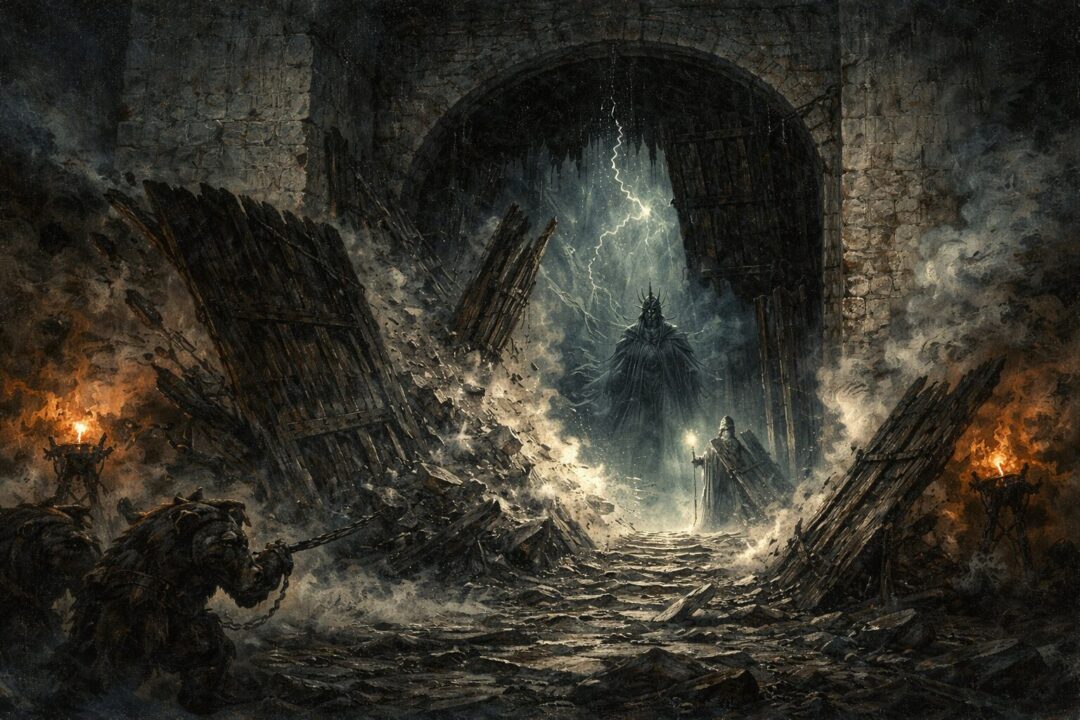
There are some objects in Middle-earth that seem too charged to disappear quietly.
Grond is one of them.
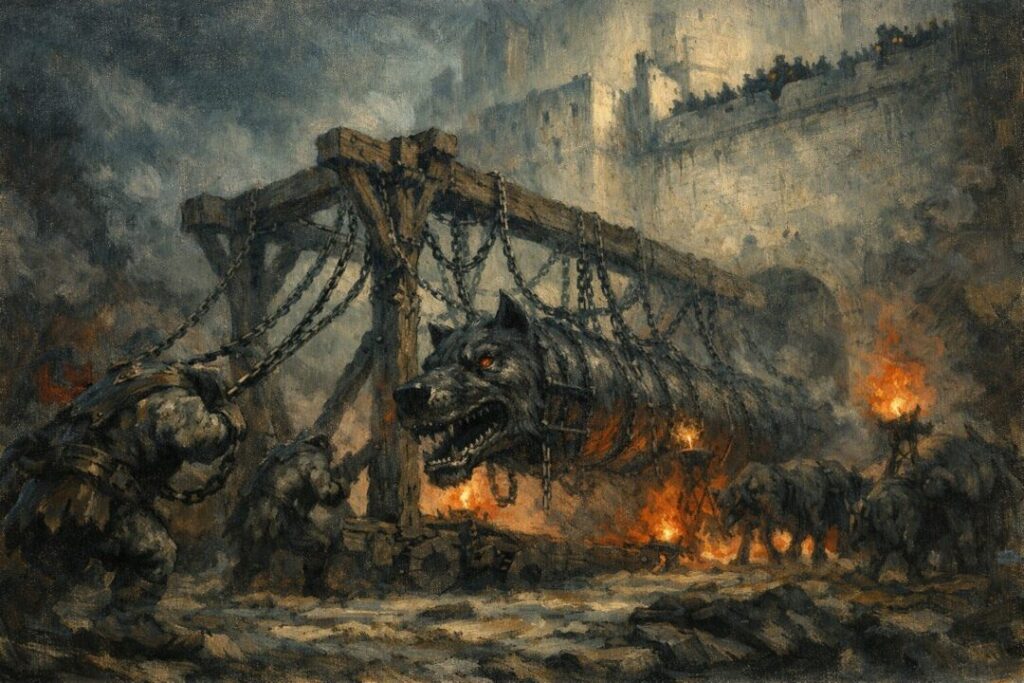
When it enters the siege of Minas Tirith, it does not feel like ordinary war machinery. The text presents it as something deliberately theatrical and deliberately dreadful: immense, iron-bound, wolf-headed, drawn by great beasts, wielded by trolls, and associated by name with the hammer of Morgoth from the Elder Days. It is not merely there to knock down a door. It is there to announce that Mordor has brought an older kind of terror back to the walls of Gondor.
That is why readers often assume Grond must have had some equally memorable end.
But when you look closely, the text does something unexpected.
It gives Grond a huge entrance, a decisive action, and then almost no afterlife at all.
Grond matters because the Gate matters
The first thing to notice is that Grond’s narrative importance is tightly tied to one job.
It exists to break the Great Gate of Minas Tirith.
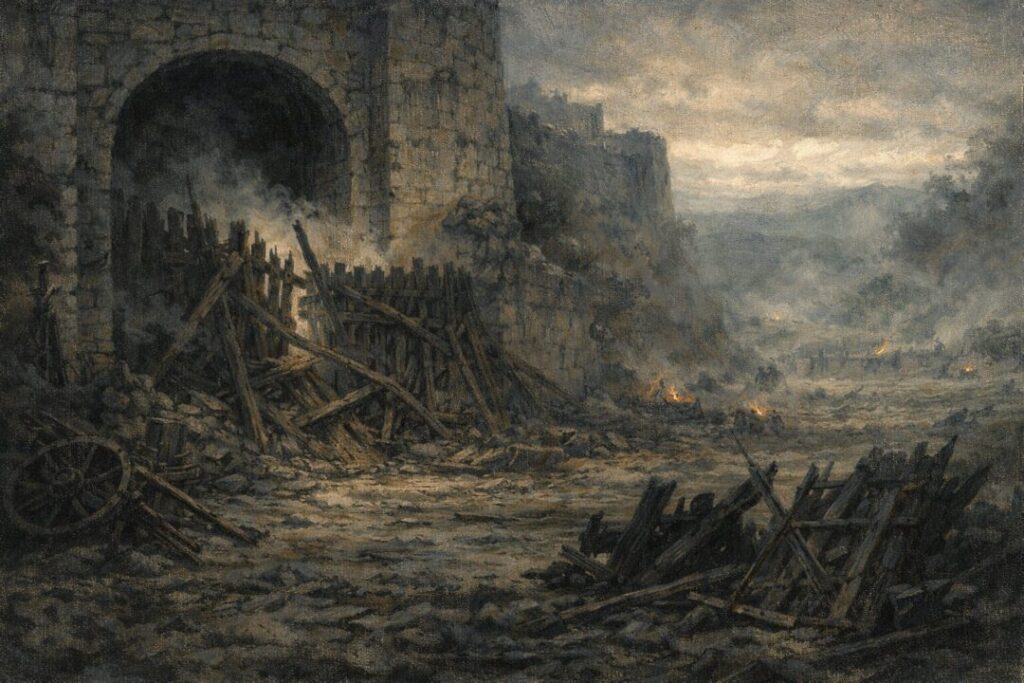
The text builds toward that moment with enormous care. The ram is brought to the weakest point of the outer defense. The Witch-king cries out. The blows fall. At the final stroke, the Gate bursts apart and its fragments fall to the ground. Then the Lord of the Nazgûl rides through the opening that no enemy had passed before.
That sequence is the point.
Grond is not treated like a famous sword that continues through the story, or like a banner that can be recovered, displayed, or inherited. It is a siege instrument whose meaning is concentrated in a single breach. Once the boundary is broken, the ram has fulfilled its symbolic and military purpose.
And the narrative immediately shifts away from it.
The story leaves Grond behind almost at once
This is the part many readers do not fully register.
After the Gate falls, the book does not pause to describe Grond standing amid the wreckage, nor does it show it being turned to some second use. Instead, attention moves at once to the confrontation between Gandalf and the Witch-king—and then even that is interrupted by the coming of Rohan. The horns are heard. Dawn begins. The Lord of the Nazgûl turns away from the Gate to meet the new threat. The battle spills outward onto the Pelennor Fields.
That movement matters.
If the text wanted Grond’s later fate to matter in the same way its arrival mattered, this was the natural place to preserve it. But it does not. The ram is simply no longer what the chapter is about.
This silence is not evidence that “anything could have happened.”
It is evidence that the story has already taken from Grond everything it needed.
What the text does tell us afterward
Even though the book does not track Grond itself, it does tell us a few important things about the aftermath at Minas Tirith.
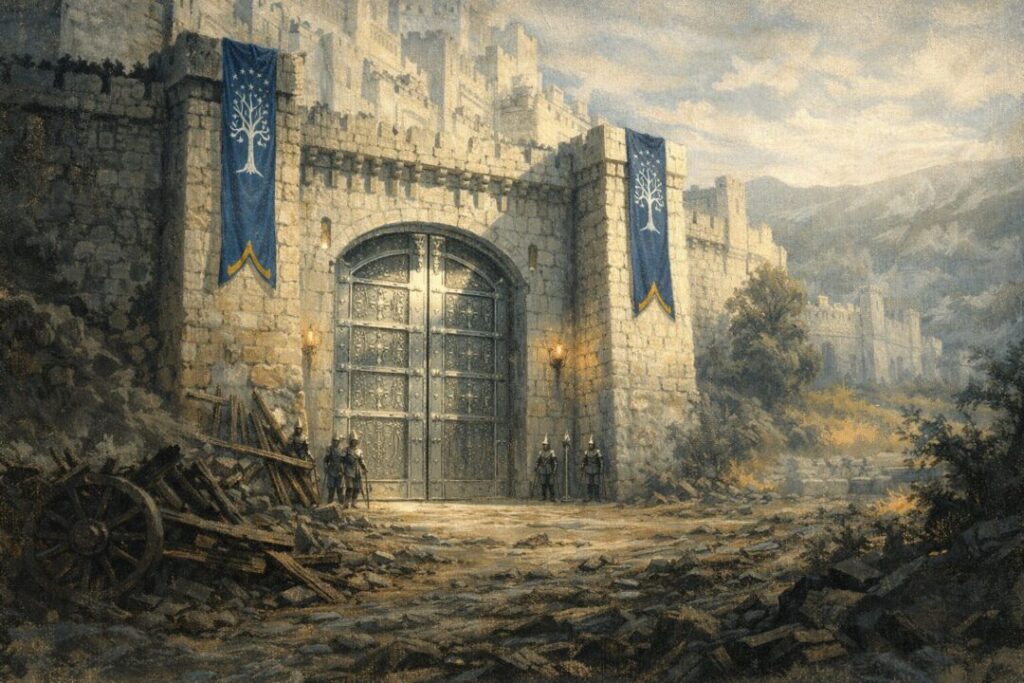
First, the Great Gate remains broken. Later references describe a temporary barricade erected in place of the ruined Gate. On the day of Aragorn’s crowning, he does not pass through restored doors; instead, the barricade is opened for him and he enters the city through a still-damaged threshold. Much later, under King Elessar, the Great Gate is replaced by a new one of mithril and steel, made by Gimli and the Dwarves.
That sequence gives us a careful limit on what we can say.
It tells us the breach was real and remained visible for some time.
It tells us the city moved quickly to make the opening defensible.
It tells us the final answer to the broken Gate was not repair of the old doors but the making of entirely new ones.
But it still does not tell us what was done with Grond.
So what is the safest conclusion?
The safest conclusion is also the least dramatic one.
The text suggests that Grond became part of the abandoned wreckage of the assault once the battle turned and Mordor’s attack failed.
That is an inference, not an explicit statement.
Why is it a reasonable one? Because Grond vanishes from the action immediately after the breach; because no later scene treats it as an active threat, a recovered trophy, or a surviving emblem of Mordor; and because the city clearly had to clear, secure, and barricade the ruined entrance before Aragorn’s return. Something had to be done at the site of the Gate. The text simply does not narrate the labor in detail.
So we may say this much with confidence:
Grond does not remain narratively or practically central after the Gate falls.
We may not say with confidence that it was burned, dismantled, preserved, or destroyed in any specifically described way.
The texts never state that.
Why Tolkien-style narrative silence matters here
This is where the question becomes more interesting than a simple piece of battlefield cleanup.
Grond is named after Morgoth’s ancient hammer, which gives it a mythic echo far beyond ordinary siegecraft. Its appearance suggests continuity between the old darkness and the new. It arrives not just as a ram, but as a reminder that Sauron is always imitating older evil, clothing present war in the memory of elder terrors.
But once the Gate is broken, that echo has already done its work.
The story does not need to tell you where the ram was dragged afterward, because Grond’s real narrative purpose was never to become an artifact with a future. It was to mark a threshold crossed: the outer defense of Gondor broken, the enemy inside, the city brought to its darkest point just before the turn.
In other words, Grond matters as an event more than as an object.
That is why the text is lavish about its approach and economical about its aftermath.
There is no trophy scene for evil machinery
It is also worth noticing what the story does not do with other instruments of Sauron’s war.
The narrative is rarely interested in cataloguing captured machinery after a victory. Its attention goes instead to persons, kingship, healing, mercy, burial, renewal, and the reordering of the world after catastrophe. In Minas Tirith, once the siege is lifted, the focus turns toward the dead, the wounded, the Houses of Healing, the march to the Morannon, the return, and the restoration of the city.
That broader pattern helps explain why Grond’s fate is omitted.
The broken Gate matters because it speaks to Gondor’s wounding.
The new Gate matters because it speaks to Gondor’s renewal.
The ram itself, once its work is done, belongs to the waste of war.
What the text most likely wants us to feel
If you ask what the text suggests emotionally, the answer is clearer than the practical details.
It suggests that Grond was terrifying right up until the moment it was no longer the center of the story.
That is exactly how evil often works in The Lord of the Rings. It arrives with overwhelming force. It seems absolute. It names itself after ancient power. And then, once the turn comes, it loses stature with startling speed. The Witch-king leaves the Gate. The battle moves. Sauron’s great engine of dread is no longer the thing that matters most.
So what happened to Grond after the Gate fell?
The most honest answer is: the book does not say.
But what it suggests is that Grond’s true end is narrative diminishment. It breaks the Gate, opens the city, and then passes out of significance. By the time Gondor is rebuilding, the story remembers the ruined threshold and the restored one—but not the ram that made the wound.
And that feels deliberate.
Because in Middle-earth, the things built only to destroy rarely receive the dignity of a long remembrance.