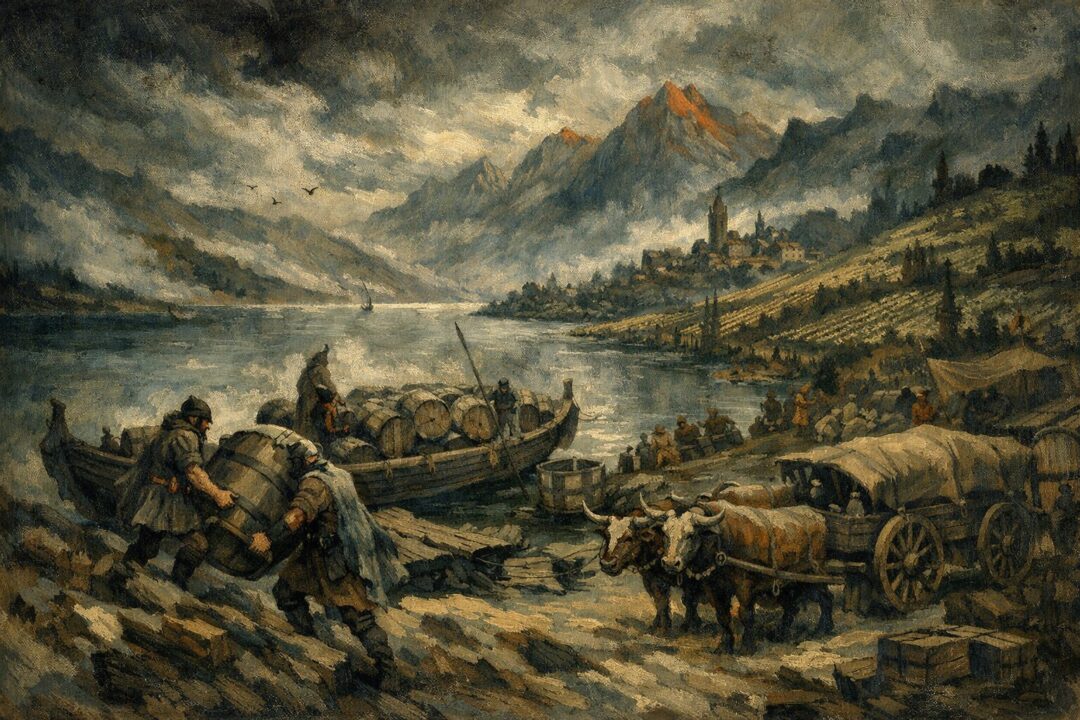
When readers think about “the East” in Middle-earth, they often think first of war.
That is understandable. The eastern horizon in the surviving narratives is usually associated with Easterlings, the Wainriders, the Balchoth, and in the late Third Age the mustering of Sauron’s allies. The West knows the East poorly, and often fears it for good reason. But if we stop there, we miss something important. The texts do not describe the East only as a military threat. They also leave behind a quieter set of clues: trade routes, exchanged goods, river transport, and commercial ties that linked the borderlands of the West to lands farther away.
The result is not a complete map of eastern commerce. Tolkien never gives that. But he gives enough to suggest what trade with the East might really have looked like.
The first thing to remember: the East was not empty
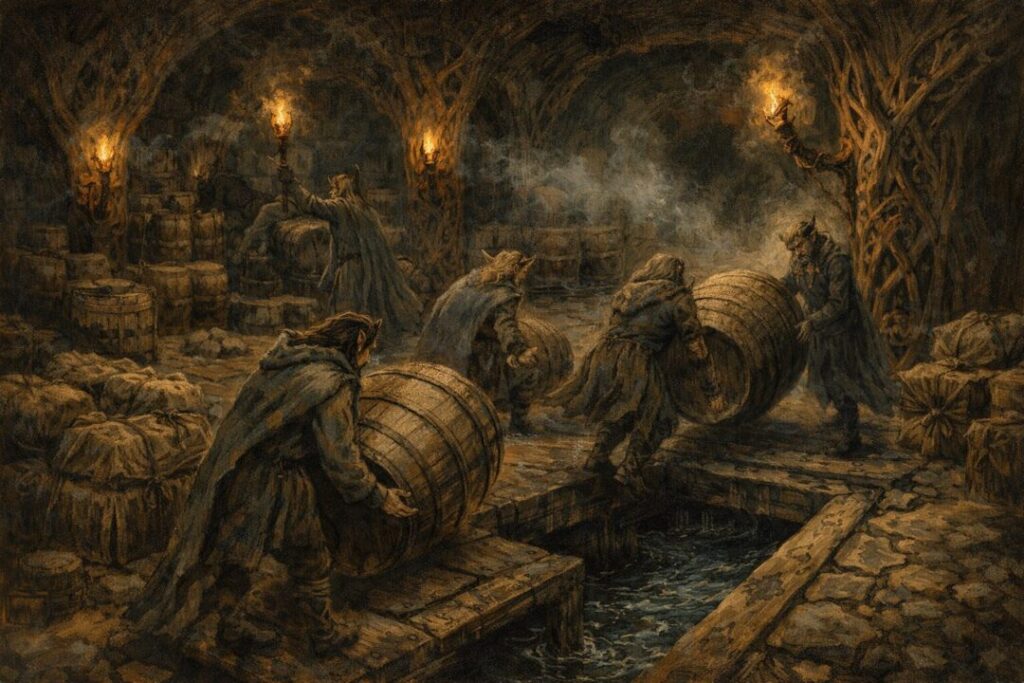
In western imagination inside the story, “the East” can feel like a blank. In textual terms, it is not blank at all. Rhûn exists. The Sea of Rhûn exists. Dorwinion exists on or near its northwestern shores. Northmen lived and moved along the River Running. Gondor at times campaigned eastward toward that inland sea. Later, Easterling pressure repeatedly broke across these same regions.
That matters because trade requires geography before it requires politics. A river, a lake, a transfer point, a settled people, a region known for one export: this is how commercial worlds begin to become visible in the text.
And in the northeast of Middle-earth, that commercial world is visible.
The clearest trade corridor is the one around Erebor, Dale, and the Long Lake
The strongest evidence does not come from a grand statement about “eastern trade.” It comes from the ordinary details of life around the Lonely Mountain.
Dale, before Smaug, is described as a town that traded mainly food supplies for the skills and crafted goods of the Dwarves. That already gives us one major economic pattern in Middle-earth: Men supplying agricultural output, Dwarves supplying skilled manufacture. The Peoples of Middle-earth makes that broader pattern explicit, describing the characteristic economy of Dwarves and Men as one in which Men provided food while Dwarves exchanged labor, building, mining, and crafted goods.
This is not incidental background. It tells us what kind of trade network we are looking at. Not a loose treasure economy. Not commerce in luxuries alone. A working regional system built on staple goods moving one way and finished or high-skill goods moving the other.
Lake-town fits directly into that system. In The Hobbit, it is described as still thriving on trade that came up the great river from the South and was carted past the falls to the town. Even after the dragon had ruined Dale and Erebor, this southern traffic still mattered. Later, after Smaug’s fall, Dale and Esgaroth grow prosperous again through renewed trade up and down the River Running.
That gives us something close to a firm conclusion: the northeastern economy of Wilderland depended on a river-based exchange system linking northern and southern markets.
The River Running was the backbone of the route
The River Running is easy to overlook on the map. In practice, it is one of the most important commercial features in the region.
It runs from the Lonely Mountain, through the Long Lake, and on toward the Sea of Rhûn. Tolkien Gateway’s summary, grounded in The Hobbit and related sources, notes that even after Smaug’s coming it remained a highway of trade for Thranduil’s realm, Esgaroth, and places to the south.
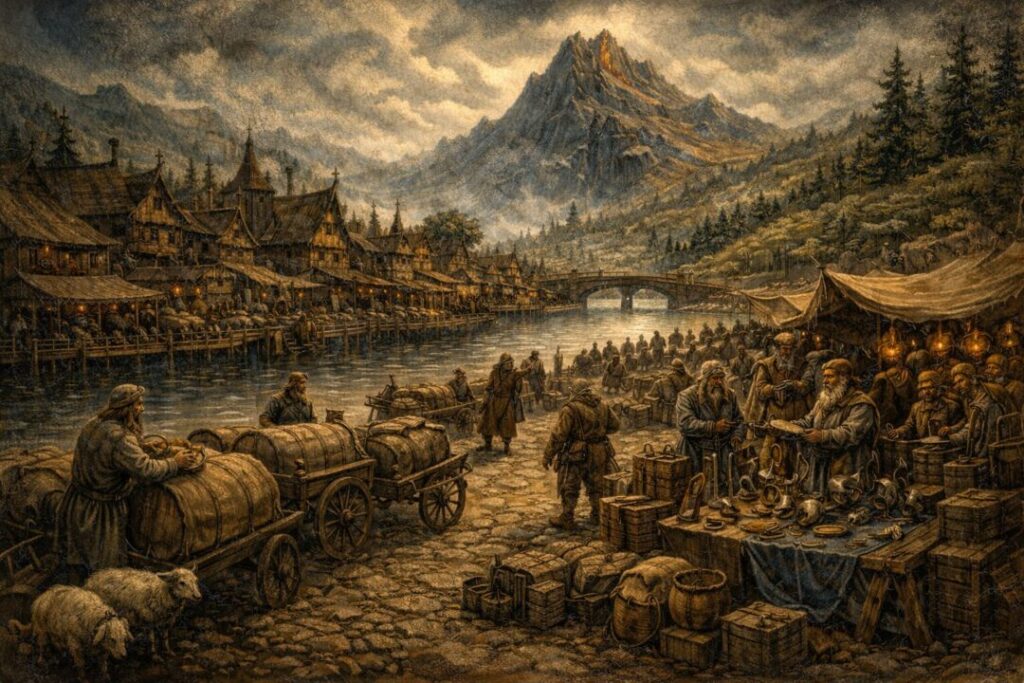
The key phrase in The Hobbit is that goods came up the great river from the South and were carted past the falls. That means the trade route was not a simple uninterrupted water journey. It included a break in transport. Goods had to be unloaded, moved around the waterfalls at the southern end of the Long Lake, and then brought into the local network. That detail makes the whole thing feel more real. It suggests laborers, carts, storage, timing, and a recognized transfer point.
So what did trade with the East really look like?
Probably not a merchant sailing from far Rhûn straight to the Elvenking’s cellar. More likely it looked like stages: river movement, overland transfer around the falls, local redistribution through Esgaroth, and onward exchange with Dale, Erebor, and the Woodland Realm.
Dorwinion is the single most revealing clue
If one place proves that eastern or southeastern goods really moved into the northwestern market, it is Dorwinion.
Dorwinion lay on the northwestern shores of the Sea of Rhûn, south of the River Running, and it was famous for its strong wine. That wine reached Thranduil’s halls in Mirkwood. In The Hobbit, the empty barrels are later sent back toward the south, and in “A Warm Welcome” we are told that men would come up from the South to take some casks away and fill others with goods to be carried back upstream to the Wood-elves’ home.
This is one of the most important commercial snapshots in the legendarium.
It shows recurring exchange, not one accidental shipment. It shows returned containers, which implies an established route. It shows southern merchants or carriers arriving at a known pickup point. And it shows two-way traffic, because some barrels go back south while others are filled with goods intended for the Woodland Realm.
The text does not explicitly say that every one of these southern traders came from Dorwinion. That is an inference, though a reasonable one given the association of Dorwinion with wine on the same river-sea system. So the careful phrasing is this: Dorwinion is the clearest named eastern-adjacent producer in the area, and it is very likely that it participated in this trade network, but the text stops short of mapping every merchant’s home precisely.
Trade was probably layered, indirect, and local at each stage
This is where interpretation becomes useful, so long as it stays disciplined.
The surviving text does not describe a grand customs regime or a map of merchant houses in Rhûn. But the structure it suggests is familiar: long-distance goods often move through many hands. The Lake-men, the Wood-elves, the Men of Dale, and the Dwarves of Erebor do not need direct diplomatic intimacy with every people farther east for eastern goods to reach them. They only need working exchange along the route.
In other words, “trade with the East” in Middle-earth may often have meant trade with border intermediaries, not daily contact with the far interior of Rhûn.
That also helps explain why the texts can preserve both ideas at once: the East as distant and threatening, and the East as economically present.
War would have shaped the trade as much as rivers did
No eastern trade route in Middle-earth would have been politically neutral.
The lands around the River Running and beyond were repeatedly destabilized by eastern invasions. Northmen were displaced. Some fled across the Celduin and merged with the folk of Dale. Gondor lost and contested eastern territories more than once. That means trade routes to the East were almost certainly variable by period: open in some generations, dangerous in others, broken entirely at moments of war.
So the most accurate answer is probably historical, not static.
In peaceful or stronger periods, trade with eastern-adjacent regions could be active, especially along the River Running corridor. In periods of invasion, those same routes would become insecure, militarized, or cut off.
That fits the evidence better than imagining either constant friendship or permanent isolation.
What the goods probably looked like
Here again, we should stay conservative.
The texts directly support wine from Dorwinion, food from Men, and crafted goods, trinkets, weapons, and skilled works from Dwarves. They also support the general prosperity of trade around Dale, Esgaroth, and Erebor.
Beyond that, caution is best. It is tempting to imagine spices, silks, dyes, horses, and exotic metals pouring westward from Rhûn. Some of those might be plausible in a broader fantasy sense, but the primary texts do not clearly establish them in this northeastern trade network. So they should not be presented as fact.
What we can say is simpler and stronger: the trade was substantial enough to support towns, sustain prosperity, maintain regular barrel return, and bind together Elves, Men, and Dwarves who otherwise lived in very different political worlds.
So what did trade with the East really look like?
Most likely, it looked less like ambassadors crossing a mysterious continent and more like a functioning border economy.
Goods moved north and south along the River Running. They were transferred around the falls. Lake-town acted as a receiving and redistribution point. Dale and Erebor formed the great northern demand center for food, craft, metalwork, and wealth. Thranduil’s halls were tied into the same system. Dorwinion, near the Sea of Rhûn, stands as the clearest named supplier from the eastern side of that world.
And that may be the most revealing part of all.
The East in Middle-earth was not only where armies came from. It was also where goods came from, where rivers led, where exchange endured, and where the map of war overlapped with the map of trade.
The texts do not give us a full merchant ledger.
But they give us enough to see the boats.