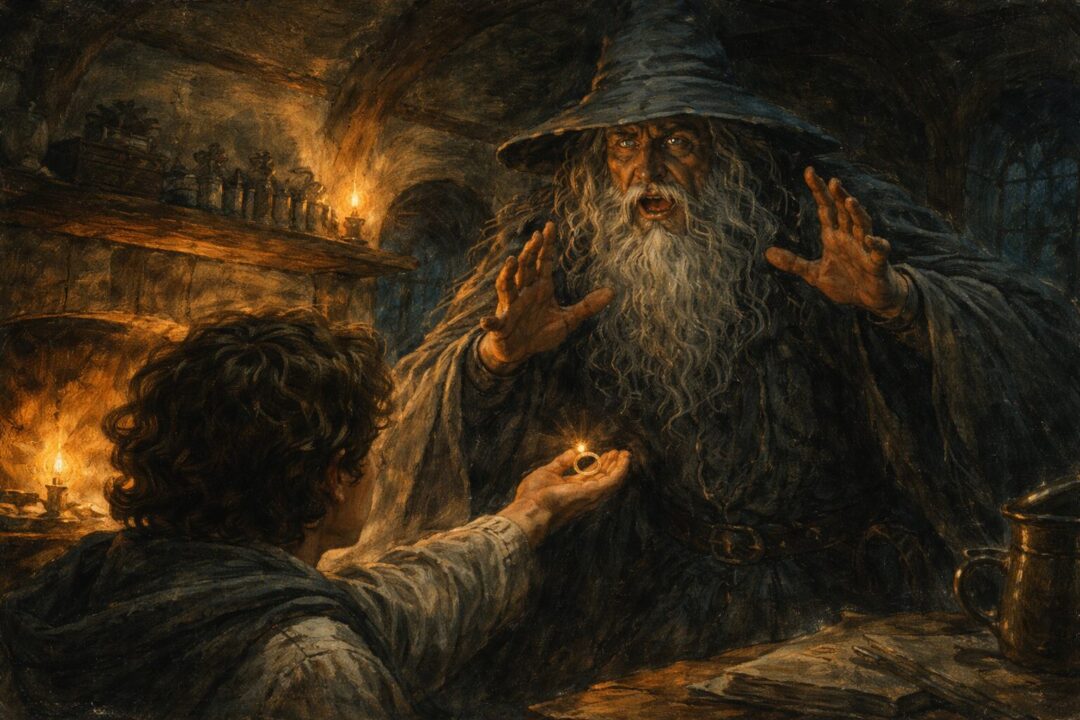
When people imagine a different ending to the War of the Ring, one alternative appears almost immediately.
Why not use the One Ring against Sauron?
At first glance, it sounds practical. Even sensible. Sauron forged the Ring as the greatest instrument of domination in Middle-earth. If the West could seize it, master it, and turn it back upon him, then perhaps the long war could end not in desperate secrecy, but in open victory.
The idea is not a modern misunderstanding imposed on the story from outside.
It appears inside the story itself.
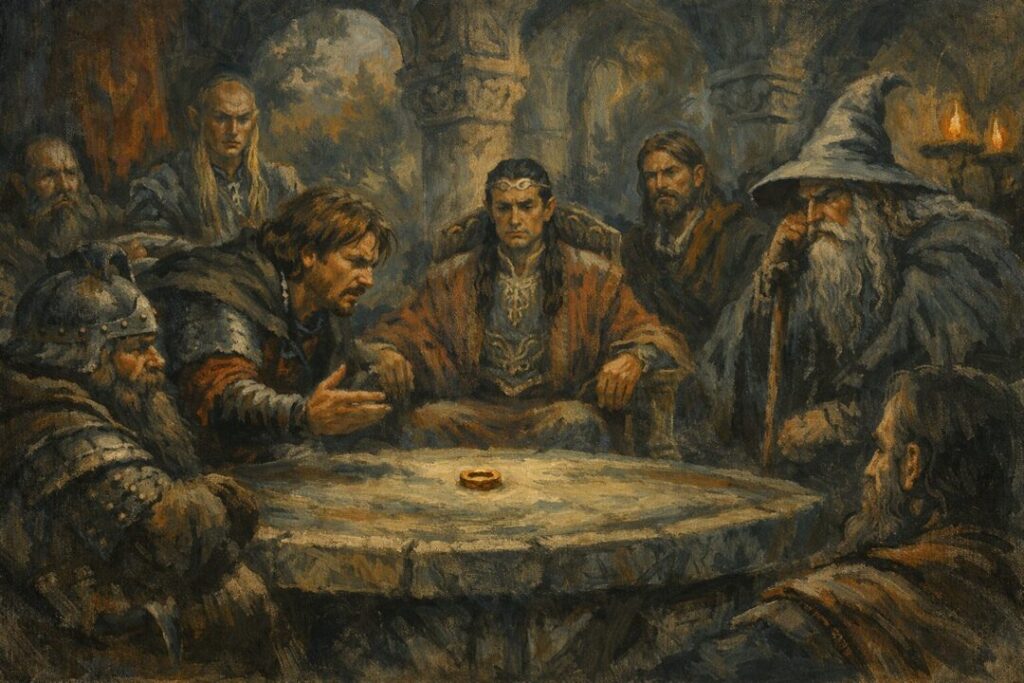
At the Council of Elrond, Boromir voices exactly this thought. Gondor has stood against Mordor for generations. Why should a weapon of the Enemy not be used against the Enemy? The proposal is not treated as absurd because Boromir is foolish. It is treated as dangerous because he has touched the central temptation of the entire tale.
And that temptation is deeper than many readers first assume.
The question is not whether the Ring has power.
The question is what someone would have to become in order to use that power successfully.
The Ring Was Never Just a Tool
One of the easiest mistakes is to think of the Ring as if it were merely an amplified weapon.
A stronger sword.
A greater engine of war.
A device that increases the natural strength of whoever possesses it.
The texts do not support such a simple picture.
The One Ring was made by Sauron alone, and made for rule. Its whole design is bound up with domination, subjection, and the bending of other wills. It is the Master Ring, created to govern the other Rings and extend the power of its maker. That means “using” it is never morally neutral. The Ring does not become wholesome because a better person picks it up. Its mode of action remains what it always was: mastery.
That is why Elrond’s words at Rivendell matter so much.
He does not say the Ring has no use. He says they cannot use it. More precisely, he says its strength is too great for anyone to wield at will except those who already possess great power, and that for such people the peril is even deadlier. If one of the Wise used it to overthrow Sauron, that person would take Sauron’s place.
This is the first thing any serious reading must hold onto.
The Ring is not rejected because it is ineffective.
It is rejected because effective use would itself be a moral catastrophe.
Why Boromir’s Logic Feels So Plausible
Boromir’s error is powerful because it is not empty ambition.
It is the logic of siege.
Gondor is under pressure. The Enemy is vast. Ordinary courage may not be enough. In that context, refusing a weapon of overwhelming force can look less like wisdom and more like recklessness. Boromir sees the Ring through the lens of necessity. That is exactly what makes his reasoning so dangerous.
The story repeatedly shows that the Ring enters the heart through motives that are not always base.
Gandalf does not fear the Ring because he wants wealth or petty glory. He fears it because he would want to do good with it. He says plainly that the Ring would come to him through pity and the desire for strength to do good. That is one of the most important statements anywhere in the story, because it explains why “using the Ring as a weapon” is not a crude villain’s fantasy. It is a savior’s temptation.
That same pattern appears again with Galadriel.
When Frodo offers her the Ring, she does not laugh at the impossibility. She imagines what she might become with it: a queen, beautiful and terrible, loved and feared. She rejects the offer, but the force of the moment depends on a crucial fact. The temptation is meaningful because a being of her stature is not fantasizing about nothing.
Who Could Actually Wield It?
Canon points toward a distinction that is often blurred.
Almost anyone can be tempted by the Ring.
Not everyone can truly wield it in the larger sense.
Isildur claimed it. Gollum possessed it. Bilbo carried it. Frodo bore it to the Fire. Sam briefly held it and felt visions of what power through the Ring might mean. But none of this is quite the same as becoming a true Ring-lord capable of using it as an instrument of large-scale domination.
Elrond’s statement narrows the field sharply: only those who already have great power could hope to wield it at will. Letter 246 develops that idea further. It suggests that figures such as Gandalf, Galadriel, or Elrond might indeed have been able to raise great armies and move against Sauron by force if they had taken the Ring. That is not a small detail. It means the feared scenario was not merely symbolic corruption. It included real effectiveness.
But there is a boundary here that must be phrased carefully.
The texts do not give us a tidy ranked chart of Ring-compatibility.
They do, however, strongly imply that lesser bearers would not become instant masters of Mordor simply by claiming it. Frodo at the Crack of Doom can claim the Ring, and that claim matters profoundly, but Letter 246 makes clear that against the Nazgûl he would still stand in extreme danger: a small brave man with a devastating weapon, but not yet the experience or stature to master the situation safely.
So the idea of using the Ring as a weapon already requires something far more demanding than possession.
It requires a claimant powerful enough to enter into a real contest of wills.
What Victory by the Ring Would Actually Look Like
This is where the fantasy often breaks.
People imagine using the Ring against Sauron as if it would produce a clean heroic victory. But the closest canon explanation points elsewhere.
Letter 246 says that if Galadriel or Elrond had used the Ring, they would have built great armies under absolutely subservient generals and gone to destroy Sauron by force. That is the key phrase.
Absolutely subservient.
This is not the language of alliance, inspiration, or rightful kingship.
It is the language of domination.
A Ring-lord would not merely become stronger in battle. They would become capable of bending others into instruments. The war effort would become more efficient precisely because freedom inside it would begin to disappear.
That is why this path is so morally corrosive even before final victory.
You do not use the Ring first and become tyrannical later.
You begin becoming tyrannical in the very act of using it successfully.

Why Gandalf Would Be Worse in a Different Way
The case of Gandalf is especially revealing.
Many readers assume Sauron is the worst possible outcome, and therefore any alternative ruler who defeated him would at least be an improvement. The texts resist that comfort.
Letter 246 says that if Gandalf had taken the Ring and prevailed, he would have remained “righteous” in intention but become self-righteous. He would have ruled and ordered things for “good” until good itself became detestable and seemed evil.
That is one of the darkest ideas in the whole legendarium.
Sauron multiplies naked domination. Gandalf with the Ring would represent domination justified by moral certainty. The world might even look healed at first. Order would increase. Resistance would be framed as disorder. Mercy would shrink because the ruler would know what is best.
This is not speculation detached from the text.
It is the clearest statement we are given about what the successful use of the Ring by a good person would do.
The result is not redemption of power.
It is the corruption of goodness into something compulsory.
Frodo at Mount Doom Shows the Final Truth
Frodo’s last moment on Orodruin matters here more than it sometimes seems.
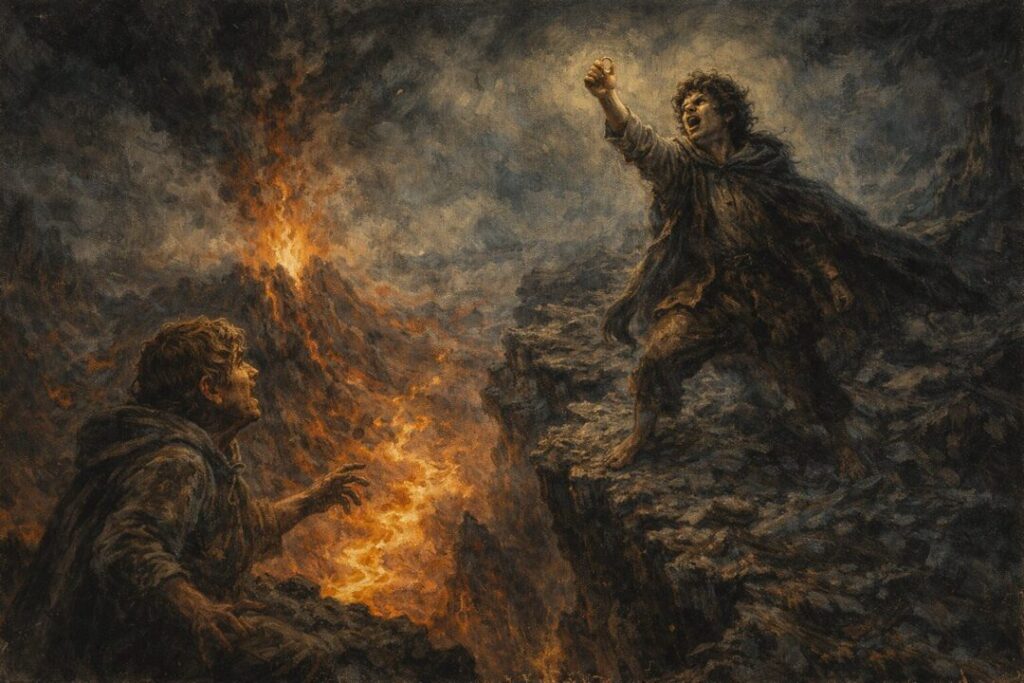
At the very place of destruction, after the full burden of the Quest, Frodo does not cast the Ring away. He claims it. “The Ring is mine.” That moment proves something essential: proximity to absolute evil does not produce easy mastery over it, even in the bearer who has sacrificed most.
Frodo’s claim is not the triumphant beginning of a new Ring-lord in any complete sense. He is interrupted almost at once. But the moment still reveals the final nature of the burden.
If even Frodo cannot simply complete the mission by strength of will, then “using the Ring” was never going to be a matter of noble restraint plus enough courage.
The Ring presses toward possession, possession toward claim, and claim toward rule.
That sequence is built into its nature.
Why Destruction Was the Only Coherent Choice
The strategy of the West begins to make sense only when we stop treating the Ring like recoverable power.
Sauron expects rivals to use it because he understands the desire for domination. What he does not understand, and what briefly blinds him, is the possibility that someone would seek to destroy such a thing rather than wield it. That is why the Quest has any chance at all.
The Ring cannot be safely stored forever. It cannot be turned into a neutral inheritance. Isildur already shows the danger of claiming it even after Sauron’s first fall. The Wise know too much by the end of the Third Age to repeat that mistake knowingly.
So when the Council rejects using the Ring as a weapon, it is not refusing the most effective military option out of sentiment.
It is recognizing that the option destroys the very thing the war is being fought to preserve.
Not only life.
Not only kingdoms.
But freedom from domination.
The Real Requirement No One Wants to Admit
What would using the One Ring as a weapon actually require?
Not bravery alone.
Not desperation alone.
Not even high intention.
It would require a person of immense stature to claim a mode of power built on mastery, bend others to that purpose, defeat Sauron in his own register, and then somehow not become a new center of domination.
The texts give no reason to think that last step was possible.
Quite the opposite.
Again and again, they suggest that the only person who could truly use the Ring on a grand scale would already be on the road to becoming the very kind of ruler the story condemns.
That is why the destruction of the Ring is not merely tactically clever.
It is morally necessary.
The war could not be won by using the Ring without also losing the deeper meaning of victory.
And that is the point many alternate-history versions quietly miss.
The Ring might have helped win the war.
But only by changing the winner into something Middle-earth was never meant to endure.