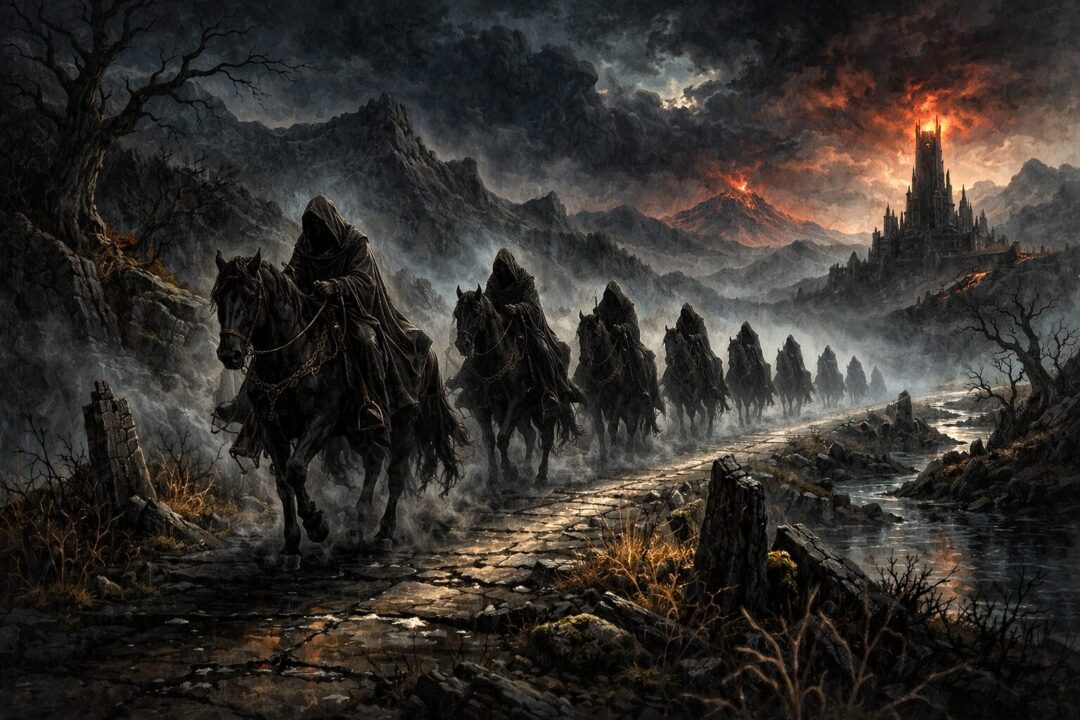
The most unsettling thing about the Nazgûl is not their shriek.
It is their certainty.
They do not hesitate. They do not bargain. They do not defect. They ride, and the world bends away from them like grass under a cold wind. That kind of obedience usually has a visible cause—chains, oaths, fear of punishment.
But in the legendarium, the cause is smaller than a chain and more permanent than an oath.
A ring.
Nine of them, given to Men. And Men—who were not made for that kind of power—faded into the unseen world until nothing remained but will, hunger, and a command that was no longer their own.
That much is familiar. The part most readers never stop to examine is this:
By the end of the Third Age, Sauron does not merely rule the Nazgûl.
He holds their Rings.
And once you accept that, a question appears that the story never answers in a single clean sentence:
When did he take the Nine back—and how?

The first clue is a line that sounds like closure
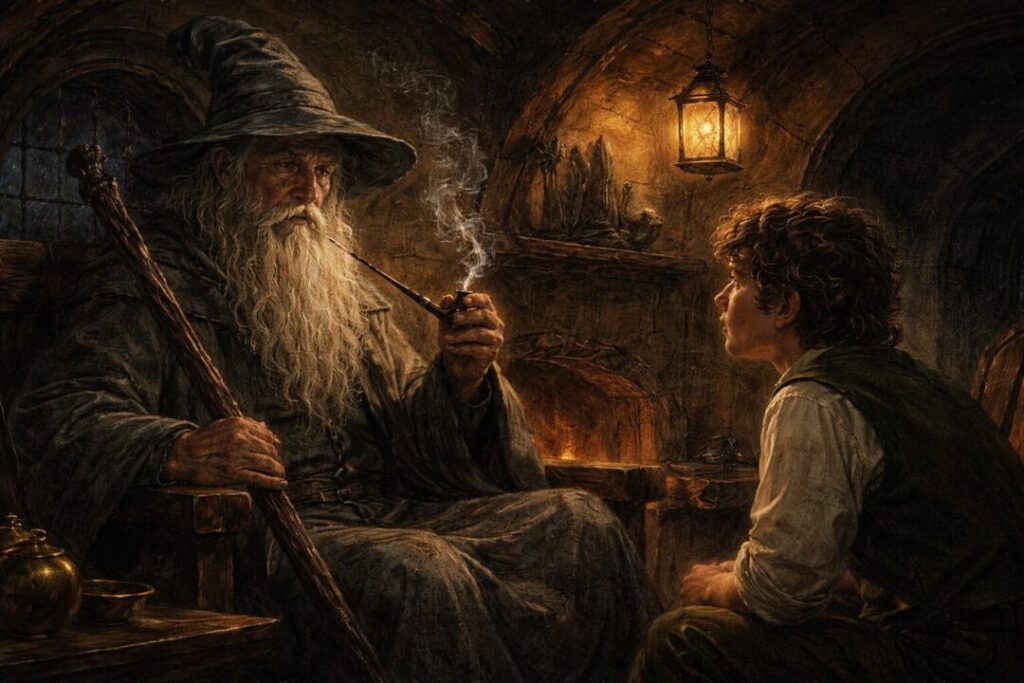
Early in The Fellowship of the Ring, Gandalf gives Frodo what feels like a simple accounting:
“It is a ring. What then? The Nine the Nazgûl keep…”
Read quickly, it lands like finality. The Nine belong with the Nine. The Seven are “taken or destroyed.” The Three are known to the Wise. The One is lost.
A tidy map.
But later in that same explanation, Gandalf adds a sentence that makes “keep” suddenly unstable:
“So it is now: the Nine he has gathered to himself; the Seven also…”
If Sauron has gathered the Nine to himself, then in what sense do the Nazgûl “keep” them?
At minimum, the text forces you to admit one of two possibilities:
- Gandalf’s “keep” is not meant as “wear” or “physically possess,” but as “are accounted for—bound up with the Nazgûl’s fate.”
- Or the situation has changed over time, and the Nine are no longer where a reader expects them to be.
The story does not pause to resolve this tension. It simply supplies more evidence.
And the next evidence comes from someone who chooses her words carefully.
Galadriel uses the colder verb
In “The Mirror of Galadriel,” Frodo is trying to understand what he has seen—what threatens them, what hunts them, what waits.
Galadriel replies:
“You saw the Eye of him that holds the Seven and the Nine.”
She does not say “him that rules the Nazgûl.” She does not say “him that commands the Ringwraiths.”
She points to the Rings themselves.
Whatever else “holds” might mean in a world where domination can be spiritual as well as physical, the text is deliberately steering your attention away from the Riders’ cloaks and toward Sauron’s possession.
And then Unfinished Tales steps in and makes the relationship even harsher.
Unfinished Tales states the dependence outright
In the “Hunt for the Ring” material, the Ringwraiths are described in terms that strip away almost every trace of independence.
They are sent because they are “his mightiest servants,” and because they are uniquely suitable for the task—precisely because they cannot truly act against him.
The text explains why:
They are “entirely enslaved to their Nine Rings, which he now himself held.”
That “now” matters. It implies a present state: at the time of the hunt—late in the Third Age—Sauron is the one in possession of the Nine.
So the question returns, sharper:
If Sauron “now” holds them… was there a time when he did not?
And if so, when did the transfer happen?
What we can say with confidence (and what we can’t)
Here is the boundary the texts set.
We can say with confidence that by the time of the War of the Ring, Sauron holds the Nine Rings in a way that gives him “primary control” of the Ringwraiths’ wills. A letter discussing the Ringwraiths makes that explicit: Sauron still, “through their nine rings (which he held),” retained primary control.
We cannot point to a canon passage that narrates the moment Sauron physically takes the Nine off the hands of the Nazgûl, or names a date when they were removed.
There is no scene: no throne-room demand, no ritual surrender, no secret vault receiving nine pieces of gold.
The legendarium gives you the result—Sauron holding the Nine—and leaves the mechanism mostly implicit.
So the honest answer to “When did it happen?” is:
The texts do not specify.
But they do allow careful inferences about how it could happen without resistance, and why Sauron would want it that way.
How could Sauron take them back?
If the Nazgûl are “entirely enslaved” to the Nine, then they are not in a position to refuse any command that matters.
That does not require the One Ring to be on Sauron’s hand at that moment. The evidence we are given is simply that the Nine remain instruments by which their bearers are bound—and that Sauron’s possession of those Rings strengthens his mastery.
So “how” can be stated conservatively:
- By command, because the Ringwraiths have no independent will strong enough to oppose him in such a matter.
- By custody, because Sauron can keep the Rings in his own keeping once the enslaving work is complete.
What we should not do is invent details the text never supplies: a ceremony, a location, a specific year, or a motive like “fear they would betray him” stated as explicit fact.
The sources don’t give that.
They do, however, give us something almost as revealing: a reason this arrangement makes narrative sense.
Why would Sauron hold the Nine instead of letting the Nazgûl wear them?
Because the Nazgûl are not simply powerful servants.
They are risks.
Not in the sense that they might become loyal to someone else—but in the sense that the One Ring changes the balance of power in any room it enters.
A crucial idea appears in that same discussion of the Ringwraiths: if someone else claimed the One Ring as a tool of command, the Nazgûl would not be “wholly” immune to its power, even though they were on an errand laid on them by Sauron.
That is a dangerous sentence.
It suggests that the One Ring, claimed strongly enough, could interfere with Sauron’s control—at least in degree, at least in moment.
Now put that beside the other fact the texts give you:
Sauron holds the Nine Rings that enslave them.
The shape of the strategy becomes visible.
If you are Sauron and you are hunting for the One, you do not want your chief hunters to have any leverage you cannot immediately tighten.
You want their slavery to be externalized—locked in objects you possess.
Not because they might develop moral independence, but because domination in this world has mechanics. And Sauron is nothing if not a mechanic of domination.
Then what are the Nazgûl, if not “ring-bearers” anymore?
This is where the question turns from trivia into something eerie.
If the Nine Rings are not on their hands, the Nazgûl become something like a completed transformation.
The Rings have already done their work: the Men who wore them faded “until they became wraiths” (the story’s general account of the Rings’ effect), and the controlling relationship is now maintained through Sauron’s custody of the enslaving instruments.
They are not “powered” in the simple sense by wearing the Rings day to day.
They are bound by what the Rings made them.
This is why “The Nine the Nazgûl keep” can still be true in one sense: the Nine are still their Rings in fate and function, even if they do not possess them as property.
The Rings belong to their story—and to Sauron’s hand.
So when did Sauron take them back?
Here is the most careful conclusion the evidence supports:
- By the time of the War of the Ring, Sauron holds the Nine Rings in his own keeping, and through them maintains primary control of the Nazgûl.
- The texts do not date or narrate the retrieval, and any specific timeline beyond “by then” would be speculation.
But that is not a weak ending.
It is the point.
Because the absence of a “when” pushes you toward a more important realization: the Nazgûl are not terrifying because they have rings.
They are terrifying because they have already lost the stage of choice where a ring could be refused, hidden, traded, stolen, or thrown away.
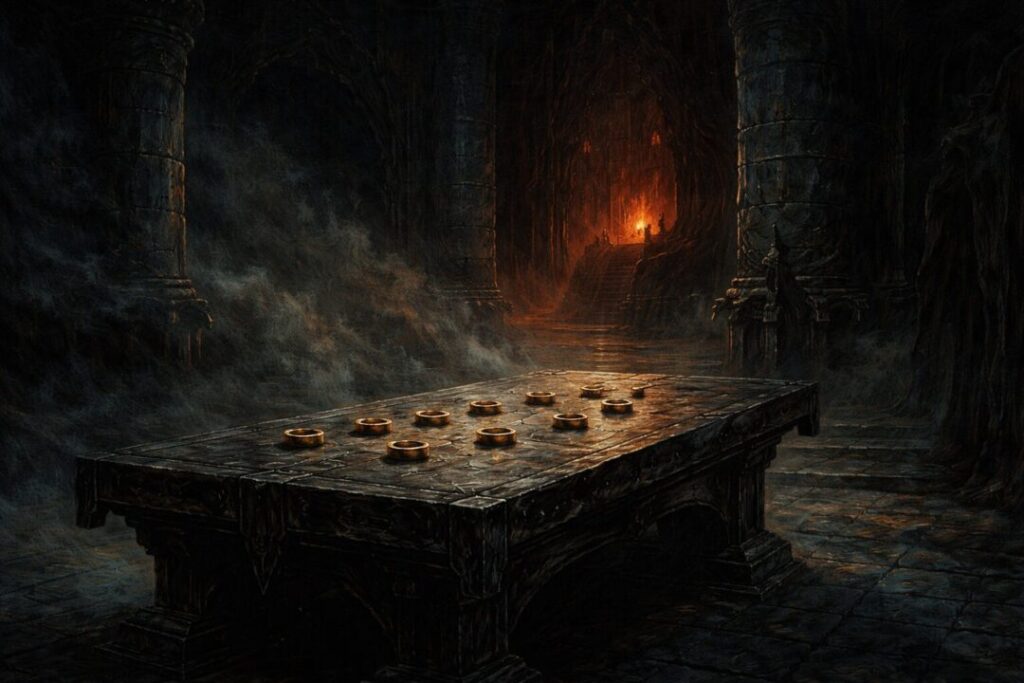
Sauron doesn’t need to keep the Rings on their fingers.
He only needs to keep them on a table he controls—while the Riders, emptied of everything but obedience, ride wherever he points.
And once you see that, you understand why the hunt for the One Ring was never a quest the Nazgûl could “win” for themselves.
They could only deliver it.
They were built to deliver it.
And the hand that held their Nine ensured they would.