Most histories of Middle-earth begin the long suffering of Gondor with the War of the Ring. They speak of the Siege of Minas Tirith, the charge of the Rohirrim upon the Pelennor Fields, and the final stand against the Shadow as the city’s darkest hour. Songs were written of that war, and its memory has never faded from the minds of Men.
Yet this was not the first time the White City burned.
Long before the return of the One Ring—before the banners of Rohan rode to Gondor’s aid, before the Steward’s line dwindled and hope itself seemed fragile—Minas Tirith faced an assault so devastating that its memory was deliberately buried. The chronicles of later ages mention it only in fragments, if at all. What few records remain were scattered, censored, or quietly sealed away.
Scholars of Gondor would later name it the First Sacking of the White City, though among the common folk it passed into half-remembered rumor, a shadowed tale spoken only in whispers.
An Age of Weariness
The assault came during an uneasy age, when Gondor was already tired of war.
Its borders were strained thin, its watchtowers undermanned, and its allies distant or unreliable. The long vigilance against the East had dulled into habit, and habit into complacency. The great city still stood proud—seven levels of stone carved into the mountainside—but its strength rested more in memory than readiness.
Hope, in those days, no longer leaned on steel.
Instead, it leaned on words.
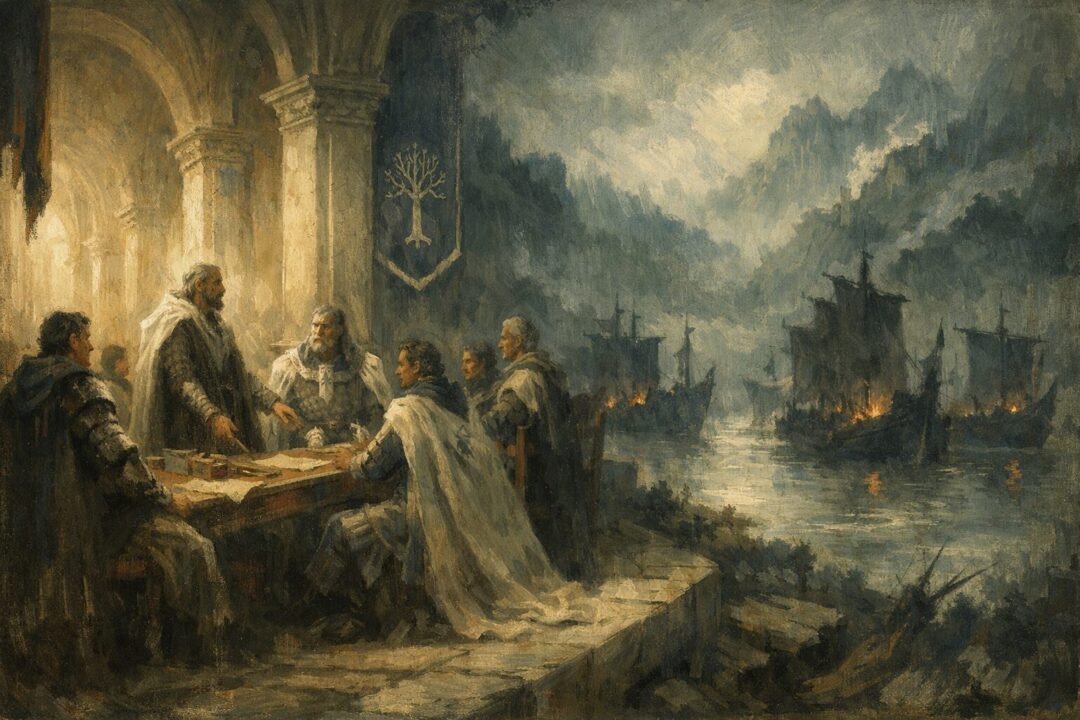
Messengers arrived bearing promises from the East: talks of ceasefires, oaths of restraint, and proposals for lasting peace. They spoke smoothly, invoking exhaustion on both sides, hinting that endless conflict served no one. To many within the city, the words sounded reasonable. Even wise.
Beneath banners of white and silver, stewards and lords debated late into the night. Some argued for vigilance, but others urged compromise. Gondor had bled enough, they said. Surely even enemies could grow weary of destruction.
What they did not see was that peace itself had become the weapon.
The Lie of Peace
While the city debated, the Enemy prepared a deception worthy of legend.
A delegation of dark emissaries traveled openly along the ancient roads. They came unarmed, or so it seemed, speaking humbly of restraint and reconciliation. Their presence was meant to reassure, to dull suspicion, and to draw Gondor’s attention inward.
Meanwhile, far beyond the sight of the White City’s watchtowers, a fleet of black ships gathered under cloud and spell. They moved silently, hugging the shadows of the Anduin, their sails darkened, their oars muffled. No signal fires were lit. No warnings reached the city in time.
At the head of this gathering storm stood Morgath the Black Hand.
Unlike the strategists and counselors who ruled the Enemy’s councils, Morgath was forged by violence alone. He had risen not through diplomacy or intrigue, but through conquest and slaughter. He did not believe in treaties. He did not believe in restraint.
He believed in endings.
To Morgath, Minas Tirith was not a bargaining chip. It was a symbol that had endured too long. In his mind, the White City had to fall utterly, or the war would never truly end.
Fire Over the City
The assault began at dawn.
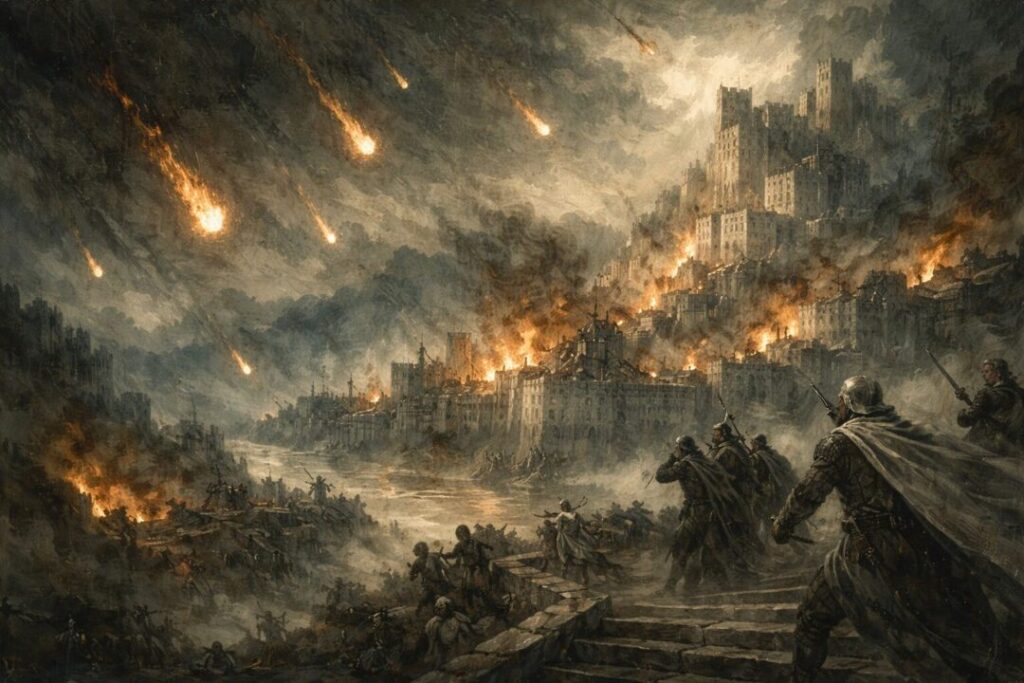
There was no warning horn, no gradual escalation. One moment the city stirred beneath pale morning light, and the next the sky itself seemed to break apart.
Fire rained upon the lower circles of Minas Tirith. Towers cracked as if struck by the fists of giants. Streets vanished beneath smoke, falling stone, and flame. The great walls, thought unassailable, were breached before the defenders could fully take their positions.
By the time the horns of alarm sounded, it was already too late.
This was no raid, no probing attack meant to test defenses. It was an execution delayed by centuries.
Enemy forces poured into the city in disciplined waves, cutting through stunned defenders and panicked civilians alike. Morgath led the charge himself, driving straight toward the Citadel, as though prophecy—or obsession—pulled him forward.
The great gates shattered beneath his assault. Stone split. Iron buckled. The halls once devoted to learning, counsel, and quiet governance were flooded with smoke and blood. Marble corridors became fields of ash. Ancient banners burned where they hung.
The White City was not merely under attack.
It was being unmade.
The Last Stand of Lord Calendir
Within the Citadel, the defenders gathered what strength they could.
They were too few, too unprepared, but they did not flee. Among them stood Lord Calendir, a man of the old Númenórean line. He was neither famed for ambition nor celebrated for conquest. He was remembered instead for restraint, wisdom, and a quiet loyalty to Gondor’s ideals.
Calendir had studied lore as deeply as swordplay. He understood that the Citadel was more than stone—it was a symbol. If it fell, something within Gondor would break that could never be fully restored.
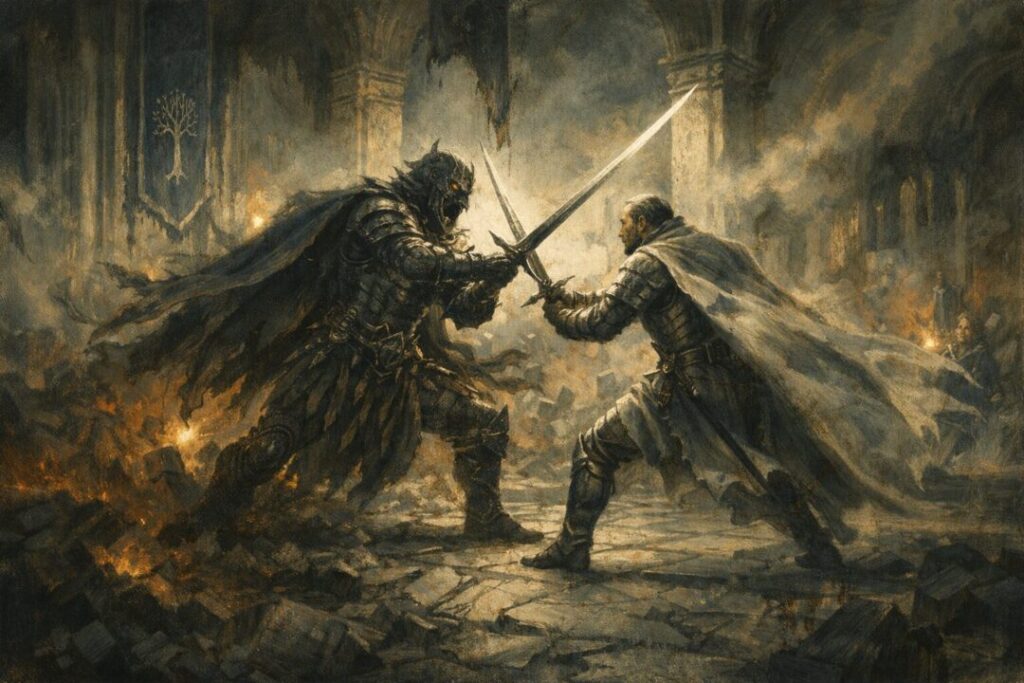
He met Morgath beneath the high vaults of the Citadel hall.
Their duel was not long, nor graceful. It was raw and brutal—order against fury, tradition against annihilation. Calendir fought with discipline and resolve, but Morgath fought like a storm unleashed, driven by hatred sharpened into purpose.
Steel rang once.
Twice.
And then Calendir fell.
The moment his body struck the stone, the spirit of the city seemed to falter. The defenders broke. Resistance collapsed. The Citadel was lost.
Victory, and Its Denial
By nightfall, Minas Tirith burned.
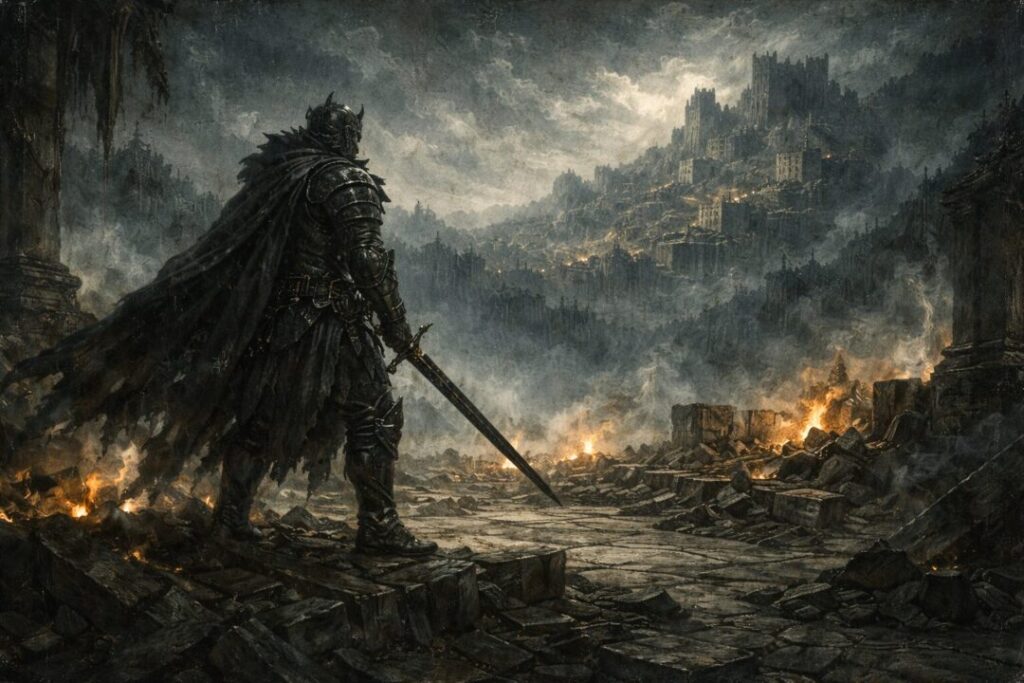
Smoke rose from shattered spires, and fires glowed across the seven levels of the city. Morgath stood amid the ruins of the Citadel, convinced that the end had finally come. This was the vision he had carried for years—a White City reduced to ash, its defiance erased from history.
But the end did not come.
Unknown to Morgath, the assault had never been intended to finish the city.
While he fought and bled for total destruction, his superiors had been negotiating elsewhere. The devastation was never meant to be final. It was leverage. A demonstration of power meant to terrify, not annihilate.
Orders came swiftly.
Halt the attack.
The fleet withdrew. The bombardment ceased. The fires were allowed to die. Morgath’s warriors were pulled back from the brink of total victory, leaving ruin—but not oblivion—in their wake.
Gondor, broken but still breathing, was forced into a humiliating accord. Its strength was curtailed. Its pride stripped away. In exchange for survival, it surrendered influence, territory, and dignity.
Peace was declared.
But it was a peace written in smoke.
The Seed of Betrayal
For Morgath, this was unforgivable.
What he had sacrificed for victory—what his soldiers had died for—was reduced to theater. The destruction he believed necessary had been traded for signatures and political advantage. The war he sought to end was merely postponed.
From that moment, his loyalty fractured.
The bitterness that followed did not fade. It turned inward, reshaping him from a servant of the Shadow into something far more dangerous: a figure who no longer trusted the masters he served.
In time, that bitterness would grow into rebellion. And that rebellion would fracture the Enemy’s own ranks in ways no treaty ever could.
A City That Endured—and Remembered
Minas Tirith survived the First Sacking.
Its walls were repaired. Its towers rebuilt. Songs were written to soften the truth. Records were altered to preserve morale. The full story was quietly set aside, deemed too dangerous, too shameful, or too unsettling for later generations.
But the scars remained.
Some ruins are rebuilt.
Others are merely hidden.
And in the shadowed corners of Gondor’s history, the memory of that day lingered—waiting, perhaps, for a future war to remind the world that the White City had already once stood at the edge of annihilation… and lived.