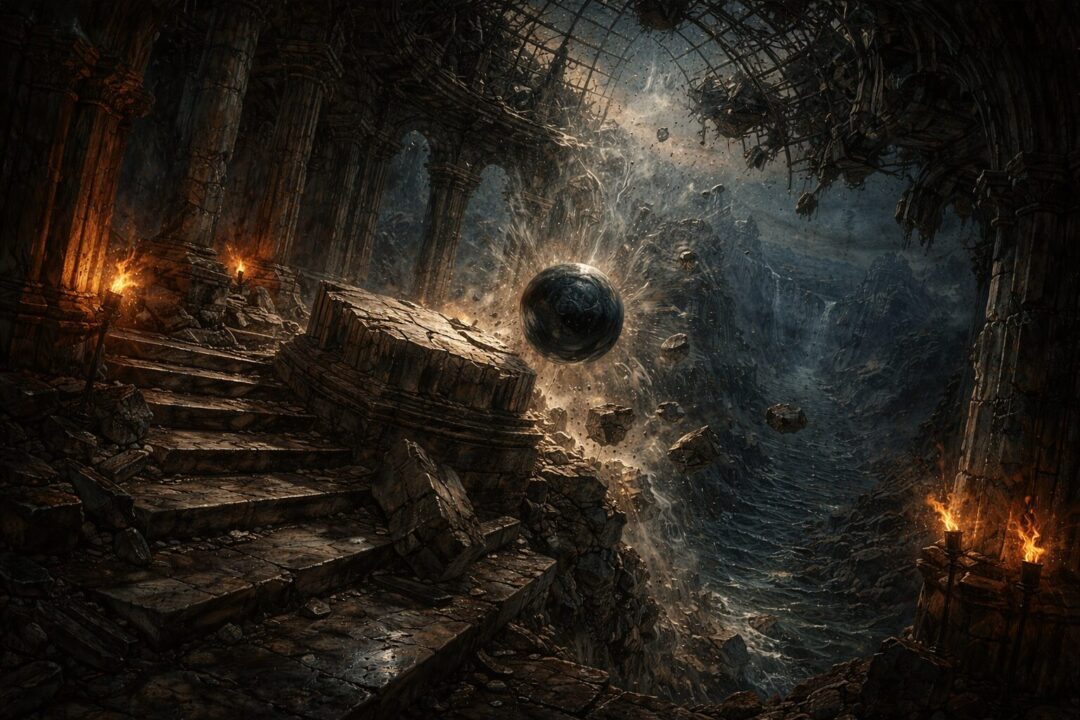
Some losses in Middle-earth arrive with thunder.
A city falls. A king dies. A tower breaks.
But the loss of the palantír of Osgiliath is recorded almost like an afterthought—one line in a timeline, wedged between names and dates:
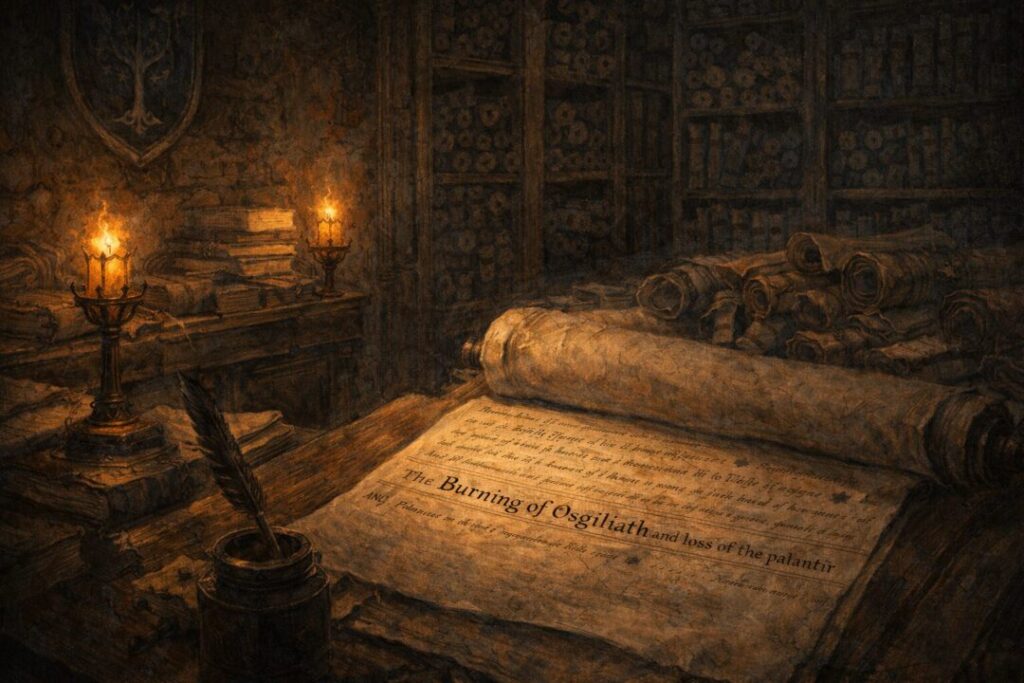
“1437 Burning of Osgiliath and loss of the palantír.”
That sentence does not sound like the disappearance of one of the greatest instruments ever entrusted to the Dúnedain.
And that is the first reason the question persists.
Because Osgiliath’s seeing-stone is not treated in later lore as merely one more artifact among many. It is consistently framed as the chief stone of the South-kingdom—kept in the city that once held the joint throne of Isildur and Anárion, beneath the Dome of Stars.
Then it is gone.
And the texts never show anyone holding it again.
So where is it?
And why was it never recovered?
To answer honestly, you have to do something that Middle-earth fans don’t always enjoy: accept what the texts say, and also accept what they refuse to say.
What we can state with confidence
The first hard anchor is the Appendix.
It does not tell you how the stone was lost, only that it was lost in the Burning of Osgiliath in Third Age 1437.
The second anchor is the later explanatory material collected in Unfinished Tales, in the essay commonly referenced as “The Palantíri.”
Here the loss becomes physical.
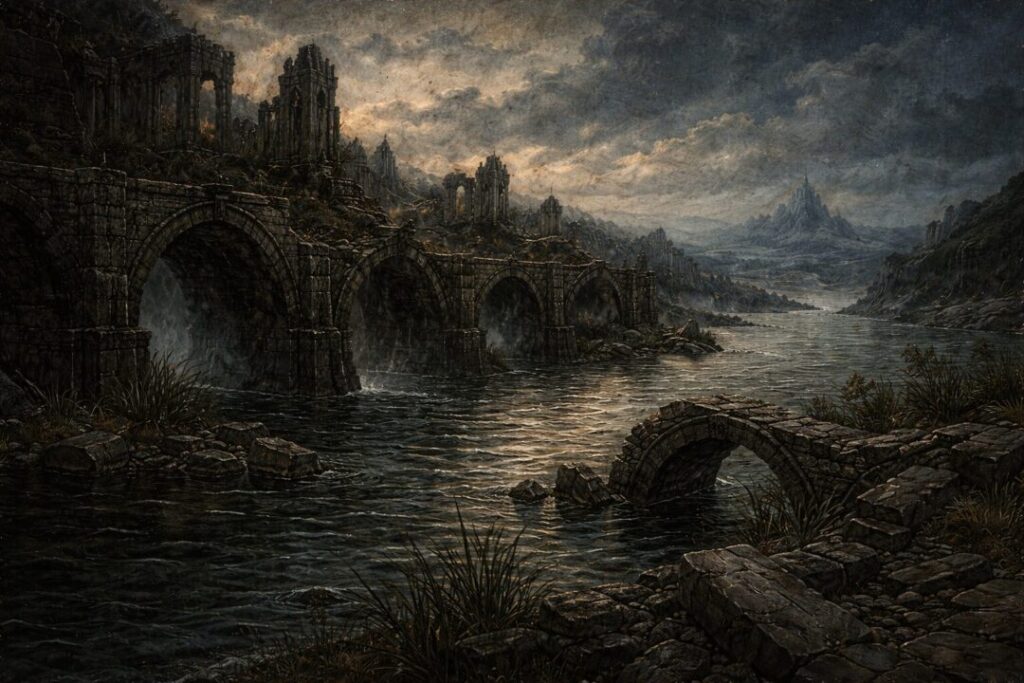
The Osgiliath-stone, we are told, fell into the Anduin during the Kin-strife and the burning of the city.
That is the closest thing to a “location” the lore gives you.
Not a hidden vault. Not an enemy hoard. Not a secret chamber beneath ruined walls.
A river.
And even that is not treated as the end of the matter.
Because the same Unfinished Tales material also admits uncertainty about what happened afterward: the stone may have lain still in the Anduin, or it may have rolled on toward the Sea.
So the real, lore-accurate answer to “Where is it?” is not a map pin.
It is a narrowing cone of probability:
- Last attested event: lost in the Burning of Osgiliath (T.A. 1437).
- Last attested environment (later note): fell into the Anduin.
- Beyond that: explicitly uncertain—still in the river, or carried onward.
That is the factual boundary.
Everything else must be labeled as inference.
The Dome of Stars, and why “just retrieve it” is not simple
One detail matters more than people expect: the Osgiliath-stone is described as unusually large—so large that it could not be lifted by a single man.
That doesn’t tell us its exact measurements. The texts do not give them.
But it does tell us something practical: this was not a trinket you tuck under your cloak while the city burns. Moving it safely required preparation, multiple hands, and control of the space around it.
Now set that against what “Burning of Osgiliath” actually means in context.
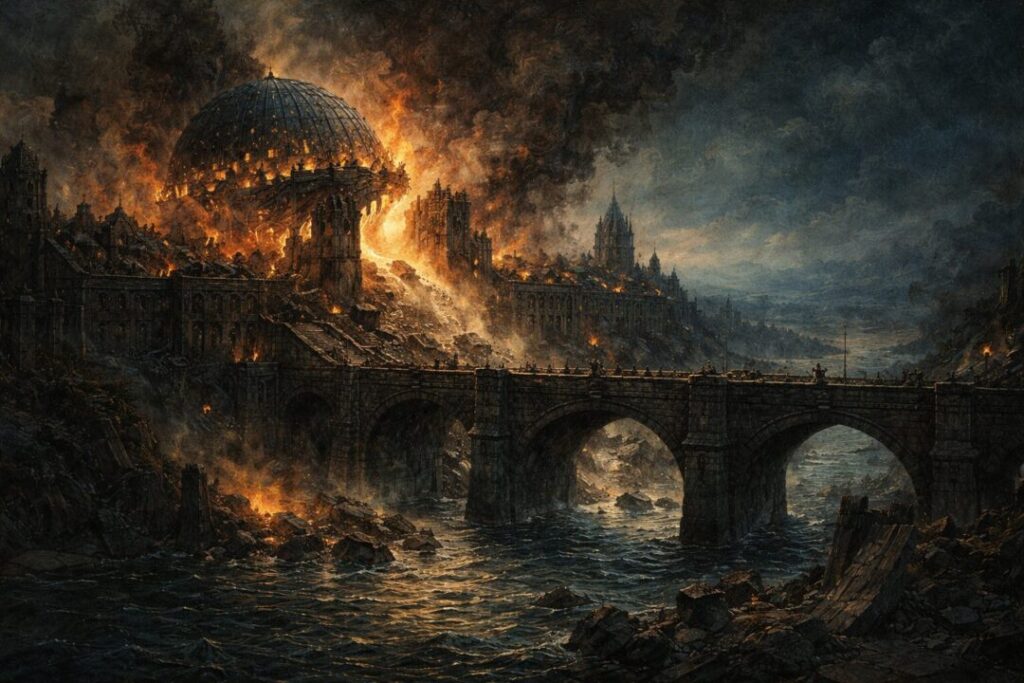
The burning happens during the Kin-strife—a civil war, not an external siege. Osgiliath is contested, assaulted, and set aflame in fighting between rival Gondorian factions.
In that kind of collapse, a large object can be lost quickly—not because nobody valued it, but because the conditions that allow recovery vanish first.
And if the stone fell into the Anduin, the problem changes shape again.
A palantír is not a buoyant thing. It does not float.
If it drops into a great river amid falling masonry, smoke, and ruin, you now have to answer questions the texts never walk you through:
How deep was the water at that point? How strong was the current? How much rubble came down with it? How much of the riverbed shifted in the following days, months, and years?
The lore does not provide those engineering details.
What it does provide is the conclusion: it was lost, and remained lost.
Why the texts never show a recovery attempt
Here is the uncomfortable part for anyone hoping for a neat, canonical explanation.
The writings do not say: “They searched for it and failed.”
They also do not say: “They chose not to search.”
They simply move on.
So any answer to “Why was it never recovered?” has to be framed carefully.
What we can do is look at what the texts do explain about palantíri in general—especially why possession and certainty mattered.
In the Unfinished Tales discussion (as quoted in lore summaries), Gondor’s leadership later faced a critical uncertainty about another stone: whether the Ithil-stone had been destroyed when Minas Ithil fell, or seized and brought into the possession of the Enemy.
That uncertainty affects policy: if you do not know who holds a seeing-stone, you do not know who might answer it, or what might look back.
This matters for Osgiliath—not because the texts say “they feared Sauron would get the Osgiliath-stone,” but because they show a real precedent: palantíri become politically dangerous the moment their chain of custody breaks.
So, with claim-control intact, we can say this much:
- The lore does not record a recovery attempt.
- The lore does record that later Gondor treated uncertainty about a stone’s fate as strategically serious.
From there, plausible factors (clearly labeled as inference) begin to gather.
The most conservative explanation: it was physically unrecoverable in practice
If the stone fell into the Anduin during the destruction of the Dome of Stars, then the simplest reading is:
It sank, was buried, or was swept away.
And the longer time passed, the less realistic retrieval became.
This doesn’t require secret plots or hidden hands.
It requires only what rivers do over centuries: move sediment, collapse banks, swallow ruins, and erase precise memory.
Unfinished Tales even leaves the door open to the most final version of that process—being carried onward toward the Sea.
Not “stolen.”
Not “destroyed.”
Just… beyond reach.
That kind of loss has precedent in the legendarium: objects can be functionally lost without being broken.
And that is exactly how this palantír is treated: absent, unreturned, not reappearing in any later hand.
A political explanation (inference): Gondor had bigger emergencies, and fewer safe opportunities
After the Kin-strife, Gondor does not enter an era of calm prosperity where kings can fund slow, careful salvage.
It remains a realm with long borders, recurring threats, and later catastrophes (none of which the lost-stone entry pauses to resolve).
The texts don’t explicitly connect those later troubles to the Osgiliath-stone’s non-recovery.
But they do show that Osgiliath itself declines, and that governance and power shift westward to Minas Anor (later Minas Tirith).
Even without adding non-canonical detail, the implication is straightforward:
Recovering a heavy object from a great river under ruined, strategically exposed conditions would require stability, safety, and sustained effort.
The narrative never gives Gondor that moment.
The unsettling possibility the texts allow: nobody could even be sure where it ended
This is where the Unfinished Tales wording matters most.
If the stone “may have lain still in the Anduin… or may have rolled on toward the Sea,” then even in the internal logic of the lore, the last known point is not a fixed location.
That uncertainty doesn’t just frustrate modern readers.
It would have frustrated Gondor.
Because the palantíri are not described as items you can simply “track” with another stone at will. Their use is bounded by will, right, knowledge, and limitation—enough limitation that Unfinished Tales treats “uncertainty about where a stone is and who holds it” as a real condition with consequences.
So the lost palantír of Osgiliath isn’t only a missing artifact.
It is a missing certainty.
And when certainty vanishes in Middle-earth, recovery is never guaranteed.
So where is it?
If you want the strictest lore answer, it is this:
The Osgiliath-stone was lost in T.A. 1437 in the Burning of Osgiliath.
Later notes place its fall into the Anduin, and concede uncertainty afterward—either still in the river or carried onward.
Everything else is storytelling built on top of a gap.
And the reason the question keeps its grip on readers is that it is one of the rare cases where the lore hands you a priceless object, tells you the moment it was lost… and then refuses to give you closure.
Not with a final owner.
Not with a recovery.
Not even with a definite resting place.
Just the Great River flowing on—past ruins, past wars, past the end of the Third Age—carrying one of Gondor’s oldest instruments of sight into darkness, silt, and silence.
And that may be the most Middle-earth answer of all.