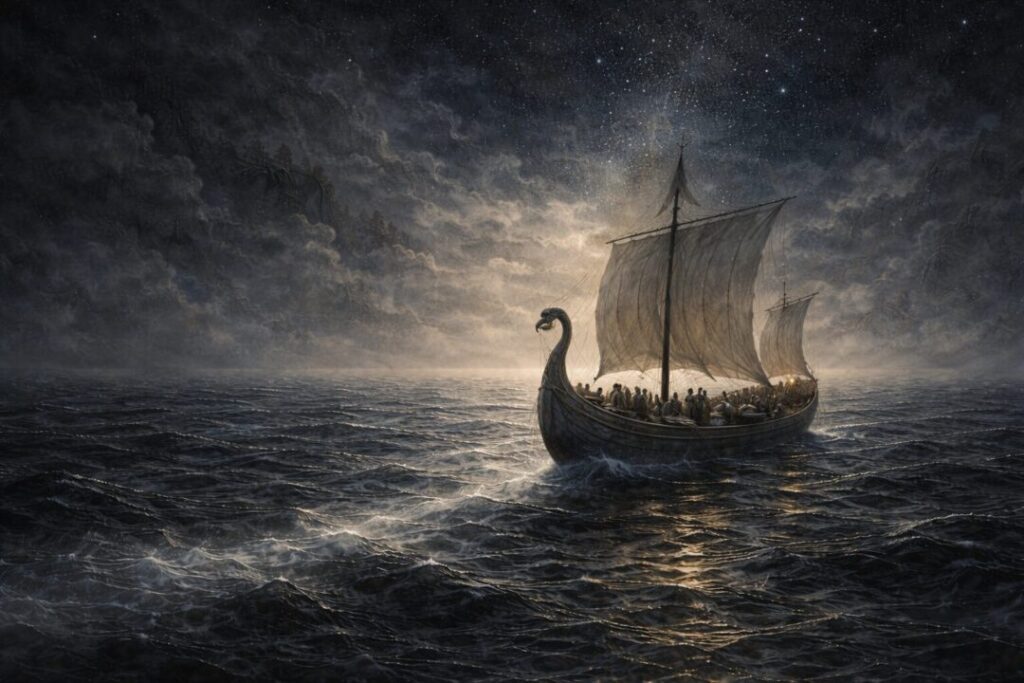
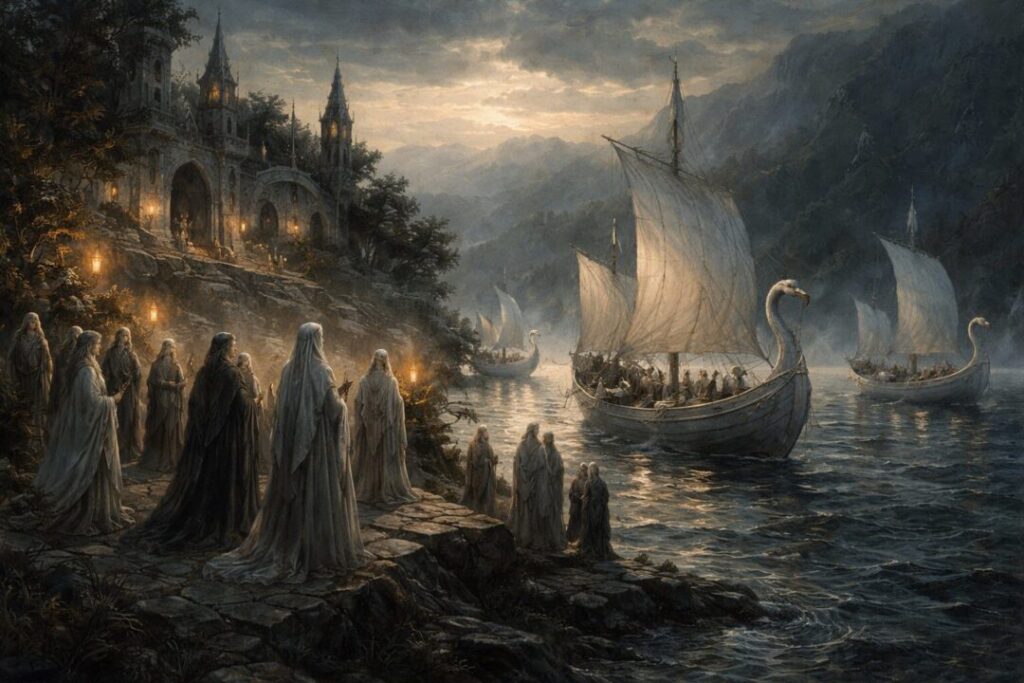
By the end of the Third Age, the ships of the Elves are leaving Middle-earth.
They depart quietly from the Grey Havens, slipping west beyond the sight of Men, carrying with them figures like Elrond, Galadriel, and eventually Frodo himself. There is no battle, no great farewell witnessed by crowds, no announcement to the world that an age is ending. The ships simply move out across the water, and then they are gone.
The story tells us they are “sailing into the West.”
For many readers, this phrase feels deliberately vague—almost poetic rather than precise. It sounds like a metaphor for peace, or perhaps for death, or even for Heaven.
But in Tolkien’s world, it is none of those things.
The Elves are going somewhere very specific. And the reason Men cannot follow them has nothing to do with distance, danger, or lack of courage.
It has to do with the nature of the world itself.
The Destination Is Not “Another Continent”
The Elves are sailing to Valinor, also known as the Undying Lands, which lie within Aman.
This is often misunderstood.
Valinor is not simply a beautiful land across the sea, nor is it a hidden island that mortals have failed to discover. In the earliest ages of the world, it was a physical place that could be reached by sailing west—if permission was granted. Elves made that journey openly. Even Men, in rare and honored circumstances, were allowed to approach its shores.
But that world no longer exists.
The pivotal moment comes with the Downfall of Númenor. When Ar-Pharazôn attempted to seize immortality by force and invade the Undying Lands, the very structure of the world was changed. The Earth was bent. Aman was removed from the ordinary geography of the world and placed beyond it.
From that moment on, Valinor ceased to be part of the same physical reality as Middle-earth.
This is the single most important fact to understand.
Men cannot reach Valinor by navigation, seamanship, or determination.
Not because the sea is too wide.
Not because the winds are hostile.
Not because some spell turns them back.
But because Valinor is no longer there in the way Middle-earth is there.
The World That Was Bent
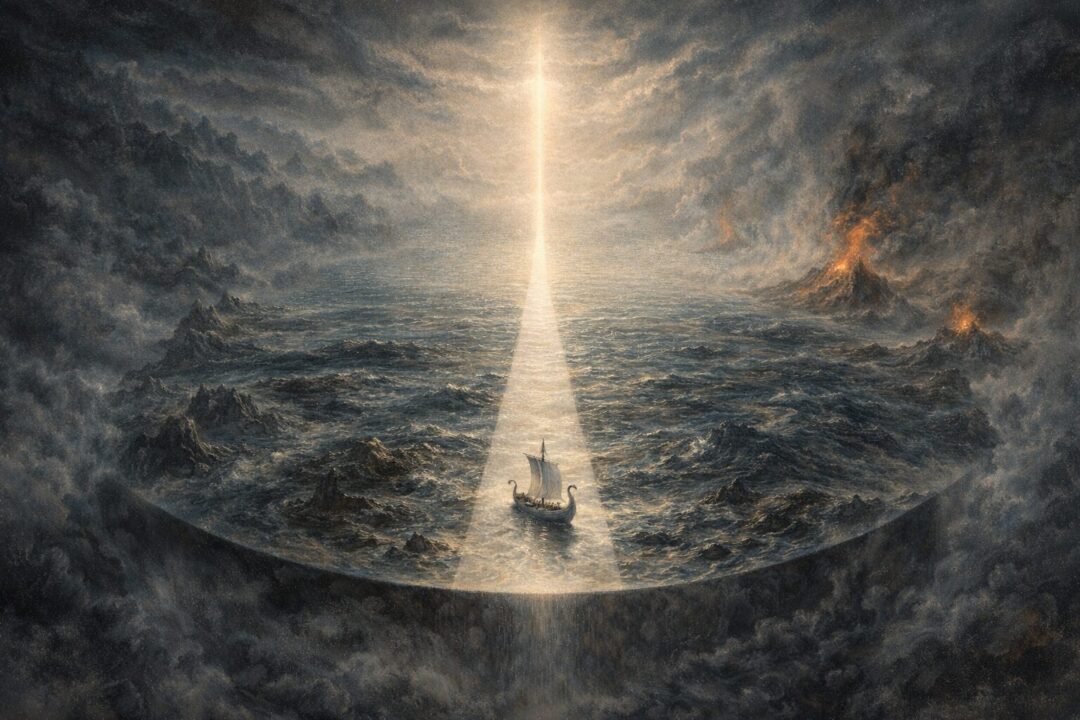
Before the Downfall, the world was flat. Sailing west meant sailing toward Aman. Afterward, the world became round, and the Undying Lands were taken away from its surface.
From a mortal perspective, the sea now curves endlessly. A ship that sails west will eventually come back east—or vanish into the vastness of the ocean.
Valinor exists outside that curve.
This is why no fleet of Men, no matter how noble or skilled, could ever rediscover it. They are not failing to find the right route. They are sailing on a world that no longer contains their destination.
The Straight Road
After the reshaping of the world, only the Elves retained access to what is known as the Straight Road.
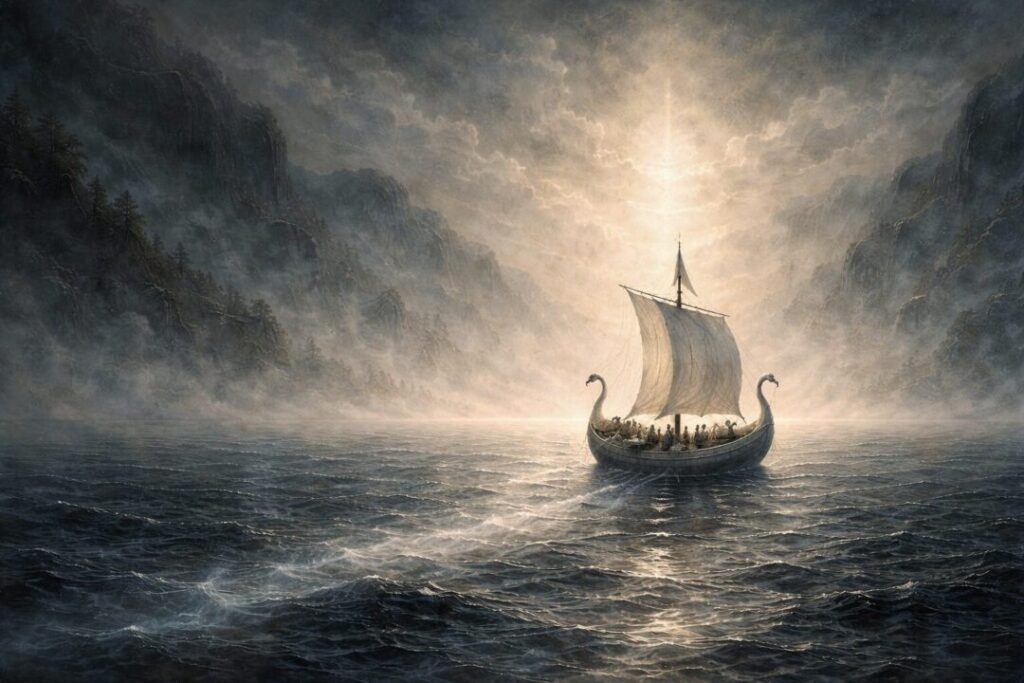
This is not a road in the ordinary sense, nor is it a clearly visible path. It is a way of leaving the bent world altogether. Elven ships do not simply travel west along the ocean’s surface; at a certain point, they pass out of it.
The journey becomes something closer to a transition between states of being than a physical voyage.
This is why the text consistently avoids describing an arrival. Elven ships do not reach Valinor in a way that observers could witness. Instead, they “pass out of sight.”
There is no spectacle.
The sea does not split.
No barrier rises.
No storm announces the crossing.
They simply go where mortal ships cannot.
This quietness is deliberate. The separation between the world of Elves and the world of Men is not enforced with drama or violence. It exists as a fundamental boundary of reality.
Why Elves Can Take the Straight Road
Elves are bound to the world in a way Men are not.
Their spirits are tied to Arda itself, enduring as long as the world lasts. They are not meant to leave it through death in the same way mortals do. Valinor is not a reward for them—it is their proper place within the design of the world.
When Middle-earth changes beyond what they can endure, the Straight Road remains as a final mercy.
This is why the ability to sail west is not based on power, status, or righteousness alone. It is rooted in what the Elves are.
Men, by contrast, are bound to the world only temporarily. Their fate lies beyond it, but not through the Undying Lands.
Could Men Ever Go There?
Under normal circumstances, no.
Even if a mortal sailor followed the exact same course as an Elven ship, they would never arrive. Their voyage would remain confined to the bent world. The Straight Road would not open to them.
There is, however, one exception.
Those who are explicitly granted permission may pass beyond the circles of the world. This happens only once in the narrative, and even then it is presented as an extraordinary act of grace, not a precedent.
Frodo, Bilbo, Sam, and Gimli do not go to Valinor because they earned it through courage or wisdom alone. They go because their suffering has altered their place in the story. They are wounded beyond the healing of Middle-earth.
Even so, the text is careful to emphasize what this does not mean.
They do not become immortal.
They do not escape death.
They do not become Elves.
They go to find healing—not eternity.
Is Valinor “Protected by Magic”?
This is a common modern assumption, but it misunderstands the nature of Tolkien’s world.
There are no wards, no guardians, no enchantments that turn ships away at the horizon. Valinor is not defended like a fortress.
Its protection is metaphysical, not defensive.
After the reshaping of the world, Valinor exists on a different plane of reality. Mortal beings cannot reach it because it is no longer part of their experiential world.
It is less like a castle behind walls, and more like a shore that no longer belongs to the same ocean.
Why the Elves Must Leave
The sailing of the Elves is not an escape from danger.
It is a necessity.
As the power of the Rings fades and the dominion of Men begins, Middle-earth becomes increasingly unsuitable for Elves. Time weighs heavier. Memory becomes sharper and more painful. The world moves on, but they remain bound to what has been lost.
To stay is to diminish.
This is why their departure is described as a fading rather than a defeat. The Elves are not overthrown. They are not conquered. They simply no longer belong at the center of the world’s story.
Their role is ending.
The Quiet Ending of an Age
This is why the final departures feel so subdued.
There is no victory song.
No last stand.
No world-shaking catastrophe.
Only white ships, grey waters, and the slow closing of a chapter that began before the Sun and Moon.
The Elves leave not because they have failed, but because the world has changed beyond them.
Why This Matters
The departure of the Elves is one of the most misunderstood elements of the legendarium. It is often treated as a reward, or as a magical escape from sorrow.
It is neither.
It is the final act of a long fading.
Men inherit Middle-earth not because they conquer it, but because it is now shaped for them alone. The Elves pass on. The Straight Road closes behind them.
And that is why no fleet of Men—no matter how noble, brave, or wise—could ever follow.
Not because they are unworthy.
But because the world they sail upon is no longer the same.