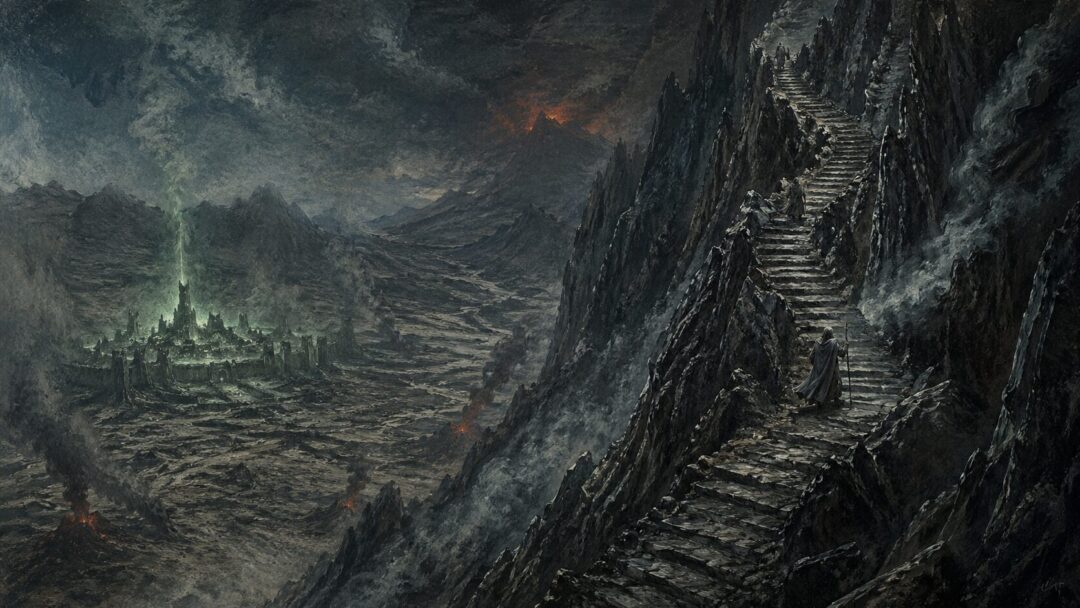
The Secret Stairs feel as if they belong to Mordor.
They rise out of darkness. They cling to the Mountains of Shadow. They lead Frodo and Sam away from the open road and into a place of hunger, webs, Orcs, and dread. By the time the Hobbits begin climbing, the reader already knows something is wrong.
Gollum has chosen this road.
And Gollum is not leading them there out of kindness.
Yet the Stairs of Cirith Ungol are more complicated than they first appear. They are not simply a villain’s trap. They are not clearly described as a secret entrance made by Sauron. They are not even given a definite maker in the text.
That is the first important point.
We are never told exactly who created them.
And because of that, the Secret Stairs become one of the more quietly unsettling pieces of geography in The Lord of the Rings. They are a road whose present use is clear, but whose origin is uncertain. A road that may once have served vigilance, not treachery. A road that may have been built to guard Mordor — and later became one of the only ways into it.
The Stairs Were Not Truly Secret
The phrase “secret way” can be misleading.
To Frodo and Sam, the route is secret because they do not know it. It is hidden from the main road through the Morgul Vale, and Gollum presents it as an alternative to the Black Gate. Compared with the watched, militarized entrances of Mordor, it feels like a hidden path.
But it was not unknown.
The Orcs of the Tower of Cirith Ungol knew of the stairs and the pass. Gollum knew the way from earlier experience. Shelob’s lair was not some accidental cave beside an unused trail. It lay along a dreadful passage associated with old fear and dark rumour.
So the “secret” is really a secret only from the Hobbits and from those who would not dare seek such a path.
It is not a forgotten back door that no one in Mordor understands.
It is a perilous high route, little used, feared, and watched in its own way.
That distinction matters, because it changes the question. We should not ask, “Who built a secret entrance for Frodo?” No one did. The road was there long before Frodo came.
The better question is: who first needed a path there at all?
What the Text Actually Gives Us
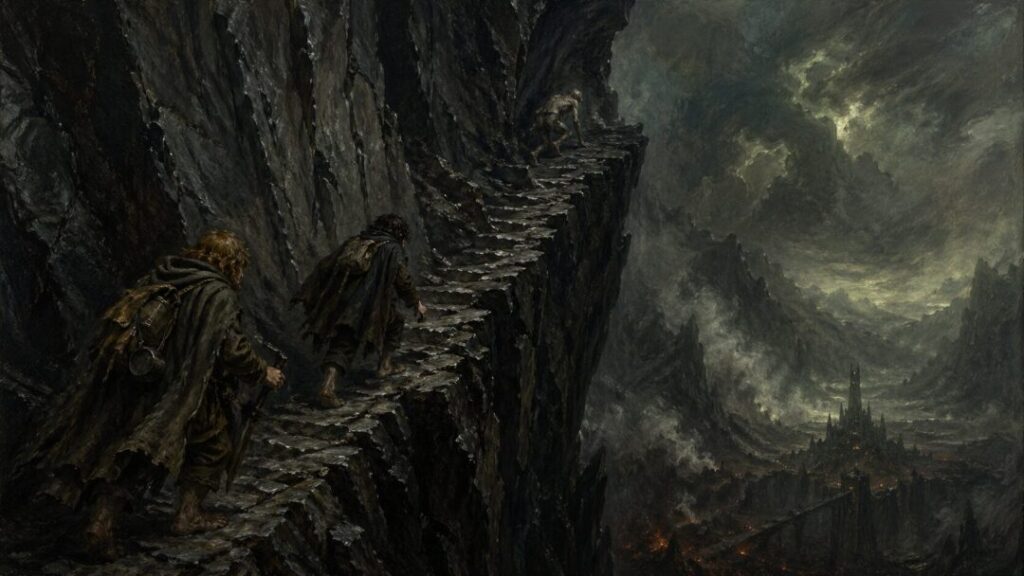
The road begins near the Morgul-road and climbs from the valley beneath Minas Morgul. It rises through the Straight Stair and then the Winding Stair, moving upward along the harsh western mountains of Mordor. From there it reaches the pass of Cirith Ungol, near Shelob’s tunnel and the Tower.
The geography is important.
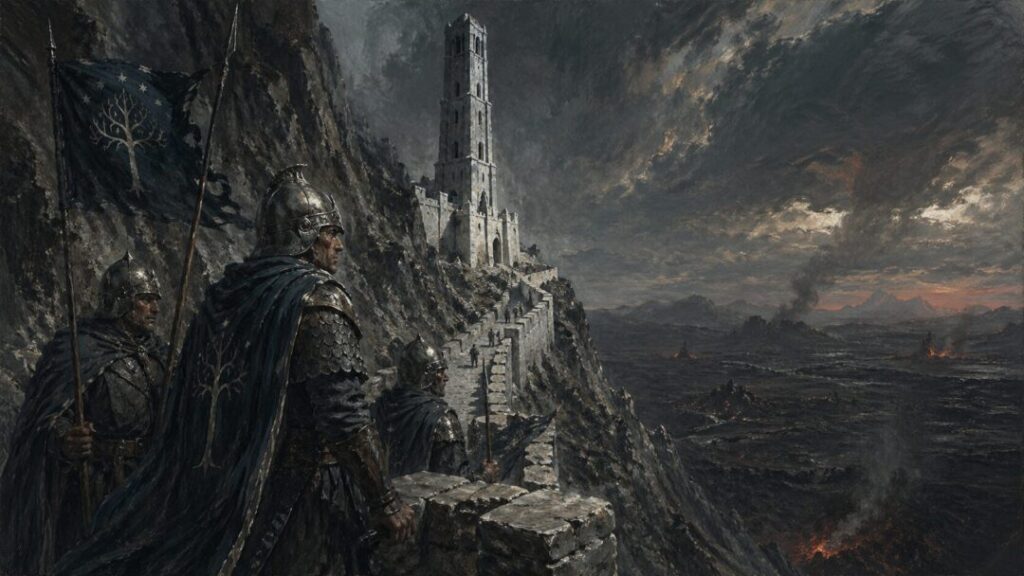
This is not a random stairway into emptiness. It connects a dangerous mountain route with a fortified point. At the far side of the pass stands the Tower of Cirith Ungol, and that tower has a known origin.
It was originally built by Gondor after the War of the Last Alliance.
Its purpose was not to serve Sauron. It was built to guard the pass and watch Mordor after Sauron’s overthrow. In other words, the Tower began as part of a defensive system. Gondor had reason to fear that evil might stir again in the Black Land, and Cirith Ungol was one of the ways by which danger might move through the mountains.
That does not prove Gondor built the stairs.
But it makes Gondor one of the strongest possibilities.
Possibility One: The Stairs Were Made by Gondor
If the Stairs were made by Gondor, their original purpose was likely practical.
A tower guarding a mountain pass needs access. Guards must be able to reach it. Supplies must move. Messages must travel. Watchmen must patrol the approaches. A stronghold cannot simply exist in isolation on the edge of a cliff without some way to reach it.
This makes a Gondorian origin plausible.
Under this reading, the Secret Stairs were not created as a dark path into Mordor. They were part of the guard against Mordor. They belonged to the same logic as the Tower of Cirith Ungol: vigilance, containment, and watchfulness.
That would make their later role deeply ironic.
By the end of the Third Age, the Tower is no longer held by Gondor. It is held by Orcs. Minas Ithil has become Minas Morgul. The old works of defense have been captured, corrupted, or repurposed. What was raised to watch the Shadow now serves the Shadow.
The Stairs would fit that pattern perfectly.
A road made for guardians becomes a road used by Gollum.
A high pass once watched by Men becomes the hunting ground of Shelob.
A defensive route becomes the path by which the Ring enters Mordor.
This possibility is powerful because it matches one of the recurring tragedies of Middle-earth: good works do not always remain in good hands.
Possibility Two: The Stairs Were Made by Sauron’s Servants
The other possibility is that the Stairs were carved by servants of Sauron.
This cannot be ruled out.
Mordor was not only a wasteland of fire and ash. It had roads, fortresses, gates, mines, and military organization. Sauron’s realm required movement and control. The Tower of Cirith Ungol, once captured, became part of Mordor’s own defensive network. A route between Minas Morgul, the pass, and the tower would have had value to the servants of the Dark Lord.
If the stairs were made or remade by Sauron’s servants, their purpose may have been military or administrative: a way to move between strongholds, watch the upper pass, or maintain control over a dangerous but useful route.
But even here, we must be careful.
The text does not say Sauron ordered the Stairs made. It does not say the Witch-king built them. It does not say Orcs carved them for Shelob. Those are possibilities, not facts.
What can be said is more restrained: by the late Third Age, the route belonged to the geography of Mordor’s borderlands. It was known to Mordor’s servants. It connected places under the Shadow’s power. And it was dangerous enough that most enemies would never choose it.
That alone made it useful.
Shelob Was Not the Builder
Shelob is central to the terror of the road, but she should not be treated as its architect.
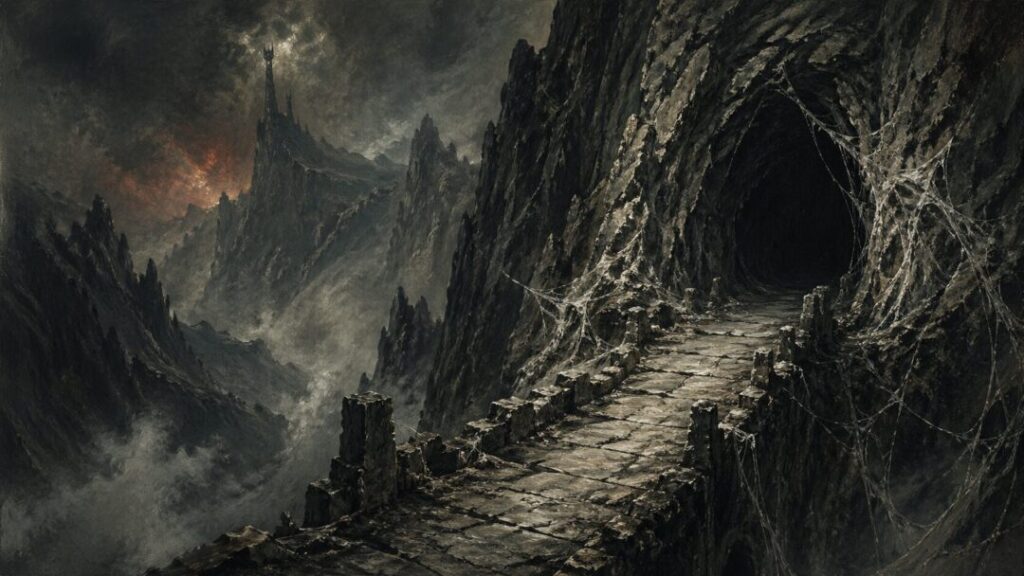
She is not described as building the stairs. She is not a servant in the ordinary sense. She is an ancient horror dwelling in the mountains, older than Sauron’s later occupation of that region in the Third Age. Sauron knew of her and was content to let her remain there because she made the pass more deadly.
But that is not the same as saying he created the path for her.
Shelob’s presence turned the route into a trap. Gollum counted on that. He knew that if Frodo and Sam entered her darkness, she might do what he could not.
Still, the stairs themselves belong to a different question.
They are made works: steps cut into the mountain. Shelob is the horror waiting beyond them, not the hand that shaped them.
Why Would Anyone Build a Road So Dangerous?
This is where the Stairs become more interesting than a simple “evil passage.”
A road can outlive its purpose.
When it was made, the surrounding situation may have been very different. If Gondor built or maintained the route, then the danger of Shelob may have been known, feared, avoided, or not yet understood in the same way. The Tower’s purpose was to guard the pass, not necessarily to invite travel through every part of it.
If Mordor’s servants made or reshaped the stairs, then danger was not a flaw. It was an advantage. A route that enemies feared could still serve those who knew how to use it, or those willing to risk others upon it.
By Frodo’s time, the whole region has become layered with old purpose and new corruption. Minas Ithil is no longer a city of the Moon but Minas Morgul. The road that once belonged to Gondor’s eastern defense now lies under the shadow of the Nazgûl. The Tower that was built to keep watch over Mordor now imprisons enemies of Mordor.
The Stairs sit inside that same reversal.
They are not frightening only because they are steep.
They are frightening because they show how history itself has been twisted.
Gollum’s “Secret Way”
For Gollum, the Stairs are not a mystery of ancient engineering. They are an opportunity.
He knows Frodo cannot enter Mordor by the Black Gate. He knows another way. And he knows what waits there.
That is the cruelty of his guidance. He does not need to overpower Frodo and Sam himself. He only needs to lead them to a place where the land, the dark, and Shelob can do the work for him.
But Gollum does not create the evil of the place.
He exploits it.
The road was already there. The tunnel was already there. Shelob was already there. The Tower was already there. Gollum’s treachery lies in bringing the Ring-bearer into a geography of accumulated danger and pretending it is mercy.
This is why the Stairs feel so oppressive. They are not merely a path through rock. They are a narrowing of choices. Every step upward takes Frodo farther from open paths and closer to a trap that was waiting long before he was born.
The Most Careful Answer
So who created the Secret Stairs as a way into Mordor?
The most lore-accurate answer is this:
We do not know.
The text never directly identifies their maker.
The two strongest possibilities are that they were carved by Gondorians in connection with the Tower of Cirith Ungol, or by servants of Sauron for use along Mordor’s western border. Of those possibilities, the Gondorian connection is especially meaningful because the Tower itself was originally built by Gondor to guard the pass after Sauron’s defeat.
But certainty is not possible from the text alone.
What we can say is that the Stairs were not created for Frodo. They were not a special hidden road made for the Quest. They were part of the older geography of the border: the Morgul Vale, the high pass, Shelob’s tunnel, and the Tower of Cirith Ungol.
Their purpose depended on who made or controlled them.
In Gondor’s hands, they would have served watchfulness and defense.
In Mordor’s hands, they became part of fear, control, and entrapment.
In Gollum’s hands, they became a betrayal.
And in Frodo and Sam’s hands, they became the impossible road by which hope entered the land where hope should not have been able to go.
The Road That Changed Meaning
The Secret Stairs are one of those places in Middle-earth where the physical world carries moral history.
A tower can be captured.
A city can be renamed.
A road can be turned against the purpose for which it may have been made.
That may be the real answer hidden in the Stairs of Cirith Ungol. Their maker is uncertain, but their meaning is not. By the time Frodo climbs them, they embody the ruin of old vigilance. They show what happens when the works of watchmen fall into the hands of the thing they were built to watch.
And yet the reversal does not end there.
Because the same road that Mordor uses, the same road Gollum twists into treachery, the same road haunted by Shelob, becomes the road that allows the Ring-bearer to pass where armies could not.
The Secret Stairs were not built for salvation.
They may not even have been built for secrecy.
But in the end, they carried two Hobbits into the heart of the Shadow — and that made all the difference.
Sources & Notes
- J.R.R. Tolkien, The Lord of the Rings, Book IV, Chapter 8, “The Stairs of Cirith Ungol” — the direct account of Gollum leading Frodo and Sam from the Morgul-road up the Straight Stair and Winding Stair toward the pass.
- J.R.R. Tolkien, The Lord of the Rings, Book IV, Chapter 9, “Shelob’s Lair” — establishes Shelob as the terror beyond the stairs and notes Sauron’s knowledge of her usefulness without making her the road’s builder.
- J.R.R. Tolkien, The Lord of the Rings, Book VI, Chapter 1, “The Tower of Cirith Ungol” — explains that the tower was built by Gondor after the Last Alliance to watch Mordor and guard against evil returning.
- J.R.R. Tolkien, The Lord of the Rings, Appendix A, “Gondor and the Heirs of Anárion” — gives the wider history of Minas Ithil’s fall into Minas Morgul, framing the region’s captured and repurposed Gondorian works.
- J.R.R. Tolkien, The Silmarillion, “Of the Rings of Power and the Third Age” — summarizes Sauron’s return to Mordor, the vigilance of Gondor, and the later weakening that let the Shadow reclaim old borders.