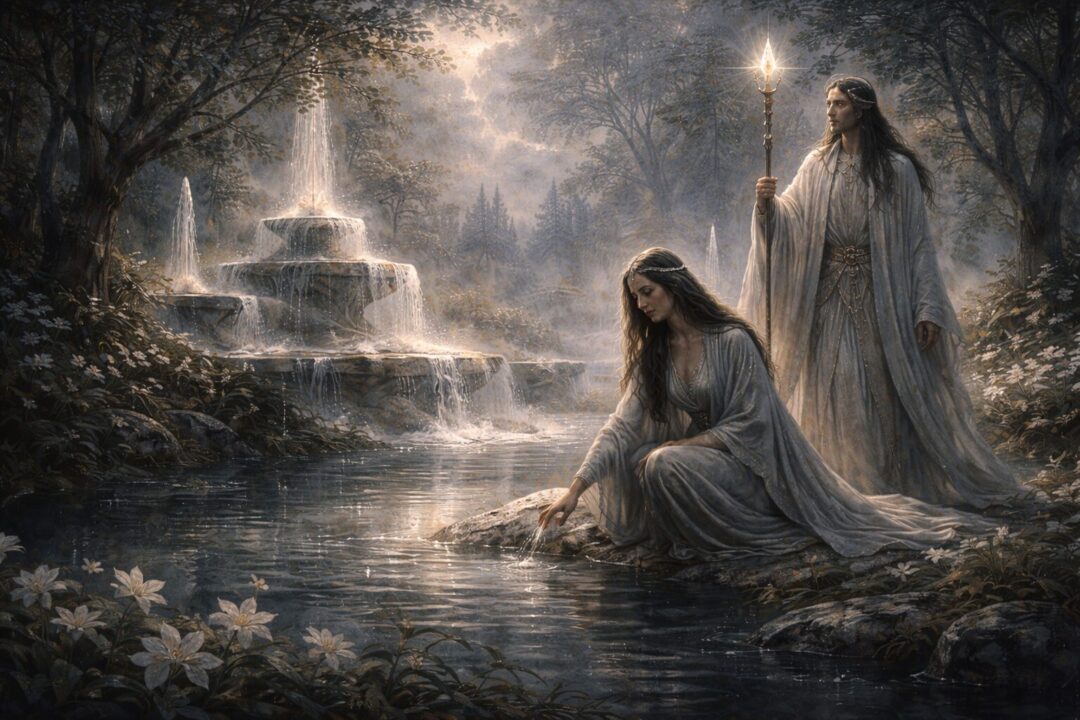
Irmo is one of the Valar, but many readers know him by another name
Irmo is one of the Valar, the great Powers who entered Arda at its beginning. In The Silmarillion, Tolkien identifies him plainly: “Irmo the younger is the master of visions and dreams.” He is more commonly called Lórien, not because that is his original personal name, but because he dwells in the gardens of Lórien in Valinor, and the place-name became attached to him just as Námo is commonly called Mandos after his own halls. Tolkien’s lore sources also connect Irmo and Námo together as the Fëanturi, the “Masters of Spirits,” which already tells you that Irmo’s role is deeper than simply being a pleasant dream-deity.
That matters because Tolkien’s world does not treat dreams as meaningless mental noise. In Middle-earth, dreams sometimes touch memory, soul, foresight, healing, or divine ordering. Irmo stands nearest to that whole domain. But Tolkien still leaves room for mystery, and that is important. Canon supports saying that Irmo is the Vala most associated with dreams and visions. Canon does not support saying that every meaningful dream in the legendarium is explicitly sent by him.
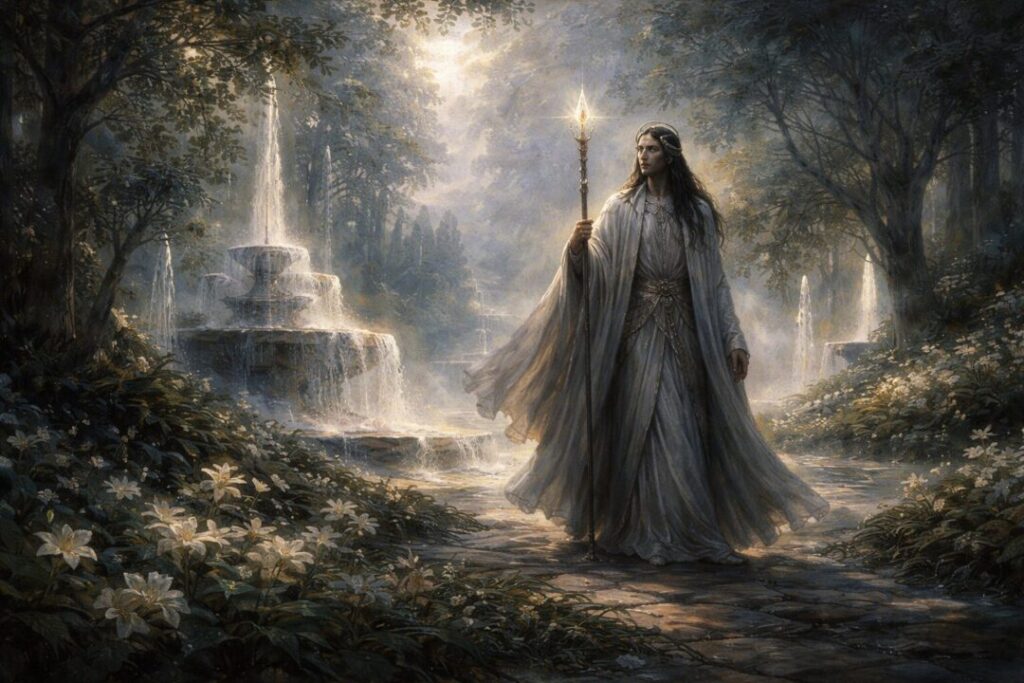
Why he is called Lórien
The name “Lórien” can be confusing because many readers first think of Lothlórien in Middle-earth, Galadriel’s woodland realm. But the older and deeper Lórien is in Valinor, the gardens of Irmo and Estë. Tolkien Gateway and the Encyclopedia of Arda both reflect the same basic tradition: Irmo’s dwelling is so closely tied to dreams, rest, and beauty that the place-name effectively becomes his everyday name. In older phases of Tolkien’s legendarium, the association is even more explicit, with Lórien described as a lord of dreams and imaginings.
This is useful because it reminds us that Tolkien does not separate dreams from landscape. Lórien is not just Irmo’s address. It is an atmosphere: stillness, fragrance, fountains, shadow, healing, quiet. Tolkien’s descriptions tie dream, rest, and renewal together. That same imaginative pattern later echoes in Middle-earth whenever enchanted rest, half-vision, or heightened inward perception appears. That does not mean every later “Lórien-like” moment is literally controlled by Irmo, but it does show that Tolkien built a world where dreams belong to the moral and spiritual fabric of creation.
Irmo’s gardens are a place of rest, healing, and spiritual refreshment
Irmo does not stand alone. His spouse is Estë the Gentle, and together they are linked with restoration and repose. One striking example comes from the creation of the Sun and Moon: when Varda first intended their lights to move in a way that would banish dimness, Irmo and Estë objected because sleep and rest had been driven from the world. As a result, twilight remained part of Arda. That detail says a great deal about Tolkien’s outlook. Rest is not laziness. Sleep is not merely biological. Both are woven into the good design of the world.
Another major example is Míriel, the mother of Fëanor. After giving birth, she became so spent in body and spirit that she went to Lórien to rest, and there her fëa departed from her body. Whatever else one says about that tragic story, Tolkien clearly presents Lórien as a place where weariness of spirit is treated with seriousness and dignity. It is a place of deep recovery, even when recovery becomes impossible within ordinary life.
So when readers reduce Irmo to “the dream guy,” that undersells him. He belongs to a whole Tolkienian structure that links dream, rest, beauty, mercy, inward healing, and spiritual perception.
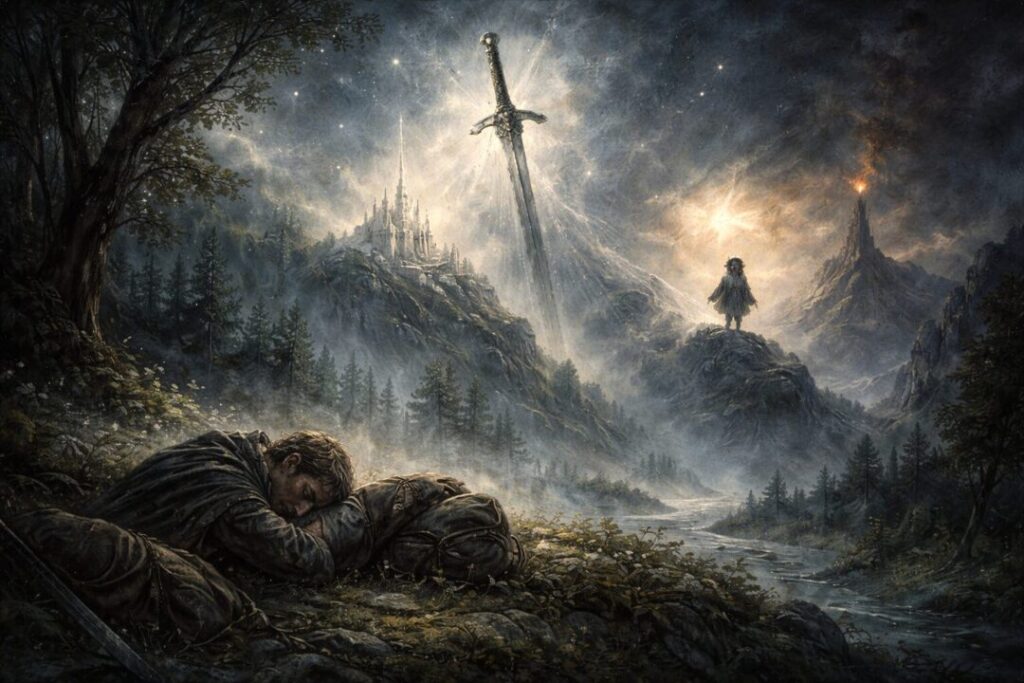
What dreams actually do in Tolkien’s world
Dreams in Tolkien are not all the same. Some are symbolic. Some are predictive. Some feel like heightened perception. Some are hard to classify at all. The important point is that Tolkien uses dreams as one of the ways truth reaches characters indirectly.
The clearest example is the dream received by Faramir, and later once by Boromir: the verse beginning, “Seek for the Sword that was broken.” Tolkien explicitly presents this as a dream with real guidance value. It points toward Rivendell, the broken sword, Isildur’s Bane, and the coming role of a Halfling. In other words, the dream is not just psychological texture. It conveys genuine information, though in poetic and partial form.
Another well-known case is Frodo’s dream at Tom Bombadil’s house, where he sees Gandalf on a high tower. At the Council of Elrond, Tolkien connects that dream to Gandalf’s actual imprisonment on Orthanc. Again, the dream is not empty mood-setting. It is a true glimpse, though Frodo only understands it later.
This pattern fits Tolkien’s broader narrative method. Important truths often arrive in forms that demand humility: poems, fragments, old lore, half-remembered names, and dreams. Characters are not usually handed neat explanations. They receive enough to act faithfully, not enough to dominate events by certainty. That is very Tolkien.
Did Irmo personally send those dreams?
This is where lore accuracy matters most.
Tolkien calls Irmo the master of visions and dreams, and that absolutely justifies connecting him to the dream-life of Arda. But Tolkien does not clearly state, in the major canon texts, that Irmo personally authored every prophetic dream seen by Frodo, Faramir, Boromir, or anyone else. Saying “Irmo is associated with such dreams” is well grounded. Saying “Irmo sent this specific dream” is usually an interpretation unless a text states it directly.
That careful distinction helps avoid fan-fiction creep. In Tolkien, many things can be providential without being mechanically explained. A dream may come through the ordering of Eru, through the wider governance of the Valar, through the spiritual nature of the world, or through causes Tolkien leaves mysterious. Irmo is the nearest named Power in that field, but Tolkien preserves ambiguity on purpose.
So the safest lore-accurate wording is this: Irmo is the Vala most closely associated with dreams and visions, and meaningful dreams in Tolkien’s world fit naturally within his sphere, but the texts rarely identify him as the explicit sender of a given dream.
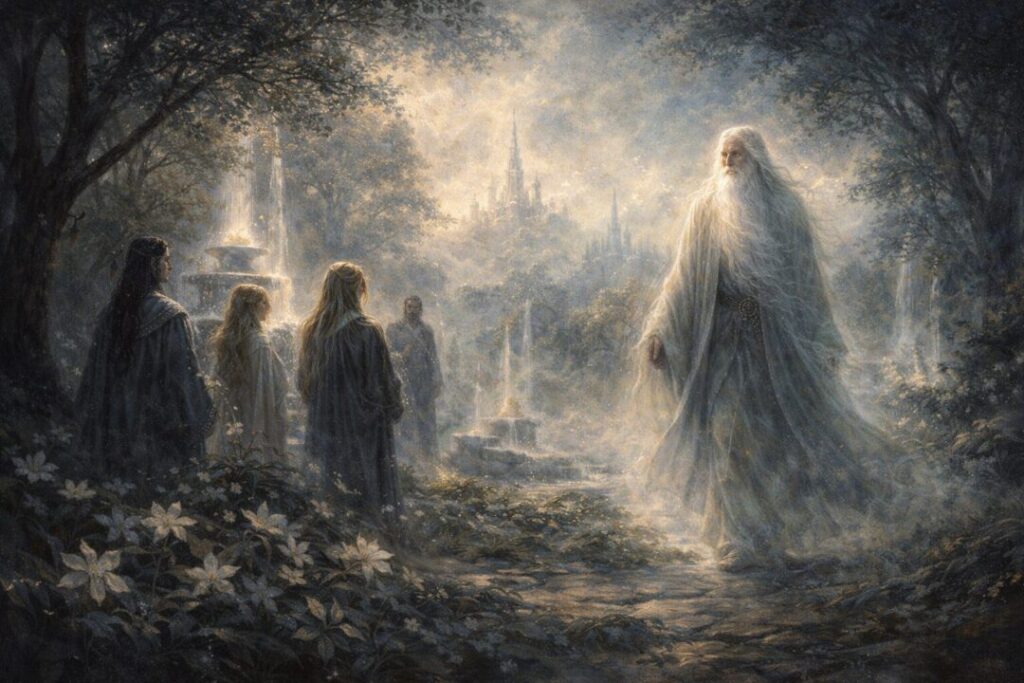
Olórin shows how Irmo’s world reaches the Children of Ilúvatar
One of the strongest links between Irmo and the peoples of Middle-earth comes through Olórin, the Maia later known as Gandalf. Tolkien’s lore says that in his earlier being Olórin lived in Lórien, and he moved among the Elves unseen or in fair form, becoming the source of “fair visions and wise promptings” in their hearts. That is an extraordinary detail, because it shows that Tolkien did imagine dreams and inward visions as a mode by which wisdom could gently be given.
This does not make dreams into a cheap shortcut. Olórin’s influence is not coercive. It encourages, steadies, and heartens. That matches the moral logic of Tolkien’s world, where the good rarely overwhelms freedom. Guidance often comes as suggestion, intuition, courage, or a vision half-understood until later.
In that sense, Irmo’s sphere is not escapist. It is practical. Dreams can prepare the heart to endure reality better. They can warn a person before danger is visible. They can carry hope into the mind before hope can be justified by outward evidence.
Dreams in Tolkien are about truth arriving indirectly
Modern readers sometimes expect fantasy dreams either to be nonsense or to function like plot-delivery devices. Tolkien does something finer. Dreams are one of the places where seen and unseen reality meet. They may be dim, lyrical, unsettling, or symbolic, but they are often meaningful because the world itself is meaningful.
That is why Irmo matters. He stands for more than sleep. He represents a part of creation in which beauty, rest, inward sight, and mystery are still real forces. His gardens in Valinor are not merely decorative background lore. They are one of the clearest signs that Tolkien believed the soul needs quiet as much as action, vision as much as strength, and refreshment as much as battle.
So who was Irmo Lórien? He was the Vala of visions and dreams, lord of the fairest gardens in Valinor, companion of Estë, brother of Mandos and Nienna, and one of the great Powers through whom Tolkien gives spiritual depth to Arda. And what do dreams do in Tolkien’s world? They do what many of the best things in Tolkien do: they reveal truth slantwise, gently, and just enough.