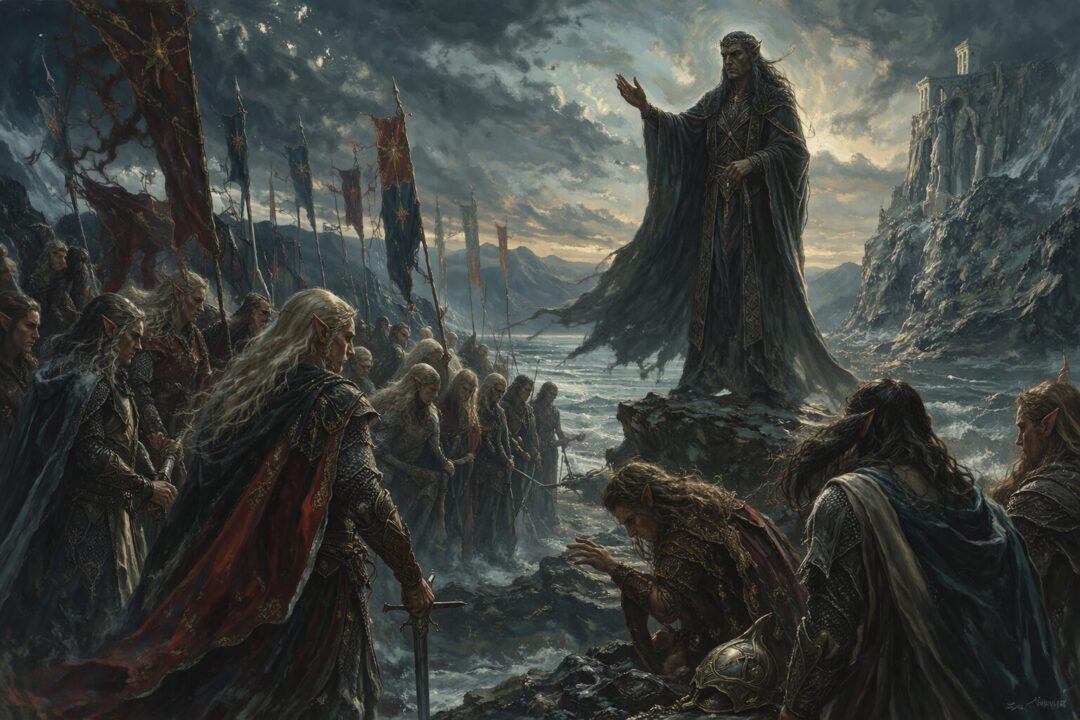
When readers first encounter the name Mandos, they often reduce him to a simple role.
He is treated as the death figure of Middle-earth. A dark power. A keeper of the dead. A stern presence in the background of the Elder Days.
None of that is entirely wrong.
But it is incomplete in exactly the way that matters most.
Because Mandos is not frightening merely because the dead come to his halls. He is frightening because he represents something far more difficult to escape than death.
He represents judgment that cannot be argued away.
In the older sense of the word, “doom” does not mean disaster alone. It means judgment, sentence, pronouncement. And once that is understood, both Mandos and the Doom of Mandos become clearer.
He is not simply the lord of a shadowy afterlife.
He is the one who names what a deed truly is, and what must follow from it.
That is why his most famous moment in the legendarium is not about death at all.
It is about choice.
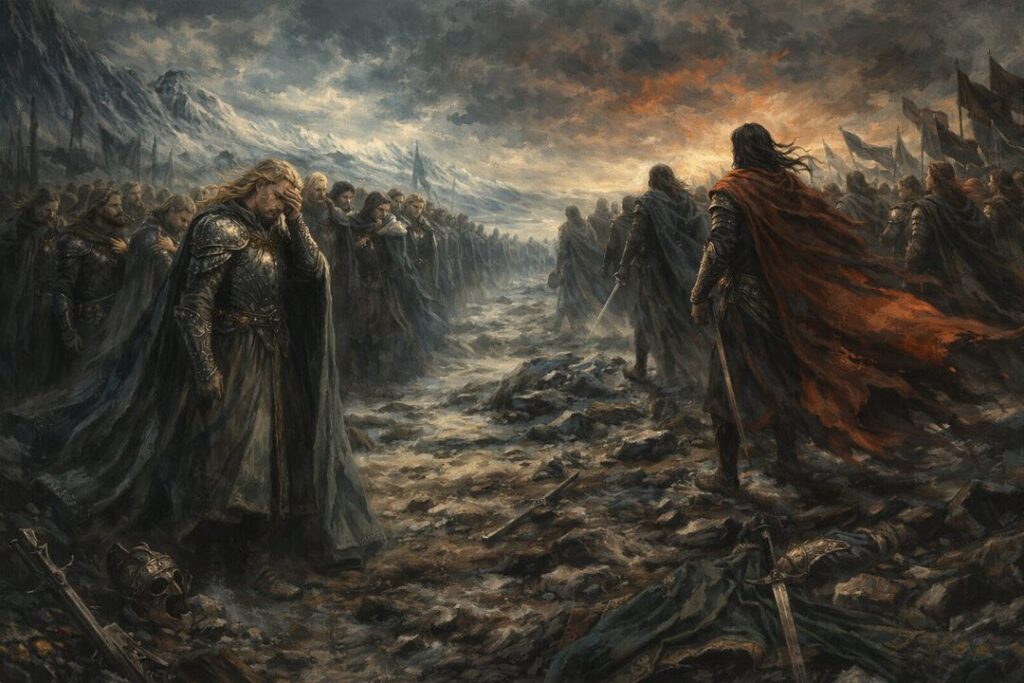
Mandos Is Really Námo
“Mandos” is the name most readers remember, but strictly speaking it is not his true personal name.
His name is Námo.
The Elves more often call him Mandos because of the Halls of Mandos, the place associated with him in Aman. Those halls are the place where the spirits of the slain are summoned, especially the fëar of Elves, who may abide there in waiting.
That detail matters because it already hints at what his role actually is.
He is not merely a jailer of the dead.
He is not a dark god ruling a realm of punishment.
He is not an embodiment of evil.
He is one of the Valar, one of the great Powers of Arda, and his office is bound up with memory, judgment, and the fate of spirits.
The texts present him as the Doomsman of the Valar.
That title is easy to misread in a modern sense. It sounds as if he brings doom the way a destroyer brings ruin. But the older force of the word points somewhere else.
He is the speaker of judgment.
He pronounces what is decreed. He sees more clearly than most the shape of what lies ahead. He does not know everything without limit, because the freedom of Ilúvatar still remains beyond complete foresight. But he knows enough that when he speaks, his words carry terrifying weight.
Not because he invents truth.
Because he announces it.
Why Mandos Is Feared
Mandos is often imagined as cold, and the texts do support that severe impression.
He is not the most comforting of the Valar. He is not associated with delight, craftsmanship, growth, feasting, or healing rest. Even when mercy exists in his sphere, it does not come cheaply.
He forgets nothing.
That may be the most important thing about him.
Middle-earth is full of characters who try to outrun what they have done. They justify themselves. They rename their motives. They wrap pride in nobler language.
Mandos cuts through all of that.
He does not flatter.
He does not soften reality for those who want noble excuses.
He does not pretend that bloodshed committed for a high cause becomes clean.
That is why his presence feels so final.
He is not frightening because he is wild.
He is frightening because he is exact.
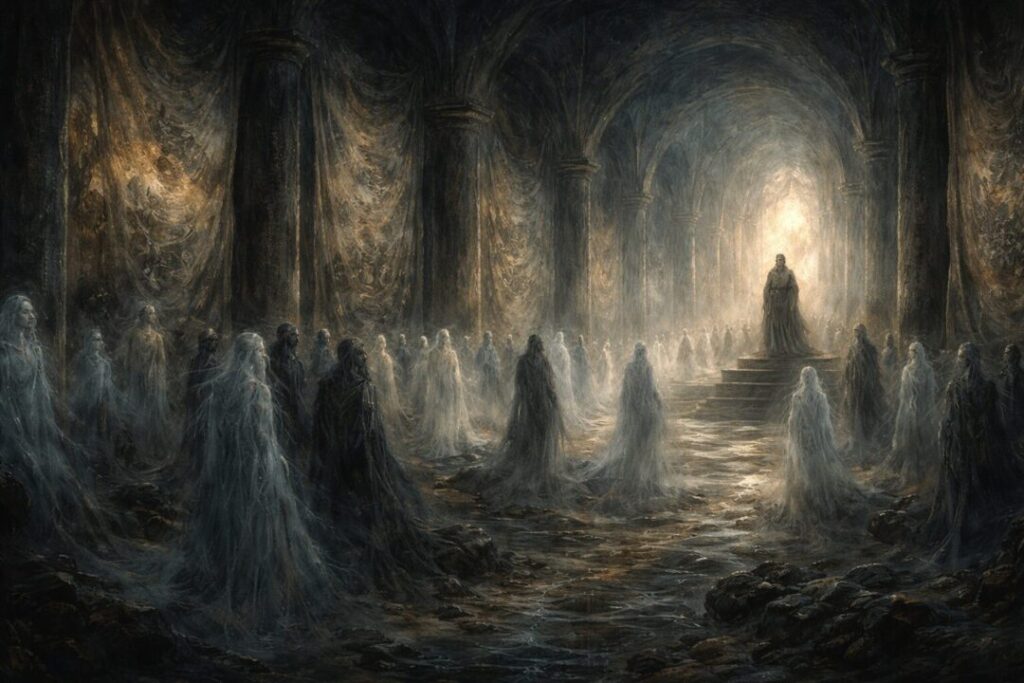
The Doom of Mandos Happens at the Moment of Rebellion
The Doom of Mandos comes after one of the great moral breaks in the history of the Elves.
The Noldor, stirred by grief, pride, rage, and the Oath of Fëanor, set out from Aman in rebellion. Then comes the Kinslaying at Alqualondë, where Elves shed the blood of Elves in pursuit of the ships of the Teleri.
This is the point that cannot be passed over.
The Doom does not fall on an innocent people wandering into tragedy by accident.
It comes after rebellion and kin-slaying.
That order changes everything.
Mandos appears not to create their guilt, but to declare it. His words warn them to turn back and seek pardon. Some do. Finarfin and those with him return. Others continue toward Middle-earth.
That alone tells us something important about how the Doom works.
It is not presented as an unavoidable bolt thrown blindly from heaven onto anyone nearby.
There is still a moment for repentance.
There is still a division between those who turn back and those who press on.
There is still moral agency.
The Doom comes as pronouncement in response to a deed and as warning about the path ahead if that rebellion continues.
Is the Doom a Curse, a Prophecy, or a Sentence?
The deepest answer is that it seems to be all three, but not in equal ways.
It is often called a curse, and that language is traditional enough that it cannot simply be dismissed.
But if we stop there, we miss what makes it so much more unsettling.
The Doom is also clearly prophetic. It foretells grief, treachery, loss, exile, fading, and the long frustration of the Noldor’s desires. Much of what it announces later unfolds in the history of Beleriand with terrible precision.
And yet even “prophecy” is not the full answer.
Because Mandos is the Doomsman of the Valar, his speech also has judicial force. This is not merely prediction in the passive sense, as though he were describing weather already on the horizon. Nor is it merely a spell cast in anger.
It is judgment pronounced on a people who have crossed a line and still refuse to turn back.
That is why the Doom feels heavier than ordinary foresight.
It does not only foresee consequences.
It ratifies them.
Still, care is needed here. The texts do not require us to imagine Mandos mechanically causing every sorrow that follows, as though every betrayal and every death were magically inserted into history by his words alone.
A more conservative reading is stronger.
The Doom declares what kind of road the Noldor have chosen: one in which pride, oath, violence, exile, and possessiveness will keep bearing fruit. The judgment is real. The prophecy is real. But the tragedy continues to emerge through the moral shape of their own actions.
That is what makes it so severe.
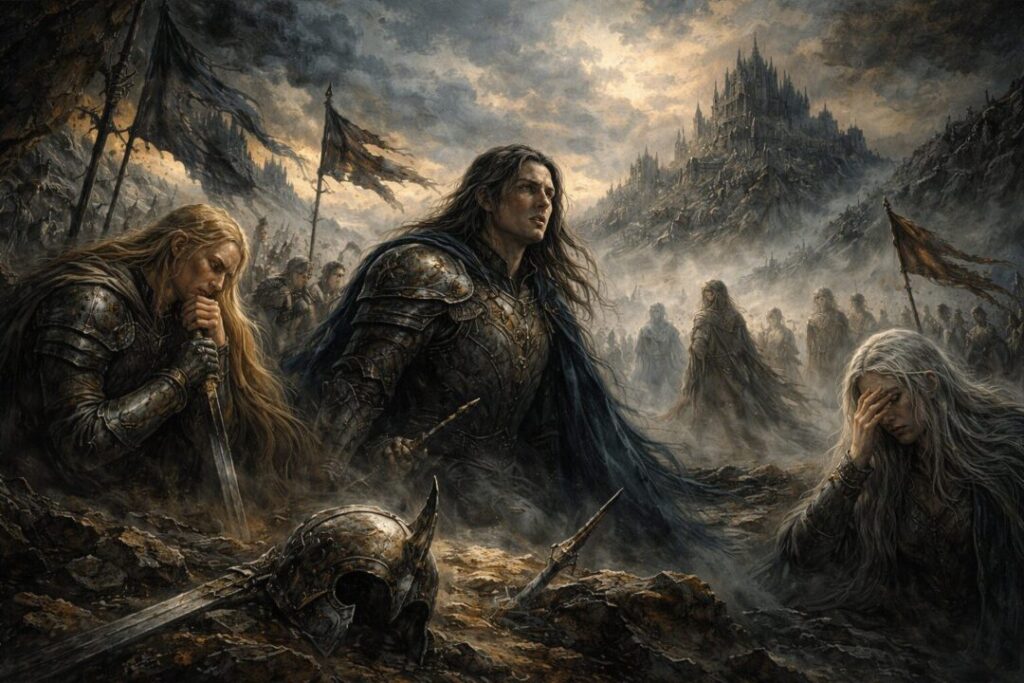
What the Doom Actually Does to the Noldor
One common misunderstanding is that the Doom acts like a simple supernatural hex.
Read that way, the Noldor are almost reduced to victims of a pronouncement.
But the legendarium resists that simplification.
The Doom does not erase responsibility. It sharpens it.
After Mandos speaks, the Noldor know what lies ahead if they continue. They are warned that grief will follow. They are warned that their oath will betray them. They are warned that exile from Valinor is now real. They are warned that even the things they most desire will be snatched from their grasp.
And still they go on.
So the Doom does at least three things.
First, it names the rebellion truthfully.
The Noldor are no longer able to imagine themselves as merely righteous avengers pursuing a clean war. Mandos strips away that illusion. Their cause may still contain real grief and a real hatred of Morgoth, but it is no longer morally pure.
Second, it establishes the judicial consequences of that rebellion.
They are shut out from Valinor. Pardon is no longer presumed. The rebellion now has an announced sentence attached to it.
Third, it reveals the inner logic of the road ahead.
This may be the most important part.
The Oath of Fëanor will not simply drive its makers toward victory. It will betray them. Their possessiveness will not preserve what they love. It will consume it. Their exile will not become a bright heroic conquest. It will become a history of splendor repeatedly marred by grief.
In that sense, the Doom does not merely add suffering from outside.
It exposes how their chosen path already contains suffering within it.
Mandos and the Dead Are Not the Whole Story
Because Mandos is associated with the Houses of the Dead, readers sometimes flatten him into a single symbolic role.
But his connection to the dead actually reinforces the broader point.
He is not merely present at endings.
He is present at reckoning.
The dead come to his halls because death, too, is a place where false stories fall away. For Elves especially, Mandos is part of the order by which their spirits are summoned, judged, and, in many cases, held in waiting. His sphere is bound to what is true after illusion has failed.
That is why his great public act toward the Noldor fits him so perfectly.
They are not dead when he speaks to them in the north.
But morally, something has already ended.
The innocence of their rebellion is gone.
The possibility of pretending they remain unstained is gone.
The dream of a clean departure from Aman is gone.
Mandos names that ending before history fully unfolds from it.
Why the Doom Matters So Much in the First Age
The Doom of Mandos hangs over the First Age because it gives the reader the right frame for nearly everything that follows.
Without it, many later tragedies might look like isolated disasters.
With it, they appear as part of one long moral unraveling.
That does not mean every Noldo is equally guilty, and it does not mean every sorrow is reducible to one sentence spoken in the north. The First Age is more complicated than that. There is heroism among the exiles. There is sacrifice, beauty, endurance, pity, and resistance to Morgoth that remains genuinely noble.
But the Doom makes one thing impossible to forget:
greatness does not cancel guilt.
The Noldor can be brilliant and still burdened.
They can resist evil and still carry the consequences of their own rebellion.
They can build wonders in Middle-earth and still remain under the long shadow of what they did to leave Aman.
That is why Mandos matters.
He forces the story to remember what its heroes would rather leave behind.
The Real Terror of Mandos
The darkest thing about Mandos is not that he rules a place associated with the dead.
It is that he is so hard to evade.
A tyrant can be resisted.
An enemy can be fought.
Even a curse can be imagined as something alien laid upon you from without.
Mandos is more disturbing because he speaks at the place where deed and consequence become inseparable.
He does not merely condemn from a distance.
He names what the rebellion already is.
And that is why the Doom of Mandos still feels so heavy long after its first pronouncement. It is not only a sentence laid upon the Noldor.
It is the moment Middle-earth’s great tragic history is told, with chilling clarity, what it has already become.
Major lore points above were checked against canon-backed summaries of Valaquenta, the account of the Flight of the Noldor, and the traditions surrounding the Halls of Mandos and the fate of Elvish and human spirits.