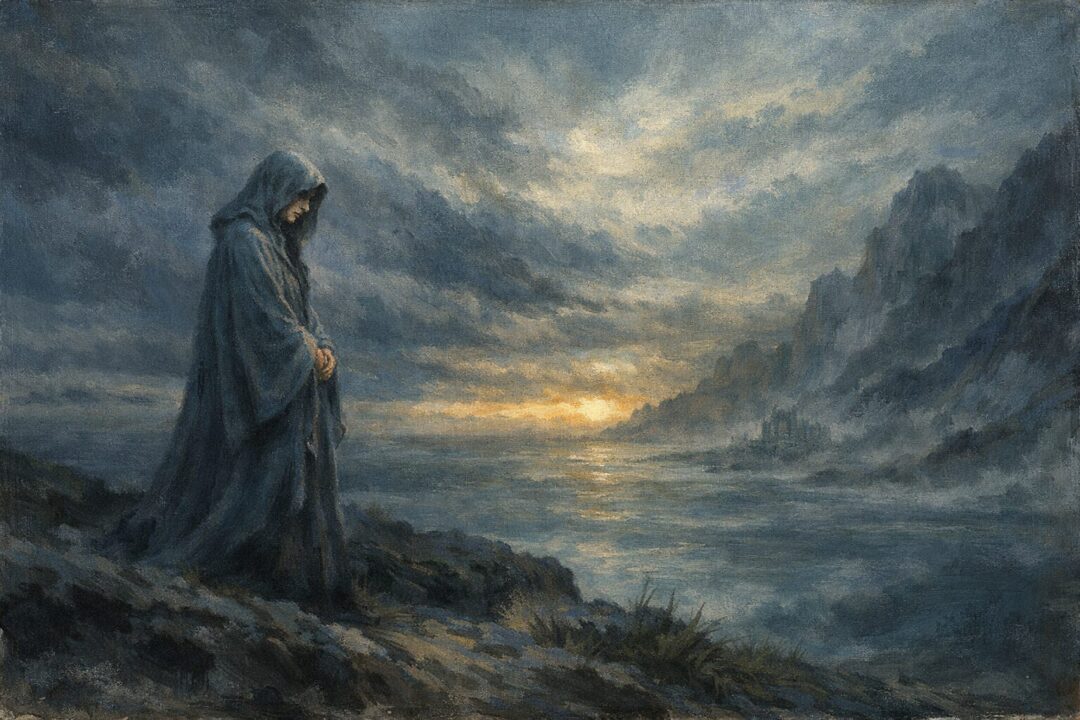
In Middle-earth, power usually arrives in forms the eye can recognize.
It shines in crowns, in swords, in armies, in towers, in terror, in command.
Even when power is hidden, it often still carries the language of mastery. Who can rule. Who can resist. Who can overthrow. Who can endure.
And that is exactly why pity can be easy to miss.
Because in the legendarium, pity does not look strong.
It looks like restraint when violence would be easier. It looks like sorrow that does not harden into cruelty. It looks like mercy shown to the undeserving, or at least to the frightening, the ruined, and the dangerous.
Yet some of the most decisive turns in the history of Middle-earth depend on it.
To understand why, it helps to begin far away from the War of the Ring, with one of the most quietly important of the Valar: Nienna. In The Silmarillion, she is described as acquainted with grief, mourning every wound that Arda has suffered in the marring of Melkor. Those who hearken to her learn pity and endurance. That combination matters. Nienna is not simply sorrowful. Her grief becomes a source of moral strength.
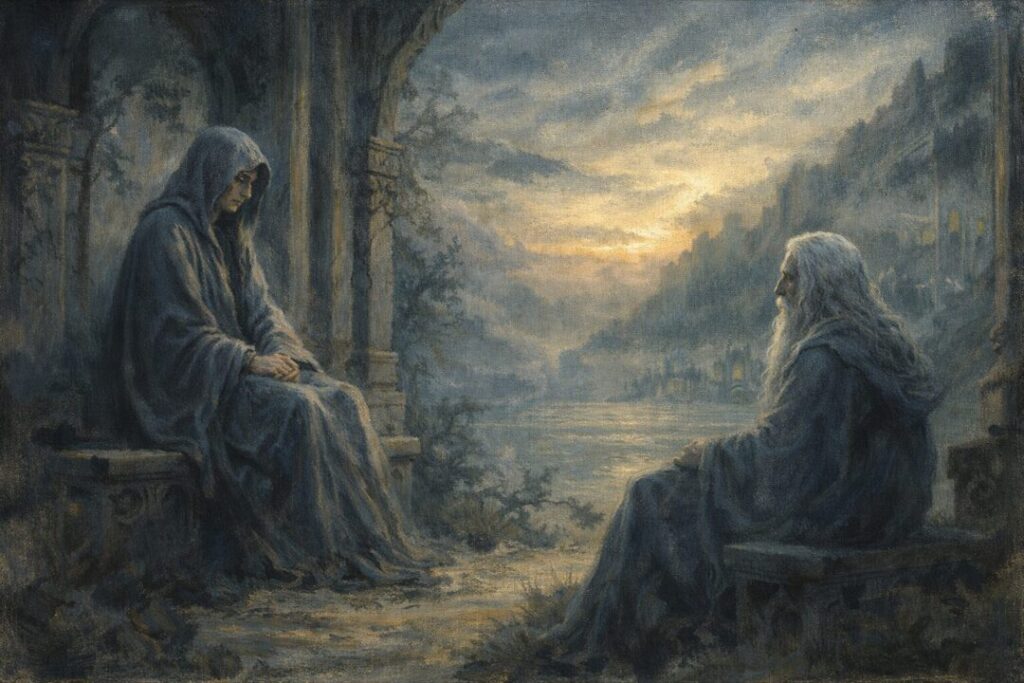
Nienna Is Not the Lady of Despair
This distinction is easy to miss.
Nienna is associated with tears, mourning, and lamentation. Her halls lie in the far West, near Mandos, and she goes often to comfort those in the Halls of Waiting. Her sorrow is ancient. The tradition even places lamentation into the Music before the world fully begins.
But the texts do not frame her as defeated by grief.
Quite the opposite.
The point of Nienna is not that she suffers. The point is what her suffering becomes. Those who listen to her learn pity. They learn endurance. In some versions of the description, that endurance is explicitly linked to hope. Her tears are not the tears of self-absorption. They are the tears of one who sees the wounds of the world clearly and does not turn away.
That is a very different thing from despair.
Despair gives up on meaning.
Nienna’s grief does not.
She mourns because the wounds are real. But her sorrow remains outward-facing. It produces compassion, not paralysis. In Middle-earth terms, that is already a kind of power: the power to remain morally awake in the presence of ruin.
Why Gandalf Matters So Much Here
Nienna might still seem remote if the texts did not connect her directly to one of the central figures of The Lord of the Rings.
But they do.
Olórin, who later comes to Middle-earth as Gandalf, is said to have gone often to Nienna, and from her he learned pity and patience. Tolkien Gateway’s summary here reflects the canonical line from Valaquenta, and it is one of the most important short descriptions of Gandalf’s moral formation.
Once you notice that, Gandalf’s role in the story sharpens.
He is powerful, certainly. But his deepest strength is almost never displayed as domination. He does not solve the central crisis by overpowering everyone else. He warns, guides, rebukes, encourages, and awakens courage in others. Even Tolkien Gateway’s character summary notes that he follows Nienna’s example by taking pity on the sorrows of the Children of Ilúvatar and lifting despair where he can.
That makes his words about Gollum far more significant than they first appear.
When Frodo says it is a pity Bilbo did not kill Gollum, Gandalf reverses the thought completely. The true pity, he says, is the pity that stayed Bilbo’s hand. He warns Frodo not to be too eager to deal out death in judgment, and says the pity of Bilbo may rule the fate of many. That is not sentimental language. It is prophetic moral language. Gandalf is telling Frodo that mercy can have consequences no one wise enough can yet fully see.
And in hindsight, he is right.
Bilbo’s Pity Is Small in Scale but Vast in Consequence
The choice itself is almost modest.
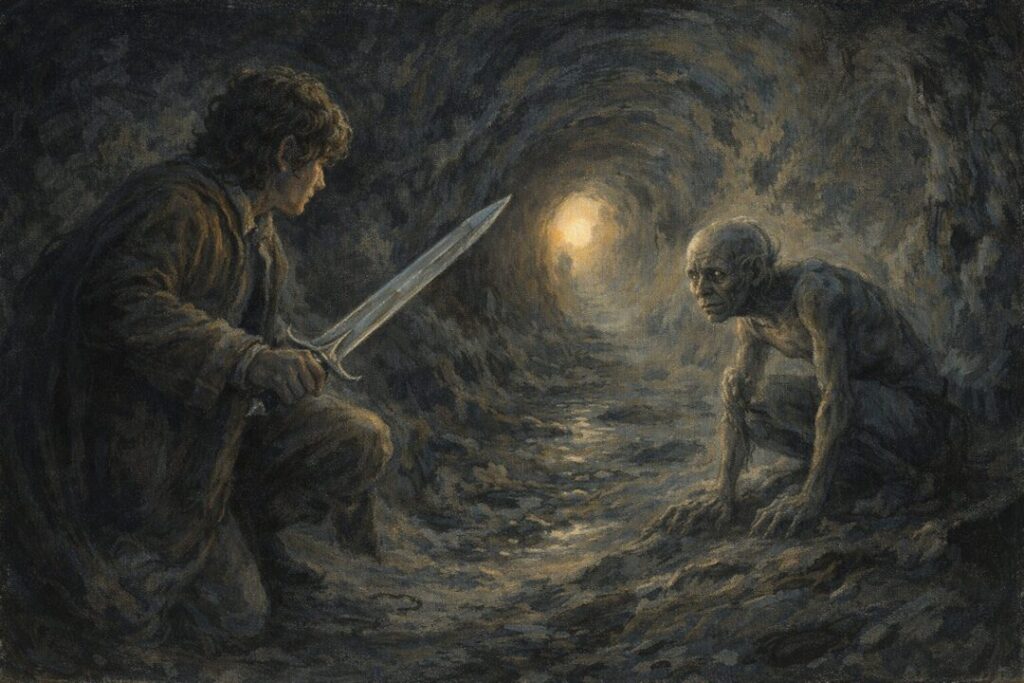
In the dark beneath the Misty Mountains, Bilbo has the chance to kill Gollum. He is frightened. He is trying to escape. Gollum is dangerous. And yet Bilbo looks at him, sees how miserable he is, and is moved to pity instead of killing him.
Nothing about that moment looks world-changing.
It is not framed as a great battle. No trumpet sounds. No prophecy is announced over Bilbo’s head. He does not understand what the Ring really is. He does not know what Gollum will later become in the wider history of Middle-earth.
He simply refuses to strike.
That is why the moment matters so much.
In Middle-earth, evil repeatedly operates through domination, possession, and the reduction of persons into uses. Pity interrupts that pattern. It refuses to see a ruined creature as only a thing to be disposed of. Bilbo does not deny that Gollum is dangerous. He does not call evil good. He just does not kill without need.
That distinction runs straight into the moral center of the larger story.
Frodo Learns the Same Lesson More Painfully
What Gandalf says in the Shire does not become fully real to Frodo until he actually sees Gollum.
At first, Frodo is afraid and revolted. That is understandable. Gandalf even answers that reaction by saying Frodo has not yet seen Gollum. Later, when Frodo finally does confront him and gains power over him, Frodo refuses to kill him and instead pities him. Tolkien Gateway summarizes this clearly: Frodo takes pity on the wretched creature, requires an oath, and lets him live.
This is important because Frodo’s pity is not abstract.
It comes after fear.
After burden.
After the Ring has already begun to work on him.
In other words, Frodo’s mercy is not easy mercy. It is the mercy of someone beginning to understand what corruption does from the inside. He can see Gollum not only as a monster, but as a warning. That does not make Gollum harmless. It makes him tragically legible.
And that is one of the deepest forms of pity in Middle-earth: not excusing evil, but recognizing the wreckage it has made of a being who was not originally made for ruin.

Even Sam Is Drawn Into This Pattern
Sam is often more suspicious of Gollum than Frodo, and not without reason.
He sees danger early and often correctly. The texts and later commentary do not treat that instinct as meaningless. But the story still pushes Sam toward pity as well, especially near the end.
At Mount Doom, when Frodo has already commanded Gollum away and presses on toward the Cracks, Sam is tempted to kill Gollum. It would seem just. It would seem safe. Yet he refrains out of pity. Tolkien Gateway’s chapter summary states this directly.
That moment is easy to rush past because the ending moves so quickly afterward.
But it matters.
Sam, too, is brought into the same moral pattern that began with Bilbo and was clarified by Gandalf and Frodo. At the very edge of catastrophe, pity remains active. And once again, it alters the shape of what follows.
There is also an important caution here. In Letter 246, Tolkien reflects that Sam earlier failed to grasp Gollum’s near-repentance and that this was, in Tolkien’s words, a tragic turning. That does not mean Gollum’s redemption was guaranteed. It means the text leaves room for the possibility that pity might have reached even further than it did. That possibility should be treated carefully, as interpretation grounded in Tolkien’s later commentary rather than as a simple narrative fact.
Pity Is Powerful Because It Refuses the Logic of the Ring
This is the heart of the matter.
The Ring works through domination. It magnifies the desire to control, to impose, to master outcomes and wills. It tempts by making power look practical, necessary, even righteous.
Pity does something almost opposite.
It accepts limits.
It refuses premature judgment.
It leaves open the possibility that the story is larger than one’s immediate fear or anger can see.
That is why Gandalf’s warning to Frodo is so central. “Do not be too eager to deal out death in judgment” is not merely private advice about being kind. It is a rejection of the very mentality the Ring cultivates.
This is also why pity can be called a power in Middle-earth without turning it into a magical force.
It is not “power” in the sense of spellcraft, rank, or military strength.
It is power because it changes what kind of world can still be saved.
Domination narrows the future.
Pity leaves room for grace.
And that is exactly what the end of the quest requires.
Nienna’s Shadow Falls Further Than It First Appears
Nienna does not stand in Mordor.
She does not sit in the Council of Elrond.
She does not enter the Sammath Naur.
And yet her influence seems to echo through all of it.
Not because the text says she is secretly intervening there in a literal, direct way. It does not say that, and that claim would go too far.
But because the moral habit associated with her—grief without bitterness, pity joined to endurance—appears in the very chain of choices that makes the Ring’s destruction possible. Gandalf learned pity and patience from her. Gandalf teaches Frodo to see Bilbo’s mercy differently. Frodo pities Gollum. Sam, in the final crisis, refrains out of pity too. The thread is not hidden once you begin to follow it.
Even Nienna’s support for Melkor’s petition for pardon fits this pattern, however unsettling that may be. The text records that she spoke on his behalf. It does not say she was blind to evil. It shows instead that pity, in her case, extends even toward the fallen. That does not erase the disaster that followed. It simply reveals how radical pity can be in the mythology.
Why This Matters So Much in Middle-earth
The great irony of the War of the Ring is that victory does not come through flawless strength.
Frodo fails at the Cracks of Doom. The Ring is not surrendered by an act of pure heroic will. Tolkien later insisted that simple judgments of failure miss the point, because there are absolute limits to what a person can endure, and mercy must shape how we judge others.
That matters here because pity is woven into the ending long before the ending arrives.
Bilbo’s pity preserves Gollum.
Frodo’s pity preserves him again.
Sam’s pity preserves him once more.
And Gollum’s survival is part of the final destruction of the Ring.
So who was Nienna?
She was not the Valië of weakness.
She was not a symbol of despair.
She was one of the great powers of the world, and her gift was the strange strength to face sorrow without becoming cruel.
That is why pity is a power in Middle-earth.
Not because it conquers by force.
Because it resists becoming the thing evil wants everyone to become.