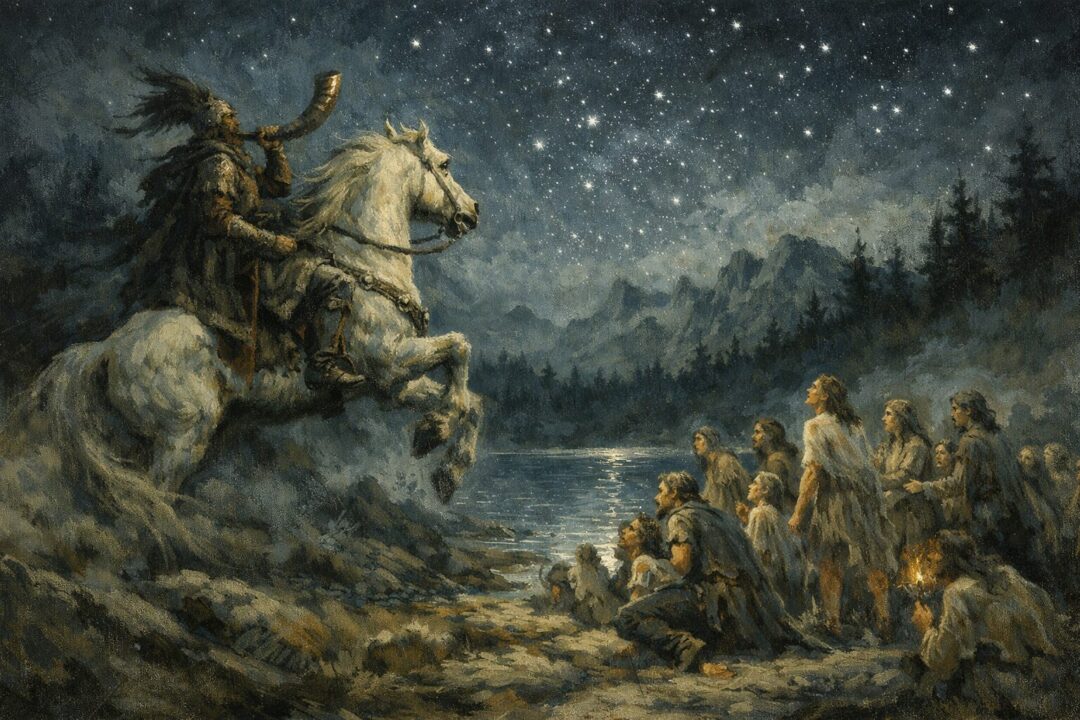
When readers think about the Great Journey of the Elves, they often think first of separation.
They think of the hosts dividing.
They think of those who reached Aman and those who did not.
They think of the long road westward, and the losses that gathered along it.
But before the journey becomes a story of sundering, it is a story of encounter.
Because the movement of the Elves toward the West begins with one figure more than any other:
Oromë.
He is sometimes remembered simply as the Huntsman of the Valar, a lord of forests, horses, and the chase. That is true as far as it goes. Yet in the earliest history of the Elves, Oromë is more than a hunter. He is the first great power of Arda to enter their world directly, to name them, to defend them, and to open before them the possibility of another fate.
That is why his horn, Valaróma, matters.
Its importance is not merely that it is loud, or martial, or memorable. Its deeper meaning lies in what it announces: the coming of a power before whom the shadows retreat, and the first summons that sets the history of the Eldar in motion.
Oromë Was the First of the Valar the Elves Truly Encountered
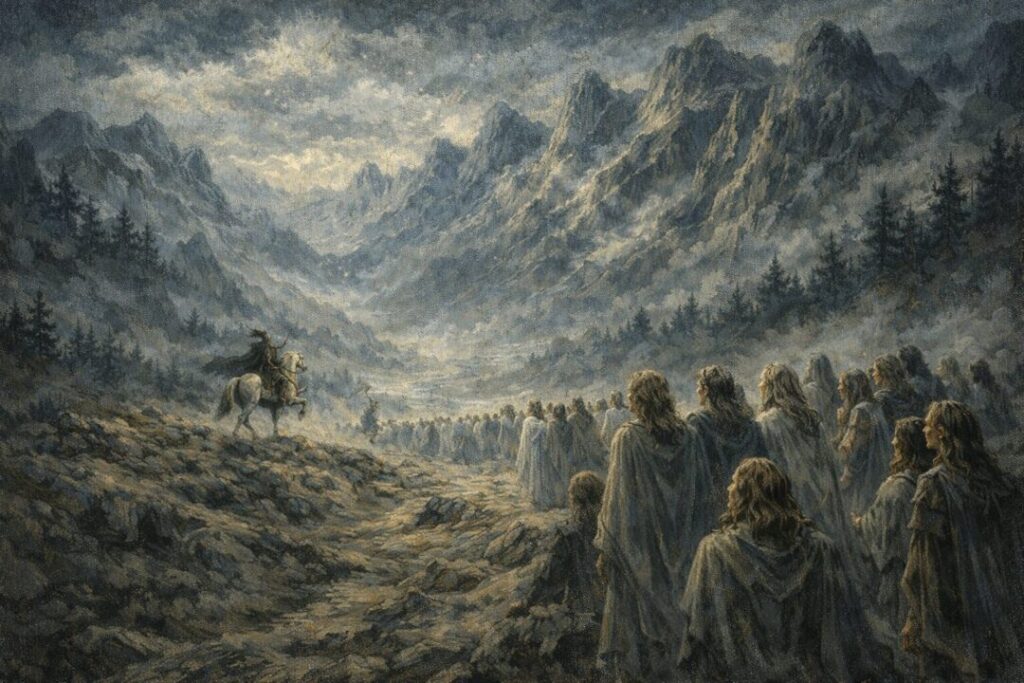
The Elves awoke at Cuiviénen under the stars, long before the Sun and Moon. In those earliest days, the texts make clear that fear already touched their first life in Middle-earth. Melkor’s servants troubled them, and dark tales spread among them of a Rider to be feared.
Into that uncertainty came Oromë.
He did not discover the Elves as a ruler arriving to claim subjects. He found them while ranging through Middle-earth, heard their voices from afar, and was amazed. He named them Eldar, “People of the Stars,” a name first applied broadly and later used especially of those who accepted the summons west.
This moment matters more than it may first appear.
Oromë is not only the one who finds the Elves. He is the first proof, within their experience, that the dark powers haunting their early life are not the only powers in the world. Before there is a Great Journey, before there is Aman in their imagination, there is this revelation: the world contains a might greater than fear. That is an inference from the structure of the story rather than a direct line of explanation, but it is strongly supported by Oromë’s role at Cuiviénen and by the association of his coming with the flight of evil shadows.
Why the Horn Matters
Valaróma, the great horn of Oromë, is one of those details that can seem ornamental until you notice what surrounds it.
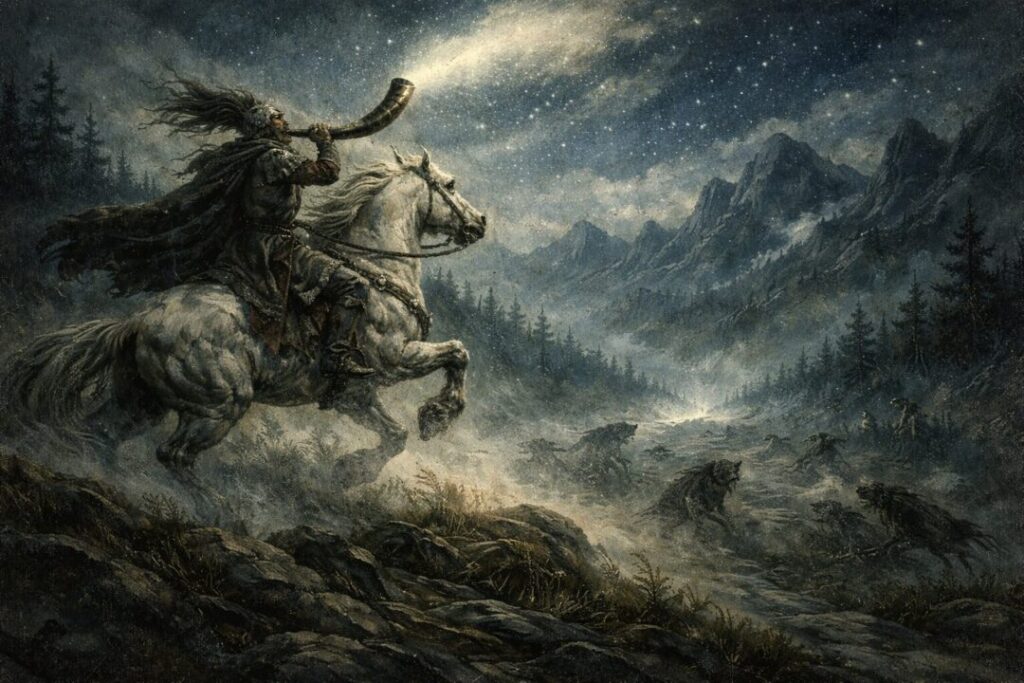
In the elder days of Arda, when Oromë rode, the texts describe the earth trembling beneath his horse and his great horn sounding across the world so that the mountains echoed and the shadows of evil fled. Even Melkor feared those ridings.
That does not mean the legendarium gives us scene after scene of Oromë blowing his horn all through the Great Journey itself. It does not. A careful reading has to stop short of claiming that. But the symbolic force is unmistakable. Valaróma belongs to the one Vala whose coming means pursuit of evil, cleansing of fear, and safe passage where darkness once held the ground.
So when we say his horn echoes through the Great Journey, the deepest sense is not merely acoustic.
It is historical.
The Journey happens because Oromë came first.
Because Oromë made contact.
Because Oromë returned with a summons.
Because the Elves had heard, in one form or another, that the darkness was not final.
Oromë Did Not Merely Find the Elves. He Set Their History in Motion
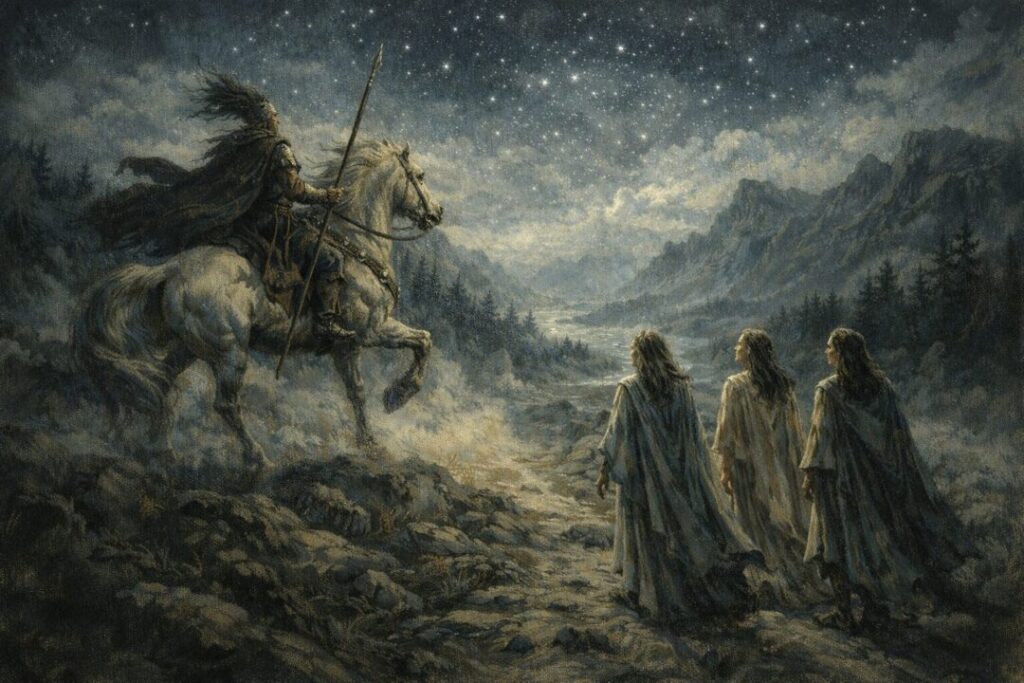
After discovering the Elves, Oromë returned to Valinor with news of their awakening and of the dangers surrounding them. The Valar then resolved to act against Melkor, leading to his captivity. After that, Oromë came back to Cuiviénen with the summons to dwell in the West.
The Elves did not simply obey at once.
Their hesitation is important. They had seen fear, and they were not creatures without memory or will. So three ambassadors were chosen from among them: Ingwë, Finwë, and Elwë. Oromë brought them to Valinor so they could see its light for themselves. When they returned, many were persuaded to begin the westward march.
This is one of the reasons Oromë stands so close to the center of Elvish history.
He does not force the Great Journey.
He makes it possible.
That distinction matters.
The road west is not presented as conquest. It is a response to witness, invitation, and trust. Oromë is the bridge between the awakening of the Quendi in the dark of Middle-earth and the possibility of a life under the light of the Trees. Without him, the entire history of the Eldar would look different.
He Rode Before Them, but the Journey Was Never Simple
When the Eldar began the Great Journey, they went forth in three hosts: the Vanyar, the Noldor, and the Teleri. Oromë rode before them. Yet the march was long, slow, and repeatedly interrupted. The texts and reference tradition both preserve the sense that this was not a swift triumphal procession, but a hard crossing through an unfinished world.
That unfinished quality matters.
Melkor had already marred Middle-earth, and even its geography bore signs of resistance. The Misty Mountains were said to have been reared by Melkor to hinder Oromë in his ridings. Later, those same mountains became a real barrier in the Great Journey. Some of the Teleri refused to cross them and turned south, becoming the Nandor.
This is one of the clearest ways Oromë’s earlier history “echoes” through the Journey.
The very lands he had once ridden in struggle against evil become the lands through which the Elves must now choose whether to continue, delay, divide, or abandon the road. His summons begins the movement, but it does not remove cost from the path.
The Great Journey Becomes a Story of Longing as Much as Arrival
Not all who began the Journey completed it.
That is central to understanding Oromë’s importance. His summons creates not only the Eldar who reach Aman, but the whole pattern of westward longing, delay, and loss that marks Elvish history afterward. Once the invitation exists, refusal and abandonment become historically meaningful in a new way.
The Teleri embody this most powerfully.
They are the largest host and the slowest. They tarry beside rivers. They fear the mountains when Oromë has gone ahead. Later, in Beleriand, Elwë is lost in Nan Elmoth after encountering Melian, and many of his people remain behind rather than complete the road west.
This means that the Great Journey does not merely sort the Elves by destination.
It reveals how each people responds to summons, fear, beauty, friendship, and delay. Oromë stands at the beginning of that pattern, but he does not flatten the will of those who hear him. The story remains moral and personal, not mechanical.
Why Oromë’s Presence Feels Larger Than His Page Count
Oromë is not one of the most frequently foregrounded figures in the later narrative of Middle-earth.
He does not dominate the wars of Beleriand in the way Morgoth does. He does not remain a daily presence in the tales of the Third Age. And yet his influence reaches far beyond the relatively brief passages that describe him directly.
That is because he stands at a threshold moment.
The first Elves do not begin in security.
They begin in wonder mixed with danger.
And Oromë is the first answer to that danger that comes from outside themselves without diminishing them. He recognizes them, names them, and invites them toward a destiny they had not yet imagined.
In that sense, his horn does not echo through the Great Journey merely because it belongs to a mighty rider.
It echoes because Valaróma represents the first turning point in Elvish history: the moment when the silence around Cuiviénen is broken by something stronger than the whispers of fear.
The Deeper Meaning of Oromë in the Story
At the deepest level, Oromë matters because he is not just a guide.
He is the first sign that history can move westward at all.
The Elves awaken beneath the stars in a threatened world.
Oromë enters that world from beyond their knowledge.
His arrival leads to naming.
Naming leads to summons.
The summons leads to choice.
And choice leads to the whole long story of the Eldar: Aman, Beleriand, sundering, longing, memory, and loss.
So who was Oromë?
He was the Huntsman of the Valar, yes.
But in the history of the Elves, he was also the first great caller on the road.
And that is why his horn still seems to sound behind the entire Great Journey, even when the text grows quiet.
Not because every step is marked by its blast.
But because everything that follows begins with the moment the shadows hear it first.