Some mysteries in Middle-earth are loud.
A flaming eye. A broken sword. A dark tower that cannot be ignored.
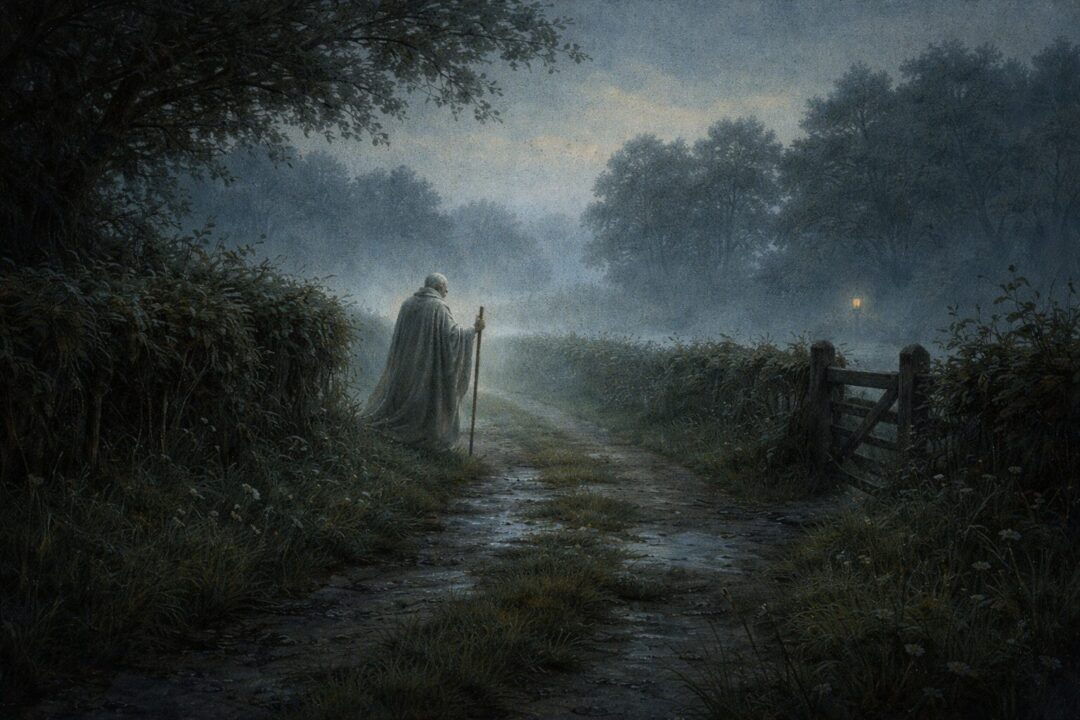
But one of the most unsettling “cameos” in The Lord of the Rings is almost silent: a report of an old man in white seen near the Shire.
He appears at the edge of the story’s vision—where Hobbits don’t usually look—and then he is gone. No name is pinned to him. No later chapter circles back and says, Yes, it was certainly this person.
That absence is not a mistake. It functions like a pressure point.
Because the Shire’s safety, in the opening movement of the book, depends on a fragile illusion: that great powers do not notice it.
An unnamed figure in white threatens that illusion.
And “white” is not a neutral detail in Tolkien’s legendarium.
It is a color tied to rank, to authority, to office—and, in one case, to a deliberate claim of superiority.
So if a white-clad old man is being spoken of near the Shire, readers naturally begin doing what the Hobbits cannot: looking outward, asking what powers might already be reaching into the little land of tilled fields and hedgerows.
But the text refuses to hand you a single stamped answer.
Instead, it gives you a few constrained options—and makes you feel the uncertainty that the Shire itself is slow to understand.
Let’s walk through what can be said with confidence, what is only plausible, and why the story may be intentionally leaving the name in shadow.
What the story does establish: the Shire was not as hidden as it believed
By the time Frodo leaves Bag End, the Shire is already brushing against the War of the Ring.
Not openly. Not with banners.
But through questions.
Through strangers appearing in places that are supposed to be provincial.
And through the simple fact that knowledge of the Shire exists among the powerful—knowledge that can be acted upon.
One of the clearest textual supports for this is the established presence of agents and spies moving around the Shire’s wider region.
Saruman, before his open ruin, is explicitly associated with building networks: he learns of the Shire and takes interest in it, and he employs agents in places like Bree and the Southfarthing.
That does not, by itself, prove that Saruman personally walked the Shire’s borders.
But it does prove something important for the “old man in white” question:
The Shire exists on the map of those who are playing for the Ring.
And once the Shire is on a map, a rumor like “an old man in white” stops being quaint.
It becomes a possible symptom of reconnaissance.
Why “white” matters: it narrows the field
In Tolkien’s narrative vocabulary, white is not a throwaway costume choice.
It is tied to two figures whose moral weight is very different:
- Gandalf the White, returned and re-clothed after his death, who bears authority as a restorer and guide.
- Saruman the White, who holds a position of leadership among the Istari and the White Council—and later corrupts that office into pride, domination, and persuasion by voice.
Saruman is explicitly described as an old man, and “white” is explicitly tied to his habitual appearance (at least in the way he is publicly understood to present himself).
That combination—old man + white—inevitably points readers toward Saruman’s orbit.
But this is where the timeline becomes crucial.
Because if the “old man in white” is being seen near the Shire in the early part of the Quest, the story’s internal chronology and character locations begin cutting down what can realistically fit.
The first bounded option: Gandalf (and why it usually doesn’t fit)
Could it be Gandalf?
At a glance, the idea feels tempting. Gandalf is a wanderer. He knows the Shire intimately. He appears, disappears, and returns.
But the strongest problem is simple:
In the early Shire chapters, Gandalf is still Gandalf the Grey, and his usual appearance is not “white-clad.” The “white” identity belongs to his later return, far from the Shire, after Moria.
So if the rumor is anchored to the opening phase—when Frodo is being hunted and Gandalf is delayed—then “Gandalf the White” is not available.
Could the report be confused or exaggerated? Possibly. Rumor is unreliable by nature, especially among people who rarely meet strangers at all.
But as a lore-accurate identification, “Gandalf the White near the Shire before the Fellowship even forms” is not something the primary narrative clearly supports.
So Gandalf can only be held here as a weak possibility: not impossible in the sense that Hobbits misreport colors, but not cleanly supported by the timeline.
The second bounded option: Saruman himself (possible, but speculative)
If readers hear “old man in white,” the mind snaps toward Saruman for a reason.
Saruman is the Wizard most associated with “white” as a public sign.
And Saruman, crucially, is also connected to the Shire as a target.
He learns of it, takes interest, and establishes agents and watchers in its surrounding regions.
From there, some fans make the leap:
If Saruman is already investing in the Shire as an object of surveillance, could he have approached its borders himself—testing the land, confirming what his spies report, or seeking Baggins by subtler means?
That is interpretation, not established fact.
The texts do not directly state: “Saruman came near the Shire in white robes, and Hobbits saw him.”
What they do state is enough to keep the suspicion alive: Saruman’s interest in the Shire is real and strategic, and his use of agents in that corridor of the world is not theoretical.
So Saruman-as-the-old-man-in-white remains a bounded, plausible option—one that fits the symbolism of white and the theme of hidden encroachment—but must be labeled as inference, not confirmation.
The third bounded option: a messenger or agent wearing “white” (plausible, and often overlooked)
There is another possibility that fits the story’s logic without requiring a major character to physically appear:
The “old man in white” could be an agent—someone operating under a banner, style, or affectation associated with Saruman.
We already know Saruman’s networks reach into the relevant regions (Bree-land and the Southfarthing).
If an agent wishes to present authority, “white” is a powerful costume. It suggests legitimacy. It suggests rank. It suggests that the speaker is not merely a traveler, but a representative.
And that is precisely the kind of subtle pressure a place like the Shire would be vulnerable to.
Not violence.
A question asked with confidence.
A stranger who seems as if he “belongs” to the wider world of powers and councils.
This option has a key advantage: it explains why the figure is never named.
Because he may not be important as an individual.
He may be important as a symptom—a sign that the Shire is already within reach of outside systems of control.
So why leave him unnamed at all?
If the story can name Nazgûl and kings, why not name this one old man?
Because the Shire chapters are not written as an omniscient political history.
They are written from the ground.
From hedge-height.
From a people whose genius is local knowledge—families, fields, food, birthdays—while the great world moves beyond their horizon.
An unnamed “old man in white” preserves that perspective.
It keeps the reader inside the Shire’s partial sight:
- You hear rumors.
- You glimpse shapes.
- You feel pressure before you understand its source.
And that matters, because the Shire’s danger is not simply that enemies will arrive.
It is that enemies can arrive without being recognized as enemies.
A named villain would be too clean.
An unnamed figure keeps the borders porous and uncertain, which is exactly how encroachment works in the early stages—especially against a community that does not expect to be watched at all.
There is also a second reason the ambiguity works so well:
White in Tolkien’s world carries a double edge.
It can be the sign of restoration.
It can also be the sign of prideful domination.
By leaving the “white” figure unnamed, the text lets the symbol itself do the unsettling work—without forcing a single interpretation too early.
The core takeaway: the Shire is being approached before it is taken
Whether the “old man in white” is:
- a misreported wanderer,
- a Saruman-connected agent,
- or Saruman himself (speculatively),
the narrative function is consistent.
The Shire’s peace is not shattered all at once.
It is tested.
Measured.
Questioned.
And that is why this tiny, half-glimpsed detail stays lodged in readers’ minds. It feels like the moment the invisible net first brushes the land—and the Hobbits do not yet know they are already inside it.
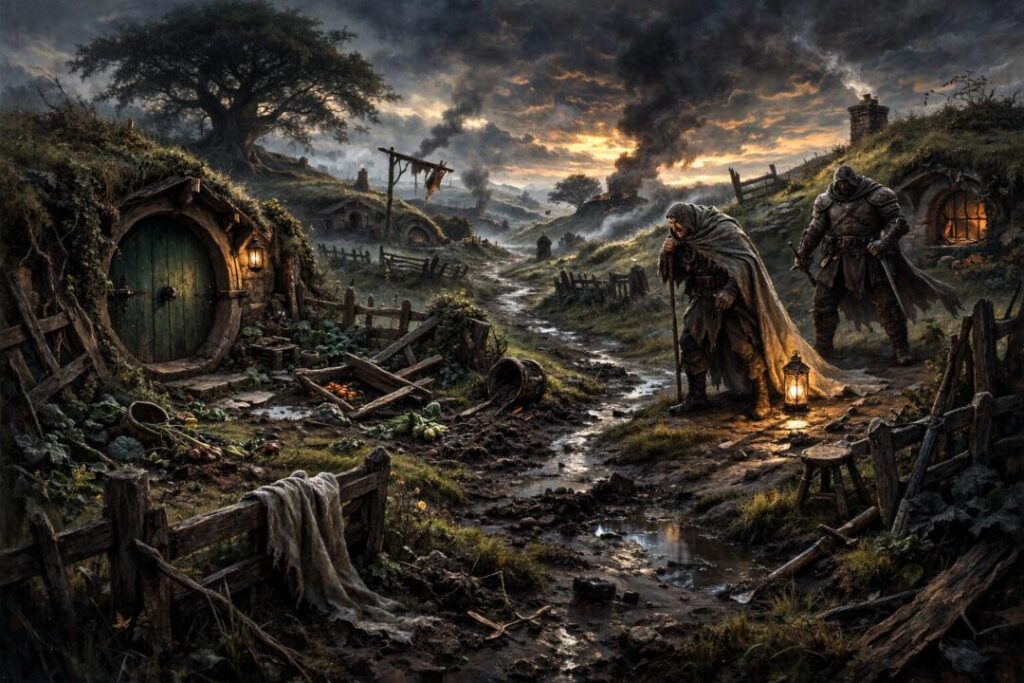
The story will later show what happens when the Shire is openly occupied.
But the “old man in white” hint suggests something colder:
That the Shire’s fall begins earlier than the Scouring.
It begins at the borders, in rumor, in strangers, in the first faint realization that the wide world has finally turned its eye toward home.
And once you notice that… the opening chapters stop feeling purely cozy.
They start feeling like the last quiet evening before footsteps appear on the road.