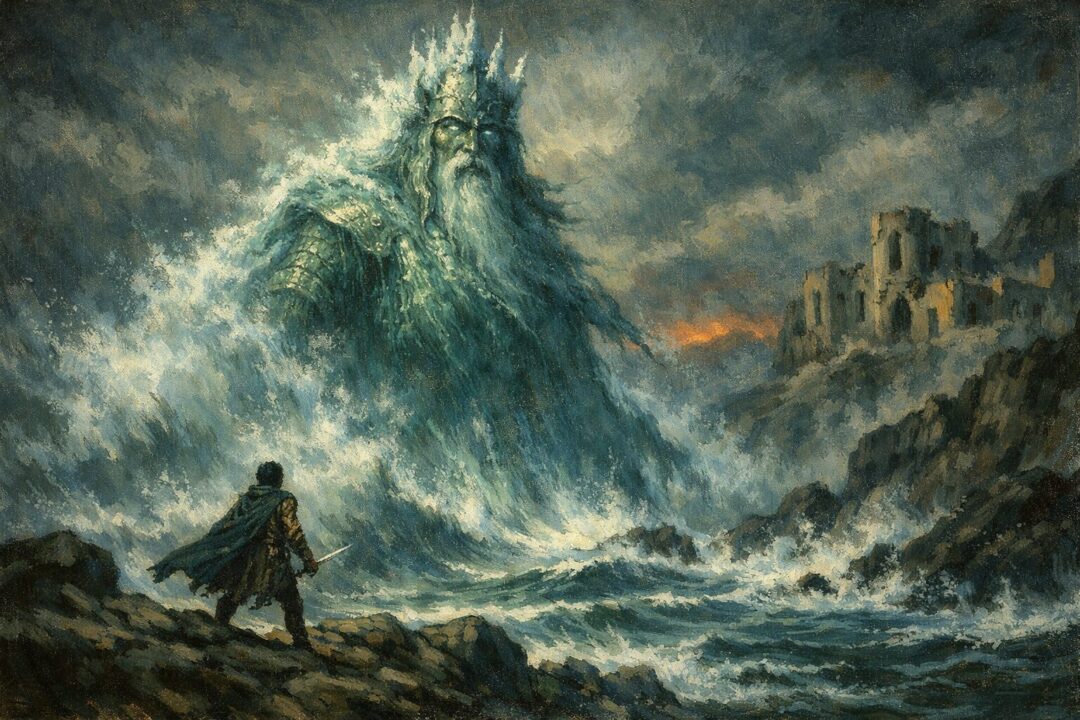
At first glance, Ulmo can seem easy to place.
He is the lord of waters. The power of the sea. The vast, remote figure behind waves, deep places, storms, and the long voice of the shore.
But that first impression is misleading.
Because Ulmo is not important merely because he rules the sea. He is important because he keeps doing what the other great Powers often do not. Again and again, when Middle-earth is in danger, Ulmo intervenes. He warns. He guides. He sends dreams. He preserves escape routes. He helps Elves and Men even in periods when the rest of the Valar seem distant, restrained, or slow to act.
That is why he feels different.
He is not presented as a rebel in any simple sense. The tradition does not frame him as defying Manwë in open disobedience. But it does show a Vala whose pattern of action is unusually direct, personal, and persistent. If readers remember Ulmo mainly as “the sea one,” they miss the deeper truth.
Ulmo is one of the most active agents of mercy in the whole legendarium.
Ulmo Was Far More Than a Sea-Spirit
The first thing to correct is scale.
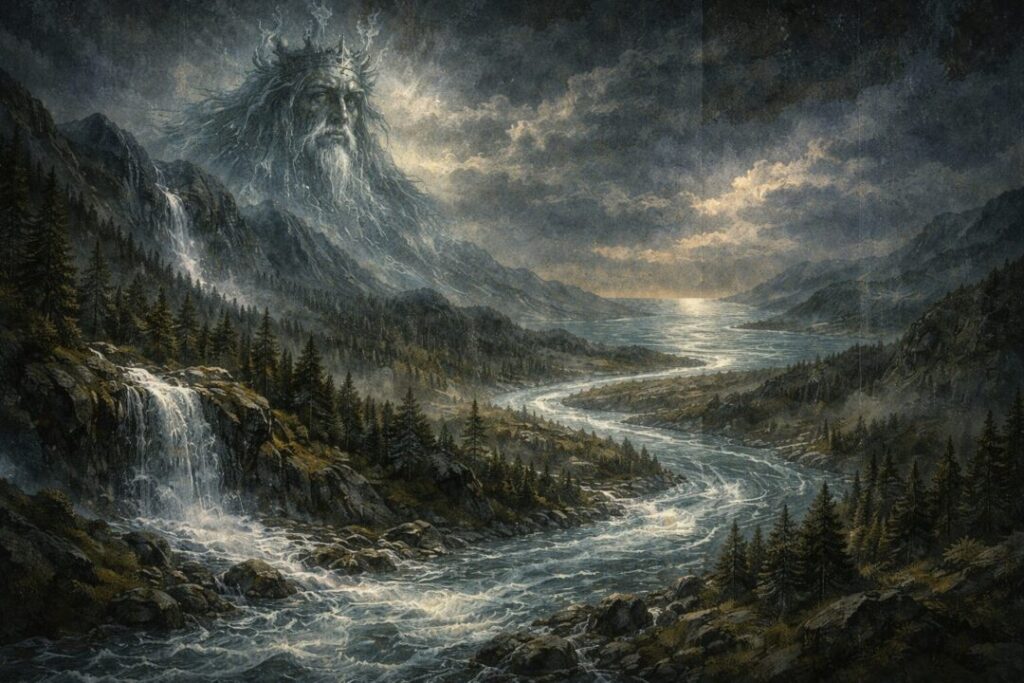
Ulmo is not a lesser spirit attached to the sea. He is one of the Valar, one of the greatest Ainur who entered the world at its making. In majesty he stands among the highest of them, after Manwë and Varda. He is the Lord of Waters, but that title is much larger than it sounds. All waters are under his thought: seas, bays, rivers, even the hidden running veins of the earth.
That matters because water is not confined to one corner of Arda.
The texts connect Ulmo to a kind of nearness that other Valar do not possess in the same way. Water moves everywhere. It touches shore, valley, rain, spring, river-mouth, tears, mist, and sea. Because of that, Ulmo is described as knowing more of the griefs and needs of the Children of Ilúvatar than even Manwë does. He is not boxed away in one domain. His element runs through the world itself.
This is one of the keys to understanding him.
Ulmo is not distant from history.
He is inside its circulation.
Why Ulmo Stands Apart from the Other Valar
Another unusual thing about Ulmo is where he lives.
He does not dwell in Valinor in the settled way many of the other Valar do. He remains in the deep places of the sea, around and beneath the world, and he comes only rarely to the councils of his brethren. That distance from the centers of deliberation seems to match a deeper difference in temperament.
Even early on, when the Valar debated what should be done with the newly awakened Elves, Ulmo belonged to the minority who believed they should remain free in Middle-earth rather than be summoned away to Aman. His counsel was overruled, and he ultimately helped bring the Eldar west on the great island that became Tol Eressëa. But the fact that he disagreed at all is telling. Ulmo is repeatedly associated with freedom, movement, and a refusal to solve every danger by removing people from the wider world.
This already gives him a different moral position in the story.
He is not detached from the Children.
He is not primarily concerned with safety through distance.
He is the Vala who stays in contact.
The “Rule-Breaking” Is Really a Pattern of Intervention
So why does Ulmo seem like he keeps breaking the rules?
Because in the First Age especially, there is a visible pattern in which the Valar are restrained, while Ulmo keeps finding ways to act.
The key text says plainly that he loved both Elves and Men and never abandoned them, even when they lay under the wrath of the Valar. That is one of the strongest statements attached to any of the Powers. It does not say he dissolved judgment or erased doom. It says he did not forsake them.
That distinction matters.
Ulmo does not simply cancel consequences. He does not announce that the Doom of the Noldor is void. He does not march openly against the decrees of the other Valar. Instead, he aids, warns, and prepares ways of endurance within a damaged world. The “rule-breaking” is less like rebellion and more like merciful pressure applied wherever hope is thinning.
In other words, he operates at the edges.
And the edges are where survival happens.
Ulmo’s Warnings to Finrod and Turgon
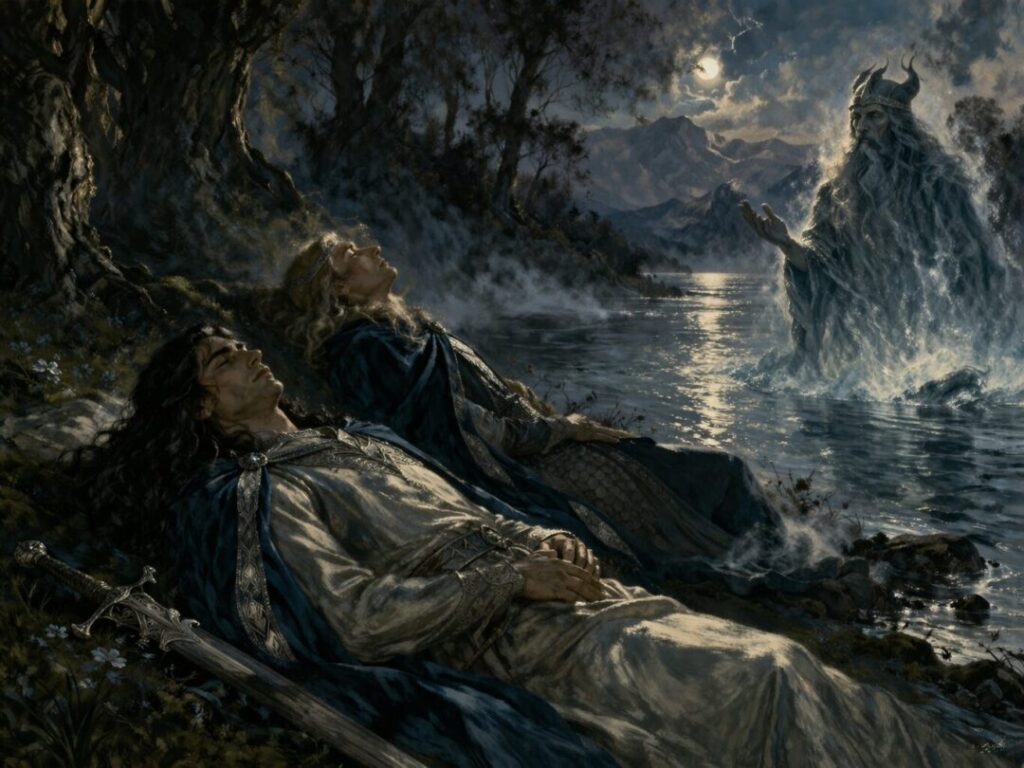
One of the clearest examples comes through dreams.
Finrod and Turgon, while resting near Sirion, are overtaken by a heavy sleep and receive foreboding visions from Ulmo. The dream urges them to prepare hidden strongholds against a future day of disaster, lest Morgoth break out and overwhelm the northern defenses. From that prompting come two of the great refuges of Beleriand: Nargothrond and Gondolin.
This is classic Ulmo.
He does not force either king.
He does not reveal every detail.
He gives warning early, through the language of water and dream, and calls for preparation before the world understands how badly it will need refuge. That is already an intervention of enormous consequence. Without it, two of the central realms of the First Age do not take shape as they do.
Yet even here there is restraint.
Ulmo can warn.
He cannot make them obey forever.
Tuor, Gondolin, and Ulmo’s Last Great Attempt
The most dramatic Ulmo story is the story of Tuor.
Ulmo chooses Tuor as his instrument long before Tuor reaches Gondolin. He guides him westward, brings him to the sea, and sets him on the path that will carry a warning to Turgon. That warning is not vague. Gondolin must not trust its secrecy forever. Turgon is urged to abandon the city and seek the sea, because doom is approaching.
This is where Ulmo looks most like a power “breaking the rules.”
Why?
Because Gondolin is hidden, sacred to hope, and tied up with the pride of the Noldor. Yet Ulmo presses against the whole logic of staying shut away. He is effectively saying that concealment is no longer enough, and that survival now depends on movement, humility, and escape.
Turgon does not truly heed him.
That is one of the tragedy-points of the First Age. Ulmo’s intervention is real, but it does not override the will of the king. Gondolin falls anyway. The warning was not false. It was refused.
This is important for understanding Ulmo’s character.
He is powerful, but he is not written as a tyrant over free wills.
He opens a path. He does not drag people down it.
Ulmo and the Survival of the Line That Matters Most
Even after ruin begins to close in, Ulmo’s activity does not end.
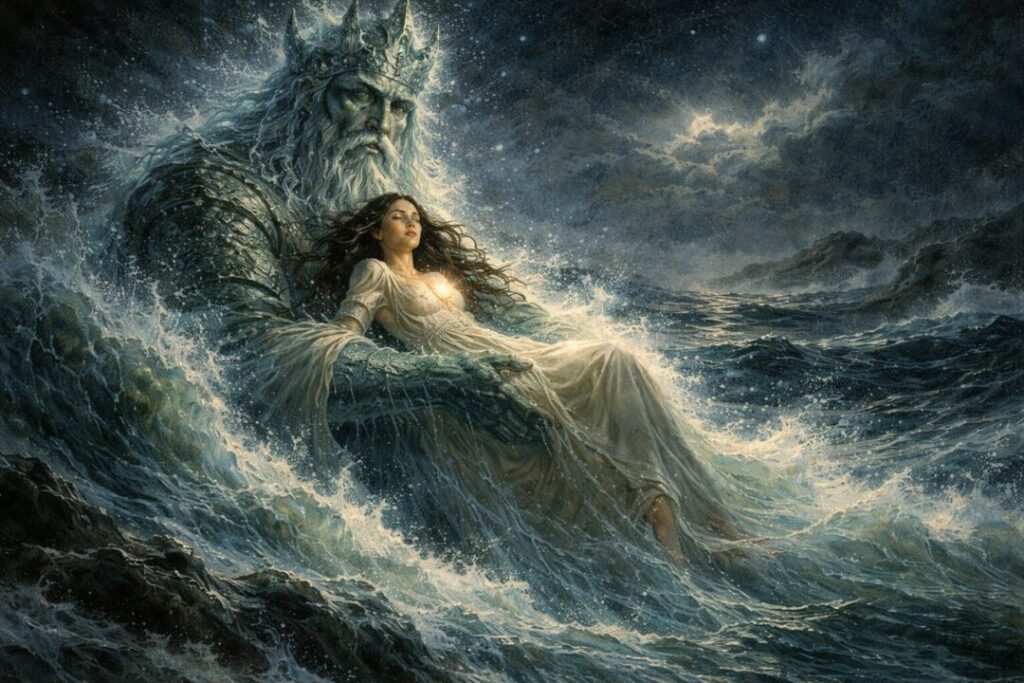
The tradition says Ulmo saved Elwing from the sea and bore her up so that she came to Eärendil still bearing the Silmaril. That moment matters far beyond the rescue itself, because Eärendil’s westward voyage becomes the turning point that finally brings the plea of Elves and Men to Valinor.
So the pattern becomes unmistakable.
Ulmo aids Tuor.
Tuor reaches Gondolin.
From Tuor and Idril comes Eärendil.
Ulmo saves Elwing.
Elwing reaches Eärendil.
Eärendil reaches Aman.
At each stage, Ulmo is not the whole cause. But he is repeatedly the one making survival, connection, and appeal still possible.
That is not a small detail at the edge of the mythology.
It is one of the hidden structural forces that keeps the First Age from ending only in total collapse.
So Was Ulmo Actually Defying the Order of the World?
Not exactly.
The evidence points in a subtler direction.
Ulmo is explicitly said not to have aided Elves and Men as an act of rebellion against the other Valar, but because this care belonged to his appointed role from before the making of the world. That is crucial. He is not lawless. He is faithful in a way that looks disruptive because his faithfulness takes the form of nearness, warning, and pity.
That makes him more interesting than a simple dissenter.
Ulmo appears to embody a truth the rest of the history keeps proving: judgment may be real, doom may advance, and yet mercy still looks for channels. Water is the perfect element for that. It does not deny rock, wall, distance, or ruin. It finds its way around them.
In that sense, Ulmo does not break the rules of Middle-earth.
He exposes that mercy was woven into them from the beginning.
Why Ulmo Matters So Much
Ulmo matters because he shows that the world of Middle-earth is not governed only by power, punishment, and catastrophe.
It is also governed by intervention that is quiet, persistent, and hard to stop.
He does not dominate history like Morgoth.
He does not stand at its summit like Manwë.
He does not dazzle like Varda.
He listens.
He moves.
He warns.
He remembers those left under shadow.
That is why he feels so strange on the page.
Again and again, when everything is hardening into doom, Ulmo becomes the pressure that keeps one passage open.
And once you notice that, he stops looking like the lord of the sea alone.
He starts looking like the Vala of the last remaining road.