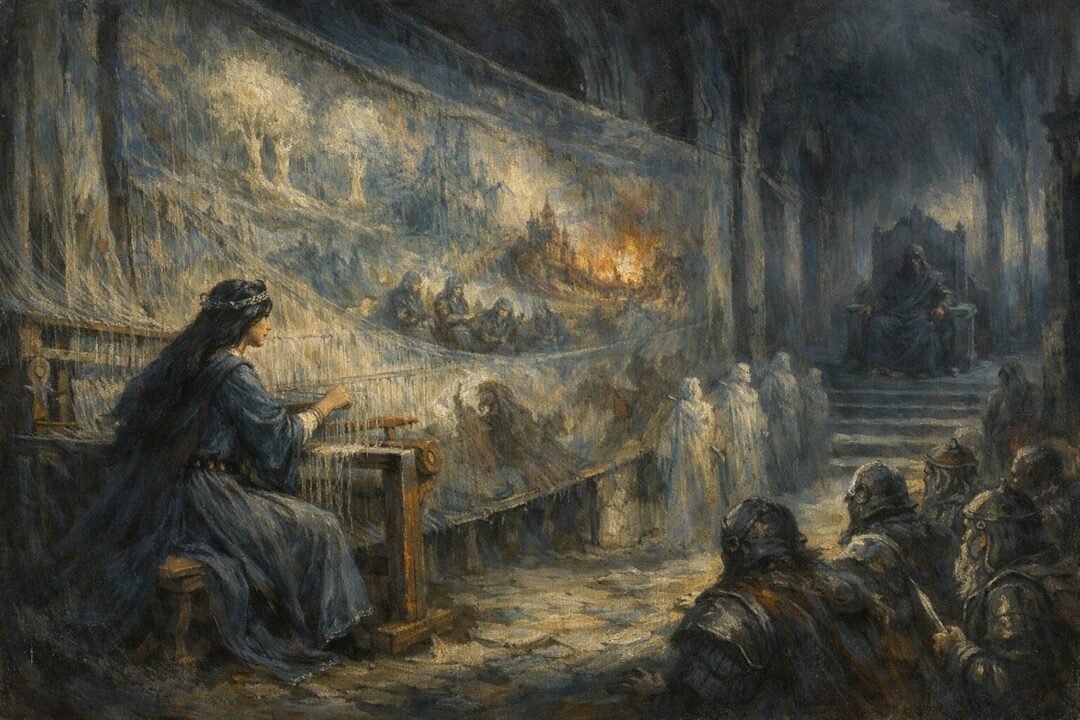
When readers think of the Halls of Mandos, they usually think first of death.
That is understandable. In the legendarium, the name “Mandos” carries a chill unlike almost any other. It suggests doom, waiting, judgment, and the strange stillness that follows the violence of history. Heroes die and go there. Grieving lovers cross its threshold. Great spirits linger there for ages. Even when Mandos does not act directly, his presence seems to stand behind some of the most solemn moments in the history of Arda.
But there is another presence in those halls, quieter and easier to overlook.
Her name is Vairë.
And once you notice what the text says about her, the Halls of Mandos stop feeling like a simple resting place for the dead. They become something larger: a house of memory, where the history of the world is not allowed to vanish.
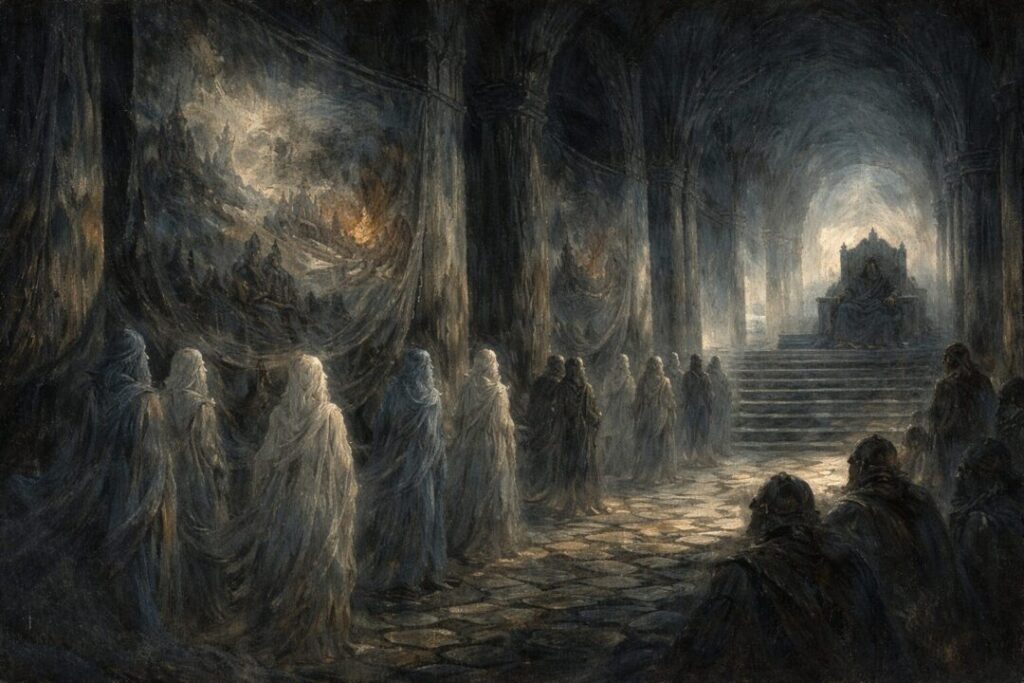
Vairë is one of the most overlooked Valier
Canon gives Vairë only a brief introduction, but it is remarkably suggestive. In the Valaquenta, she is described as the spouse of Mandos, and her defining work is this: she “weaves all things that have ever been in Time into her storied webs,” and the halls of Mandos, which widen as the ages pass, are clothed with them. That is the central fact from which everything else follows.
This immediately distinguishes her from many other great figures in the legendarium. Vairë is not presented through warfare, rulership, or open intervention in the struggles of Elves and Men. Her power is interpretive, preservative, almost archival. She does not alter the tale by force. She preserves the tale by weaving it.
That matters because Tolkien’s world places enormous weight on memory. Songs preserve history. Names preserve meaning. Oaths preserve consequences. Nothing truly important is treated as disposable. In that context, Vairë’s role is not decorative. It is fundamental.
Her webs are not described as random art. They are storied. They contain what has been in Time.
That is as close as the legendarium comes to saying that the world itself is recorded in the halls of the dead.
The Halls of Mandos are more than a place of death
The Halls of Mandos are the dwelling of Námo, the Doomsman of the Valar, who is more commonly called Mandos from the name of his halls. He is associated with judgment, memory, and the summoning of the spirits of the slain. The tradition also places those halls in the far West of Aman, beside the Outer Sea.
That alone gives the place a severe and solemn character. But the Halls are not just a prison, nor simply a warehouse for the dead. Their purpose differs depending on who enters them.
For Elves, death is not the final departure from the world. Their spirits remain bound to Arda until its end. If they die, their fëar may go to Mandos, where judgment and waiting are involved, and in some cases eventual re-embodiment is possible. Later texts also emphasize that the houseless fëar are by nature solitary, which makes the condition of waiting in Mandos even more haunting than many readers first imagine.
For Men, the situation is more mysterious. The Elves do not fully know the fate of Men after death, but some texts say that they too may come to the Halls of Mandos for a time of recollection before passing beyond the world. That is why the story of Beren and Lúthien is so important here: Beren lingers there, awaiting Lúthien on the shores by the Outer Sea, because the fate of Men is departure, not permanent residence.
So the Halls are a threshold, not merely an ending.
And thresholds are exactly the kind of places where records matter.
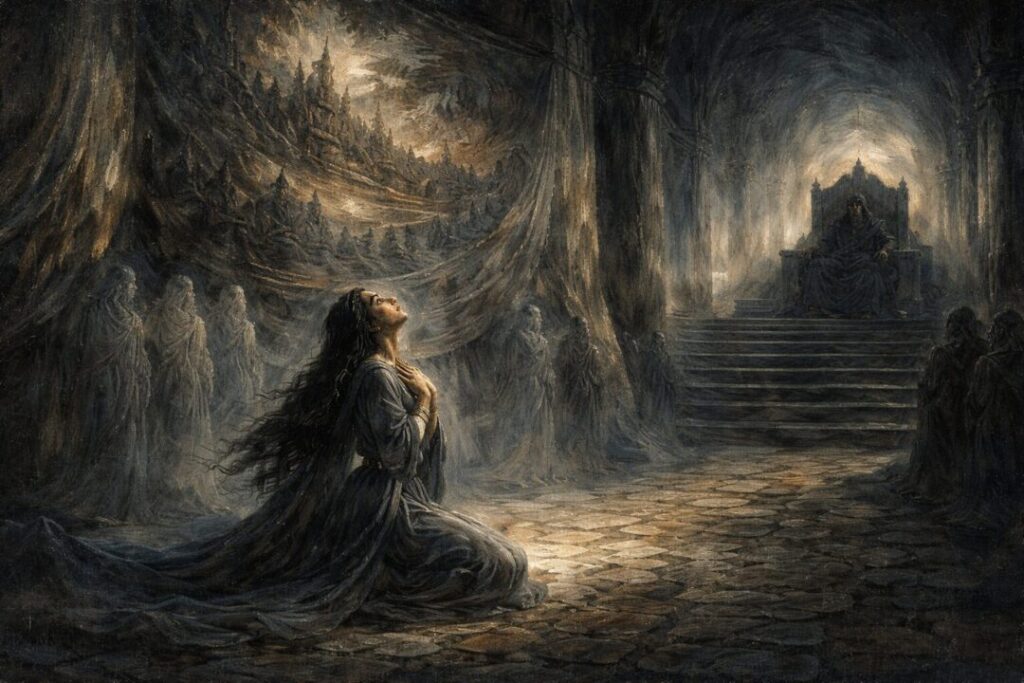
Why “records” in Middle-earth do not mean ledgers
Modern readers hear the word “records” and often imagine shelves, documents, lists, or courtroom archives.
That is not how the Halls of Mandos are described.
The canon image is far stranger and more mythic. Vairë does not write down history. She weaves it. The record of the world takes the form of storied webs that clothe the halls themselves. In other words, history is not boxed away. It surrounds those who enter.
This is a crucial distinction.
If Vairë’s work is the memory of Time made visible, then the Halls are not simply preserving facts. They are bearing witness. What was done in life does not disappear into abstraction. It remains part of the texture of reality.
That fits Mandos perfectly. He is described as one who forgets nothing. He knows much of what shall be, except what still lies in the freedom of Ilúvatar. He is not a careless or sentimental judge. His authority is tied to memory, truth, and doom.
Seen this way, Vairë and Mandos form a kind of paired symbolism.
Mandos remembers and judges.
Vairë preserves and displays.
Together, they make the Halls a place where history cannot be evaded.
Why the dead would dwell among history
Once the Halls are understood as a place clothed in the woven memory of the world, a powerful implication emerges.
The dead do not arrive in emptiness. They arrive in the presence of what has been.
That does not mean the text explicitly says every spirit studies Vairë’s webs, or that they function as moral lessons in a systematic way. Canon does not spell that out, so it should not be stated as fact. But the setting itself strongly implies that Mandos is not a place of forgetfulness. It is a place where the truth of life is held intact.
This helps explain the tone of many Mandos scenes across the legendarium. The Halls are solemn because they are close to reality stripped of illusion.
Consider some of the spirits linked with those halls. Míriel departs there after yielding up life. Fëanor’s spirit is said to remain there and not return. Lúthien comes there in grief and sings before Mandos for Beren. These are not casual episodes. In every case, death is connected with reckoning, memory, and the enduring weight of what has happened.
For that reason, saying that the Halls “keep records” is true only if we mean it in a mythic, Tolkienian sense. They keep records because nothing in them is divorced from truth. Their records are woven, storied, and inseparable from judgment.
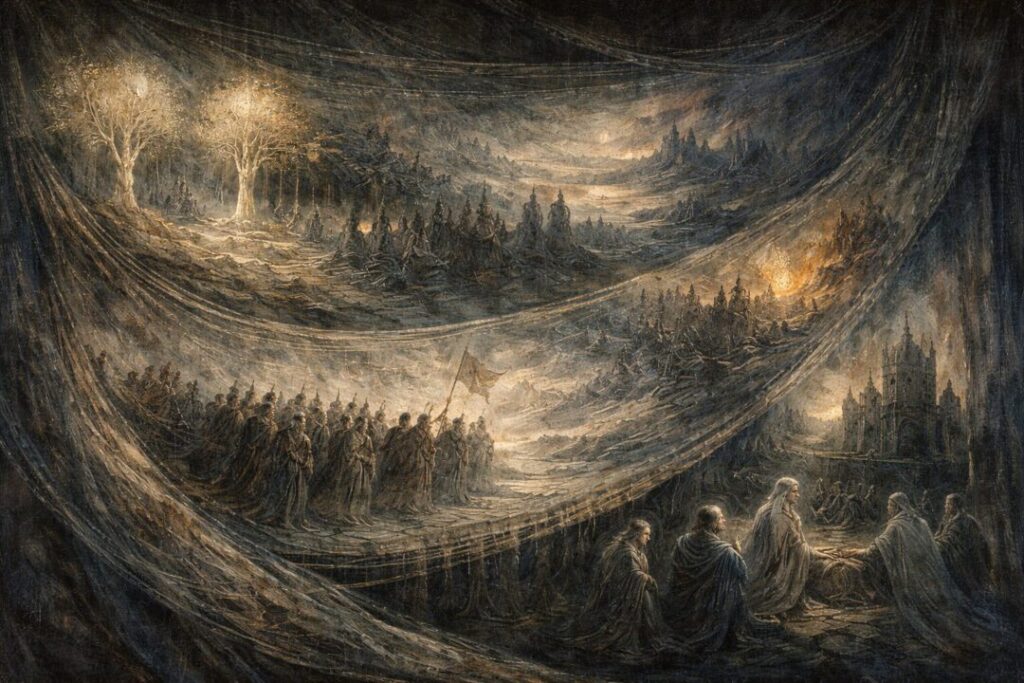
Vairë’s webs may also reflect the nature of Time in Arda
There is another reason Vairë’s role feels so profound.
She is said to weave all things that have ever been in Time. That phrase matters. It suggests not merely personal memory, but the unfolding of history itself within Arda. Her work is tied to what has entered Time and become part of the world’s actual story.
This makes her more than a recorder of individual deeds. She is linked, at least by implication, to the completed pattern of events.
That does not mean she controls fate. The texts do not say that. Nor do they say that her webs are prophetic. Quite the opposite: the wording points backward, not forward. She weaves what has been in Time, not what may yet be.
That backward-looking quality is important because it preserves the moral seriousness of action in Middle-earth. Deeds are freely done; afterward, they belong to history. Once they are woven, they cannot be unmade.
And that may be the deepest reason the image is so haunting.
In many fantasy worlds, history fades into background lore. In Tolkien’s world, history remains alive. It can be sung, remembered, grieved, judged, and in Vairë’s case, visibly woven into the walls of one of the most powerful places in creation.
Why Vairë matters more than many readers realize
Vairë rarely appears in popular discussions because she does not dominate dramatic scenes the way figures like Fëanor, Lúthien, Galadriel, or Morgoth do.
But in thematic terms, she stands close to the heart of the legendarium.
Middle-earth is full of ruins, fading realms, lost languages, and fragile memories. Again and again, the stories ask whether beauty, suffering, courage, and guilt will be forgotten. Vairë is one of the clearest answers to that fear.
They will not be forgotten.
The world remembers.
Not sentimentally. Not selectively. But fully.
That is why the Halls of Mandos feel so different from a generic underworld. They are not merely where the dead go. They are where truth remains present. Mandos represents the weight of that truth in judgment. Vairë represents the permanence of that truth in memory.
And together they make the Halls one of the most quietly terrifying and beautiful places in all Arda.
So why do the Halls of Mandos keep records?
Because in Tolkien’s mythology, death does not erase meaning.
The Halls of Mandos “keep records” because Vairë weaves the history of the world into storied webs, and because Mandos is the keeper of memory, doom, and the spirits who come into his care. The idea is not bureaucratic but mythic: what has happened in Time is preserved, clothed upon the halls, and held where judgment and waiting meet.
That is why Vairë matters.
She is the reason the Halls are not only silent.
They are remembering.