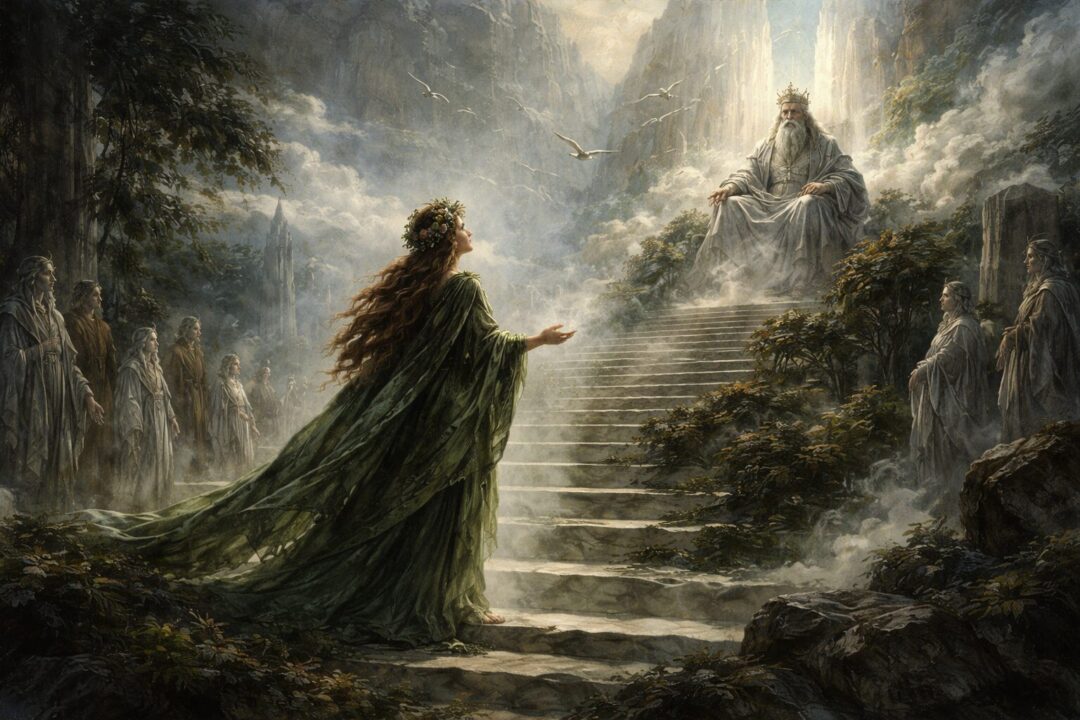
When people think of power in Middle-earth, they usually think first of kings, dark lords, wizards, or warriors.
They do not usually think of the being who cared for roots, seeds, fruit, forests, and the slow green life of the earth.
But Yavanna stands much closer to the center of the world than that instinct suggests.
She is not a minor figure standing at the decorative edge of creation. She is one of the great powers of Arda, and the texts describe her as the lover of all things that grow in the earth, holding in her mind their countless forms, from towering trees to the smallest life in the mould.
That already makes her important.
What makes her fascinating is something else.
Yavanna is one of the few great powers in the legendarium who seems to understand, very early, that beauty alone is not protection.
And that insight leads directly to one of the strangest and most important consequences in the mythology: the existence of guardians for the trees.
Yavanna Was Not Only a Lady of Flowers and Forests
It is easy to flatten Yavanna into a simplified image of a “goddess of nature.”
That loses too much.
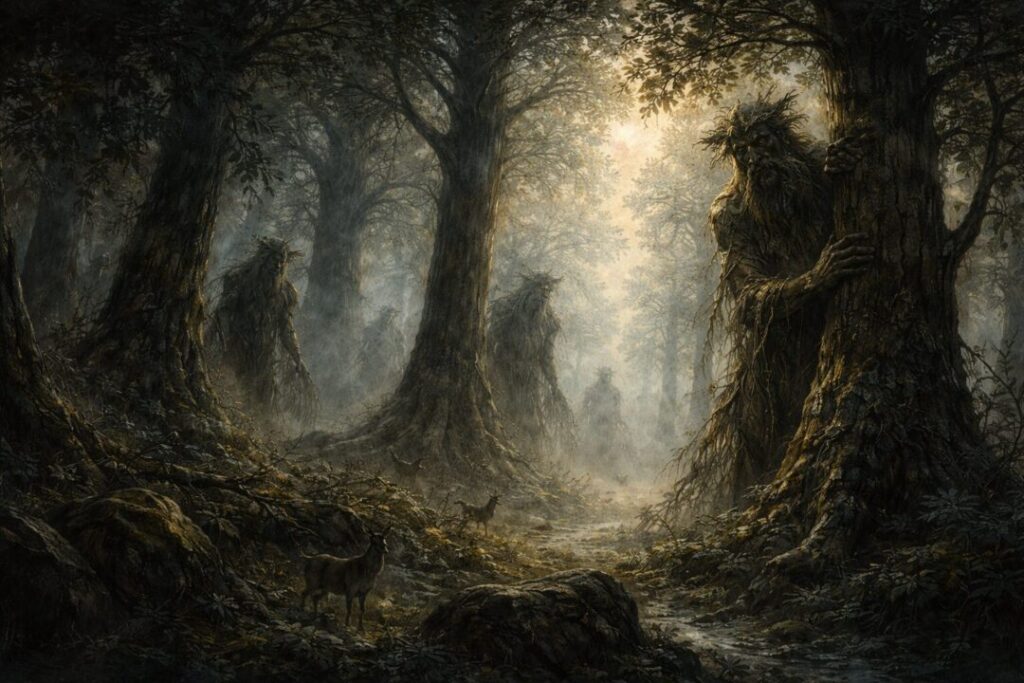
The texts place her among the mightiest of the Valar. She is associated not merely with pleasant landscapes, but with the entire realm of growing things. Her concern ranges from moss and grain to vast forests and the great works of living creation. She is also the maker of the Two Trees of Valinor, the luminous sources of light that stood before the Sun and Moon.
This matters because Yavanna’s relationship to life is not passive.
She does not simply admire growing things.
She brings them forth, sustains them, remembers them, and mourns their injury.
That is why her fears are serious. When Yavanna is troubled, the text does not present that as sentimental overreaction. It presents it as insight.
She knows that everything which grows can also be cut down.
The Problem Begins with Aulë
The crucial turning point comes in the chapter “Of Aulë and Yavanna.”
Aulë, Yavanna’s spouse, makes the Dwarves in impatience before the coming of the Children of Ilúvatar. He cannot truly create independent life on his own, but Ilúvatar, after confronting him, allows the Dwarves to live under his authority.
This scene is often remembered mainly for what it says about Aulë and the origin of the Dwarves.
But for Yavanna, it raises another question.
Once such beings are in the world—beings of craft, force, hunger, settlement, building, shaping—what happens to everything more vulnerable than they are?
Yavanna’s concern is not limited to the Dwarves as a people. The chapter makes that clear. Aulë replies that not only Dwarves but also Elves and Men will at times have need of wood.
That exchange is essential.
It means the issue is larger than one race.
The issue is built into the condition of embodied life in Middle-earth. The Children and other speaking peoples will use the world. They will need its materials. They will shape and transform what they find.
And Yavanna immediately asks the question no one else is asking strongly enough:
what, then, protects the things that cannot argue for themselves?
Why Trees in Particular Matter
Yavanna’s anxiety is often summarized as concern for plants in general, but the texts give special weight to trees.
That is not accidental.
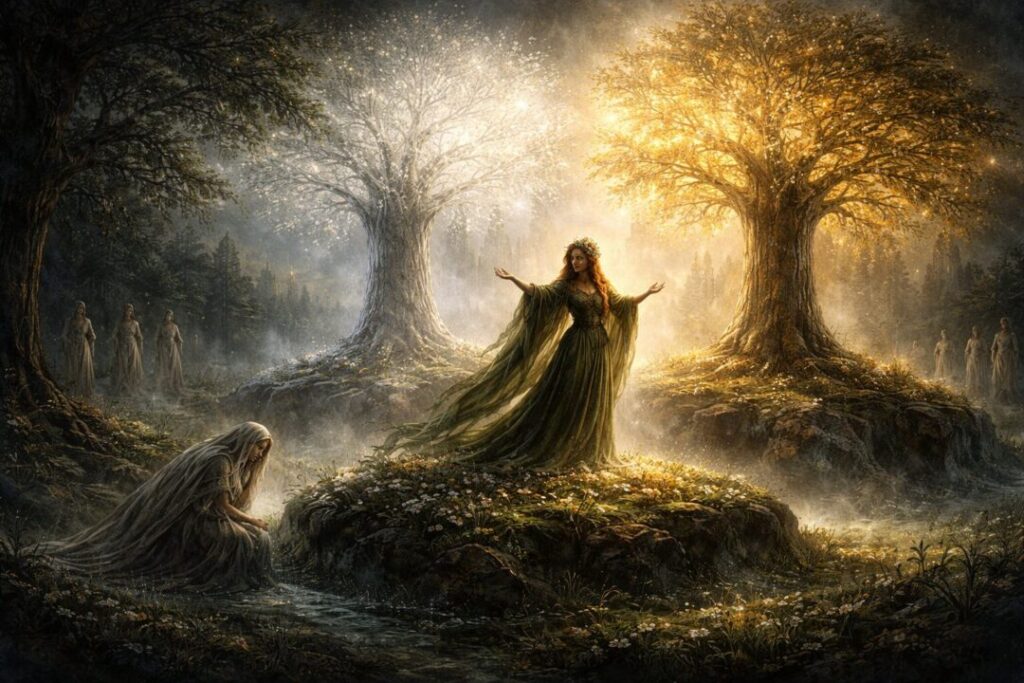
Trees are among her most beloved works. Her description in Valaquenta gives them pride of place, and her greatest act in Aman is the making of the Two Trees.
In Middle-earth as a whole, trees also carry unusual symbolic force.
Forests preserve memory.
They outlast generations.
They stand between the made world and the unmade one.
They can shelter, conceal, nourish, or resist.
Even in The Lord of the Rings, trees are rarely treated as mere background. Fangorn, the Old Forest, and the memory-haunted woods of earlier ages all suggest that the vegetal life of Arda is never wholly inert in the way modern readers may expect.
Still, we have to be careful here.
The texts do not say that all trees are persons.
They do not say that every forest is fully conscious.
What they do show is that Yavanna’s thought leads to a world in which some living things are granted defenders, and in which the boundary between mere landscape and living presence is not always simple.
Manwë’s Answer Changes the World
Yavanna brings her fear to Manwë.
This is the decisive moment.
She is troubled that the things she has made may pass under the dominion of others, to be damaged or consumed without any answering voice. In response, Manwë does not dismiss her concern. He looks deeper into the design of the world and recalls that her thought was already present in the Music.
Then comes the answer.
When the Children awake, Yavanna’s thought will awake also. Spirits will go among the kelvar and the olvar, and some will dwell there. Their anger will be feared. And in the woods, the Shepherds of the Trees will walk.
That is the real reason trees needed guardians.
Not because Yavanna misunderstood the world.
Because she understood it too well.
She knew that goodness in Arda does not survive merely because it is beautiful. Once the world is inhabited by builders, cutters, miners, kings, armies, and empires, vulnerable things need more than admiration.
They need defenders.
The Ents Are the Answer
This is where the Ents enter the mythology in their deepest form.
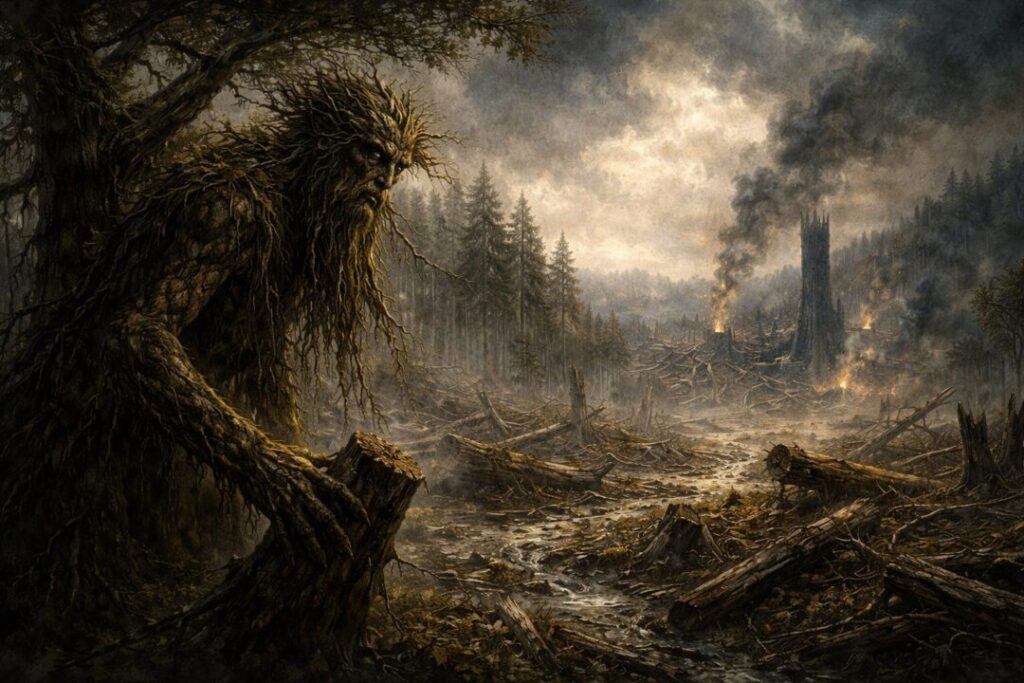
They are not merely curious forest beings added for color in a later story. In the legendarium’s internal logic, they are the fulfillment of Yavanna’s plea: the Shepherds of the Trees, set in the woods so that the trees are not left entirely voiceless before stronger hands.
That does not mean every Ent is simply a weapon of vengeance.
Treebeard himself shows something more complex. Ents remember, guard, mourn, deliberate, and endure. Their relationship to trees is intimate enough that the destruction around Isengard feels personal, not abstract.
This is important because Yavanna does not ask for endless retaliation.
She asks that her works not stand wholly defenseless.
The Ents are therefore not an interruption of the moral order of Middle-earth. They are part of it.
They exist because Arda is a world where domination is always a danger, even from those who are not wholly evil.
This Is Not an Anti-Dwarf Story
One mistake readers sometimes make is to turn this episode into a simple opposition between Yavanna and the Dwarves.
That is too shallow.
Yavanna does fear what Dwarves may do with axes, but the text broadens the issue almost immediately. Elves and Men, too, will use wood. The problem is not that one people are villains and the others innocent. The problem is that all embodied peoples transform the world to live in it.
That tension runs through the legendarium.
Craft is good.
Making is good.
Building is good.
But every act of shaping also risks turning stewardship into dominion.
In that sense, the conversation between Yavanna and Aulë is not a side note. It is one of the clearest mythic statements of a recurring tension in Middle-earth: the tension between making and preserving, between use and reverence, between mastery and care.
Why Yavanna Matters More Than People Realize
Yavanna matters because she sees something the later stories repeatedly confirm.
Saruman cuts and burns.
Sauron blackens and desolates.
Industrial force and military power consume forests as though they were only fuel.
Against that, the Ents do not feel like an oddity.
They feel like a promise being remembered at last.
And behind that promise stands Yavanna.
Not distant from the drama of Middle-earth, but quietly underneath it.
She is there at the beginning with the first growing things.
She is there in the light of the Two Trees.
She is there in the fear that living beauty may be used up by stronger hands.
And she is there in the answer that the woods will not remain entirely undefended.
Why Trees Needed Guardians
In the end, the answer is larger than “because Yavanna loved them.”
Trees needed guardians because love does not stop axes.
They needed guardians because in Middle-earth, even rightful peoples can become users, takers, cutters, and claimants.
They needed guardians because the world is full of beauty that cannot survive on beauty alone.
That is what Yavanna perceives so early.
And that is why her story matters.
She is not simply the lady of green things.
She is one of the first voices in the legendarium to recognize that innocence, once placed into the world, may need strength beside it.
And from that recognition come the Shepherds of the Trees—one of the clearest signs that in Middle-earth, creation is not only made.
It is also defended.