At first glance, the idea seems obvious.
If war in Middle-earth had true air power, everything would change.
Armies could be watched from above. Messengers could cross vast distances in hours instead of days. Fortresses that seem nearly unassailable from the ground would suddenly become exposed. Surprise would shrink. Distance would shrink. Even fear itself would take on a different shape.
And yet the deeper question is not whether air power would matter.
It is how.
Because Middle-earth is not a world that lacks flying beings. It already has them. The Great Eagles exist. The Nazgûl eventually ride winged creatures. In the Elder Days, winged dragons appear in one of the most catastrophic wars in the whole legendarium. The texts do not present the sky as irrelevant. They present it as rare, dangerous, and hard to control.
That distinction matters.
The most common modern assumption is that aerial superiority would simply hand victory to whichever side used it first. But the logic of Middle-earth is more severe than that. Air power would indeed change everything—but not necessarily by making victory easy.
It would change what could remain hidden.
And in the War of the Ring, that is almost the whole war.
The Sky Is Already Part of War in Middle-earth
One reason this topic is so compelling is that the legendarium already shows flashes of what airborne force can do.
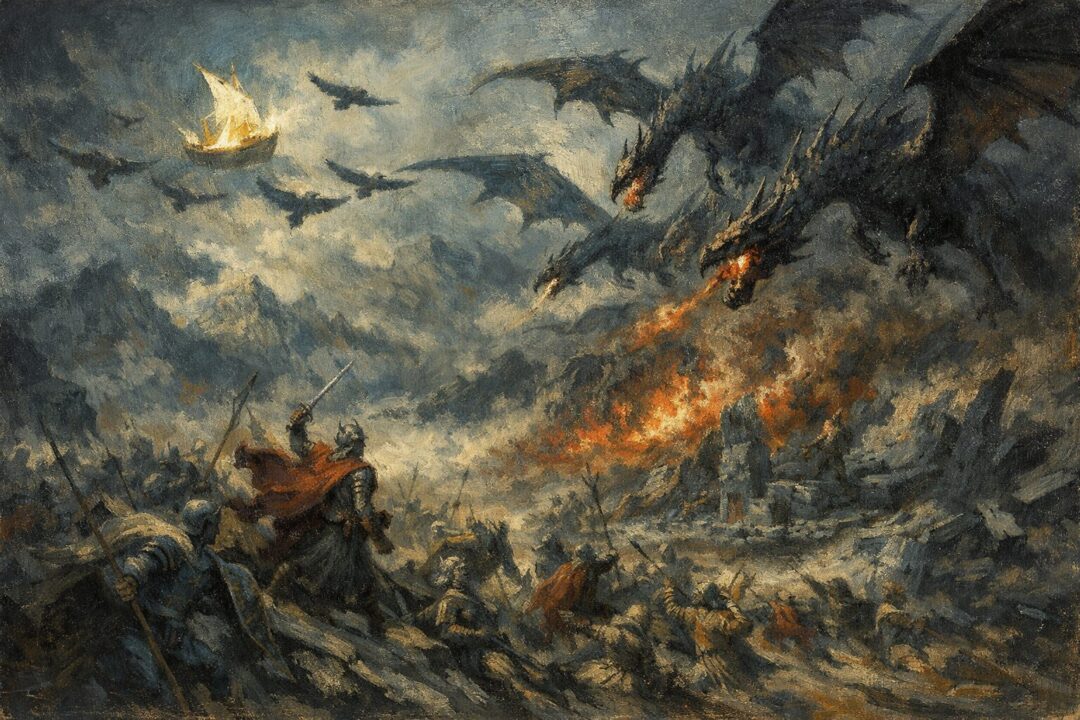
The clearest large-scale example comes from the First Age. In the War of Wrath, Morgoth unleashes winged dragons, and their arrival is described as so terrible that even the host of the West is driven back until Eärendil and the Eagles oppose them. This is one of the strongest pieces of evidence in the texts that aerial warfare can alter the balance of an entire conflict.
That is important because it prevents any shallow answer.
The texts do not imply that flight is useless in war. Quite the opposite. When the sky becomes part of battle at that scale, it is devastating.
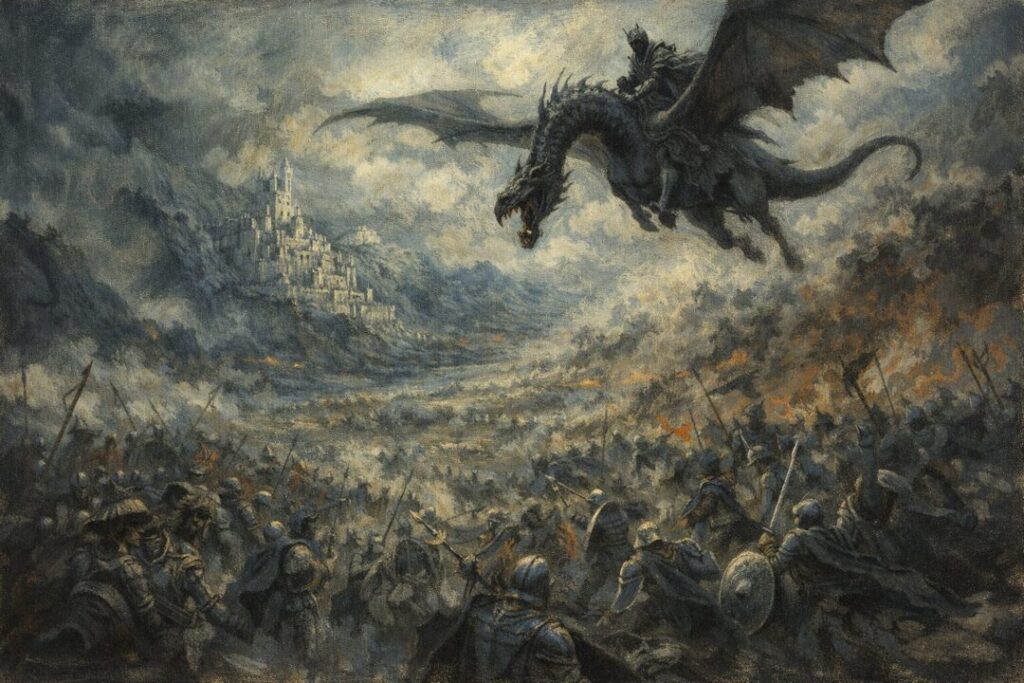
The Third Age offers a narrower but still revealing form of the same truth. Sauron’s greatest airborne asset is not a dragon-host, but the Nazgûl on winged beasts. By the late War of the Ring, these creatures are used for terror, reconnaissance, command presence, and direct assault. The Witch-king’s approach over the Pelennor is not merely physical danger. It is the arrival of pressure from above—psychological, mobile, and difficult to answer.
So the premise holds.
Yes, air power would change everything.
But canon also shows that Middle-earth already understands that truth. What it does not show is a world where such power is common, cheap, or fully dependable.
Why the Eagles Do Not Function Like an Air Force
This is where the discussion usually becomes much less comfortable.
People often treat the Eagles as if they are simply an unused strategic resource. But the texts do not support that.
In The Hobbit, the narrator explicitly says that eagles are not generally kindly birds, and even the noble northern Eagles are proud and strong rather than tame or domesticated. They intervene against goblins, rescue travelers at times, and can turn a battle—but they do not behave like mounted troops under a king’s command.
The same pattern remains in The Lord of the Rings.
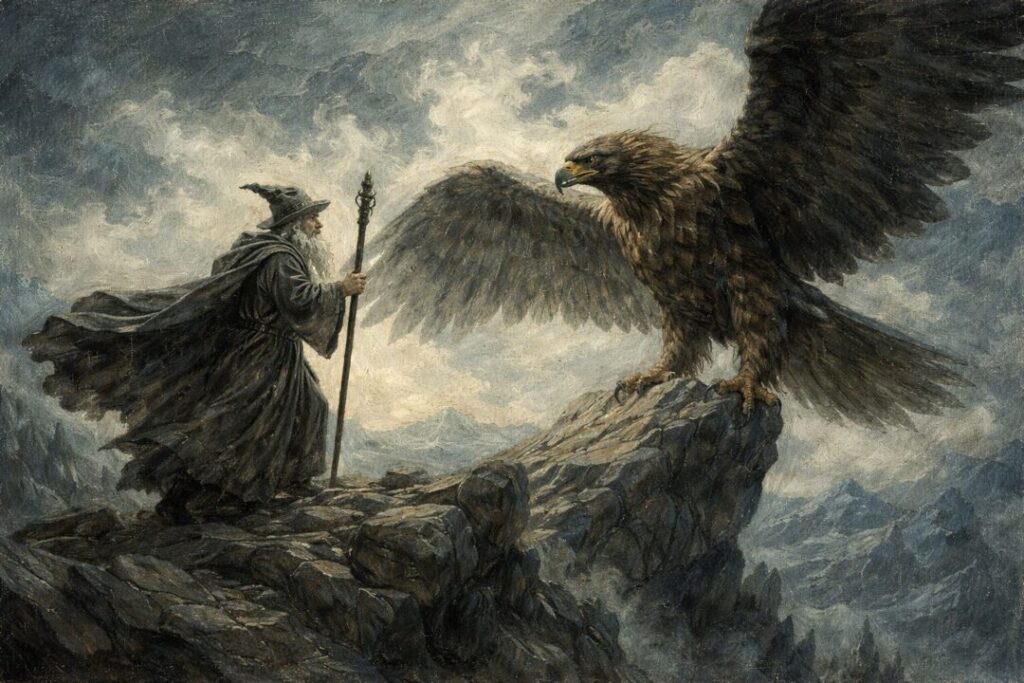
Gwaihir rescues Gandalf from Orthanc, but when Gandalf asks how far he can bear him, the answer is limited: “Many leagues… but not to the ends of the earth,” and he adds that he was sent “to bear tidings not burdens.” That single exchange quietly destroys the fantasy that the Eagles are an endlessly deployable transport network.
Even outside the story proper, the authorial comment preserved in Letter 210 is revealing. The Eagles are called a “dangerous ‘machine’” and said to be useful only within strict limits. That remark is partly literary, but it also aligns with how they function inside the world: sudden, exceptional, and never the main operating system of war.
So yes, if Middle-earth had large, reliable, command-driven air forces, war would change dramatically.
But the Eagles are not that.
They are one of the reasons the question exists at all—and one of the reasons the easy answer fails.
Air Power Would Destroy Secrecy First
This is the deeper issue.
The War of the Ring is not won by military superiority. Gandalf says this plainly in the final debate: victory cannot be achieved by arms alone, and the only hope is to keep Sauron’s Eye fixed away from the Ring-bearer’s true peril. The West must act as bait, drawing out his force so that he empties his land and looks in the wrong place.
That means secrecy is not a side concern.
It is the strategy.
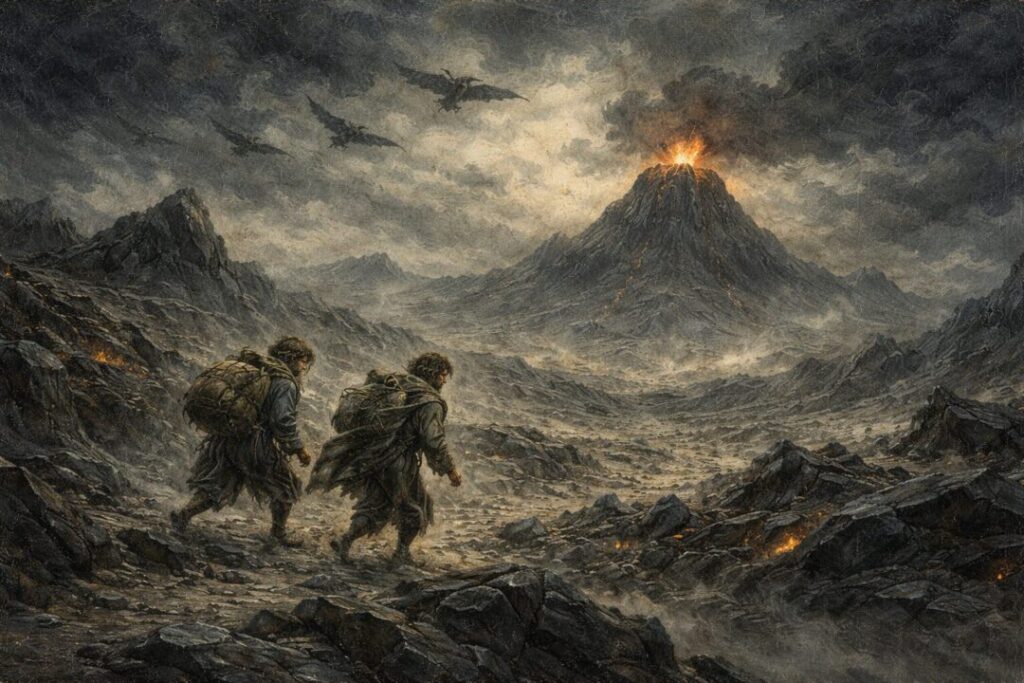
Once that is clear, the notion of openly using the sky becomes much more dangerous. Aerial travel is visible. It is exposed. It shortens distance, yes—but it also shortens uncertainty. A figure crossing the air toward Mordor is harder to hide than two exhausted Hobbits moving on foot through ash, rock, and shadow.
This does not prove that any airborne attempt would certainly fail. The texts never run that experiment directly, so absolute certainty would go too far.
But they strongly imply the principle behind the decision. Sauron’s mind is shaped by domination, power, and visible force. He expects great rivals to challenge him openly. Gandalf’s whole strategy depends on feeding that assumption while concealing the truth. A dramatic aerial move toward Mordor would risk collapsing that concealment at once.
In other words, air power would not merely make movement faster.
It would make intentions legible.
And in this war, that may be fatal.
Sauron Also Has Air Denial
Another common mistake is imagining the sky above Mordor as uncontested.
It is not.
By the end of the War of the Ring, the Nazgûl ride winged creatures, and the texts show them ranging over the battlefield and over Mordor itself. These are living creatures, not invulnerable monsters, and they can be slain—Legolas kills one, and Éowyn brings down the mount of the Witch-king on the Pelennor. But that does not make them insignificant. It makes them dangerous assets that still impose real risk.
This matters strategically.
Even limited airborne defenders can be enough to make the use of rare airborne attackers prohibitive. The Eagles are powerful, but they are few. The Nazgûl are terrifying, swift, and directly tied to Sauron’s will. The point is not that Sauron possesses overwhelming air supremacy in a modern military sense. The texts do not quantify forces that way.
The point is simpler.
Any attempt to use the sky near Mordor would almost certainly enter a watched and contested space.
And because the mission depends on one object, one bearer, and one destination, even a small chance of interception becomes enormous.
Air Power Would Transform Every Other Kind of War
If we step back from the Ring and look at Middle-earth more broadly, the consequences become easier to see.
Sieges would change first.
Fortresses such as Helm’s Deep, Minas Tirith, and even older strongholds from the Elder Days gain much of their defensive value from terrain, walls, gates, and controlled access. Real aerial capacity would weaken all of that. Supplies could be watched or disrupted. Rear positions could be reached. Commanders could be targeted. A fortress would still matter, but it would no longer feel sealed from the world beyond its walls.
Scouting would change next.
Middle-earth often turns on imperfect information: delayed messengers, uncertain sightings, hidden roads, and whole armies moving under partial cover. Airborne reconnaissance would narrow that fog dramatically. Rohan’s movements, Gondor’s relief efforts, Orc musters, refugee routes—all would become easier to track.
So would kingship itself.
A ruler with dependable control of the sky would not merely gain military advantages. He would gain reach. Orders would move faster. Borders would become more porous. Surprise raids would grow easier. Peripheral regions would become less peripheral.
This is one reason the Númenórean comparison is quietly suggestive, even though it is not literal air power. In the Second Age, their sea-power already gives them a kind of strategic mobility that overwhelms more localized peoples. Air power would do something similar, only more radically: compress the map.
Middle-earth is full of distance.
Air power would wound that distance.
But Middle-earth Resists Mechanized Solutions
There is also a thematic reason the question never settles into something simple.
Middle-earth does not treat power as neutral scale.
Again and again, the stories resist the idea that the side with the greatest force, the most efficient weapon, or the strongest tool automatically becomes the rightful victor. Great power can help, but it also distorts judgment. It tempts rulers into exposure, haste, overconfidence, and the belief that visible control is the same thing as wisdom.
That is why the Ring itself is such a trap.
And that is why the Eagles remain limited.
A fully militarized sky would fit poorly with the moral structure of the War of the Ring, where restraint, secrecy, endurance, and humility matter more than spectacular strength. That does not make air power unreal. It makes it morally unstable within the world’s deepest conflicts.
The First Age shows how catastrophic it becomes when unleashed on a mythic scale.
The Third Age shows why the last struggle cannot depend on it.
So Would Air Power Change Everything?
Yes.
The texts strongly support that answer.
Winged dragons alter world-level war. Nazgûl on fell beasts multiply terror and mobility. Eagles can reverse moments that seem hopeless. The sky, when weaponized, matters immensely.
But the second answer matters more.
It would not change everything in the direction people usually imagine.
In the War of the Ring, the side of the West does not need a faster road to Mordor. It needs Mordor not to understand the road at all. And that means the greatest value of the quest lies not in force, but in concealment.
So the real danger of air power in Middle-earth is not simply that it would make war deadlier.
It would make hidden purposes harder to hide.
And once that happens, the whole shape of the story changes.
Not because flying is weak.
But because in Middle-earth, the sky reveals too much.
Sources & Notes
- J.R.R. Tolkien, The Silmarillion, “Of the Voyage of Eärendil and the War of Wrath” — shows winged dragons entering the War of Wrath as a catastrophic aerial force, opposed by Eärendil and the Eagles.
- J.R.R. Tolkien, The Hobbit, “Out of the Frying-Pan into the Fire” — presents the Eagles as proud, independent rescuers and fighters, not a tame air force under ordinary command.
- J.R.R. Tolkien, The Lord of the Rings, Book III, Chapter 5, “The White Rider” — has Gwaihir bear Gandalf only within limits, reinforcing that Eagle-help is exceptional rather than routine transport.
- J.R.R. Tolkien, The Lord of the Rings, Book V, Chapter 4, “The Siege of Gondor” — shows the Nazgûl’s winged mounts spreading terror and giving Sauron mobile presence over the war.
- J.R.R. Tolkien, The Lord of the Rings, Book V, Chapter 9, “The Last Debate” — grounds the secrecy argument: the West cannot defeat Sauron by arms, but must draw his Eye away from the Ring-bearer.
- J.R.R. Tolkien, Letter 210 — calls the Eagles a dangerous “machine” in storytelling terms and warns against treating them as an unlimited solution.