
When readers think of the greatest acts of courage in The Lord of the Rings, they often picture Frodo climbing Mount Doom, Éowyn standing before the Witch-king, or Aragorn leading the Host of the West. Yet one of the most consequential choices in the War of the Ring happens inside the walls of Minas Tirith, made not by a king or wizard but by an ordinary guardsman.
Beregond of the Third Company of the Citadel Guard faces a decision that appears impossible. His sworn duty is obedience. His captain is absent. His lord, Denethor, is still the lawful Ruling Steward of Gondor. Every law, oath, and military custom demands that Beregond remain at his post.
Instead, he abandons it.
He kills fellow servants of Gondor.
He enters the forbidden Silent Street.
He interrupts the Steward himself.
By every outward measure, Beregond commits grave crimes against Gondor's order. Yet the story ultimately reveals a profound paradox: by breaking Gondor's law, he preserves the very values that law was meant to protect.
The Weight of Law in Gondor
Gondor is not portrayed as a kingdom where discipline is optional. Throughout the narrative, military hierarchy, sworn service, and obedience are treated with great seriousness. Beregond is no reckless rebel. Earlier in the story he appears as an exemplary soldier—courteous, faithful, knowledgeable, and deeply devoted both to Minas Tirith and to Captain Faramir.
This makes his later actions even more significant.
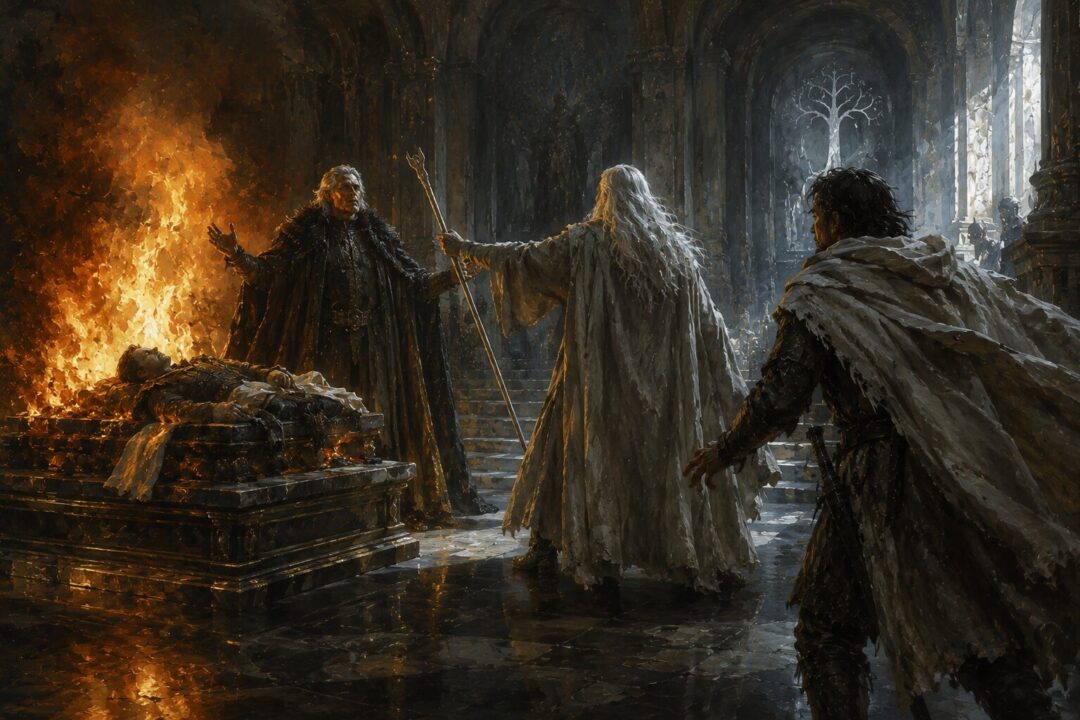
When Pippin races through the city after discovering Denethor intends to burn Faramir alive upon a funeral pyre, Beregond initially answers exactly as a loyal guardsman should. His orders forbid him from leaving his assigned post. The conflict is not between courage and fear but between two competing duties.
Pippin's response exposes the moral crisis. If Beregond obeys, Faramir almost certainly dies. If he disobeys, he becomes a criminal under Gondor's laws.
The text never suggests this choice is easy.
Denethor Remains the Lawful Steward
An important detail is often overlooked.
Denethor has fallen into despair and madness through his misuse of the palantír, yet he has not been formally removed from office. Gandalf opposes him, but Gandalf possesses no legal authority to depose the Steward. Even after Denethor's judgment has become deeply clouded, his commands still carry legal force within Gondor's government.
That makes Beregond's actions genuinely unlawful.
He does not resist an obvious usurper.
He does not oppose an invading enemy.
He acts against his own lawful ruler because that ruler is about to commit a terrible injustice.
The distinction matters because Tolkien does not create an easy legal loophole. Beregond knowingly accepts the cost of disobedience.
The Silent Street Is Not Merely Another Road
Beregond's offenses extend beyond abandoning his post.
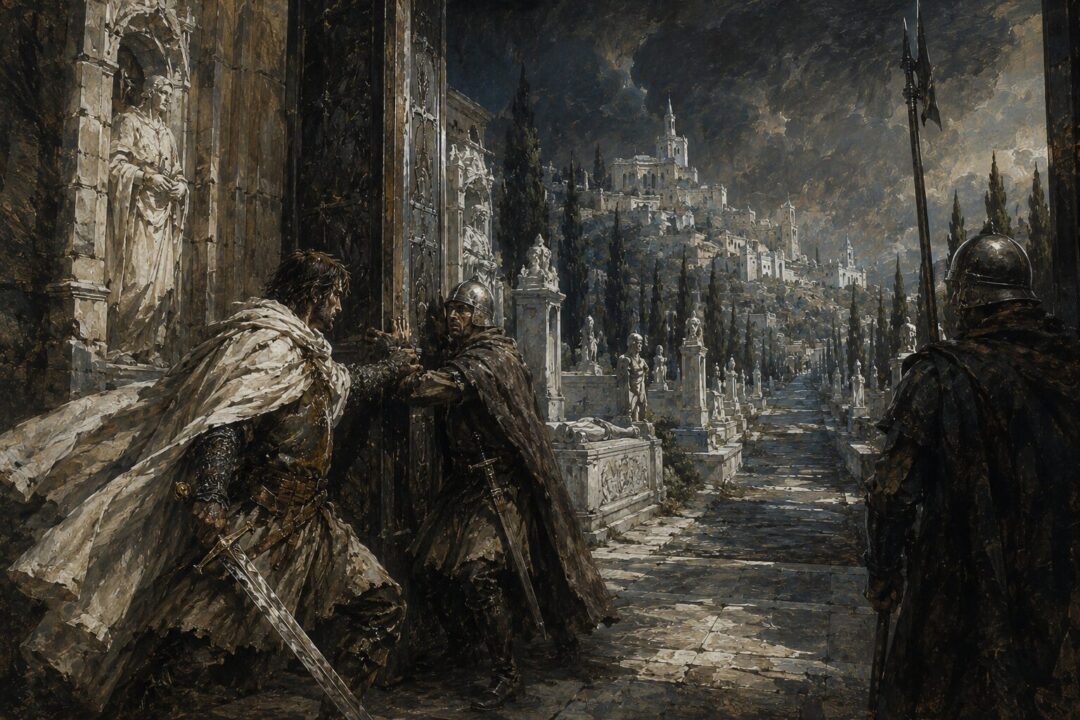
To reach Denethor, he enters Rath Dínen, the Silent Street, where the tombs of the Kings and Stewards lie. Access is tightly controlled. During the confrontation he kills the Porter who guards the entrance after the man refuses him passage.
He then kills another servant attempting to carry out Denethor's commands before reaching the Steward himself.
These deaths are tragic.
Nothing in the narrative celebrates them. Beregond acts with urgency rather than anger. His purpose is singular: to reach Faramir before the pyre is lit.
The story never portrays violence between loyal men of Gondor as glorious, even when undertaken for a just cause.
Faramir Represents Gondor's Future
Beregond is not merely saving his beloved captain.
Faramir is the last surviving heir of the House of Húrin, the line of the Ruling Stewards stretching back nearly a thousand years. With Boromir dead and Denethor descending into despair, Faramir embodies Gondor's remaining legitimate civil leadership.
Had Faramir died upon the pyre, Gondor would have lost more than an outstanding captain.
Its continuity would have been shattered.
The Stewardship itself would effectively end in catastrophe rather than honorable transition.
Beregond cannot know every future consequence, but he clearly understands that allowing Denethor's madness to consume Faramir would destroy something precious within Gondor itself.
Obedience Cannot Become Complicity
One of the deepest moral themes in Tolkien's legendarium is that authority possesses legitimacy, but it is not absolute.
Characters repeatedly face moments where obedience alone is insufficient.
Faramir refuses to seize the One Ring despite immense pressure.
Éowyn rejects the command to remain behind in safety.
Sam briefly bears the Ring only to continue Frodo's mission.
None of these choices reject rightful authority as a principle. Rather, they recognize that authority exists to serve what is good.
Beregond belongs in this same tradition.
His loyalty to Gondor ultimately proves greater than simple obedience to its current ruler.
Gandalf Understands the Difference
After Denethor's death, Gandalf immediately recognizes Beregond's role.
Rather than treating him as a murderer or mutineer, Gandalf instructs that Beregond should remain beside Faramir in the Houses of Healing, observing that Faramir was saved through Beregond's intervention.
Importantly, Gandalf does not declare Beregond innocent under Gondor's law.
Instead, he distinguishes between legal guilt and moral necessity.
That distinction prepares the way for Aragorn's later judgment.
Aragorn Refuses to Pretend No Crime Occurred
Perhaps the most remarkable part of Beregond's story comes after the war.
King Elessar does not simply pardon everything.
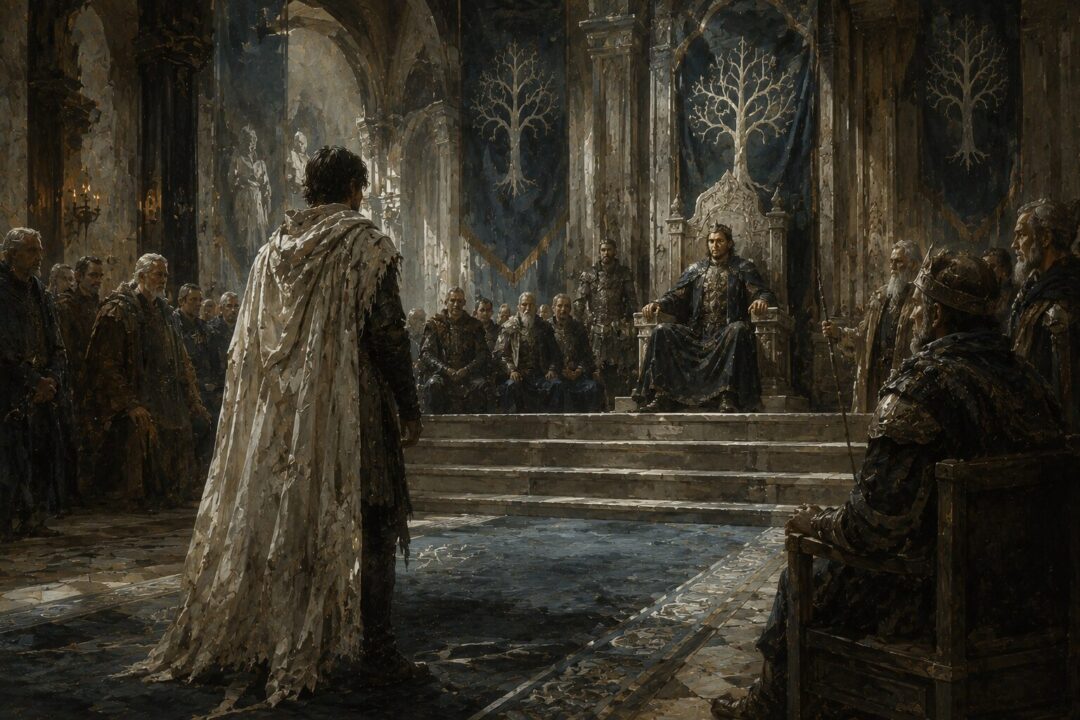
Instead, he publicly declares that Beregond has indeed committed serious offenses.
He deserted his assigned post.
He shed blood within the Hallows.
He entered places forbidden except by authority.
These are real crimes.
The King refuses to erase the law merely because the outcome proved beneficial.
This restraint matters enormously.
Justice cannot become arbitrary simply because the ruler likes the accused.
Justice Tempered by Wisdom
Yet Aragorn immediately explains why punishment alone would fail justice.
Beregond acted from love rather than ambition.
He sought neither power nor personal advantage.
He risked everything to save an innocent life from wrongful death.
Accordingly, Aragorn pronounces a sentence that simultaneously upholds law and recognizes virtue.
Beregond must leave the Citadel Guard forever because he has violated its sacred discipline.
But instead of disgrace, he receives honor.
He is appointed Captain of Faramir's White Company in Ithilien and granted permission to dwell there with his family.
The punishment remains real.
So does the reward.
Neither erases the other.
The judgment illustrates that mercy is strongest when it acknowledges truth rather than denying it.
Saving Faramir Also Saves the King's Return
The consequences ripple outward through the story.
Because Beregond saves Faramir, Aragorn later heals him in the Houses of Healing.
Faramir survives to surrender the Stewardship freely to the returning King.
His willing recognition of Aragorn helps restore the ancient relationship between King and Steward without civil conflict.
The texts do not explicitly state that Beregond foresaw any of this.
Indeed, there is no indication that he did.
His decision rests on immediate moral necessity, not political calculation.
Only afterward does the full significance become visible.
Gondor's Soul Was Never Its Walls
The siege demonstrates that stone walls alone cannot preserve a kingdom.
Denethor still commands the strongest fortress in Middle-earth.
Its gates stand.
Its soldiers fight bravely.
Its defenses remain formidable.
Yet internally, Gondor is already collapsing because despair has entered its highest office.
The danger inside the Citadel becomes greater than the armies outside.
Beregond's choice confronts that internal collapse.
He refuses to let lawful authority become an instrument of innocent death.
In doing so, he protects the moral foundation upon which Gondor actually rests.
The city survives militarily through many acts of courage.
It survives spiritually because individuals continue choosing justice over despair.
A Quiet Hero Beside the Great Ones
Beregond never becomes famous like Aragorn.
He never bears a Ring.
He never slays a Nazgûl.
He never commands vast armies.
His greatness lies somewhere quieter.
He understands that true loyalty sometimes demands immense personal sacrifice.
He expects punishment.
He risks execution.
He acts anyway.
That willingness gives extraordinary weight to his decision because it cannot be dismissed as convenient heroism.

Why Beregond's Story Still Matters
Modern readers often imagine moral courage as defying authority whenever authority seems flawed.
Tolkien presents something more demanding.
Authority deserves respect.
Law matters.
Oaths matter.
Institutions matter.
Precisely because they matter, violating them should never become casual.
Beregond's greatness comes from recognizing that this is an exception of the gravest kind.
He breaks the law with full awareness of its value.
He accepts responsibility afterward instead of claiming exemption.
Likewise, Aragorn refuses both extremes. He neither ignores Beregond's crimes nor condemns him without regard for motive. Justice and mercy work together because each remains rooted in truth.
In the end, Beregond saves more than Faramir's life.
He helps preserve Gondor's capacity for righteousness at the very moment despair threatens to consume it from within.
His story reminds us that the highest purpose of law is not merely preserving order.
It is preserving the good that order was created to defend.
Sources & Notes
- Tolkien Gateway — Beregond: summarizes Beregond's service in Minas Tirith, his leaving his post, and his actions at Rath Dínen to save Faramir. https://tolkiengateway.net/wiki/Beregond
- Tolkien Gateway — Faramir: background on Faramir as Denethor's surviving son and the Stewardship context that makes his rescue politically and morally significant. https://tolkiengateway.net/wiki/Faramir
- Tolkien Gateway — Denethor: overview of Denethor II as Ruling Steward, his despair during the Siege of Gondor, and the pyre episode. https://tolkiengateway.net/wiki/Denethor
- Tolkien Gateway — Rath Dínen: explains the Silent Street/tombs setting where Denethor attempted to burn himself and Faramir. https://tolkiengateway.net/wiki/Rath_D%C3%ADnen
Sources focus on Beregond's unlawful rescue of Faramir, Denethor's authority and despair, and the Rath Dínen setting.