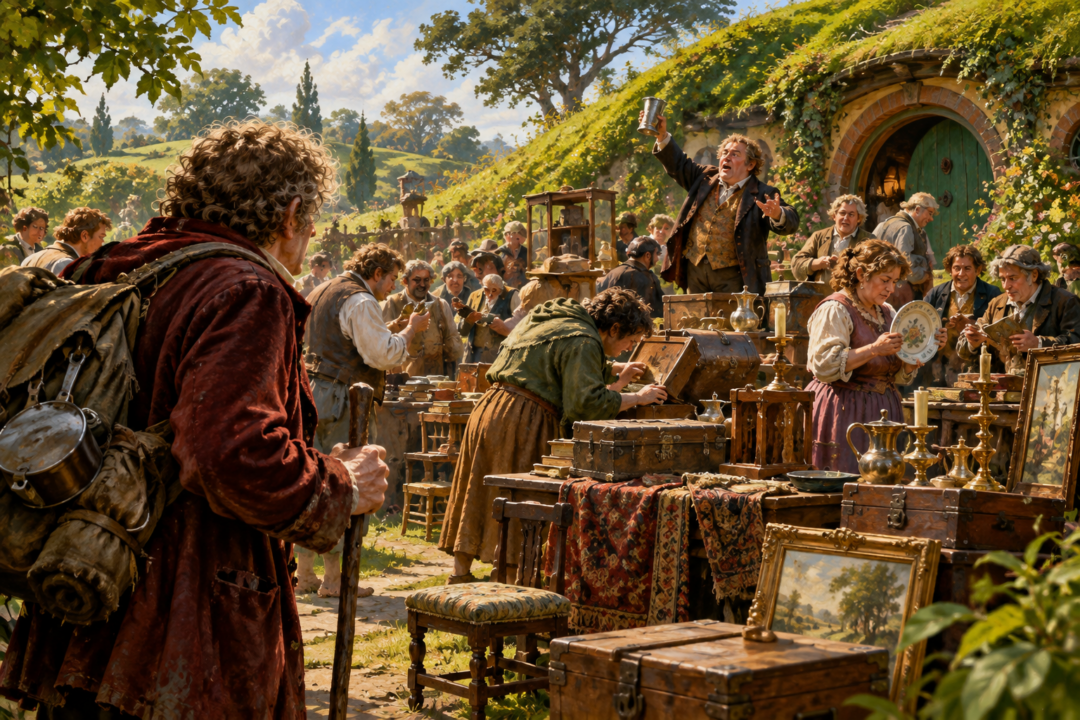
Bilbo Baggins survives trolls, goblins, giant spiders, Smaug, and the Battle of Five Armies. Yet when he finally reaches Bag End, one of the strangest obstacles of his adventure is waiting at his own front door: other hobbits are buying his furniture.
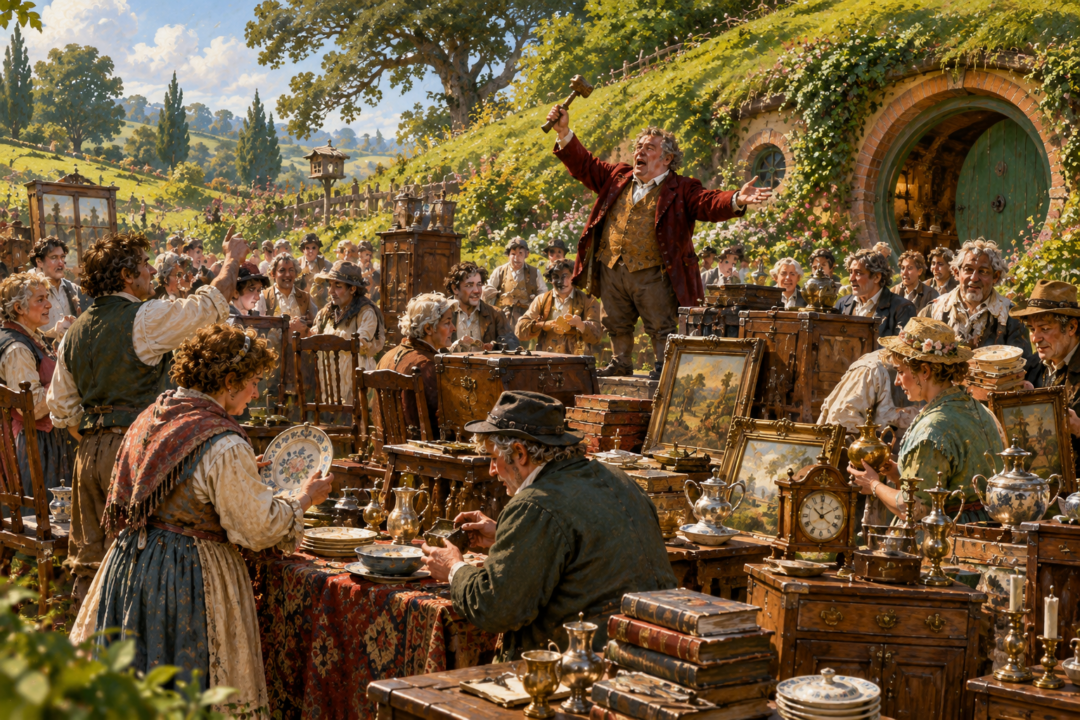
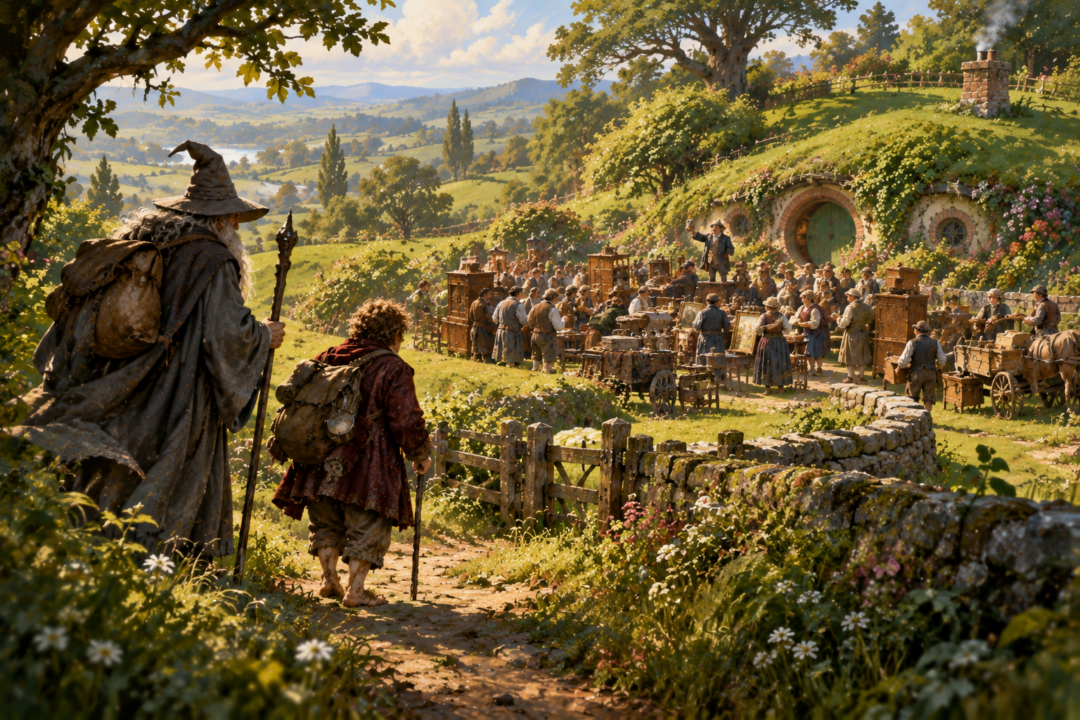
The scene at the end of The Hobbit is deliberately absurd. Bilbo returns on June 22 to discover Messrs. Grubb, Grubb, and Burrowes auctioning the possessions of the “late” Bilbo Baggins. Most of the sale is already over. The Sackville-Bagginses are inside measuring rooms for their own furniture.
Then the narrative gives us the crucial phrase: Bilbo is “Presumed Dead.”
But immediately afterward comes an apparently contradictory detail. His return causes legal trouble lasting years, and it takes a considerable time before Bilbo is accepted, in legal terms, as being alive again.
That raises an intriguing question. If Bilbo has not yet gone through some final legal process establishing his death, how can his property already be sold?
The answer is that the text never actually gives us the modern legal procedure we may instinctively imagine. What it gives us instead is a wonderfully Shire-like collision between presumption, property, relatives, local institutions, and an owner who has returned at exactly the wrong moment.
Bilbo Has Not Been Away for Twenty Years
First, one misconception needs clearing away.
Bilbo's absence is not extraordinarily long by modern missing-person standards. He leaves Bag End in late April 2941 of the Third Age and returns on June 22 of the following year. His adventure therefore keeps him away for roughly fourteen months.
That makes the auction stranger, not easier to explain.
Yet the circumstances of his disappearance matter enormously.
Bilbo does not arrange a respectable extended journey. He runs out of Bag End without a hat, walking-stick, money, or proper preparation after suddenly joining Thorin Oakenshield's company. From the perspective of Hobbiton, the extremely predictable Mr. Baggins simply vanishes.
And the journey on which he disappears leads into the dangerous lands beyond the Shire.
There is no indication in The Hobbit that Bilbo sends reassuring messages home during the quest. By the time the sale occurs, his neighbors have every reason to know that he has been absent for more than a year and no obvious reason to expect him to walk through the gate that morning.
The text does not tell us exactly when the Shire began treating him as presumed dead, nor what evidence was required. Any detailed reconstruction of that process would therefore be speculation.
What we do know is that by June 22, 2942, the presumption has advanced far enough for an auction house to be selling his effects publicly.
“Presumed Dead” Is the Key — Not a Formal Death Certificate
It is tempting to imagine that something has gone wrong because Bilbo has not been formally declared dead.
But The Hobbit never says that no legal declaration or procedure occurred before the auction. Nor does it describe a Shire equivalent of a death certificate, probate court, statutory waiting period, or modern missing-person law.
The safest conclusion is much narrower.
Bilbo has been treated as dead on the basis of a presumption, and that presumption has acquired sufficient practical or legal force for his possessions to be sold.
That is all the text requires.
Indeed, the aftermath strongly suggests that the Shire possesses recognizable property law or at least established legal customs. Bilbo cannot simply walk into Bag End, announce “I am alive,” and automatically undo everything that happened while he was away. His return creates a dispute serious enough to continue for years.
The comedy depends precisely on that distinction.
Biologically, Bilbo's case is remarkably simple.
Legally, it is not.
Why Doesn't Bilbo's Return Automatically Cancel Everything?
This is perhaps the funniest part of the episode.
Bilbo is physically standing there. Gandalf has returned with him. Yet the narrative says that it takes a long time before Mr. Baggins is “in fact admitted to be alive again.”
That wording makes sense if the problem is not whether the breathing hobbit in front of everyone possesses a pulse, but whether the returned traveler can reoccupy the legal identity and property rights of the Bilbo Baggins who has already been treated as dead.
The book does not explain the evidentiary rules involved, so we should not invent them. But it does reveal the practical consequences.
People have already purchased Bilbo's possessions. Some of them obtained very good bargains and are reluctant to surrender them. Bilbo eventually decides that, to save time, he will buy back a considerable amount of his own furniture.
That detail shows why reversing the presumption is complicated.
The auction has created other claims.
If Bilbo's supposed death caused his property to pass into a sale recognized as valid at the time, his unexpected return potentially affects not only Bilbo and his heirs but numerous purchasers. The story never supplies the precise Shire law governing those transactions. It simply tells us that sorting them out becomes prolonged “legal bother.”
In other words, Bilbo's existence is obvious. Untangling everything done because he was believed dead is the difficult part.
The Sackville-Bagginses Have a Very Particular Interest
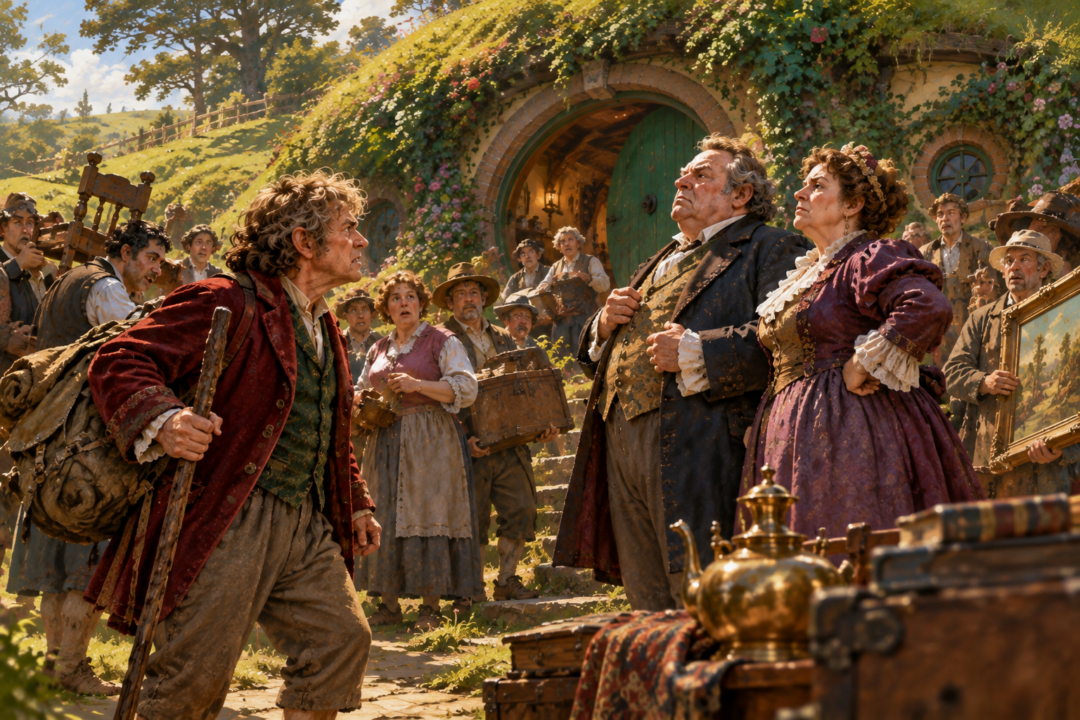
Then there are the Sackville-Bagginses.
When Bilbo arrives, they are not merely attending the auction. They are measuring Bag End's rooms to determine whether their furniture will fit.
That tells us exactly what they expect to happen.
They want Bag End.
Their later role in The Lord of the Rings confirms how important the property question remains within the family. In “A Long-expected Party,” we learn that Otho Sackville-Baggins had been Bilbo's heir until Frodo's adoption frustrated those expectations. Lobelia's desire for Bag End remains one of the long-running domestic tensions surrounding Bilbo.
But we should be careful about going further.
The Hobbit does not explicitly state that the Sackville-Bagginses engineered the legal presumption of Bilbo's death or personally arranged the auction. Bilbo does suspect them when some of his silver spoons disappear, and the narrator makes their eagerness for Bag End perfectly clear.
That is evidence of self-interest, not proof of a conspiracy.
Their presence nevertheless sharpens the joke. The question of whether Bilbo is dead is not purely abstract when his relatives stand to acquire one of the most desirable hobbit-holes in the neighborhood.
Some people have considerably more reason than others to accept the presumption.
The Auction Reveals That the Shire Is More Organized Than It Looks
The Shire can sometimes seem almost institutionless: gardens, inns, post, family trees, gossip, meals, and local worthies.
But that impression is incomplete.
The Prologue to The Lord of the Rings describes a society with officials and established arrangements, even though hobbits have little experience of government in the intrusive sense. The Mayor of Michel Delving, the Shirriffs, and the postal service all belong to the Shire's ordinary civic life.
The auction fits comfortably within that world.
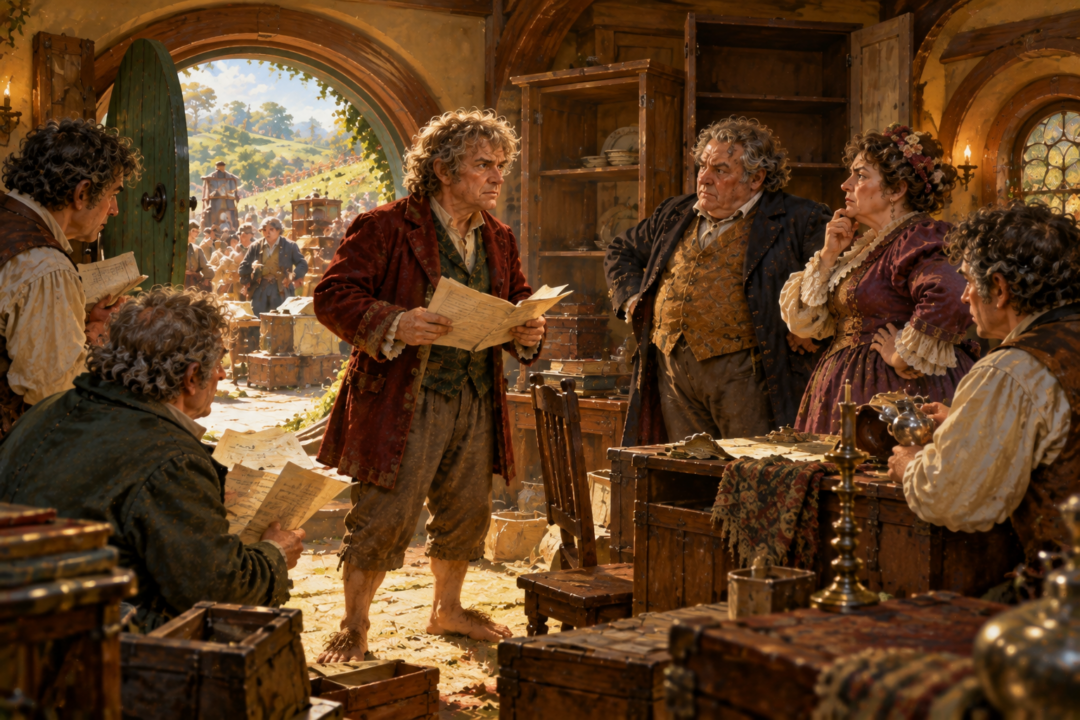
Messrs. Grubb, Grubb, and Burrowes are not portrayed as looters breaking into an abandoned home. They are a named firm conducting an advertised public sale at a specified time. Buyers arrive openly. Bilbo's relatives behave as though the transfer of Bag End is proceeding through accepted channels.
Whatever precise legal machinery lies behind the sale, the scene looks legitimate enough to everyone involved until the supposedly deceased owner comes walking up the road.
That is important.
The joke is not that Hobbiton has descended into lawlessness during Bilbo's absence.
The joke is that its orderly machinery has produced a ridiculous result.
Bilbo Cannot Simply Put the Old Bag End Back Together
The consequences are surprisingly permanent.
Bilbo stops the sale, but stopping it does not restore the morning to its original state. Much has already been sold. He buys some things back. His missing silver spoons are never accounted for, and he privately suspects the Sackville-Bagginses.
Yet something more important than furniture has disappeared.
His old social identity is gone.
Before the adventure, Bilbo's defining virtue in Hobbiton is respectability. The Bagginses are known for predictable behavior. Bilbo's neighbors know what sort of hobbit he is because nothing unexpected happens around him.
Then he vanishes with dwarves and a wizard.
When he returns, he brings wealth, extraordinary stories, friendships with outsiders, and a reputation for strangeness. His neighbors never again regard him in quite the old way.
The auction therefore works on two levels.
Hobbiton has mistakenly disposed of Bilbo's possessions because it thinks the old owner is dead.
But in another sense, the old Bilbo really is gone.
That is interpretation rather than literal lore: the story does not say the auction magically symbolizes the death of Bilbo's former personality. Yet the placement of the episode makes the contrast difficult to miss. Immediately before reaching home, Gandalf observes that Bilbo is no longer the hobbit he was.
Then Bilbo reaches Bag End and discovers that home itself has been rearranged in his absence.
The Real Irony Is That Everyone Is Both Wrong and Strangely Right
The people of Hobbiton are factually wrong about the most basic thing.
Bilbo is not dead.
Their mistake costs him furniture, spoons, years of legal trouble, and whatever remained of his conventional reputation.
But their assumption also exposes the transformation at the center of The Hobbit.
The hobbit who ran from Bag End worried about pocket-handkerchiefs, regular meals, and what the neighbors might think. The hobbit who returns has spoken with a dragon, crept alone through goblin tunnels, surrendered the Arkenstone to prevent bloodshed, mourned Thorin, and seen kingdoms changed.
He still loves Bag End. He still wants his chair, his kettle, and the comforts of home.
What changes is his dependence on respectability.
The narrator tells us that Bilbo loses his reputation and does not particularly mind. He remains an elf-friend, receives dwarves and wizards, writes poetry, and continues being regarded as peculiar by ordinary hobbits.
That may be the deeper reason the auction makes such a perfect ending.
Bilbo comes home expecting restoration. Instead, he finds that even home cannot simply return him to the person who left it.
The furniture can be bought back.
The spoons might be gone forever.
The legal disputes eventually become manageable.
But the respectable Mr. Baggins whom Hobbiton thought it understood has disappeared for good.
And that is why the technical oddity of the auction matters. Bilbo does not return to a world patiently waiting for him. Life in the Shire has already proceeded on the assumption that he will never return.
His final task is not merely proving that Bilbo Baggins survived.
It is discovering what being Bilbo Baggins means now that he has.
Sources & Notes
- Tolkien Gateway — The Return Journey (The Hobbit chapter recounting Bilbo's return): https://tolkiengateway.net/wiki/The_Return_Journey
- Tolkien Gateway — Messrs Grubb, Grubb and Burrowes (auction of Bilbo's estate): https://tolkiengateway.net/wiki/Messrs_Grubb%2C_Grubb_and_Burrowes
- Tolkien Gateway — Bag End (Bilbo presumed dead and estate put up for auction): https://tolkiengateway.net/wiki/Bag_End
Sources for the auction at Bag End and Bilbo's presumed-dead status; the text does not specify a modern legal procedure.