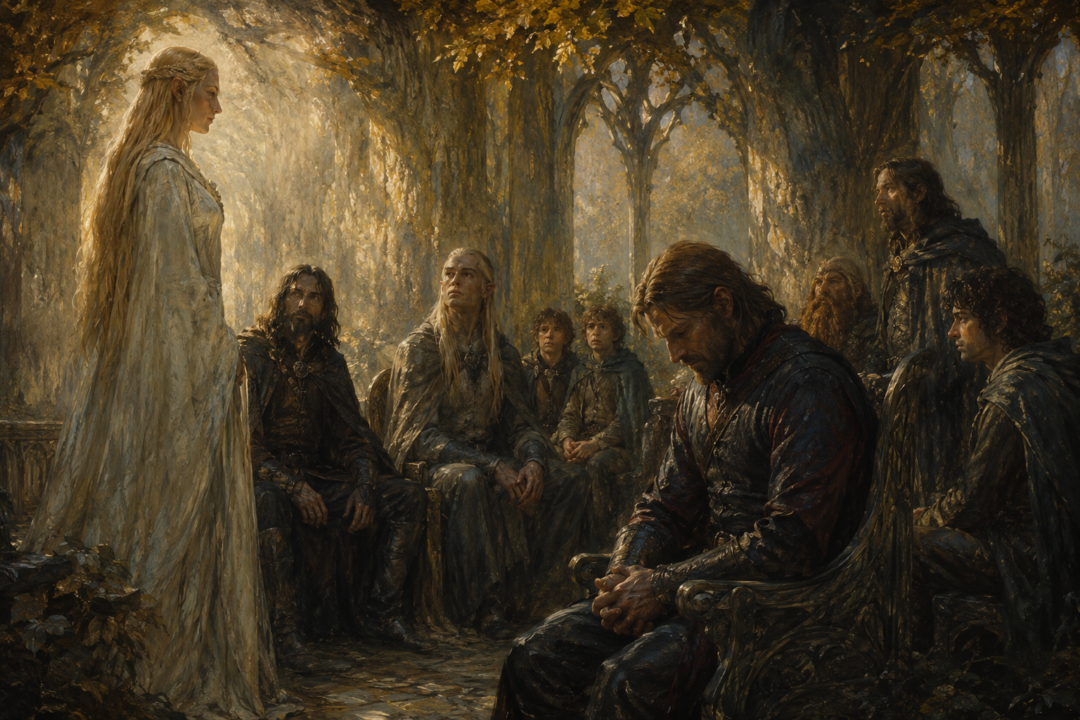
When the Fellowship enters Lothlórien, Galadriel does something far more unsettling than simply welcome them. She looks into each member of the Company and tests what lies within.
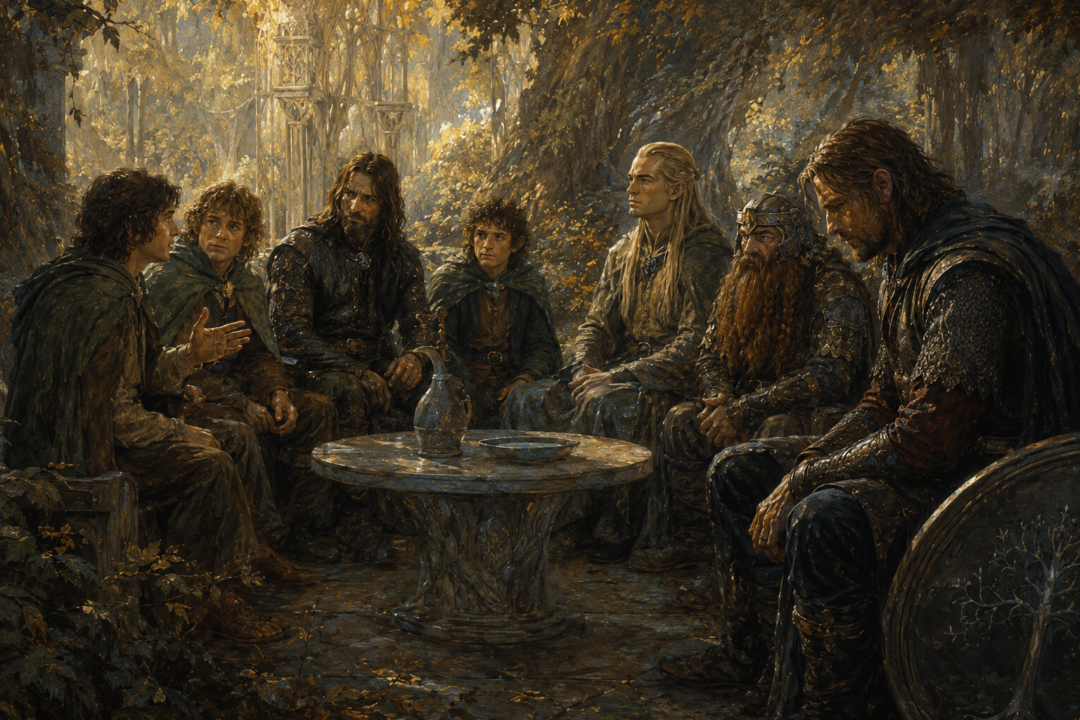
Later, the companions compare what they experienced. Sam admits that he felt exposed and confronted with the possibility of abandoning the Quest for something he deeply wanted. Gimli remembers that the choice seemed as though it could remain secret. Boromir speaks too—but carefully.
He says Galadriel appeared to be tempting them, offering things she supposedly had the power to give. He insists that he refused her.
Then the narrative gives us the crucial detail: Boromir does not tell the others what he thought Galadriel had offered him.
That silence matters.
The text never explicitly reveals the content of Boromir's temptation, so any attempt to identify it exactly must remain interpretation. But the surrounding chapters make his refusal to explain remarkably revealing. Boromir has already argued that the One Ring could be used against Sauron. Soon afterward, his fixation on the Ring becomes increasingly visible. Galadriel's test therefore falls at precisely the point where Boromir's public loyalty and his private desire are becoming dangerously difficult to reconcile.

Galadriel Is Testing the Fellowship, Not Simply Tempting It
Boromir is suspicious of Galadriel almost from the beginning. Before entering Lothlórien he repeats Gondorian warnings about the Golden Wood, and after experiencing her searching gaze he remains uneasy about her purposes.
But the narrative eventually clarifies what happened more directly than Boromir can.
When Frodo later freely offers Galadriel the One Ring, she describes his action as a kind of repayment for her earlier testing of his heart. Her own words therefore confirm that the first encounter involved a test.
The members of the Fellowship experienced that test differently, but its basic structure becomes clear when they discuss it. Each was confronted inwardly with something greatly desired, set against the frightening road ahead. Accepting that desire meant turning away from the Quest.
This is important because Galadriel does not simply implant alien desires into them. The test exposes what is already present.
Sam's longing for home is genuinely Sam's. His little garden and peaceful life in the Shire are not corrupt ambitions. The danger lies in choosing them at the wrong moment, when doing so would mean abandoning Frodo and leaving the struggle against Sauron to others.
Galadriel's gaze therefore reveals a principle that runs throughout the story: temptation often works through something that appears good, reasonable, or deserved.
For Boromir, that is especially dangerous.
Boromir Has Already Revealed His Weakness at Rivendell
Boromir's problem does not begin in Lothlórien.
At the Council of Elrond, he openly questions why the Ring should not be used as a weapon against the Enemy. His reasoning is understandable. Gondor has endured generations of warfare against Mordor. Boromir has spent his adult life defending a realm that stands directly in Sauron's path.
To him, destroying a weapon of immense power can look almost incomprehensible when that weapon might instead save his people.
The Council rejects that reasoning because the Ring cannot safely be wielded as a neutral instrument. Boromir outwardly accepts the decision, but the underlying attraction has not necessarily disappeared.
That distinction is central to understanding him.
Boromir is not secretly serving Sauron. He does not want Gondor destroyed. He wants almost exactly the opposite: victory, security, strength, and the defeat of the Enemy.
The Ring can corrupt precisely because those desires can be redirected toward domination.
By the time Boromir meets Galadriel, therefore, there is already something within him for her test to uncover.
What Did Galadriel Actually Offer Boromir?
The safest answer is that we do not know.
The text deliberately withholds it.
It is tempting to say that Galadriel showed Boromir himself wielding the Ring, saving Minas Tirith, defeating Sauron, or becoming a great ruler. Those possibilities fit his later words remarkably well, but none is explicitly stated in the chapter.
What we can say is that Boromir encountered something he greatly desired and understood that obtaining it would require turning aside from the Quest.
Given everything established about him, that desire probably concerned Gondor, power sufficient to defend it, his own role in its salvation, or some combination of these. The Ring is an obvious possible element, but the text never confirms the precise vision.
That uncertainty may itself be intentional.
We are not allowed to see Boromir's temptation directly because Boromir refuses to let the Fellowship see it.
His secrecy becomes part of the characterization.
Why Sam Can Speak but Boromir Cannot
The contrast with Sam is striking.
Sam is embarrassed by Galadriel's gaze. He feels as though she has looked straight through him. Yet he can eventually explain what happened: he was offered the chance to return to the Shire and have the quiet home and garden he wanted.
There is vulnerability in admitting that.
Boromir responds differently.
Rather than beginning with what Galadriel revealed about him, he begins by questioning Galadriel. Perhaps it was merely a test, he suggests. Perhaps she was reading their thoughts for purposes of her own. He goes further and says it almost seemed that she was tempting them.
Then he immediately asserts his own faithfulness.
This defensive structure is important. Boromir moves the focus away from the desire that was exposed and toward the person who exposed it.
Galadriel becomes the suspicious figure.
Boromir becomes the loyal Man who resisted her.
Yet he will not tell the others what he resisted.
That does not prove conscious dishonesty. Boromir may genuinely believe he has rejected the temptation. But it strongly suggests discomfort with what the test revealed.
The Offer May Have Shown Him Something He Did Not Want Others to Know
Boromir's identity is deeply bound to duty.
He is the son of Denethor, heir to the Stewardship, captain of Gondor, and representative of a kingdom fighting on the edge of destruction. His language repeatedly emphasizes strength, loyalty, courage, weapons, warfare, and responsibility.
To admit that Galadriel found a desire capable of pulling him away from the Quest would therefore be painful.
Worse, depending on what he experienced, explaining it might reveal that his disagreement at Rivendell was not entirely settled.
If his temptation involved possessing or using the Ring, telling Aragorn, Frodo, and the others would effectively announce that the Ring-bearer was travelling beside a man who could imagine taking a different path for the Ring.
Again, the text never states that this was exactly what Galadriel showed him.
But Boromir's later behavior makes the possibility difficult to ignore.
His silence protects his reputation, but it also prevents the others from seeing clearly how dangerous his internal struggle may have become.
Aragorn's Reply Cuts Close to Boromir's Problem
After Boromir warns the others that he does not entirely trust Galadriel, Aragorn rebukes him.
Aragorn says there is no evil in Galadriel or her land unless a person brings evil there himself.
The significance is larger than a defense of an Elf-lady.
Aragorn redirects the question inward.
Boromir wants to ask whether Galadriel is dangerous. Aragorn's answer implies that the greater danger may lie in what someone carries within himself.
This is almost exactly how the Ring operates.
The Ring does not need to persuade Boromir to love Sauron. It can work through his fear for Gondor, his confidence in strength, and his desire to become the man who saves his people.
Galadriel's test has exposed the same vulnerable territory.
His Silence Foreshadows Amon Hen
The importance of the Lothlórien scene becomes clearer once the Fellowship leaves the Golden Wood.
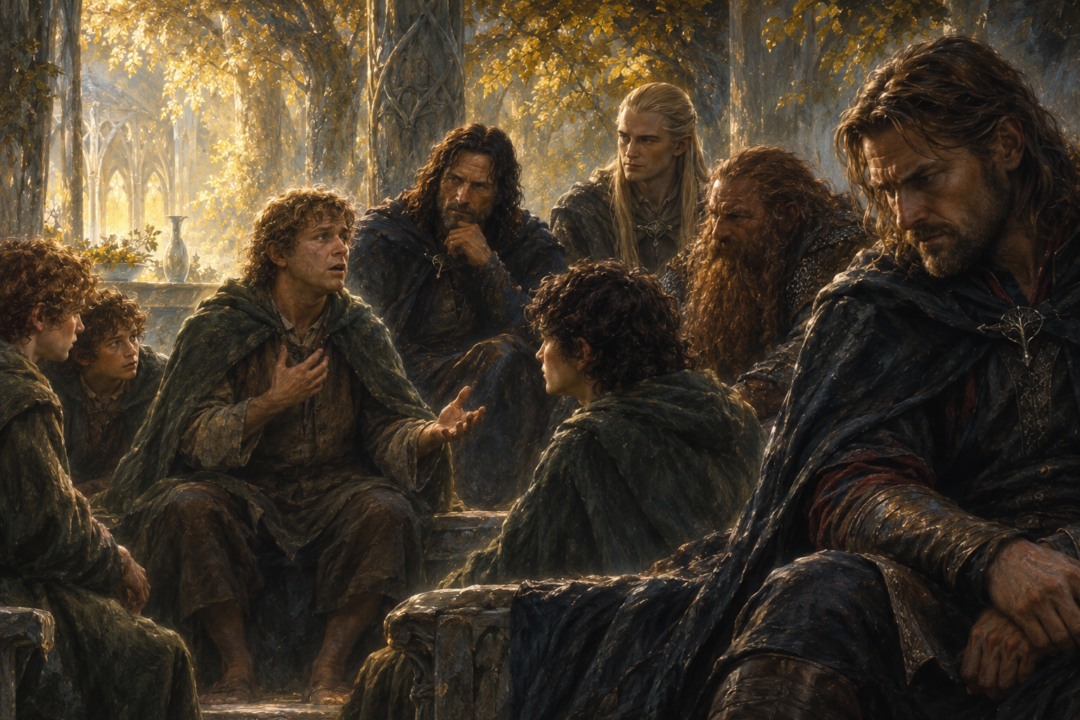
As they travel south, Boromir becomes increasingly preoccupied with the Ring and with the Company's direction. Eventually, at Amon Hen, he speaks privately with Frodo.
There the arguments that had appeared at Rivendell return with greater force.
Why destroy the Ring instead of using it? Why should powerful Men fear to wield it? Could it not provide the strength necessary to overthrow Sauron?
Boromir imagines what a great commander might accomplish with such power.
Finally, he tries to take the Ring from Frodo.
That moment does not prove exactly what Galadriel showed him. But it gives retrospective weight to his earlier silence.
In Lothlórien, Boromir will not name the desire.
At Amon Hen, the desire finally speaks openly.
The progression is tragic because Boromir continues to understand his temptation as service. He does not dream of becoming Sauron's servant. He imagines defeating Sauron.
That is precisely why the Ring is so dangerous to him.
Galadriel Does Not Cause Boromir's Fall
It would be misleading to blame Galadriel for what happens afterward.
Boromir's attraction to using the Ring predates Lothlórien. His argument at the Council of Elrond already demonstrates that. Galadriel's test therefore does not create the central weakness that later overwhelms him.
It reveals it.
Nor does the text say that Boromir leaves her presence already doomed to betray Frodo. He still has choices ahead of him.
This matters because Boromir's tragedy depends upon moral freedom. His failure at Amon Hen is real, but so is what follows.
Almost immediately after Frodo escapes, Boromir recognizes what he has done. He is horrified by his own actions. When Orcs attack, he fights to defend Merry and Pippin, and he is mortally wounded doing so.
Before dying, he confesses his attempt to take the Ring to Aragorn.
That confession provides a powerful contrast with Lothlórien.
Earlier, when Galadriel exposes his hidden desire, Boromir conceals the crucial detail.
At the end, he conceals nothing.

Boromir's Silence Is Part of His Tragedy
There is no canonical sentence explaining exactly why Boromir refuses to tell the Fellowship what Galadriel offered him. The text leaves us to judge his silence through his words before and after it.
But that silence fits a larger pattern.
Boromir can recognize danger when it appears as an enemy army, an Orc, or the power of Mordor. He has far greater difficulty recognizing danger when it appears as his own desire to save Gondor.
Galadriel forces him to confront that possibility.
His response is not to confess what he saw but to insist that he resisted and to question the motives of the person who revealed it.
That is why this small scene matters so much.
Boromir's downfall does not begin when he suddenly becomes wicked. It grows from a noble purpose that he increasingly believes justifies possessing terrible power. His secrecy in Lothlórien marks the distance between the loyal man he believes himself to be and the temptation he is not yet prepared to acknowledge openly.
And his final redemption reverses that silence.
At Amon Hen, Boromir finally names his failure. He admits what he tried to do, fights for his companions without hope of reward, and dies defending them.
Galadriel's test reveals the hidden crack.
The Ring widens it.
But Boromir's last actions show why his story is not merely about corruption. It is also about the possibility of recognizing a terrible mistake before the end—and choosing loyalty again when there is no longer anything to gain from it.
Sources & Notes
- The Encyclopedia of Arda, “Council of Elrond” — documents Boromir’s proposal to wield the Ring against Sauron, its rejection, and the decision to destroy the Ring: https://www.glyphweb.com/arda/c/councilofelrond.html
- The Encyclopedia of Arda, “Galadriel” — covers the Fellowship’s stay in Lórien, Galadriel’s use of the Mirror with Frodo and Sam, and her own rejection of the One Ring: https://www.glyphweb.com/arda/g/galadriel.html
- The Encyclopedia of Arda, “One Ring” — background on Sauron’s Ruling Ring and the power that makes proposals to wield it dangerously attractive: https://www.glyphweb.com/arda/o/onering.html
- The Encyclopedia of Arda, “Quest of Mount Doom” — summarizes the Fellowship’s accepted mission to carry the One Ring to Orodruin and destroy it: https://www.glyphweb.com/arda/q/questofmountdoom.html
References for Boromir’s earlier proposal to use the Ring, the Council’s contrary mission, Galadriel’s encounter with Frodo and Sam in Lórien, and the Ring’s nature. The exact content of Boromir’s unreported offer remains interpretive, as the article notes.