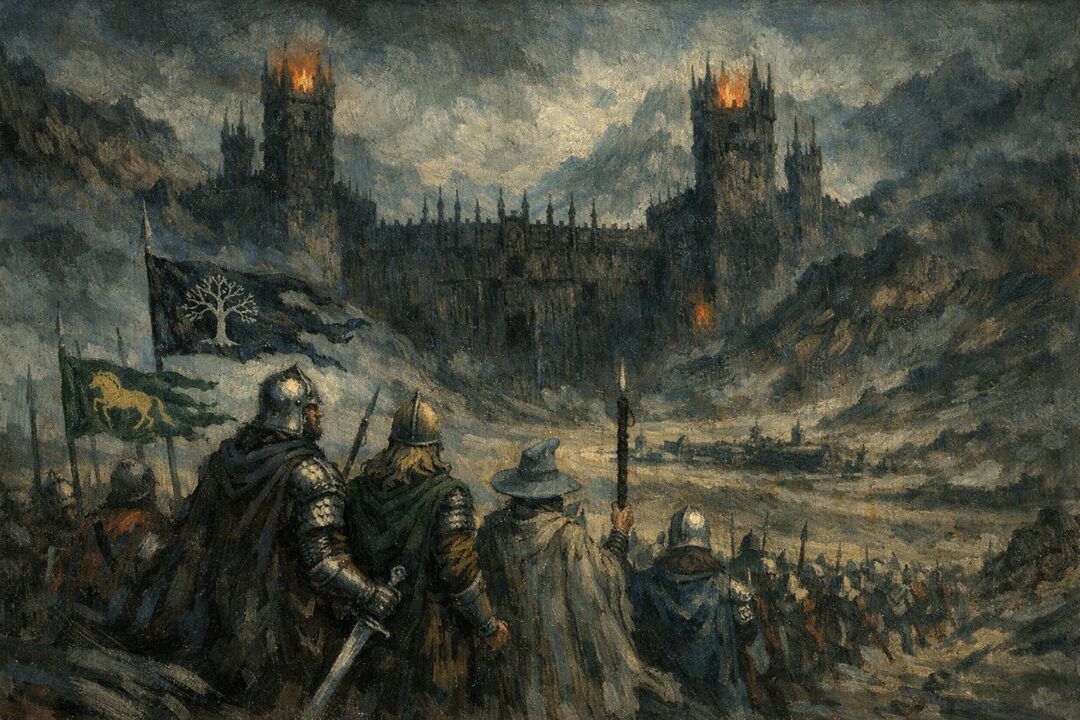
It is one of the most common “practical” questions readers ask after finishing The Lord of the Rings: if the One Ring had to be destroyed in Mount Doom, why not send an army with it?
On the surface, that sounds sensible. The Free Peoples still had warriors. Aragorn, Gandalf, Éomer, Imrahil, and the surviving strength of the West could gather men under arms. Why trust the fate of the world to two starving Hobbits when swords, horses, and banners still existed?
Because the book’s own strategy rejects that idea from the start.
The closer you read the final movement of the war, the clearer it becomes that a march on Mount Doom with an army behind the Ring would not have improved the plan. It would have broken it.
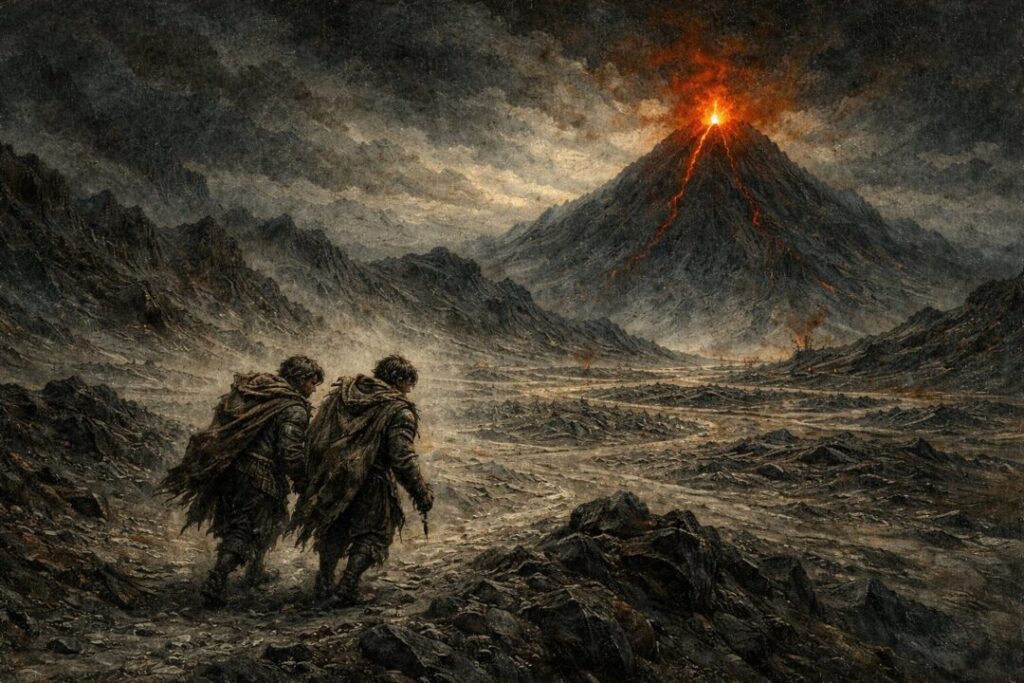
Gandalf says outright that Sauron cannot be defeated by force
One of the most important details in the endgame is that the leaders of the West do not believe they can win militarily.
Gandalf says this openly before the march on the Black Gate. They do not have the Ring, and without it they cannot defeat Sauron by force. The purpose of arms is not victory in battle. It is to keep Sauron’s attention fixed elsewhere long enough to give the Ring-bearer a chance. Aragorn then accepts the same logic and agrees they must provoke Sauron into emptying his land and closing his jaws on them.
That matters because it destroys the premise behind the army idea.
If the Wise thought military conquest of Mordor was possible, they would not have marched to the Black Gate as a sacrificial distraction. They would have tried to win. Instead, they act as men deliberately walking into a trap because distraction is the only service their army can still perform.
So the text’s own answer begins here: an army was useful only as a decoy, not as an escort to the Crack of Doom.
Mordor is designed to resist invasion, not welcome it
The geography of Mordor is not a blank plain waiting to be crossed.
It is ringed by mountain barriers and entered through dangerous passes. The main northern entrance, Cirith Gorgor, is the deep defile guarded by the Black Gate and the Towers of the Teeth. Tolkien Gateway’s summaries of Mordor, the Black Gate, and Cirith Gorgor all reflect the book’s picture: a realm naturally defended by mountains and artificially sealed at key entries. By the end of the Third Age, Mordor is also heavily militarized, with northern garrisons and the agricultural labor around Núrnen supplying Sauron’s armies.
That does not mean invasion is literally impossible. The Last Alliance did invade Mordor. But that example actually cuts against the “send an army to Mount Doom” idea.
The Last Alliance was an immense coalition of Elves and Men at the height of power almost unimaginable in the late Third Age. Even then, the war ended in a siege of Barad-dûr and a final confrontation with Sauron himself. It was not a clean military march to the fire. And, most importantly, Isildur did not destroy the Ring when he had the chance. The military victory did not solve the Ring problem.
So even Middle-earth’s greatest historical invasion is not evidence that “an army to Mount Doom” was the obvious solution. If anything, it shows the opposite: armies can fight Sauron’s realm, but they do not guarantee the one act that actually matters.
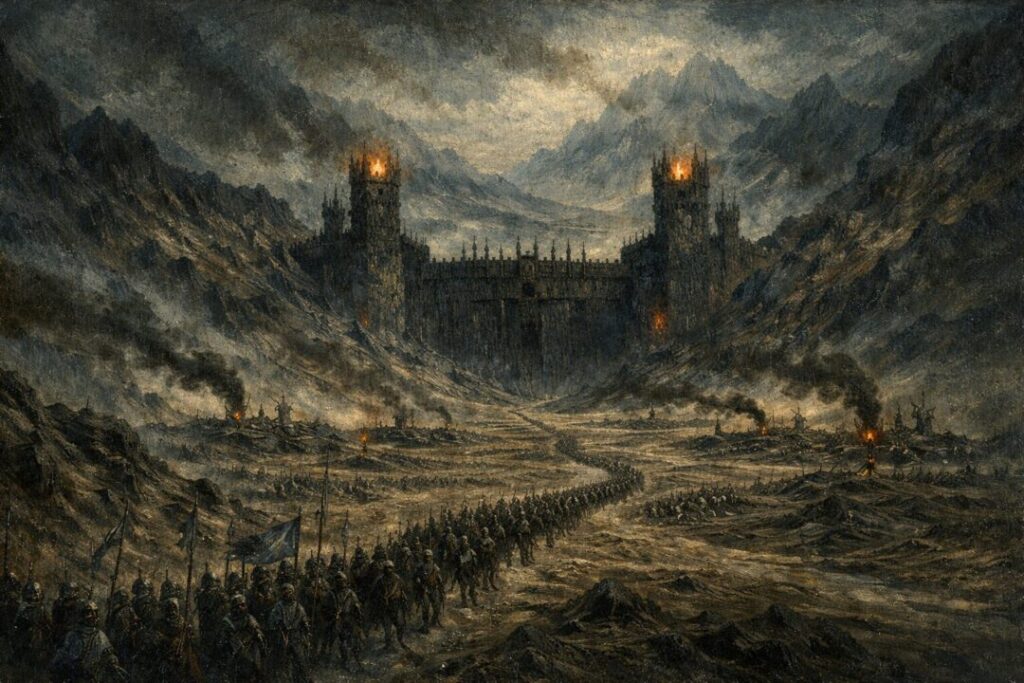
An army would have confirmed Sauron’s assumptions, not escaped them
The whole Quest depends on one psychological weakness in Sauron: he cannot imagine his enemies truly trying to destroy the Ring.
He expects power to answer power. He expects a rival to claim the Ring, challenge him, and try to supplant him. That is why the Captains of the West decide to make themselves visible. They know this kind of boldness fits Sauron’s own way of thinking and will hold his Eye on them.
An army approaching Mount Doom would have done the exact same thing, only worse.
It would not have looked like humility, secrecy, or renunciation. It would have looked like a direct challenge. In other words, it would have looked like exactly the kind of power-play Sauron already knows how to answer.
Here we should be careful. The text does not give a line saying, word for word, “If they had brought an army to Mount Doom, Sauron would have stopped them instantly.” But the strategic logic strongly points that way. The whole plan at the Black Gate is built around keeping Sauron’s attention away from the Mountain. If you take that attention and march it straight toward the Mountain under banners, you throw away the one advantage the West actually possesses: surprise through apparent weakness.
Even Frodo’s final approach works only because Mordor is being emptied elsewhere
There is a subtle irony in the book’s endgame.
Frodo and Sam do not succeed because Mordor is unguarded in general. They succeed because the West deliberately forces Sauron to redistribute his strength.
That is exactly what Gandalf and Aragorn intend: to draw out his hidden power, make him commit troops, and focus his will on the wrong front. So when people ask why not bring an army to Mount Doom, they are often proposing the reverse of the strategy that actually opens Frodo’s path.
In other words, the tiny mission works partly because the visible army is somewhere else.
Replace that with a single large force marching for Orodruin, and the concealment disappears. The road to the Mountain becomes the war’s obvious center. The pressure that was meant to drain Mordor now concentrates on the very place Frodo must reach.
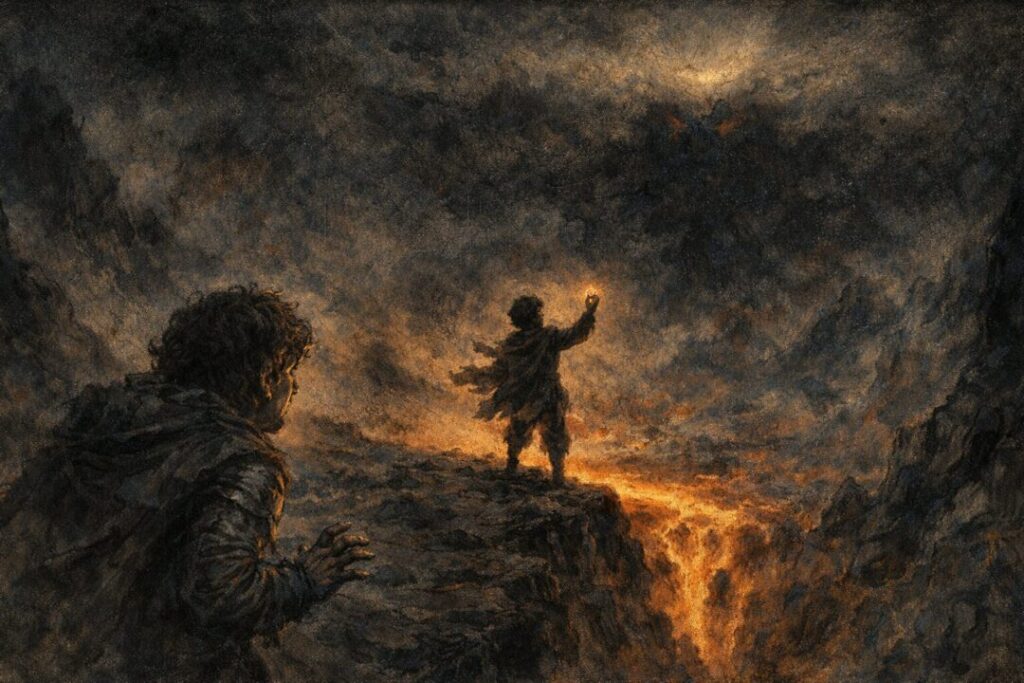
The instant the Ring is claimed, Sauron understands everything
One of the strongest pieces of evidence comes at the very end.
When Frodo reaches Sammath Naur, he does not destroy the Ring. He claims it. At that very moment, Sauron becomes suddenly aware of him. The text says the magnitude of Sauron’s folly is revealed in a blinding flash, his armies halt, and his entire mind bends with overwhelming force toward the Mountain.
That tells us something crucial.
Even after everything else, even after the diversion at the Black Gate, Sauron reacts to the true danger immediately once it becomes unmistakable. So an army making a direct, noisy, unmistakable approach to Mount Doom would not have enjoyed delayed recognition. It would have announced the decisive point of the war far too early.
Again, the book does not need to spell out the rest. Once Sauron knows where the threat truly lies, the entire weight of Mordor can turn there.
The final act is not something soldiers can do for Frodo
There is also a deeper problem with the army idea.
Even if some impossible escort had cut through every defense and placed Frodo at the Crack of Doom under perfect military protection, the final act would still not have been secured.
At the end, Frodo cannot willingly cast the Ring away. A late letter explains this very plainly: at the last moment the pressure of the Ring reached its maximum, and resistance was, in Tolkien’s own phrasing, impossible for anyone in Frodo’s condition. Frodo had done all that could be asked, but he could not complete the act by unaided will.
That means the problem was never only logistical.
It was moral, spiritual, and metaphysical. No wall of spears could solve that. No cavalry charge could make the Ring-bearer stronger than the Ring at the place of its making.
And that is why the story turns on mercy as much as strategy. Frodo later says plainly that without Gollum, he could not have destroyed the Ring and the Quest would have failed at the bitter end.
An army cannot replace that truth. It cannot manufacture the strange providential turn on which the Quest finally depends.
Why the idea feels practical — and why the book rejects it
The “bring an army” solution feels practical because it thinks like a conventional war story.
But The Lord of the Rings is not telling us that evil is beaten by assembling a larger force and smashing through the last fortress. It tells us almost the opposite. Sauron is strongest in the world of power, armies, gates, fear, and domination. To meet him on those terms is to enter the field where he is already prepared.
The Ring is destroyed only because the West refuses that logic long enough to create a narrow opening. Their army succeeds precisely by not being the real weapon.
So would an army at Mount Doom have failed instantly?
“Instantly” is a dramatic way of putting it, but the underlying claim is sound. The texts strongly support the conclusion that such a plan would have collapsed almost at once as a strategy. It would have exposed the Quest, confirmed Sauron’s expectations, concentrated Mordor’s strength on the one place that needed secrecy, and still left the deepest problem unsolved at the very edge of the Fire.
Mount Doom was never a target that could be taken in the ordinary sense.
It could only be reached in weakness, almost in failure, by those so small that the Dark Lord could not imagine them as the true danger until it was too late.