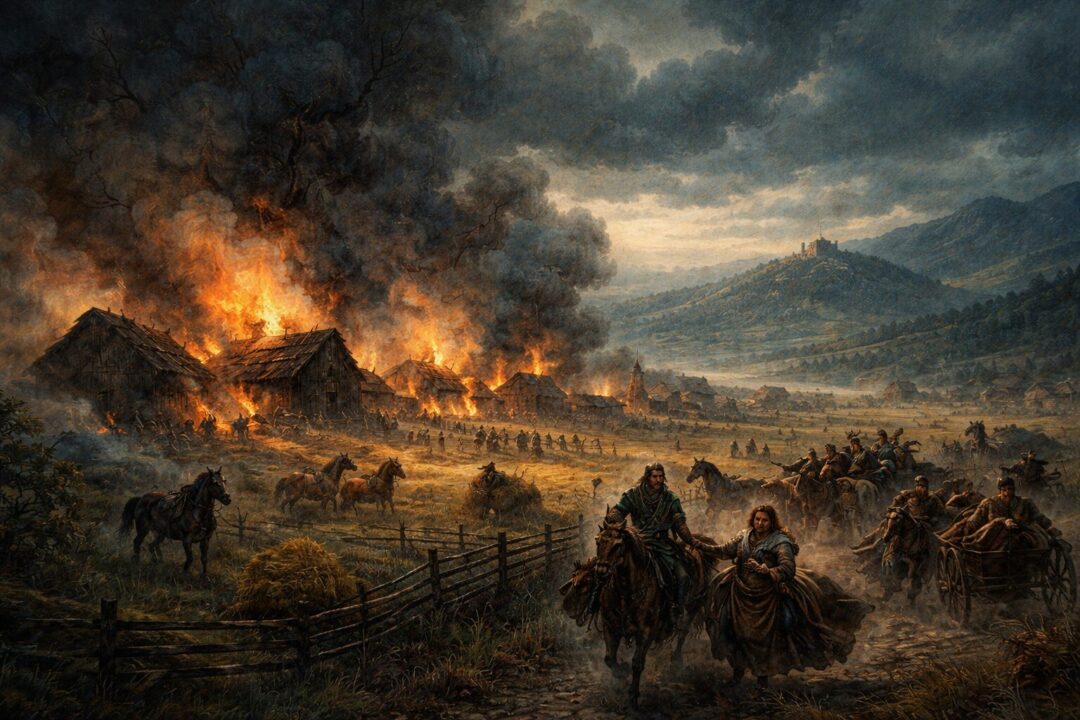
In many fantasy stories, burned fields and ruined farmsteads are just background scenery. They help signal that war has come, but they do not always feel central to the story.
Tolkien handles this differently.
In Middle-earth, land is not just scenery. It is livelihood, memory, order, and survival. So when crops burn, or barns fall, or orchards are cut down, the loss is not merely visual. It is practical, immediate, and lasting. Tolkien does not always stop to explain this in economic detail, but the structure of his world makes the consequences clear. Places such as the Shire, Rohan, and the Pelennor Fields depend on agriculture, stored goods, livestock, and local production. Destroy those things, and a people may still be standing, but they are already in crisis.
Middle-earth runs on land, not abstraction
One reason this matters so much is that Tolkien’s societies are deeply rooted in the land around them.
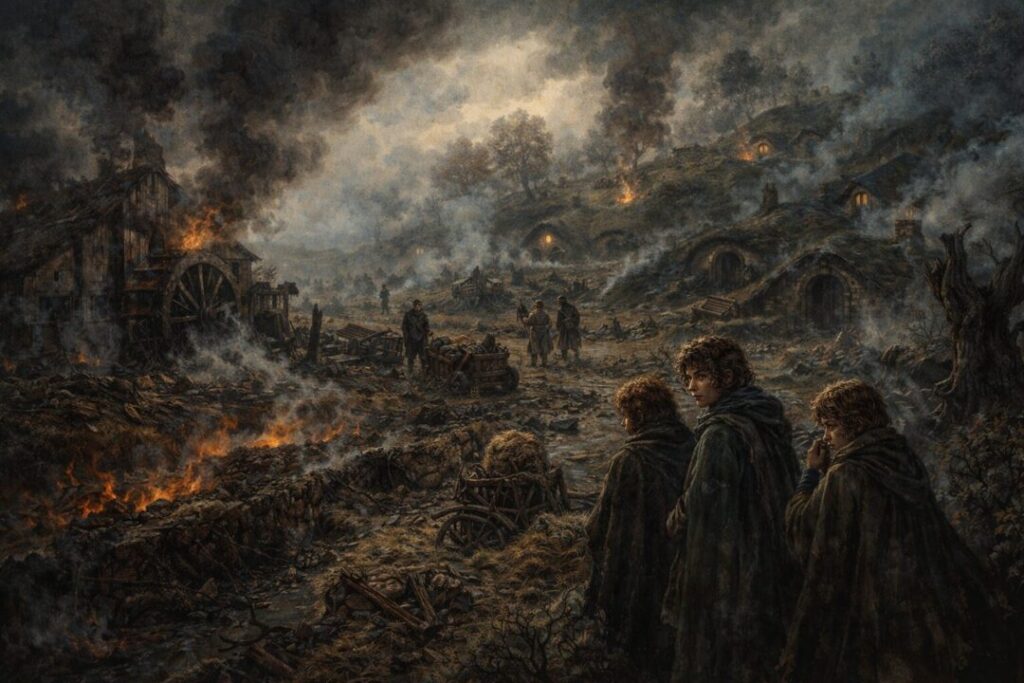
The Shire is described as a fruitful country with cereals, fruit, wood, and pipe-weed, supported by a broad agricultural life rather than industrial systems. Hobbits love comfort, but that comfort rests on fields, mills, gardens, food stores, and steady local work.
Rohan is even more obviously tied to the land. The Rohirrim are famous for horses, but Tolkien Gateway’s summary from Tolkien’s texts is careful to note that Rohan is a kingdom of herdsmen and farmers. That matters. Horses need pasture and fodder. People need grain, livestock, and storage. Even a military kingdom of riders cannot function if its agricultural base is shattered.
The same is true outside Minas Tirith. The Pelennor Fields were not just empty land reserved for battle scenes. They were fertile farmland with tilled fields, orchards, barns, granaries, pens, livestock, and kilns for drying hops and malt. That is one of the clearest examples in Tolkien of a landscape where agriculture and defense sit side by side.
So before we even get to war, Tolkien has already established the basic truth: these societies live from what the land yields and what they can store.
A burned barn is not just one loss
A barn sounds small compared with a fortress. But in a pre-industrial world, a barn can represent a huge concentration of survival.
It may hold grain already harvested, seed reserved for planting, hay or fodder for animals, tools, wagons, or shelter for livestock. If it burns, the loss is not only today’s supply. It can also wipe out next season’s planting and weaken the animals needed for transport, plowing, or riding. In a world without modern supply chains, replacing that loss is slow and uncertain.
This is why burning agricultural buildings is so dangerous in Middle-earth. It creates layered damage all at once:
food disappears, seed disappears, animals become harder to feed, labor becomes harder to organize, and vulnerable people may lose shelter in the same attack.
In Tolkien’s world, that kind of blow is especially serious because communities are local and seasonal. A missed harvest or destroyed winter store is not an inconvenience. It can become a catastrophe. This is not stated as a formal economic lecture by Tolkien, but it follows directly from how his agrarian societies are described.
The Pelennor shows the scale of the damage
The clearest canonical setting for this idea is the Pelennor Fields.
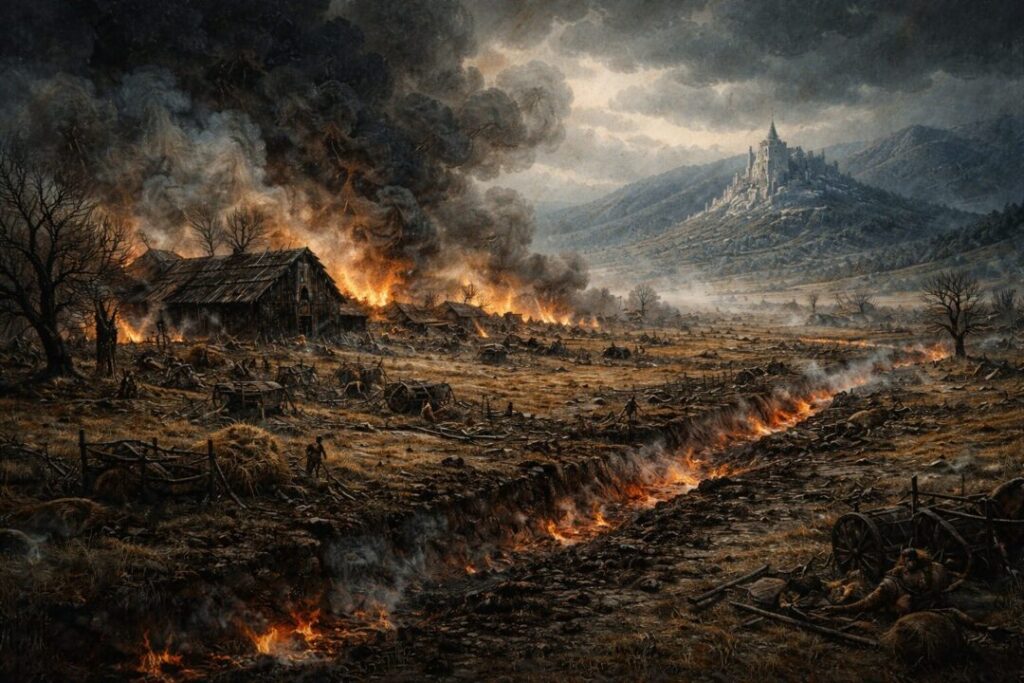
Tolkien Gateway’s summary, citing The Return of the King, describes the Pelennor as farmland populated by farmers and herdsmen, with barns, granaries, pens, orchards, and livestock. As Sauron’s invasion closes in, the people and animals evacuate. Then the enemy overruns the Rammas Echor, besieges Minas Tirith, burns homes and trees, and cuts fiery trenches through the fields.
That detail matters enormously.
Minas Tirith is a great city, but no city feeds itself by walls alone. If the surrounding farmland is ravaged, the city’s future becomes fragile even if the siege is lifted. The damage is not just military. It is agricultural and civic. The enemy is not merely trying to break gates; he is helping make recovery harder afterward.
This is part of what gives Tolkien’s warfare weight. Victory does not erase the cost. Even when Gondor survives, the land around it has been scarred. The article could carefully say that Tolkien presents war as something that consumes the structures of ordinary life, not only armies. The Pelennor is the perfect example.
Rohan is more vulnerable than its horse-lords first suggest
Readers often remember Rohan through motion: riders gathering, horns sounding, cavalry charging. But that image can hide how exposed the kingdom really is.
Rohan is broad, rural, and heavily dependent on settlements, herds, and fields. Tolkien Gateway notes that during the War of the Ring almost all of Rohan’s settlements came under attack, with several towns razed and others abandoned when their people fled for safety.
That makes strategic sense inside the lore. If your enemy cannot meet all the Rohirrim in open battle immediately, he can weaken the kingdom by attacking its support structure: villages, food stores, and the people who keep the land productive. Burned settlements are not just tragic images; they help explain why refuge at Helm’s Deep matters and why Saruman’s campaign is more dangerous than a single battlefield encounter.
There is even a Tolkien Gateway entry noting Grimslade in the Westfold and a later adaptation detail about attackers intending to burn it; while that specific dramatic scene is adaptation material, it still reflects a wider canonical truth from Tolkien’s Rohan: settlements in the Westfold are exposed, and war reaches civilian space fast.
So in Rohan, burning barns and fields would not just reduce comfort. It would directly undermine the kingdom’s ability to sustain both people and horses.
The Shire proves this can happen without a formal war front
The Shire gives us a different version of the same danger.
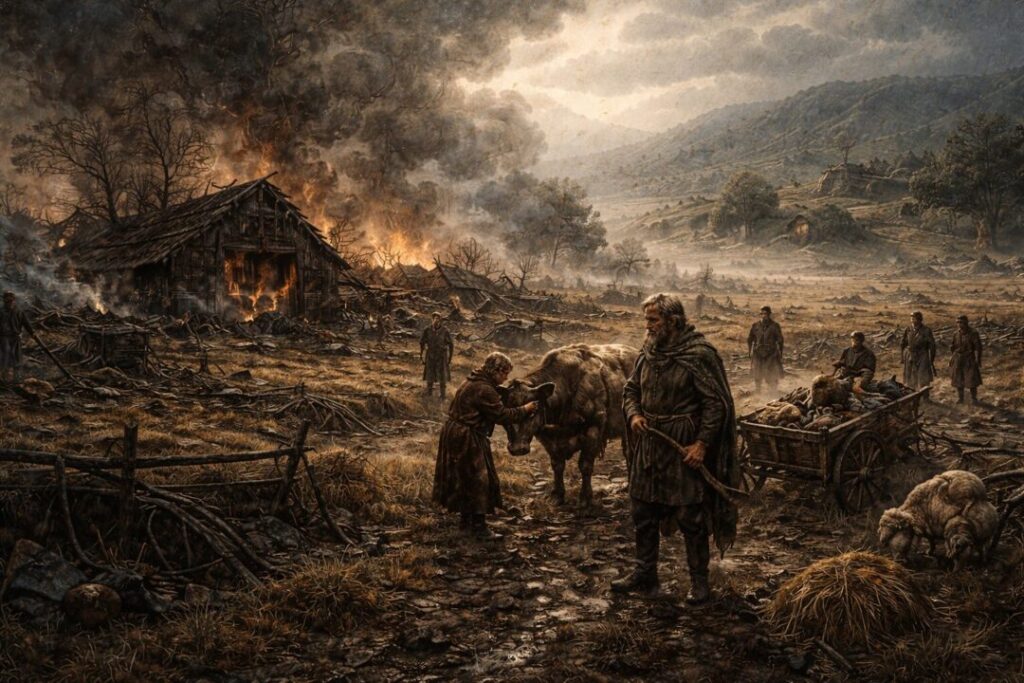
Saruman’s takeover is not described mainly through mass battlefield conquest. Instead, Tolkien shows corruption, extraction, petty rule, ugly building, tree-cutting, confiscation, and the removal of goods. Tolkien Gateway notes that ruffians carried pipe-weed and other goods south, while the Shire itself was increasingly controlled through Lotho’s and Sharkey’s system. The Shire’s old productive balance is exploited and disfigured.
The cutting down of the Party Tree is emotionally memorable, but it is only one symbol of a broader assault on the land and its order. The Shire’s mills, trees, stores, and trade goods matter because they are part of how hobbit life works. Once those are commandeered or ruined, the damage becomes social as well as material.
This is one of Tolkien’s sharpest points: you do not have to slaughter a people in open battle to wound their world. You can despoil the land, control the food, seize the productive spaces, and make home feel alien.
So when we think about burned barns or stolen harvests in Middle-earth, the Shire reminds us that the deeper issue is not spectacle. It is whether ordinary life can continue.
Fire attacks the future, not only the present
That may be the simplest way to put it.
When a warrior dies in battle, the loss is immediate and personal. When a field burns, the loss keeps unfolding. The next planting may fail. The animals may weaken. The stores for winter may vanish. Refugees may strain whatever safe place remains. Repair takes time, labor, wood, seed, and peace.
In Tolkien’s world, all of this matters because his cultures are not detached from the natural world. They are bound to it. The good places in Middle-earth are usually places where land is tended, not merely occupied. That is true in the Shire, in Rohan, and in Gondor’s farmlands. So the destruction of crops and barns is never just background damage. It is an assault on continuity itself.
Why Tolkien’s version feels so real
Part of Tolkien’s realism comes from scale. He remembers what many stories forget: wars are won or lost not only by kings and captains, but by whether a people can still eat, shelter themselves, plant again, and endure the winter.
That is why burning crops and barns is more dangerous than it sounds in Middle-earth.
It threatens survival in the moment.
It threatens recovery afterward.
And it threatens the quiet, rooted life that Tolkien treats as one of the chief goods worth defending in the first place.