
Celeborn is one of the most misunderstood figures in The Lord of the Rings.
He is often remembered as Galadriel’s husband—the quieter half of Lothlórien’s rule—standing beside one of the most powerful beings left in Middle-earth. Compared to Galadriel’s vision, temptation, and radiance, Celeborn can seem almost secondary. He speaks less. He reveals less. He rarely draws the eye.
But that impression is deeply misleading.
Celeborn represents a form of power that Tolkien consistently treats as both rare and dangerous: power that does not announce itself.
He is not feared because he dominates the narrative.
He is feared because he never needs to.
Celeborn’s Roots Lie in the Most Dangerous Realm of the First Age
Celeborn did not rise to prominence late in history. By the time readers meet him in The Lord of the Rings, he is already unimaginably old.
Long before Lothlórien existed in its familiar form, Celeborn lived in Doriath, the hidden kingdom ruled by Thingol and Melian. This alone places Celeborn at the heart of one of the most perilous courts ever to exist in Middle-earth.
Doriath was not protected by armies or walls alone. It survived through secrecy, suspicion, and restraint. Outsiders were unwelcome. Knowledge was controlled. Pride was punished swiftly and often brutally. It was a realm where a single misstep could lead to catastrophe—and eventually did.
Celeborn learned rulership in a court where silence was survival.
He witnessed how great Elf-lords were destroyed not by weakness, but by arrogance. He saw how brilliance invited attention, and attention invited ruin. When Doriath finally fell, it was not because its leaders lacked strength, but because restraint gave way to rashness.
Celeborn survived that fall.
And in Tolkien’s world, survival through the collapse of an entire age is never accidental.
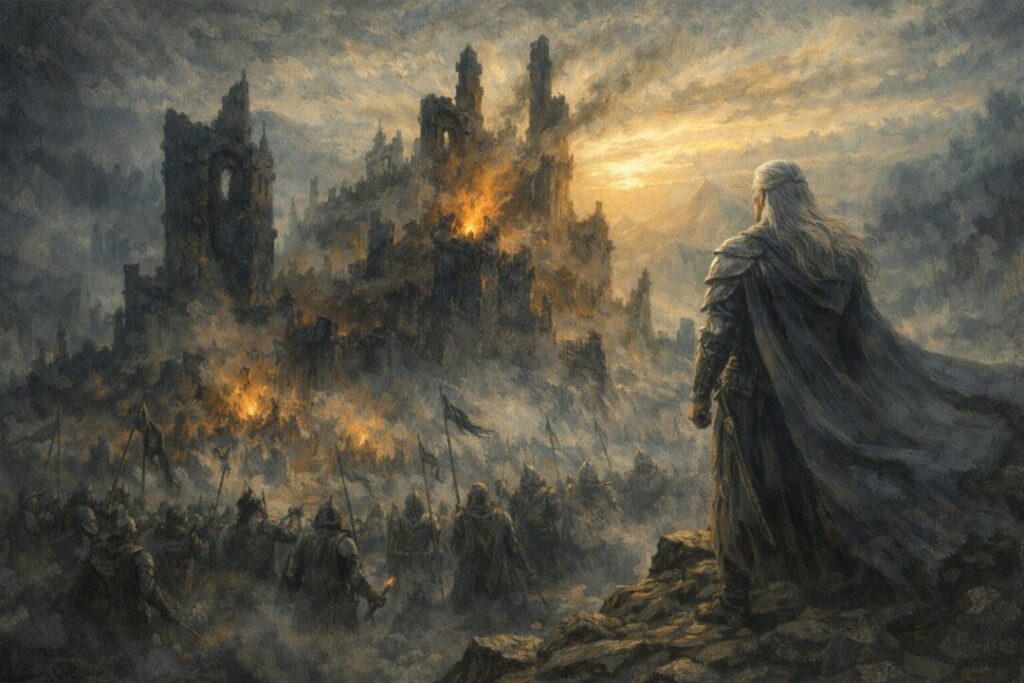
Lord of Lothlórien: Power Without Display
By the Third Age, Celeborn rules Lothlorien alongside Galadriel, but their authority is carefully divided.
Galadriel is the realm’s spiritual center—its seer, its tester, its mirror of temptation and wisdom. Celeborn, by contrast, is its administrator, its judge, and its military commander.
This distinction matters.
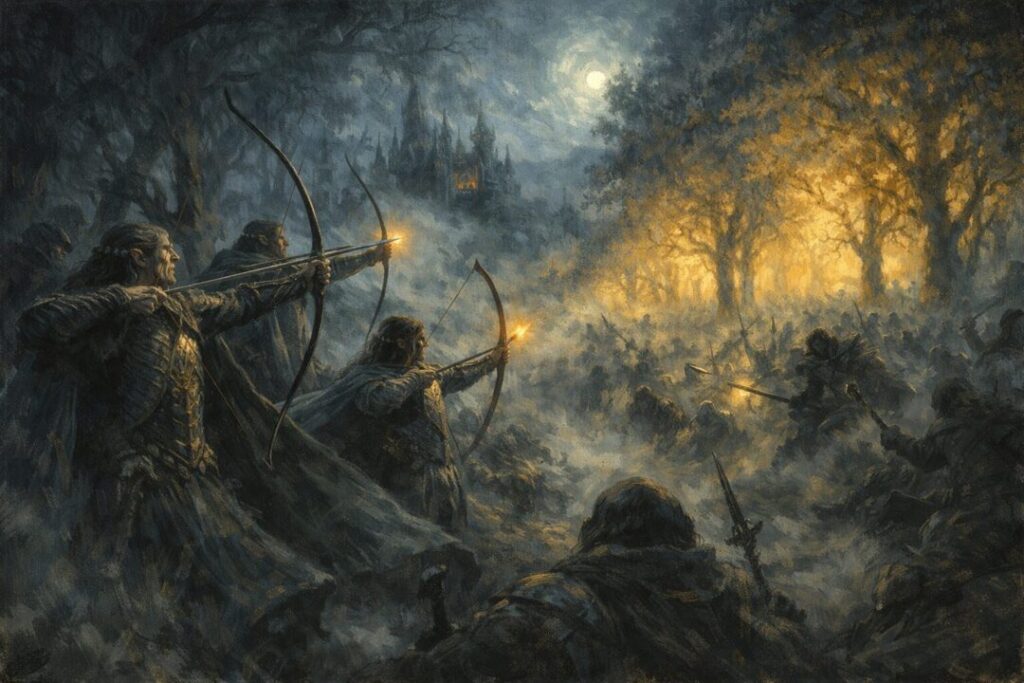
Unlike Rivendell, Lothlórien is not merely hidden from the world. It is actively hostile to evil. Orcs do not wander near its borders by chance. Spies do not return with useful knowledge. Darkness presses against the Golden Wood and finds no purchase.
This is not the result of enchantment alone.
Celeborn commands the Galadhrim with a discipline rarely emphasized in the narrative—not because it is unimportant, but because the Hobbits never truly see it. The defenses of Lothlórien are subtle, layered, and unforgiving. Enemies are misdirected, isolated, and eliminated before they ever glimpse the heart of the realm.
Lothlórien does not advertise its strength.
It demonstrates it—once.
The Assault on Lothlórien—and Why It Failed
During the War of the Ring, Sauron launches multiple assaults against Lothlórien from Dol Guldur.
All of them fail.
This fact is easy to overlook amid the larger battles of the war, but it is quietly devastating in its implications.
Sauron does not squander resources. He does not attack strongholds repeatedly unless he believes they pose a meaningful threat. That he commits forces against Lothlórien again and again tells us he understands its strategic importance.
That he fails every time tells us something more unsettling.
Celeborn is not merely holding ground.
He is winning.
While other realms barely endure, Lothlórien repels every assault without falling, without being overrun, and without revealing its vulnerabilities. The shadow breaks against it and recedes.
After Sauron’s fall, Celeborn does not remain content with defense. He leads forces across the Anduin, assaults Dol Guldur directly, and orders its destruction.
Few Elves in the Third Age wage a successful offensive war.
Celeborn does—and then stops.
He does not press further. He does not seek conquest. The threat is eliminated, and he withdraws.
That restraint is not weakness. It is judgment.
Why Celeborn Rarely Speaks
Celeborn’s silence is not a lack of character. It is a deliberate narrative and thematic choice.
Tolkien repeatedly portrays wise rulers as those who speak least and act last. Celeborn embodies this principle fully. He does not dominate councils. He does not offer grand philosophical speeches. He intervenes only when intervention is necessary.
Where others are tempted—to despair, to pride, to rash action—Celeborn remains focused on preservation.
This is why Lothlórien endures when other realms diminish.
Celeborn understands something many powerful beings do not: that survival is not guaranteed by brilliance, and victory is not guaranteed by strength. It is secured by patience, boundaries, and the refusal to overextend.
In a world full of figures who blaze brightly and burn out, Celeborn chooses to remain.
Fear Without Terror
Celeborn is never described as terrifying.
But fear does not always arise from spectacle.
Sauron fears resistance that cannot be corrupted.
Orcs fear enemies who do not chase glory.
Darkness fears what it cannot predict.
Celeborn offers no dramatic weakness to exploit. He does not seek glory. He does not reveal desperation. He does not expose his plans.
He waits.
He watches.
He strikes once—and ends the threat.
This is the kind of opponent darkness dreads most: not the hero who challenges it openly, but the ruler who ensures it never gains momentum in the first place.
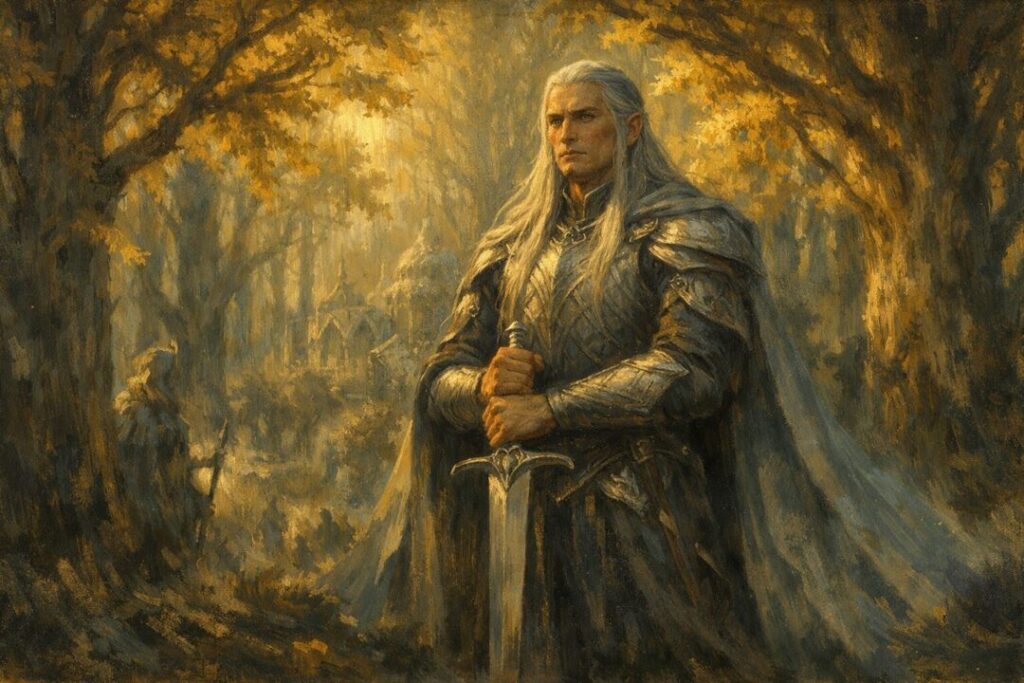
The Quiet Lords Are the Last to Fall
When the War of the Ring ends, Celeborn remains.
He does not fade immediately.
He does not abandon Middle-earth in defeat.
He does not cling to power out of pride.
He stays to heal what was broken, to cleanse what was corrupted, and to ensure that evil does not quietly return under a new name.
Celeborn is not feared because he dominates the page.
He is feared because he never needed to.
And once you understand that, his silence becomes one of the most eloquent statements Tolkien ever made about power.