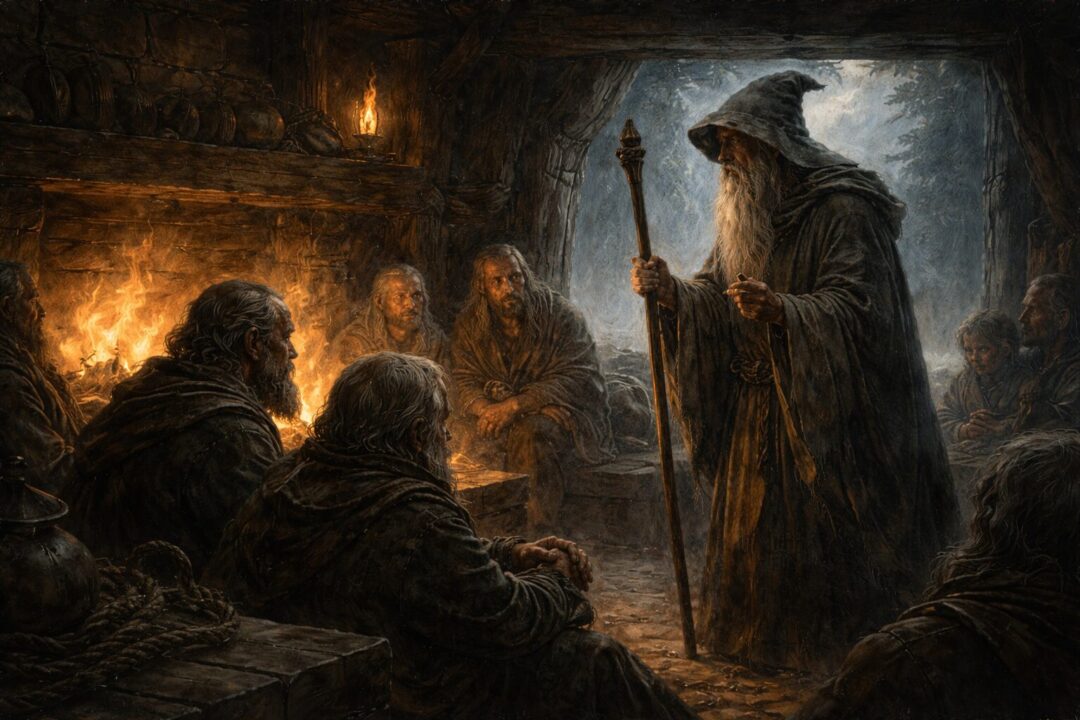
There is a moment in the Third Age that is almost easy to overlook—because it happens far from battlefields, far from councils, far from the sound of horns.
It happens at the Grey Havens.
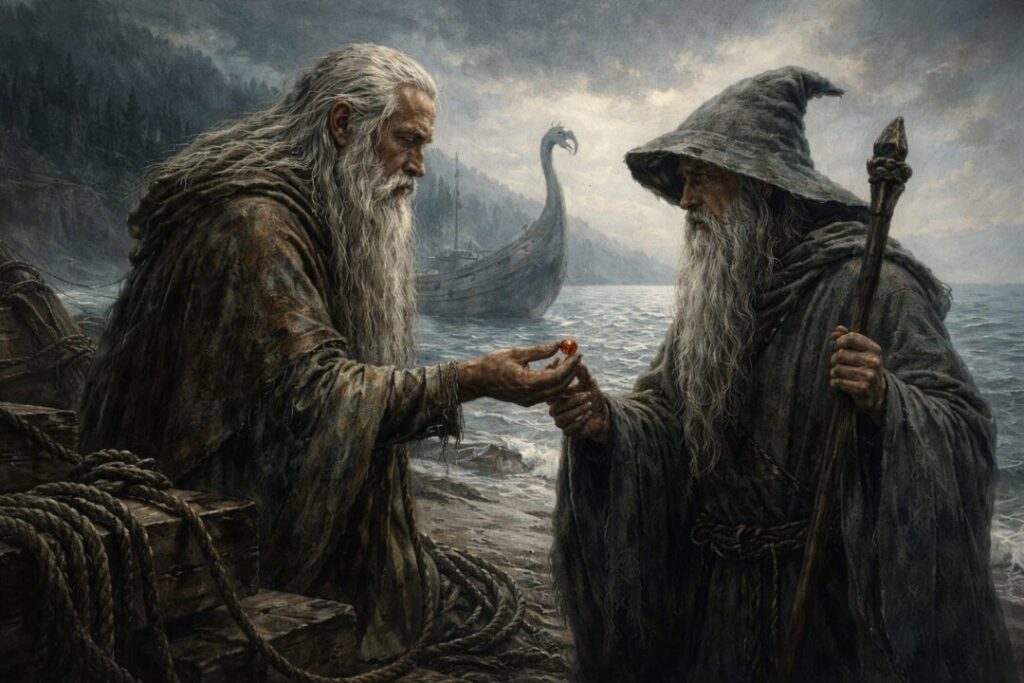
A shipwright stands on the shore. A stranger arrives, cloaked in grey.
And one of the Three Rings of the Elves changes hands.
Not seized. Not demanded. Not “won.”
Given.
And the giving matters, because it tells you what kind of wisdom still remained in Middle-earth when so much was already passing away.
The oddest part isn’t that Gandalf had Narya
By the end of The Lord of the Rings, the Ring is openly named.
In “The Grey Havens,” Gandalf’s ring is seen, and the stone upon it is described as red, “as fire.”
So yes—Narya is his.
But that’s not the question.
The question is why the Ring ever left Círdan at all.
Because Círdan wasn’t a minor Elf keeping a trinket until someone “worthier” came along. In the Tale of Years we are told that, in the beginning, the Three were held by the greatest of the Eldar—and that Círdan was counted among them.
He had authority. He had age. He had a realm. He had the Havens.
And unlike many who dwelt in Middle-earth late, he was not blind to what was coming.
So why surrender the Red Ring?
What the texts actually say happened
Appendix B gives the bare spine of the event:
Círdan “surrendered” his ring to Mithrandir, and we are told why: Círdan “saw further and deeper than any other in Middle-earth,” and he welcomed Mithrandir at the Havens “knowing whence he came and whither he would return.”
That alone already tells you something important.
Círdan is not making a political gift.
He is responding to perception—recognition. He understands something about Mithrandir that others do not yet grasp.
Unfinished Tales adds the tone and the purpose.
When Círdan gives the Ring, he frames it as support for weariness, and as a tool to “rekindle hearts” in a world that grows chill.
This is crucial, because it defines Narya in the only way the texts clearly define it in-story:
Not as a weapon.
Not as a crown.
Not as a device for domination.
But as endurance and warmth—hope kept alive.
Narya is the wrong Ring for a stationary guardian
If you step back, the logic becomes almost uncomfortable in its simplicity.
Círdan’s life-work is the Havens.
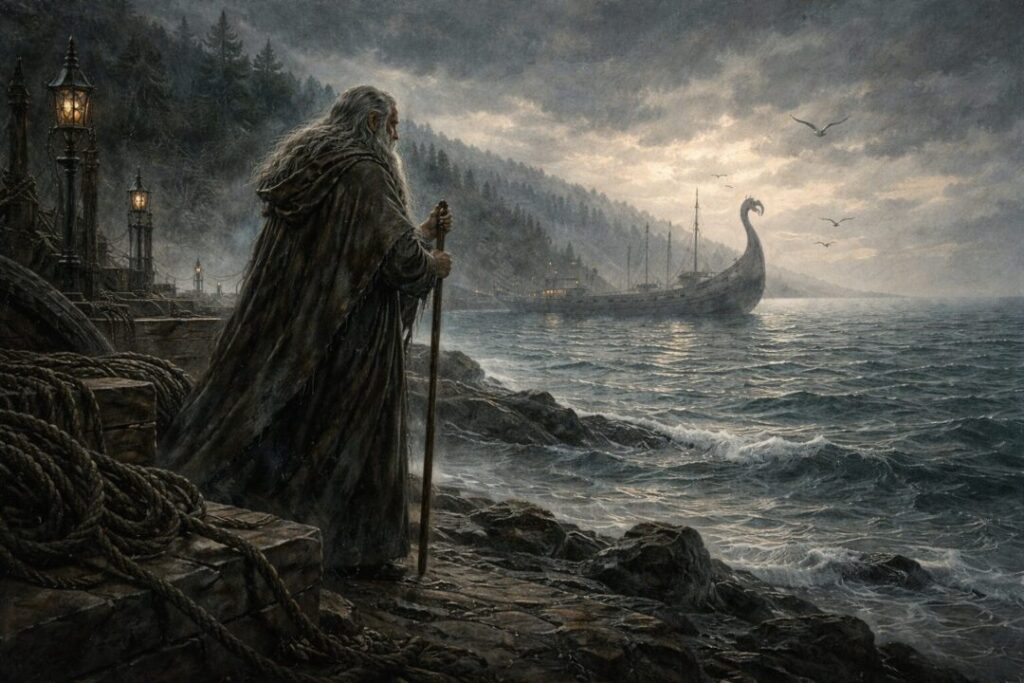
He is the keeper of the western shore, the steward of departure, the one who builds ships and guards the last way out. In the very words attached to the gift of Narya, he speaks of dwelling by the grey shores until the last ship sails.
That is not the posture of someone meant to range.
Círdan’s strength is long patience, fixed duty, and the ability to remain when the world shifts beneath him.
And Narya, as described in the giving, is meant to be carried into the world—to meet coldness where it spreads.
If you keep Narya in the Havens, you are keeping a hearth-fire locked in one room while winter moves through every village outside.
Círdan’s calling is to hold the door.
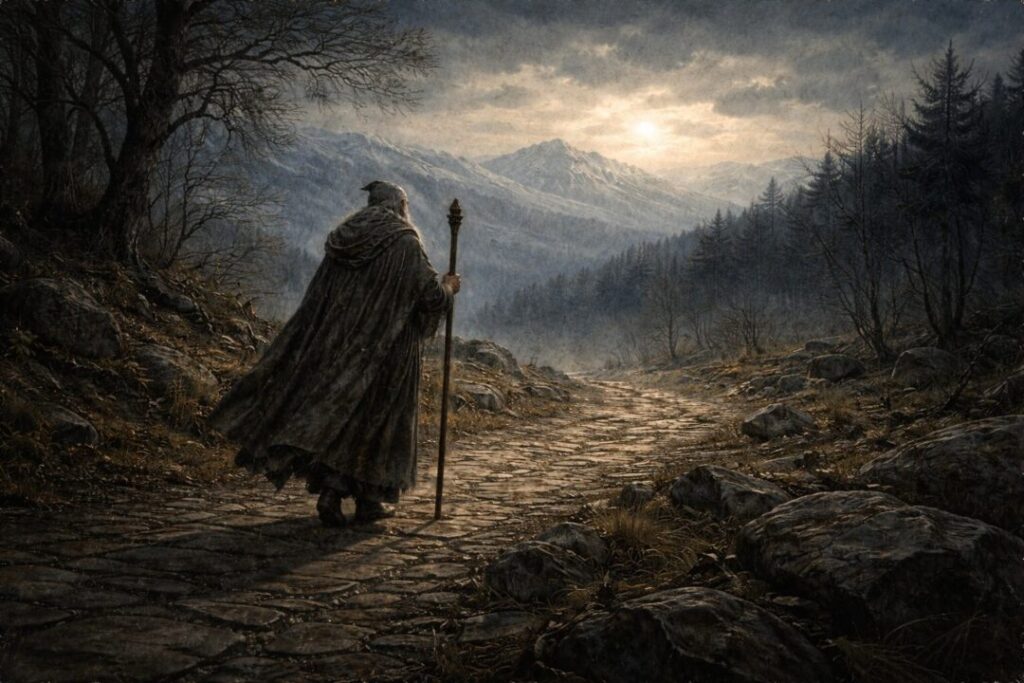
Gandalf’s is to walk the road.
Why Gandalf—especially Gandalf
It is tempting to make this about rank.
Saruman is repeatedly called the “chief” of Wizards, and Gandalf himself acknowledges that.
So why not Saruman?
The texts do not present Círdan as “snubbing” Saruman, or predicting betrayal in explicit terms. Tolkien never directly says Círdan foresaw Saruman’s fall.
What we are told is narrower—and more telling.
In Unfinished Tales, Círdan perceives in Mithrandir “the greatest spirit and the wisest” among those who arrived.
That doesn’t mean “highest office.”
It means something closer to moral and spiritual fitness for the task—especially a task defined by patience, pity, endurance, and the kindling of courage.
And that matches what Gandalf actually does across the Third Age.
He does not found a realm.
He does not gather wealth.
He does not take a throne.
He goes where the need is.
He counsels. He warns. He provokes people into choosing the hard good. He strengthens others to resist.
Narya, in the terms given with it, is almost described like an instrument designed for precisely that kind of labor.
“Rekindle hearts” is not poetic fluff—it’s the theme of the Age
The Third Age is a long decline.
Not only of Elves, but of memory, unity, and confidence.
Sauron does not simply conquer by force. He corrodes, isolates, frightens, exhausts.
So when Círdan places Narya into Gandalf’s keeping, he is not “upgrading” Gandalf.
He is investing the Ring where it can do the most good: among the Free Peoples as they strain under years, losses, and doubt.
And notice the restraint in how this is handled.
The guardianship of the Three is said to have been kept secret through the Third Age.
So whatever Narya did, it was not meant to be spectacle. It was meant to be quietly effective—like warmth in a cold room, like breath kept steady through a long climb.
That fits Gandalf’s public role perfectly: a wanderer who seems like “only a guide,” while unseen strengths are being preserved behind the scenes.
Why Círdan didn’t keep it
Because keeping it would be a different kind of choice.
To keep Narya would be to treat the Ring as a tool for holding one strong place against the Shadow.
And there is an argument that this could have been useful: the Havens mattered. They remained a last refuge, and the western shore was not outside the war.
But the texts point to a different priority.
Círdan’s duty is not to become a power-center. It is to maintain the passage, to prepare the ships, to wait—so that when the final hour comes, the road is still open.
Meanwhile, Gandalf is sent to engage the war in its most difficult form: not merely fighting, but sustaining resistance over centuries.
So Círdan does the most Círdan-like thing imaginable:
He gives away power.
Not because he despises it, but because he knows what kind of power is needed, and where it must go.
The real twist: this gift defines the whole relationship between Elves and the Istari
The Elves do not “appoint” the Wizards.
They do not command them.
But at the Havens, Círdan recognizes a messenger for what he is—someone who came from the West and will return there—and he equips him for the road.
That is what makes the scene so revealing.
It’s an act of cooperation between the waning Elder Days and the long struggle of the later world.
The Elves are not going to “save” Middle-earth by preserving it forever. The Ring-bearers themselves are fading, and the end of their time is written into the story.
So instead of tightening his grip, Círdan places the fire where it can travel.
And that changes how you should read Gandalf from the very beginning.
Because if Círdan—who “saw further and deeper”—judged that the Grey Pilgrim needed the Ring most, then Gandalf’s entire mission is being framed, right there at the shore, as a fight against the coldness of despair.
Not through domination.
Through courage.
Through endurance.
Through rekindling.
And once you see that, Narya stops being a hidden extra.
It becomes a quiet headline for the Third Age itself.