Among all the Eldar who remain in Middle-earth during the Third Age, few are as ancient—or as quietly influential—as Círdan the Shipwright.
He appears only briefly in the main narrative, often unnamed or mentioned in passing, yet his presence stretches across the entire history of Arda. From the shores of Beleriand in the First Age to the Grey Havens at the close of the Third, Círdan stands at the western edge of the world, watching ships depart, welcoming exiles, and preparing the final road away from Middle-earth.
He is older than Galadriel.
He outlives most of the great lords of the Eldar.
He recognizes truths that others only come to understand much later.
And yet, he never takes a Ring of Power.
Not one of the Three.
Not even briefly.
Not even in secret.
This absence is not accidental. It is not a gap in the record, nor a matter of chance. Círdan’s refusal—or rather, his quiet non-claim—is one of the most deliberate and thematically precise choices in the legendarium.
To understand why, we must first understand what kind of figure Círdan actually is.
Círdan’s Role Was Always Transitional
Círdan is not a preserver.
This immediately distinguishes him from other great Elves of the Third Age.
Galadriel’s realm resists decay. Through Nenya, Lothlórien becomes a place where time slows and memory lingers unnaturally long.
Elrond’s Rivendell shelters lore, lineage, and remembrance, holding fragments of earlier ages intact against the long years.
Even Gandalf’s task, though humble in appearance, is one of resistance—standing against domination, corruption, and despair.
Círdan’s purpose is fundamentally different.
He builds ships.
Not for war.
Not for conquest.
But for departure.
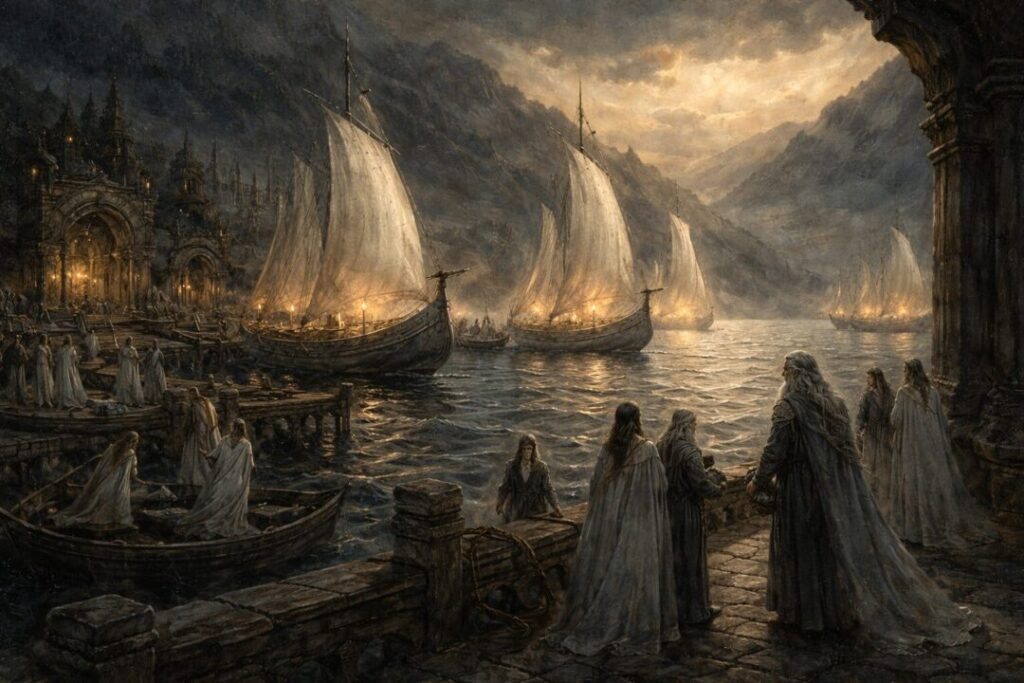
The Grey Havens exist for one reason only: to carry the Eldar out of Middle-earth and into the West. They are not a refuge meant to endure forever. They are a threshold—a place of transition between what was and what must come next.
Círdan’s work is not about maintaining the world as it is.
It is about accepting that the world is passing away.
This distinction is crucial, because Rings of Power exist to do the opposite.
The Rings Are Instruments of Preservation
The Three Rings of the Elves were not forged as weapons. They were created to heal, preserve, and resist the slow erosion of time.
They slow decay.
They maintain beauty.
They hold the past in a fragile, living suspension.
This is why Galadriel bears Nenya.
This is why Elrond holds Vilya.
This is why their realms feel untouched by age, sheltered from the weariness that afflicts the rest of Middle-earth.
But preservation is not neutrality.
To wield a Ring is to make a philosophical claim about the world: this place must remain as it is.
It is a refusal to let go.
Círdan never makes that claim.
He does not anchor himself to Middle-earth. He does not attempt to prolong an age that is already ending. Instead, he prepares others for the moment when preservation must finally give way to acceptance.
In this sense, a Ring of Power would be not merely unnecessary for Círdan—it would be contradictory.
Círdan and the Burden of Foresight
Círdan is one of the few remaining Eldar who can see the shape of the world clearly, without illusion or denial.
He understands that the dominance of Elves in Middle-earth is ending. Not because they are defeated, but because their time has passed. The world is turning toward Men, and no amount of power—however benevolent—can halt that shift without distortion.
This is why Círdan does not attempt to rule a great realm.
This is why he does not gather followers or proclaim authority.
And this is why he never reaches for a Ring.
Rings delay endings.
Círdan prepares for them.

Why Círdan Gives Narya Away
Círdan’s most revealing action comes not in refusal, but in gift.
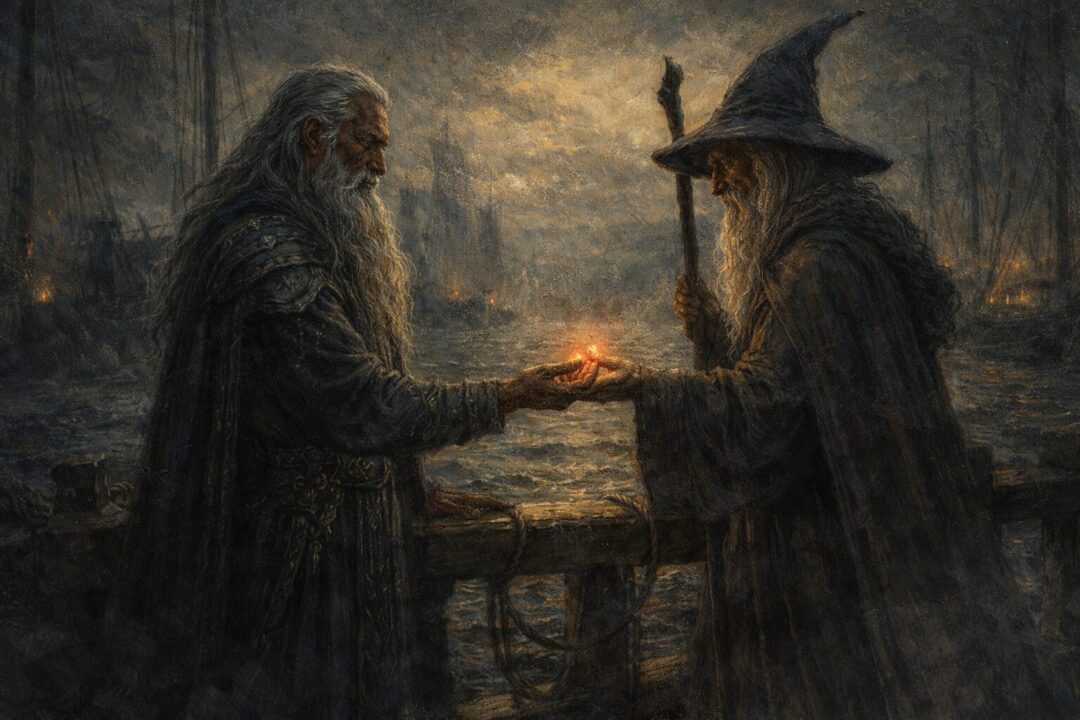
When Gandalf arrives from the West, Círdan perceives something that others do not—at least, not immediately. He recognizes Gandalf’s true nature and stature among the Istari, even when Gandalf himself is uncertain of it.
And so Círdan gives him Narya, the Ring of Fire.
This moment is easy to overlook, but it is profound.
Círdan does not keep the Ring “just in case.”
He does not test it.
He does not delay or consult.
He passes it on.
Because Círdan understands that the Rings are not meant for him.
They are tools for those who must remain in Middle-earth longer—those who must walk among its peoples, resist despair, kindle hope, and endure suffering without succumbing to it.
Gandalf’s task is endurance.
Círdan’s task is release.
The Ring of Fire strengthens hearts against weariness. Círdan does not need that strength. He has already accepted the end.
A Guardian of the Ending, Not the Struggle
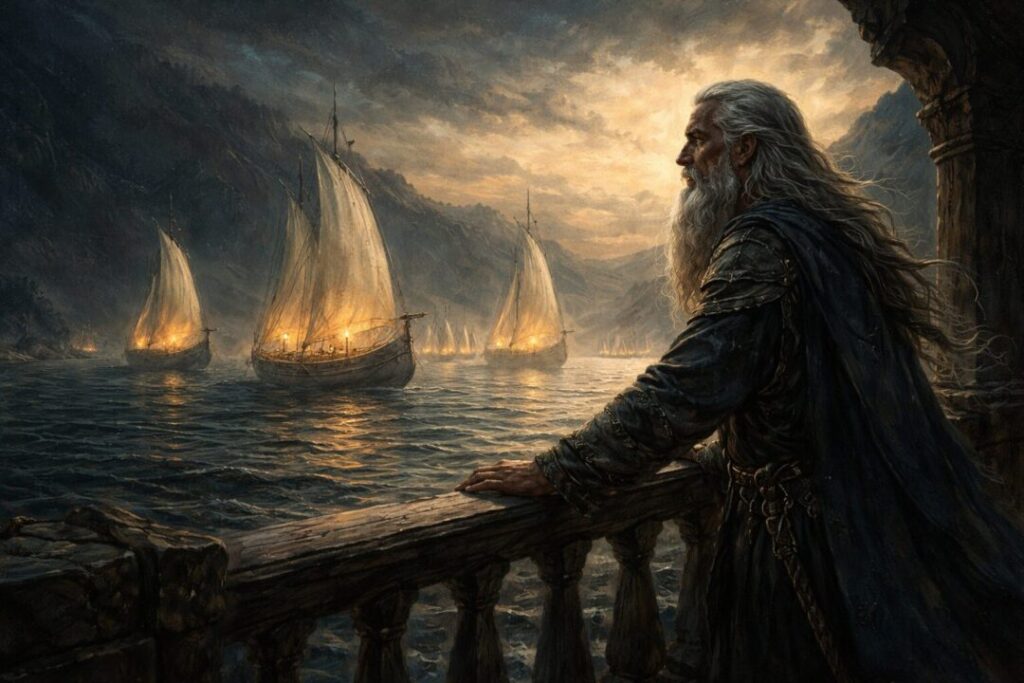
Throughout the Third Age, Círdan remains at his post, yet his gaze is always turned westward—toward the Sea.
He does not involve himself directly in the War of the Ring.
He does not seek renewed purpose after Sauron’s fall.
He does not attempt to reshape the world in the aftermath of victory.
When the One Ring is destroyed, Círdan’s response is not ambition, relief, or triumph.
He prepares the final ship.
He sails with the Keepers of the Rings.
With Frodo.
With Gandalf.
With those whose work is finished.
This confirms what his entire story has always suggested.
Círdan never took a Ring because he was never meant to bind himself to Middle-earth.
He was meant to help others unbind.
Why This Matters
Círdan’s refusal is one of the quietest yet most thematically precise choices in the legendarium.
It reminds us that power does not always look like resistance.
That wisdom does not always look like preservation.
And that not all guardians are meant to stay and fight.
Some are meant to stand at the edge.
Some are meant to know when holding on becomes a kind of failure.
And some—like Círdan the Shipwright—are meant to guide others gently toward the end of an age, without bitterness, without denial, and without fear.
In that role, he is unmatched.
And in his refusal of a Ring of Power, Círdan reveals a form of wisdom rarer than strength: the courage to let go.