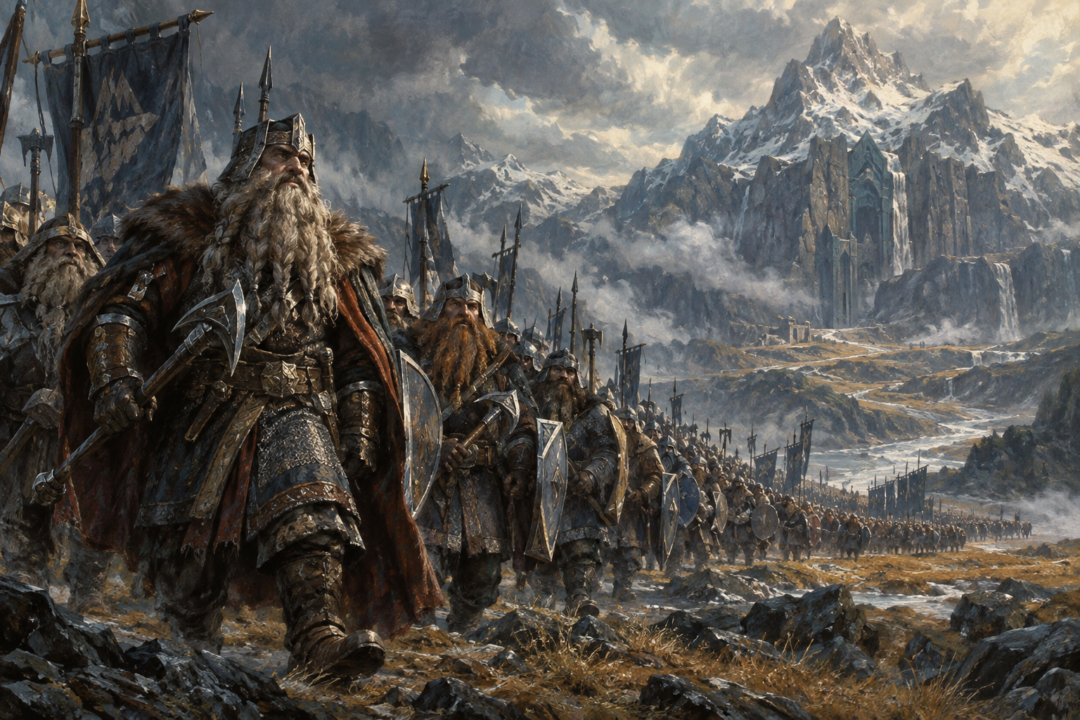
When Dáin Ironfoot finally appears before the Lonely Mountain, he does not arrive as a mediator.
Five hundred Dwarves march out of the Iron Hills armed and equipped for battle. Before them stand the forces of Bard and the Elvenking. Behind the newly built wall at Erebor is Thorin Oakenshield, surrounded by treasure and refusing to yield while armed hosts remain outside his gate.
It can look as though Dáin simply marches into somebody else’s quarrel and immediately chooses violence.
But that misses the crucial point.
Dáin has not been summoned to negotiate a settlement. He has been summoned because Thorin believes Erebor is under hostile pressure. Everything Dáin knows when he begins his march tells him that his kinsman has reclaimed the ancestral kingdom of Durin’s Folk, only to find himself besieged almost immediately afterward.
From Dáin’s perspective, he is leading a relief army.
And by the time he reaches Erebor, the dispute has developed so far that Dwarves, Men, and Elves are only moments away from fighting one another over a treasure that none of them will ultimately be able to defend alone.
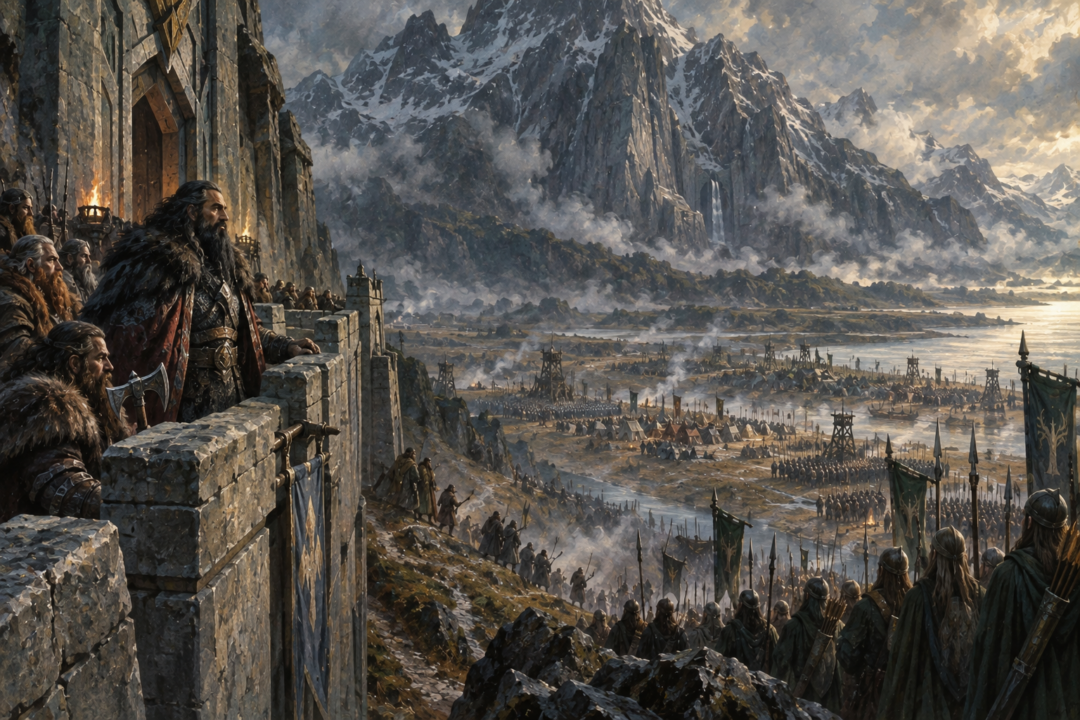
Thorin Does Not Ask Dáin to Come Until the Crisis Has Begun
The key to understanding Dáin’s arrival lies several days earlier.
After Smaug is killed by Bard, the survivors of Lake-town face catastrophe. Their homes have been destroyed, and winter is approaching. Bard has strong reasons for going to the Mountain. He argues that some of Smaug’s treasure came originally from Dale, that the people of Lake-town had aided Thorin’s company, and that the Dwarves’ actions had helped provoke the dragon’s final attack upon Esgaroth.
Thorin rejects Bard’s demands while an armed Elven host remains nearby.
This distinction matters. Thorin is not merely refusing to discuss money. He believes he is being compelled under military pressure.
The Elvenking had initially marched toward the Mountain after hearing of Smaug’s death, but when he encountered the refugees from Lake-town, he turned aside to aid them. He later joined Bard’s movement toward Erebor. The resulting host is therefore not simply an army of treasure-seekers, even though treasure is certainly part of the dispute.
Yet Thorin sees armed forces gathering outside the kingdom he has only just recovered.
When the raven Roäc brings news of events beyond the Mountain, he advises Thorin to make peace. Thorin does the opposite.
He sends Roäc to Dáin in the Iron Hills.
That decision transforms the confrontation.
Dáin Is Responding to a Call for Military Aid
Dáin is Thorin’s kinsman and the lord of the Dwarves of the Iron Hills. He is also no inexperienced commander.
Appendix A of The Lord of the Rings places him at the Battle of Azanulbizar in T.A. 2799, where, though still young by Dwarven reckoning, he slew Azog after the great battle before Moria. More than a century later, when Thorin calls upon him, Dáin is an established ruler with warriors capable of moving rapidly to Erebor.
The Hobbit describes his force as more than five hundred strong and emphasizes their formidable equipment. These are not travelers who happen to be carrying weapons. They are a disciplined Dwarven host sent into an armed confrontation.
That tells us something important about the message Dáin has received.
The text does not reproduce Thorin’s complete instructions to him, so we should not invent their exact wording. But the circumstances make their purpose clear: Thorin wants armed assistance because Men and Elves are outside Erebor and he refuses to surrender treasure while they remain there in force.
Dáin therefore has little reason to arrive expecting a peaceful reception.
His relative is effectively besieged.
The ancestral treasure of Durin’s Folk is contested.
Armed forces occupy the approaches to the Mountain.
Dáin comes prepared accordingly.
The Dwarves Have Reasons to Distrust the Elvenking
There is another layer to the confrontation.
Thorin’s company has recently been imprisoned by the Elvenking.
During the journey through Mirkwood, the Wood-elves capture the Dwarves and bring them before their king. Thorin refuses to explain his purpose, and the company remains imprisoned until Bilbo engineers their escape in barrels.
That episode does not prove that Dáin personally shares every resentment Thorin carries, and the text does not describe Dáin’s private feelings toward Thranduil.
But from Thorin’s side of the dispute, the presence of the Elvenking is hardly neutral.
The same Elven ruler who recently held Thorin and his companions captive is now camped near Erebor with an army.
Even Bard recognizes the importance of the Elves to the standoff. Thorin specifically demands that the Elven host be withdrawn before he will negotiate Bard’s claims.
Bard refuses.
The siege continues.
To the people outside the Mountain, Thorin increasingly appears unreasonable.
To Thorin, armed outsiders are attempting to dictate what happens to the recovered wealth of his house.
Dáin marches into that contradiction.
Bard’s Claim Is Stronger Than Thorin Wants to Admit
Yet the tragedy of the confrontation is that Dáin is not marching against simple thieves.
Bard has legitimate grievances.
Some of the wealth accumulated by Smaug had belonged to Dale. Bard is the heir of Girion, its last lord. More urgently, the people of Lake-town are homeless because Smaug destroyed their settlement after Thorin’s expedition reached Erebor.
Bard also killed Smaug.
Thorin’s company could enter the Mountain precisely because Bard accomplished what the Dwarves themselves had not: the dragon was dead.
That does not automatically make Bard owner of Erebor’s entire hoard, and Bard does not claim the entire treasure. But his demand for compensation cannot fairly be reduced to opportunistic plunder.
This is what makes the conflict so effective.
Both sides possess arguments they believe are defensible.
Thorin has reclaimed the kingdom and treasure of his fathers after generations of exile.
Bard represents people who have lost almost everything and can identify wealth within Smaug’s hoard that came from Dale.
The Elvenking has aided those refugees, but his armed presence makes Thorin more suspicious rather than less.
Then Dáin arrives with another army.
Every attempt to strengthen one side’s bargaining position makes peace harder.
Bilbo Understands the Danger Before the Warriors Do
Bilbo sees where this is heading.
He learns that Dáin is approaching, and the ravens themselves warn that his arrival may bring battle. Thorin nevertheless expects his reinforcements to change the balance of power.
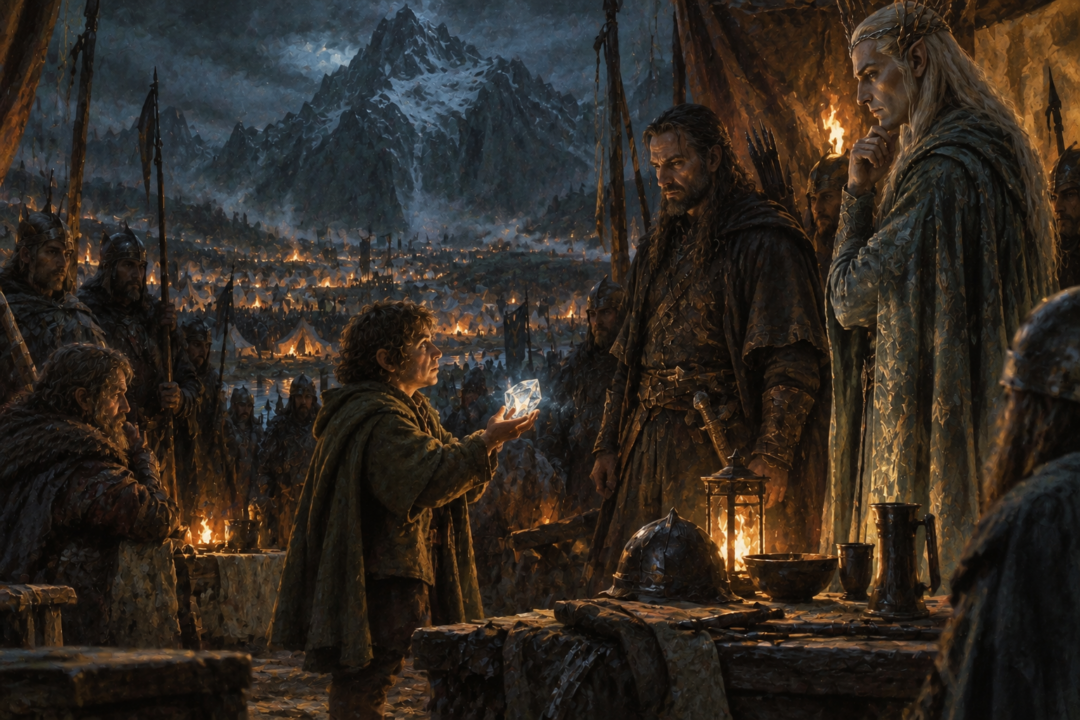
Bilbo instead takes the Arkenstone.
He secretly leaves Erebor and delivers it to Bard and the Elvenking so that they can use it as leverage in negotiations.
This is not merely a clever trick involving a valuable jewel.
Bilbo is trying to prevent a war.
The Arkenstone matters to Thorin beyond its monetary value. By giving Bard something Thorin desperately wants, Bilbo creates a bargaining tool powerful enough to reopen negotiations.
It nearly works.
Thorin agrees that a fourteenth share of the treasure can be exchanged for the Arkenstone.
But the timing is disastrous.
Dáin is already coming.
Dáin Arrives Before the Settlement Is Completed
When the Iron Hills host reaches the Mountain, the crisis has changed since Dáin was summoned.
Bilbo has intervened.
The Arkenstone has passed into Bard’s hands.
Thorin has agreed to terms, though bitterly.
But the exchange has not yet resolved the confrontation.
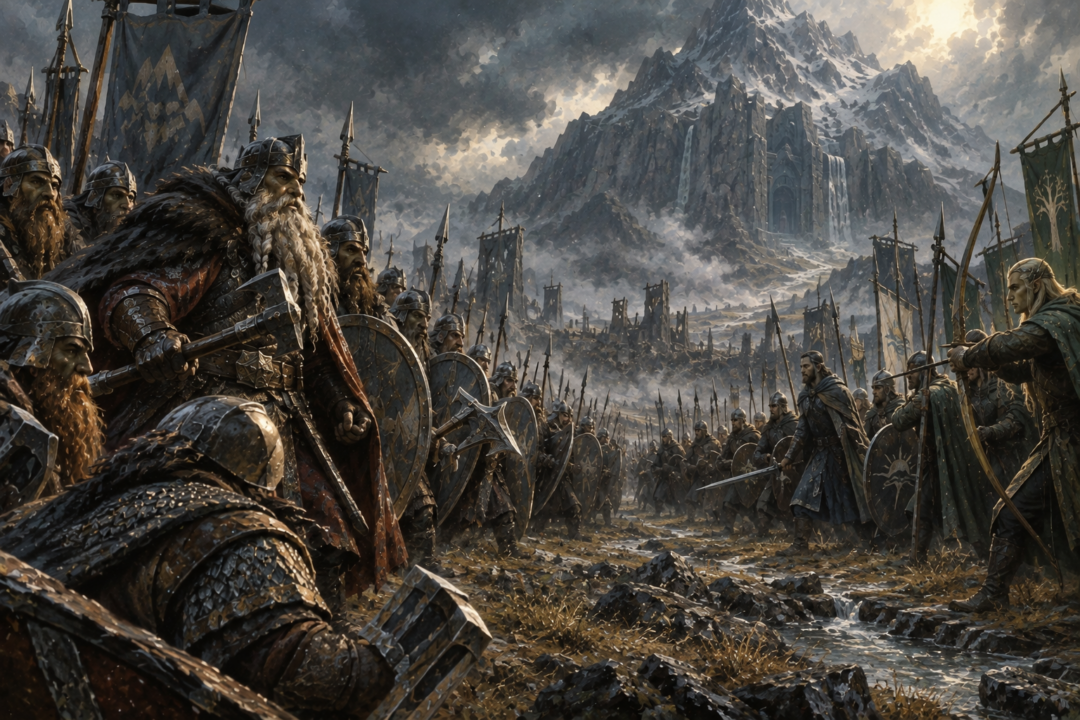
Dáin therefore arrives in a situation where the original military problem still visibly exists: Men and Elves remain outside Erebor, while Thorin and his companions remain enclosed within it.
The Dwarves attempt to reach the Mountain.
The opposing forces block them.
Now the logic of the relief expedition takes over.
Dáin has marched armed warriors across the country to aid Thorin. He is not going to turn around because the army surrounding Erebor tells him that negotiations are underway.
The confrontation moves toward violence.
Significantly, the Elvenking is reluctant to begin a war for gold. That detail prevents the scene from becoming a simple racial feud between Dwarves and Elves. Thranduil may have his own interest in treasure, but when battle threatens, he does not eagerly embrace slaughter.
Nevertheless, events have developed their own momentum.
Dáin’s Dwarves prepare to force the issue.
Men and Elves prepare to resist them.
Then Gandalf interrupts.
The Real Enemy Reveals How Small the Treasure Dispute Has Become
The arrival of the Orcs changes everything.
Bolg’s great host is descending upon Erebor, accompanied by wolves. The enemies of Dwarves, Elves, and Men have learned of Smaug’s death and the exposed wealth of the Mountain.
Suddenly the three forces preparing to fight each other must become allies.
The irony is brutal.
Minutes earlier, Dáin’s warriors were ready to fight the very Men and Elves beside whom they must now stand.
Nothing magical erases their grievances. The treasure has not ceased to matter. Bard’s claims have not disappeared. Thorin has not suddenly become generous.
A larger danger simply reveals the madness of continuing the smaller conflict.
Dwarves, Elves, and Men arrange themselves for battle against their common enemies.
The Battle of Five Armies begins.
Dáin’s Later Actions Show That He Was Never Merely a Treasure-Hungry Warlord
What happens afterward is important when judging Dáin’s arrival.
Thorin is mortally wounded in the battle. Fíli and Kíli also die, leaving Dáin as the successor to the kingship under the Mountain.
Dáin now controls what Thorin fought so fiercely to keep.
And he handles the settlement differently.
The promises concerning the treasure are honored. Bard receives wealth, and from it comes the means to aid the people of Lake-town and restore Dale. The Elvenking also departs with gifts, including the emeralds of Girion that Bard gives him in gratitude for his assistance.
The old enemies do not remain enemies.
Under Dáin and Bard, Erebor and Dale become neighboring kingdoms whose fortunes are closely connected. Decades later, during the War of the Ring, Dáin dies beside King Brand of Dale while defending the same northern realm against Sauron’s forces.
That later history casts his arrival in T.A. 2941 in a revealing light.
Dáin comes ready to fight Men and Elves because he believes he is answering Thorin’s call against armed opponents.
He does not come because coexistence with Men or Elves is impossible.
Once the immediate dispute is resolved, cooperation becomes not merely possible but enduring.
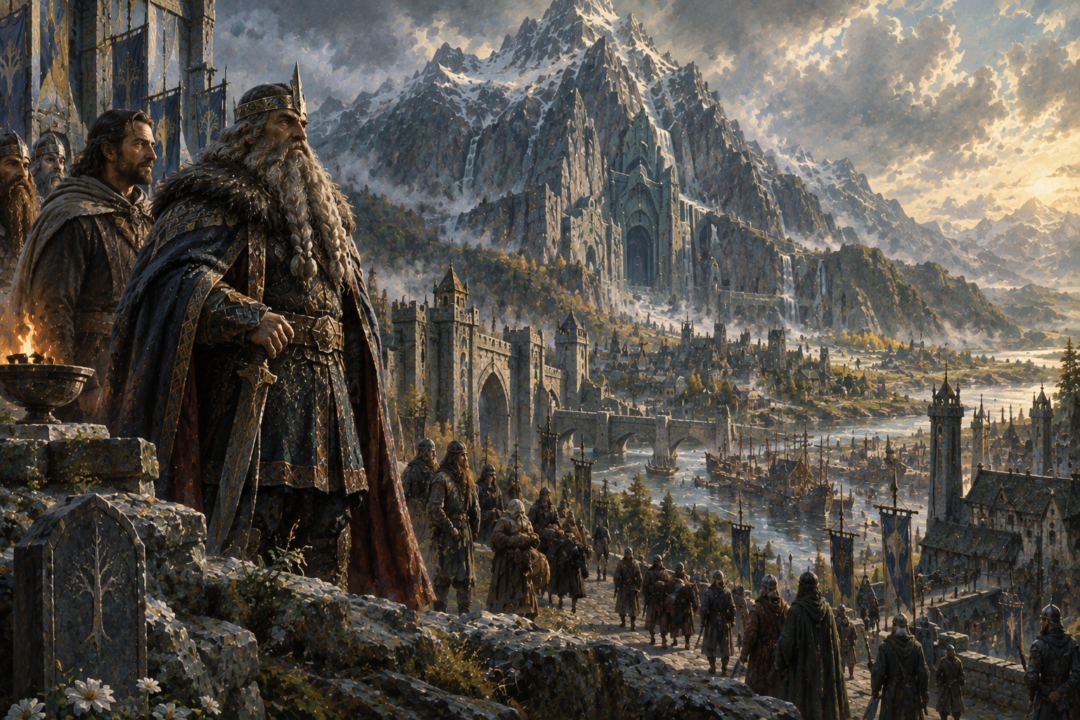
The Near-Battle Is Really About Fear
The treasure matters, but the confrontation before Erebor is driven just as much by fear.
Thorin fears losing control of the kingdom he has spent his life trying to recover.
Bard fears for people who have no homes and little time before winter.
The Elvenking has committed his strength to Bard’s cause while also having interests of his own.
Dáin fears, or at minimum has been given reason to believe, that his kinsman and the restored Dwarven kingdom are threatened by armed neighbors.
Each side therefore increases its strength.
And every increase in strength confirms the fears of the other side.
That is why Dáin arrives ready for war.
By the time he sees Erebor, diplomacy has already been backed by armies, the Mountain is under siege, Thorin has called for armed assistance, and Dáin has marched hundreds of warriors to answer him.
The remarkable thing is not that the Dwarves nearly attack.
It is that the attack is stopped at all.
Only the appearance of a far greater enemy forces everyone to recognize what Bilbo had already understood: a treasure worth recovering was not worth turning potential friends into corpses.
The gold survives the Battle of Five Armies.
Many of those who desired it do not.
And Dáin Ironfoot, who arrived prepared to fight the armies outside Erebor, ultimately becomes the king who helps turn the Lonely Mountain from the center of a bitter siege into part of a restored northern alliance.
Sources & Notes
- Tolkien Gateway — Dáin Ironfoot: why Thorin summoned him and the size, equipment, and initial intent of his force. https://tolkiengateway.net/wiki/D%C3%A1in_Ironfoot
- Tolkien Gateway — The Gathering of the Clouds: Roäc’s warning, Thorin’s request for aid, Bard’s demands, and the siege. https://tolkiengateway.net/wiki/The_Gathering_of_the_Clouds
- Tolkien Gateway — Battle of Five Armies: Dáin’s arrival, the near-clash among Dwarves, Men, and Elves, and their alliance against the Goblins. https://tolkiengateway.net/wiki/Battle_of_Five_Armies
Sources on Thorin’s summons, Dáin’s experienced force from the Iron Hills, the armed standoff at Erebor, and the Battle of Five Armies.