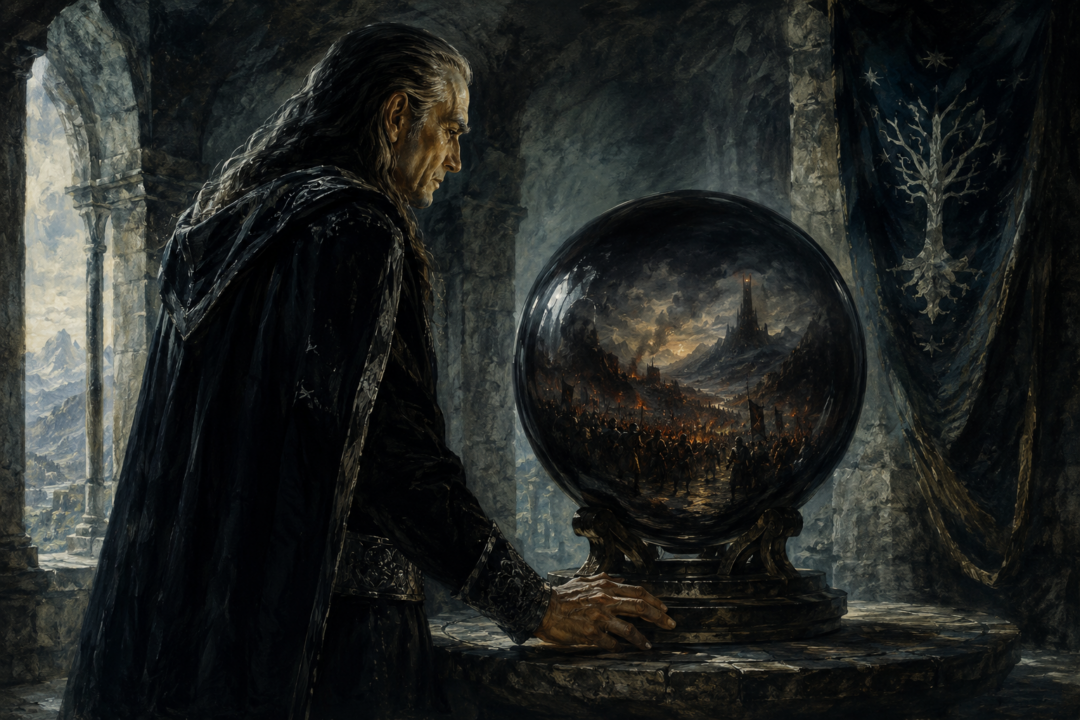
The palantír hidden in Minas Tirith should have been one of Gondor’s greatest advantages.
While other commanders depended on scouts, messengers, beacon fires, and reports carried across dangerous country, Denethor possessed something extraordinary: the Anor-stone, one of the ancient Seeing-stones brought to Middle-earth by the Faithful of Númenor. Through it, the Steward could look far beyond the walls of his city and gather knowledge unavailable to almost anyone else in the West.
And Denethor was not an incompetent man who happened to possess a dangerous artifact. He was formidable: intelligent, strong-willed, experienced, and deeply committed to Gondor.
That is precisely what makes his downfall so interesting.
Sauron did not need to fill the palantír with simple lies. The deeper danger was that Denethor could see real things without possessing the full meaning of what he saw.
His extraordinary information advantage gradually became a strategic liability because knowledge without context narrowed his judgment, magnified the enemy’s apparent strength, and encouraged him to believe that he understood the whole war.
Denethor Was Far More Capable Than His Final Hours Suggest
Denethor’s collapse can overshadow the man he had been.
The appendices to The Lord of the Rings describe him as proud, tall, valiant, and unusually perceptive. He had spent decades governing a kingdom living beneath the growing shadow of Mordor. Gondor was not a peaceful realm suddenly surprised by invasion. Its eastern defenses had been under pressure for generations.
Denethor understood that pressure intimately.
He strengthened Gondor’s defenses, maintained forces in Ithilien, and prepared Minas Tirith for the assault he knew was coming. Even Gandalf recognizes that Denethor has long resisted Sauron rather than simply surrendering to fear.
His use of the palantír must therefore be understood in that context.
Denethor was not merely indulging curiosity. The surviving Anor-stone offered a ruler responsible for Gondor’s survival an almost irresistible strategic tool.
And unlike Saruman, Denethor was not simply mastered through the Stone.
The essay on the palantíri published in Unfinished Tales makes an important distinction: Denethor possessed lawful authority to use the Anor-stone and had sufficient strength of will that Sauron could not simply dominate him through it.
That makes the eventual disaster subtler.
Denethor could resist Sauron’s will.
He could not escape the consequences of seeing the war through a channel in which Sauron possessed enormous advantages.
The Palantír Did Not Simply Show Denethor False Visions
One of the most important rules governing the Seeing-stones is that they were not ordinary instruments of illusion.
They could show distant realities. What a viewer saw might be incomplete, directed, difficult to interpret, or stripped of essential context, but the danger was not necessarily fabricated imagery.
This distinction matters enormously.
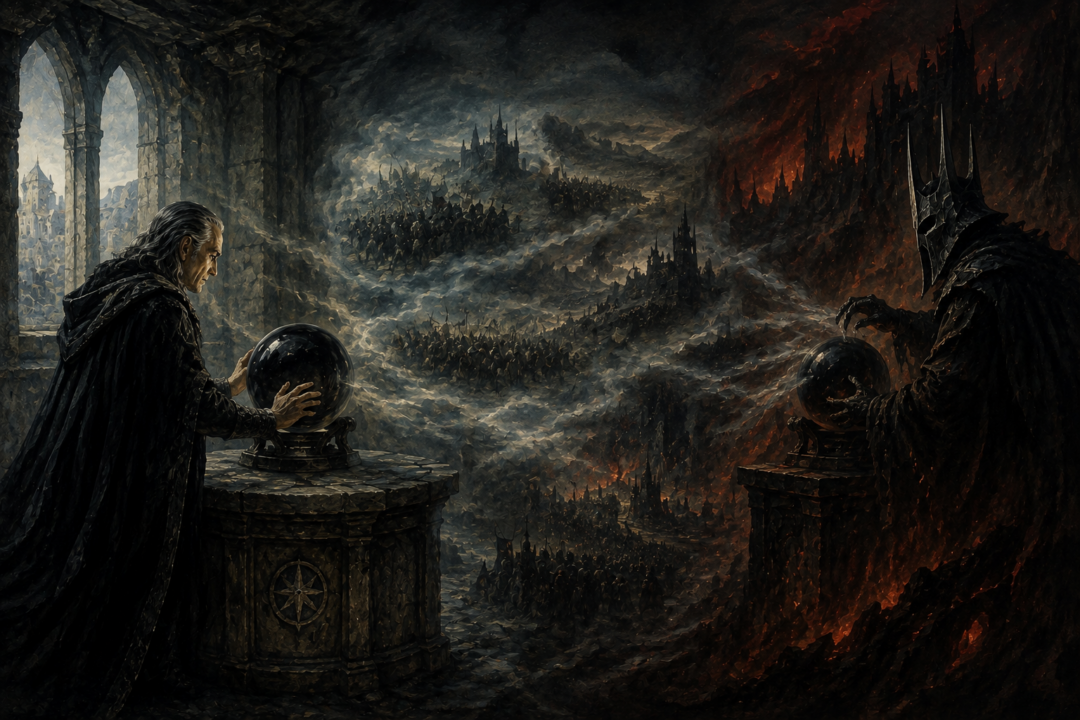
Sauron possessed the Ithil-stone, captured when Minas Ithil fell to the Nazgûl. Once Denethor began using the Anor-stone, he was therefore operating within a network where his greatest enemy controlled another Stone.
Sauron could influence what Denethor was likely to see.
The result was something more effective than a simple lie: selective truth.
Denethor could behold armies gathering, territories dominated by Sauron, and the immense military resources available to Mordor. These things were real.
But seeing an enemy’s strength is not the same thing as understanding the future.
The palantír could reveal forces.
It could not tell Denethor what those forces would ultimately accomplish.
Sauron Weaponized Context
This is where Denethor’s information advantage began turning against him.
A conventional military report arrives with limitations that are obvious. A scout tells his commander what he saw from one hill. A messenger reports what happened yesterday. A captain admits what he does not know.
The palantír could feel far more authoritative.
Denethor could see.
Yet his sight remained limited.
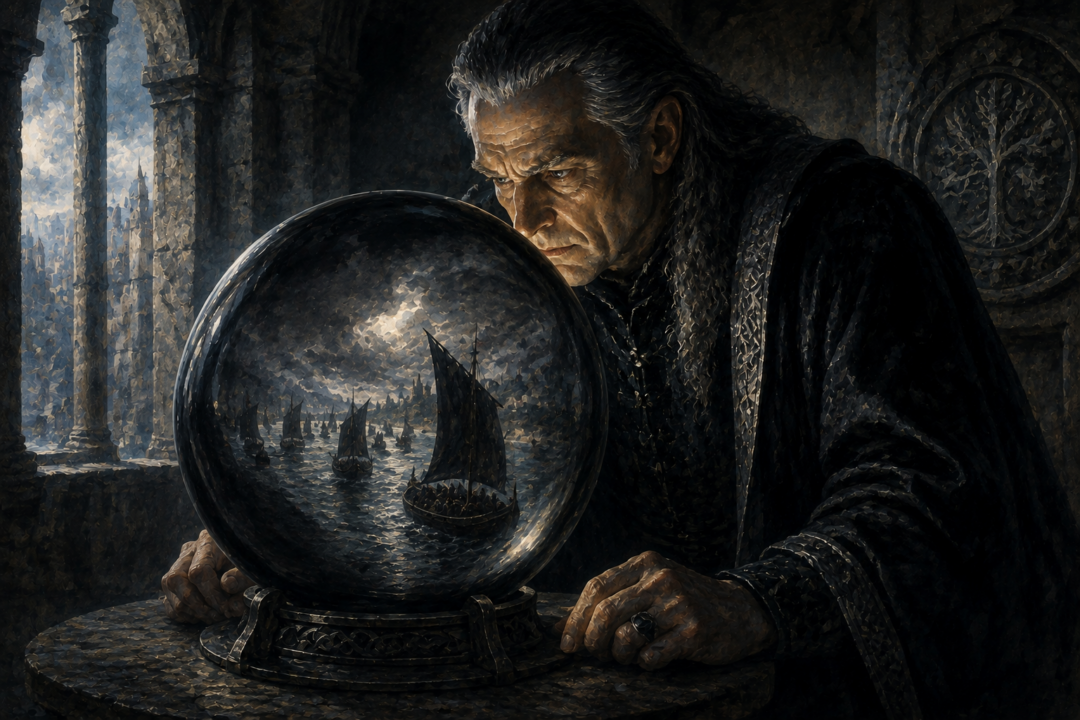
The clearest example appears near the end of his life. Denethor has seen the Corsair fleet sailing up the Anduin. From his perspective, the meaning seems obvious: enemies from the south are approaching while Minas Tirith is already under overwhelming attack.
The ships are real.
The interpretation is wrong.
Aragorn and the Grey Company have seized the fleet at Pelargir, and the ships are carrying allies toward the Pelennor.
Denethor possesses accurate information and reaches a disastrous conclusion because he lacks the decisive piece of context.
That is almost a perfect miniature of his larger strategic failure.
He knows more than nearly everyone around him.
But what he knows convinces him that he knows enough.
Seeing Mordor Made Victory Look Impossible
Denethor’s despair was not entirely irrational.
Sauron’s military strength really was immense. Mordor had gathered armies beyond Gondor’s ability to defeat through conventional strength alone. Even victory at the Pelennor would not solve that underlying imbalance.
Gandalf and Aragorn understand this too.
The difference is not that they believe Gondor can simply defeat Mordor’s armies in a normal war.
They know it cannot.
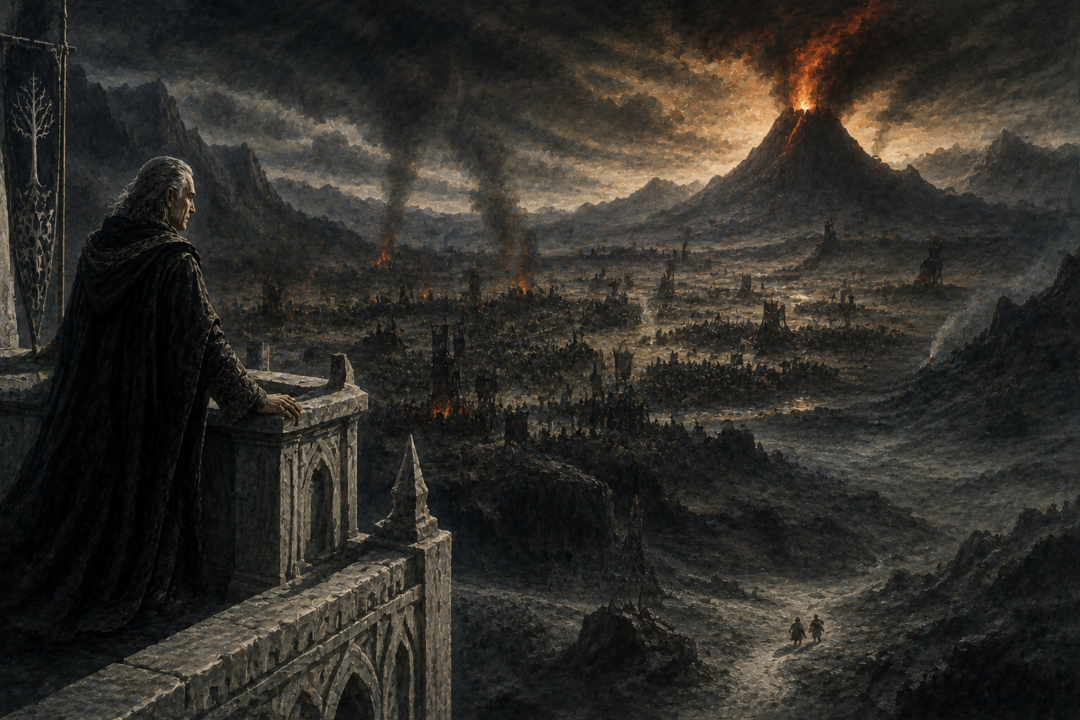
Their hope depends upon something Denethor does not fully comprehend: the possibility that the Ring can be destroyed.
That strategy looks almost absurd when judged purely from the visible balance of military power. A tiny group has entered Mordor, and ultimately Frodo and Sam continue alone toward Mount Doom while the Captains of the West deliberately march toward a vastly superior enemy.
Denethor’s intelligence therefore pushes him toward exactly the wrong kind of rationality.
He measures armies.
He sees fortresses.
He watches enemy movements.
And everything visible tells him that Sauron will eventually win.
The decisive factor in the war is something that conventional strategic observation cannot adequately measure: two hobbits carrying the Ring through Mordor in secret.
The more Denethor sees of the visible war, the less reasonable hope appears.
His Information Became Isolating
There was another cost.
Denethor possessed knowledge that most of his commanders did not possess, and he could not easily explain its source.
This created an extraordinary imbalance between ruler and advisers.
He could know things without revealing how he knew them.
More importantly, repeated use of the Stone encouraged a worldview in which Denethor himself became the privileged interpreter of the conflict.
His relationship with Gandalf shows the consequences.
Denethor does not simply disagree with Gandalf about tactics. He suspects Gandalf’s larger purposes, especially concerning Aragorn and the return of the King. He believes that the wizard is involved in political designs that threaten the Stewardship.
Some of that suspicion predates the final crisis. Denethor is a proud ruler guarding a realm his house has preserved for centuries.
But the palantír deepens the tragedy because it gives him genuine secret knowledge.
A man who repeatedly discovers that he knows things others do not can easily become less willing to trust what others know.
Denethor’s intelligence network therefore becomes psychologically self-reinforcing.
He sees more.
Because he sees more, he trusts his own judgment more.
Because he trusts his own judgment more, contradictory counsel appears increasingly naive or politically suspect.
Information that should broaden his strategic understanding instead narrows it around himself.
Sauron Did Not Need to Defeat Denethor’s Will
This is perhaps the most important distinction between Denethor and Saruman.
Saruman becomes entangled with Sauron through the Orthanc-stone and eventually enters into open treachery. Denethor does not become Sauron’s servant.
He remains Sauron’s enemy.
That makes Sauron’s victory over him more disturbing.
The Enemy does not need Denethor to change sides. He only needs the Steward to conclude that resistance is meaningless.
According to the account of the palantíri in Unfinished Tales, Sauron could not simply force Denethor into submission. Denethor’s authority and strength prevented that.
Instead, the confrontation exhausted him and allowed Sauron to exploit what Denethor saw.
The result was despair rather than allegiance.
That distinction explains Denethor’s final behavior. He does not suddenly admire Mordor. He believes Mordor’s victory is inevitable.
When Faramir is brought back gravely wounded, the remaining structure of Denethor’s hope collapses.
Boromir is dead.
Faramir appears to be dying.
Enemy armies surround the city.
The Corsair ships seem to be approaching.
And beyond all of that stands the vast power Denethor has already witnessed through the Stone.
From inside that information environment, catastrophe appears complete.
Denethor Mistook Probability for Destiny
This is where his strategic failure becomes a moral one.
Denethor has excellent reasons to fear defeat.
But he moves from recognizing terrible odds to claiming certainty about the future.
Gandalf rejects that step.
During their confrontation in the House of the Stewards, the conflict between them is no longer really about intelligence. It is about what a person is entitled to do with incomplete knowledge.
Denethor believes he has seen enough to pronounce the struggle hopeless.
Gandalf insists on continuing while any possibility remains.
The difference is crucial.
Denethor’s mistake is not that he understands nothing.
It is that he understands much and mistakes that knowledge for completeness.
No palantír shows him Frodo standing inside Mount Doom.
No military calculation predicts Gollum’s final intervention.
No assessment of Gondor’s remaining strength makes the destruction of the Ring appear likely.
The decisive events of the war exist beyond Denethor’s strategic model.
His tragedy is that he cannot leave room for what he cannot see.
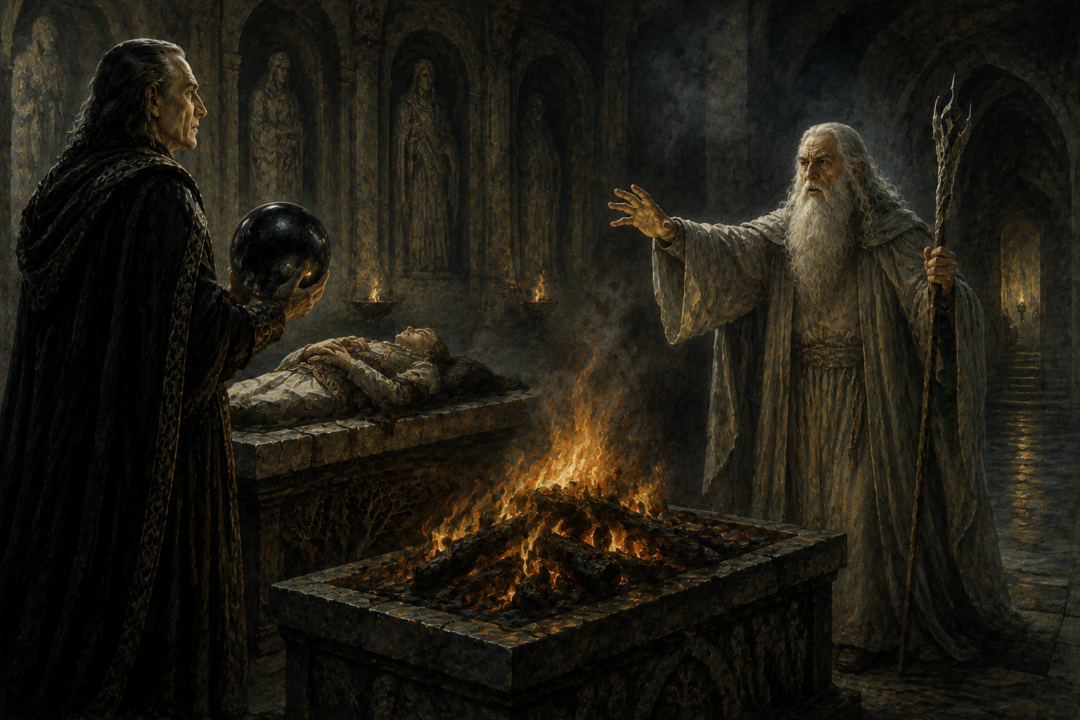
The Greatest Intelligence Tool in Gondor Created a Blind Spot
Denethor’s palantír therefore produces one of the strangest paradoxes in The Lord of the Rings.
The Steward with access to extraordinary information becomes dangerously blind.
Not because everything he sees is false.
Because so much of it is true.
Mordor really is overwhelmingly powerful.
Gondor really is close to destruction.
Faramir really is gravely wounded.
A great fleet really is sailing toward Minas Tirith.
Yet the meaning of those facts is not fixed.
The fleet carries Aragorn.
Faramir survives.
Rohan arrives.
The assault on Minas Tirith fails.
And far inside Mordor, the Ring reaches the Fire.
Denethor’s information advantage becomes a liability because Sauron succeeds in controlling the frame around reality. He allows the Steward to see enough truth to make despair seem like wisdom.
That is why Denethor’s fall is more tragic than simple madness or deception.
He is a brilliant ruler defeated partly through his own greatest strength: his determination to know the enemy.
He looks farther than almost anyone else in Gondor.
But in the end, he cannot see beyond what the enemy permits him to behold.
And the fate of Middle-earth is decided by the things that remain outside his sight.
Sources & Notes
- The Encyclopedia of Arda — Denethor II: https://www.glyphweb.com/arda/d/denethor.html
- The Encyclopedia of Arda — Palantíri: https://www.glyphweb.com/arda/p/palantiri.php
- The Encyclopedia of Arda — Anor-stone: https://www.glyphweb.com/arda/a/anorstone.html
- The Encyclopedia of Arda — Ithil-stone: https://www.glyphweb.com/arda/i/ithilstone.html
Reference entries covering Denethor, the capabilities and limits of the palantíri, and the linked Anor- and Ithil-stones behind Sauron’s selective presentation of information.