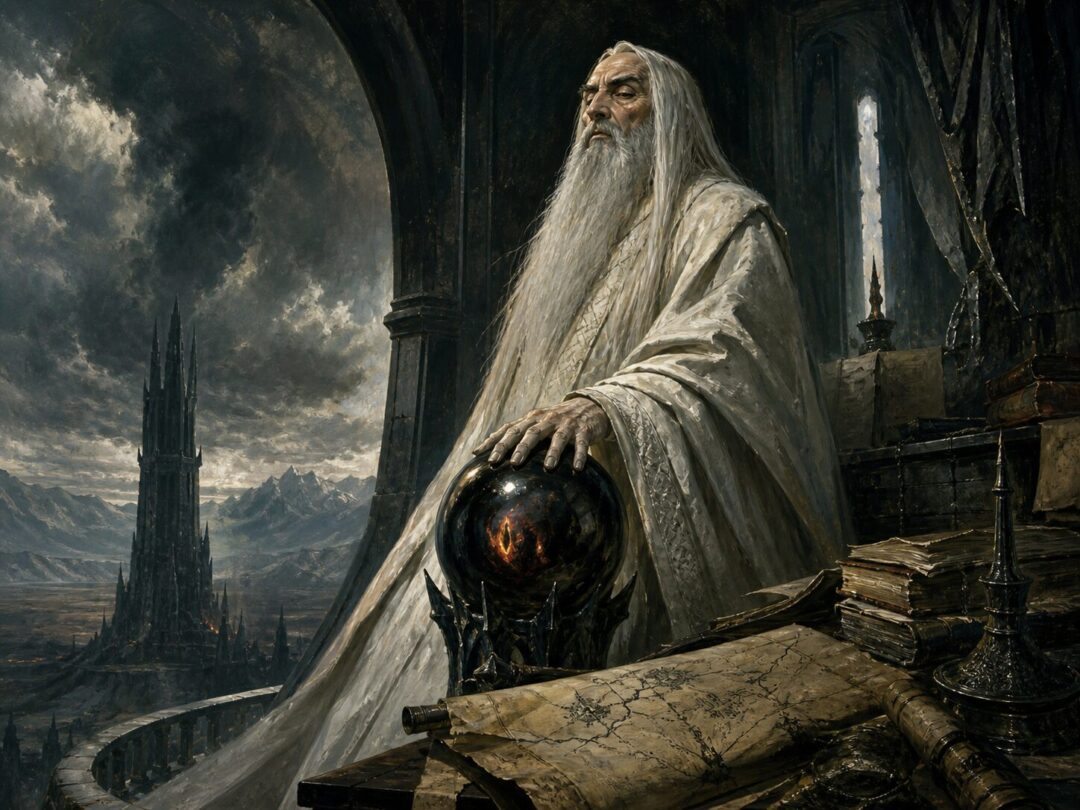
At first, it seems like one of the great unanswered questions of the War of the Ring.
Saruman knew about the Ring.
He knew Hobbits were involved.
He knew the name Baggins.
He had spies watching the Shire. He had searched for information. He had sent his own servants into the wider game. And most dangerously of all, he had used the palantír of Orthanc, placing himself in contact with Sauron.
So if Saruman knew that Frodo was carrying the One Ring toward Mordor, why did he not warn Sauron?
Why did he not use that knowledge to save himself?
Why did he not tell the Dark Lord the one thing that would have changed everything?
The answer is not that Saruman was careless.
It is stranger than that.
The real answer is that the question assumes more than the texts actually prove. Saruman knew much. He guessed much. He desired much. But there is no clear evidence that he fully understood Frodo’s mission: that the Ring was being carried into Mordor, not to be wielded, but to be destroyed.
And that distinction changes everything.

Saruman Knew About the Ring, But Not the Whole Plan
Saruman was not ignorant.
Long before the final stages of the war, he had become deeply interested in Ring-lore. He had studied the matter. He knew enough to deceive the White Council for a time, and he secretly desired the One Ring for himself.
He also knew that Hobbits mattered.
The search for “Baggins” had already drawn dangerous attention toward the Shire. Saruman’s own dealings and spies connected him to that trail. By the time his forces attacked the Fellowship, his Orcs were not simply told to kill everyone. The Hobbits were to be taken alive.
That detail matters.
It strongly suggests that Saruman believed one of the Hobbits might be useful. Most likely, he suspected the Ring was with them, or that they could lead him to it.
But suspicion is not the same as knowledge.
Saruman did not witness the Council of Elrond. He was not present when the decision was made to send the Ring secretly into Mordor. He did not hear Frodo accept the burden. He did not know the exact shape of the plan unless he learned it by some means the story never confirms.
The texts show Saruman pursuing the Ring.
They do not show him understanding the Quest.
That is the first key.
Saruman did not need to know Frodo was going to Mordor in order to want the Hobbits captured. He only needed to believe they were connected to the Ring.
And that is exactly the kind of partial knowledge that defines him.
Saruman Was Not Loyal to Sauron
Another mistake is imagining Saruman as a simple servant of Mordor.
He was not.
Saruman had fallen into evil, but his fall did not make him humble. He did not become merely obedient. He wanted power for himself. His dealings with Sauron were not the actions of a faithful lieutenant, but of a rival who had misjudged the strength of the master he pretended to serve.
This is why his silence makes sense.
If Saruman had discovered the Ring’s location with certainty, his first instinct would not necessarily have been to warn Sauron. It would have been to seize the Ring.
That was the whole danger.
Saruman wanted to become a power in his own right. He built an army. He fortified Isengard. He bred and armed Orcs. He manipulated Rohan. He did not act like someone merely waiting to hand victory to Barad-dûr.
He wanted his own victory.
So even if Saruman suspected that the Ring was with the Fellowship, and even if he believed the Hobbits were central to its movement, telling Sauron would have meant surrendering the very prize he desired.
Saruman’s treachery worked in two directions.
He betrayed the Free Peoples.
But he was also false to Sauron.
That double treason is essential to understanding him.
The Palantír Did Not Make Saruman All-Knowing
The palantír is often treated as if it gave Saruman complete knowledge of events.
It did not.
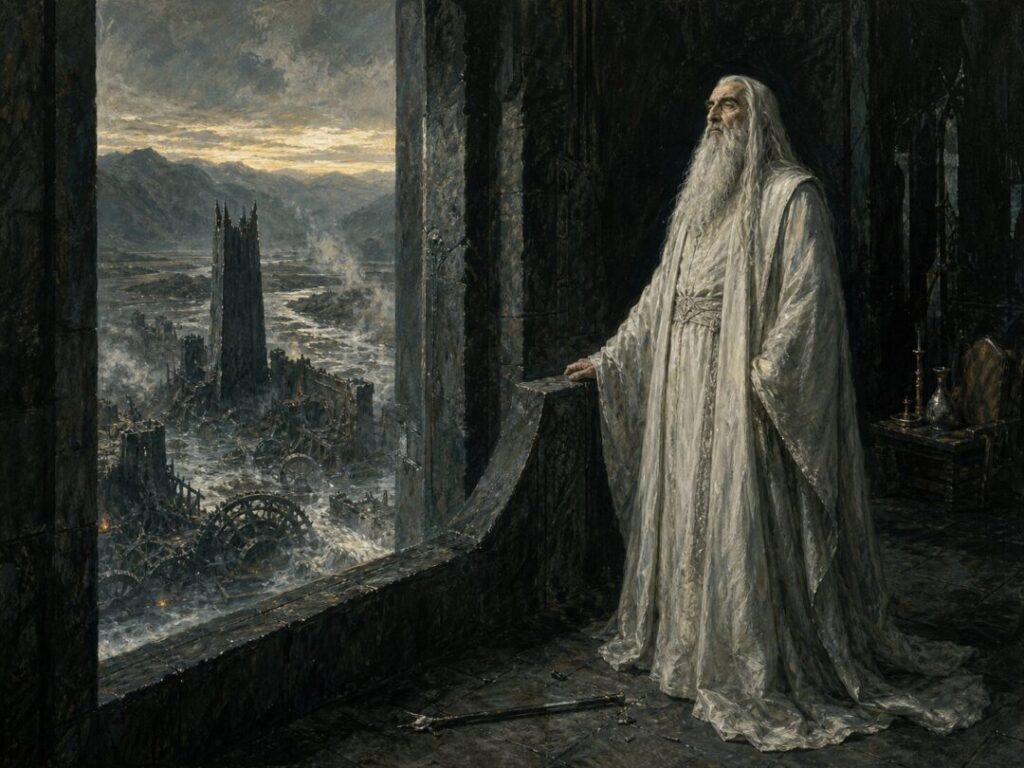
The Seeing-stones were powerful, but they were not simple windows into every secret of Middle-earth. They could reveal much, and they could be used for communication, but they were dangerous tools. What one saw could be limited, guided, interpreted wrongly, or turned against the viewer.
Saruman used the Orthanc-stone and fell under Sauron’s influence through it. But that does not mean Sauron told him everything, or that Saruman could see every hidden movement of the Ring-bearer.
In fact, the palantír becomes one of the great sources of confusion in the story.
When Pippin looks into the Stone, Sauron sees a Hobbit and draws the wrong conclusion. He believes, or at least strongly suspects, that Saruman has captured the Hobbit connected to the Ring. This causes fear and urgency, but it does not reveal the truth.
The moment is important because it shows how close the Enemy can come to the truth and still misunderstand it.
Sauron sees a Hobbit.
He knows Hobbits matter.
He knows Saruman has been hunting for the Ring.
But he still does not understand the actual Quest.
The palantír gives him a glimpse.
It does not give him wisdom.
Saruman Lost His Chance to Speak
After the fall of Isengard, Saruman’s situation changed completely.
He was no longer an active power in the war.
His armies had been destroyed. His stronghold was surrounded. Gandalf confronted him at Orthanc, rejected his manipulations, and broke his staff. The palantír was no longer in his possession.
This matters because by the time Frodo and Sam were moving through the most dangerous stages of their road, Saruman was cut off.
He did not have his old channels of power.
He did not command the war.
He did not sit safely in Orthanc directing events through the Stone.
The idea that Saruman could simply send Sauron a clear warning assumes he still had the means, freedom, and position to do so. But the story shows the opposite. Saruman had been reduced. He remained cunning and malicious, but he was no longer the great strategist he had once appeared to be.
He had become trapped in the ruin of his own designs.
That is one of the quiet ironies of the War of the Ring.
Saruman spent years seeking knowledge and control, but when the decisive moment came, he was no longer in control of anything important.
Sauron Did Not Know the Real Plan Either
The deeper issue is not only what Saruman knew.
It is what Sauron could not imagine.
Sauron’s great blindness was not lack of intelligence. He was ancient, powerful, and terrifyingly perceptive. He understood domination, fear, military strength, corruption, and the desire for power.
But he did not understand renunciation.
He did not believe that anyone who possessed the Ring would truly seek to destroy it.
This is why the plan of the Wise was so desperate and so brilliant. It depended on secrecy, but it also depended on Sauron’s own nature. He expected his enemies to use the Ring as he would use it. He expected a rival. A claimant. A new lord rising against him.
He did not expect pity, endurance, humility, and self-sacrifice to become the road by which he would be overthrown.
That is why Aragorn’s actions after using the palantír were so effective. By revealing himself to Sauron, Aragorn encouraged the Dark Lord to believe that the heir of Isildur might be preparing to challenge him with the Ring.
This did not make Sauron foolish.
It made him consistent.
He interpreted events according to his own nature.
And that nature could not comprehend the actual purpose of Frodo’s journey.
Frodo’s Capture Did Not Reveal the Truth
Even when Frodo was captured near Cirith Ungol, Sauron still did not grasp the full danger.
This is one of the most important pieces of evidence.
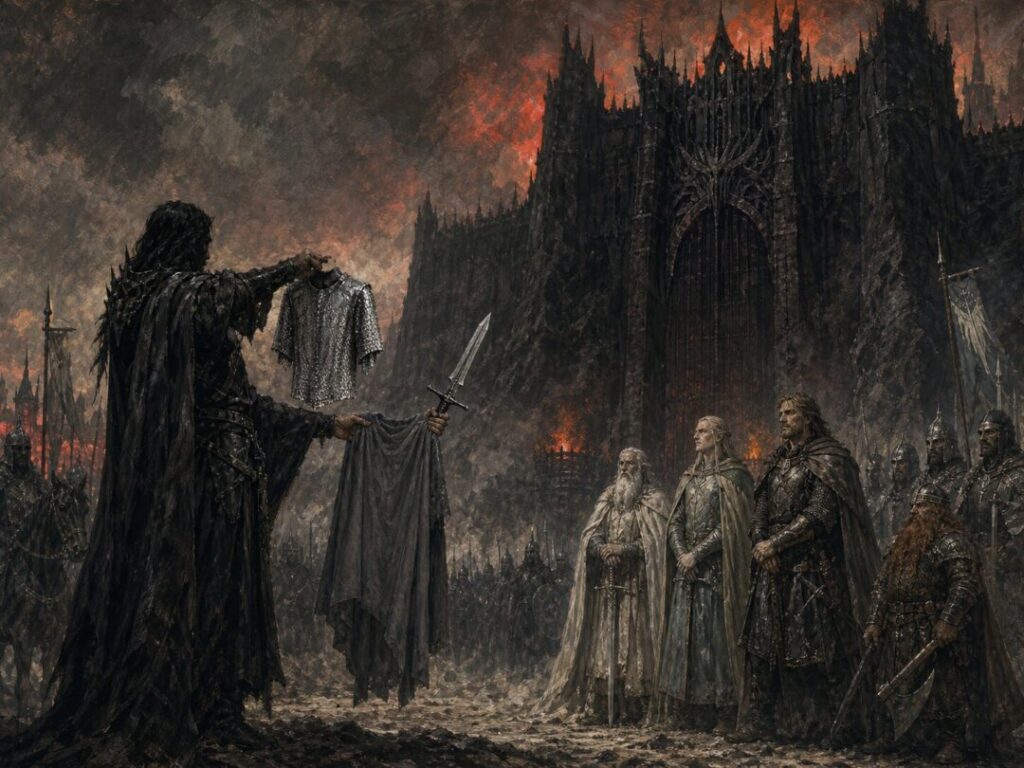
At the Black Gate, the Mouth of Sauron displays Frodo’s mithril-coat, Sam’s sword, and the grey Elven cloak. These tokens are meant to break the courage of the Captains of the West. They suggest that a Hobbit has been captured and that Sauron knows enough to threaten his enemies with that knowledge.
But what Sauron does not reveal is even more important.
He does not announce that he has found the Ring-bearer.
He does not declare that the Ring has been recovered.
He treats Frodo as a spy.
That misunderstanding is enormous.
If Sauron had known that Frodo was carrying the One Ring into Mordor to destroy it, the entire shape of his response would have changed. Mount Doom would have become the center of his attention. The road to the Fire would have been watched with a terror greater than any battlefield.
But that is not what happens.
Sauron still thinks in terms of war, spies, surrender, and military victory.
He is looking outward, toward the armies at his Gate.
The real danger is already behind him.
Saruman’s Silence Was Not the Decisive Factor
This is why Saruman’s failure to warn Sauron is not really the central mystery.
The more important point is that Saruman probably did not possess the complete truth, and even if he suspected parts of it, his own motives made him unreliable as a messenger.
He wanted the Ring.
He wanted power.
He was not loyal.
Then, after Isengard fell, he was stripped of the means that had connected him to Mordor.
By the time the Quest reached its final stage, Saruman had become almost irrelevant to the central movement of the story.
That is a hard fall for someone who once imagined himself as the great mind of the age.
But it fits his character perfectly.
Saruman’s tragedy is that he believed knowledge would make him master of events. He studied, schemed, calculated, and manipulated. Yet his knowledge was always bent toward possession. He could gather facts, but he could not understand mercy. He could read signs, but he could not understand humility.
In that, he resembled Sauron more than he realized.
Both were defeated not merely because they lacked information, but because they misunderstood the hearts of those who opposed them.
The Hidden Strength of the Quest
Frodo’s road succeeded because it was almost unthinkable to the Enemy.
Not impossible in a practical sense.
Unthinkable in a moral sense.
Sauron could imagine armies marching against him. He could imagine a king claiming the Ring. He could imagine betrayal, ambition, fear, and conquest. Saruman could imagine much the same. Both understood the desire to possess power.
Neither truly understood the willingness to give it up.
That is why the Quest could pass through the cracks of their wisdom.
It was not hidden only by distance, darkness, or secrecy. It was hidden by its own humility.
A Hobbit carrying the greatest weapon in the world, not to become mighty, but to end its power forever, did not fit the pattern by which Saruman and Sauron understood the world.
And so they missed it.
Not because they were stupid.
Because they were corrupt.
Why the Question Matters
So why did Saruman not warn Sauron?
Because the story never shows that he truly knew Frodo’s mission.
Because he wanted the Ring for himself.
Because he was a traitor even to the master he feared.
Because after Isengard fell, he lost the power and position to shape events.
And because the truth of the Quest was something both Saruman and Sauron were spiritually unfit to understand.
That is the deeper answer.
The Ring was not destroyed because the Enemy lacked spies.
It was destroyed because the Enemy could not imagine someone refusing mastery.
Saruman’s silence did not save Middle-earth.
Sauron’s blindness did.
And in the end, the smallest road remained hidden from the greatest powers because it was built on something they had both abandoned long ago.
Not strategy.
Not domination.
Not the hunger to rule.
But mercy, pity, and the terrible courage to let power go.
Sources & Notes
- J.R.R. Tolkien, The Lord of the Rings, Book II, Chapter 2, “The Council of Elrond” — Saruman’s Ring-lore, his desire for the Ring, and the Council’s secret decision to send it toward Mordor.
- J.R.R. Tolkien, The Lord of the Rings, Book III, Chapter 3, “The Uruk-hai” — the Orcs’ orders to seize Hobbits alive show Saruman seeking the Ring without proving he understood Frodo’s mission.
- J.R.R. Tolkien, The Lord of the Rings, Book III, Chapters 10–11, “The Voice of Saruman” and “The Palantír” — Saruman’s fall at Orthanc and Pippin’s use of the Stone reveal both his loss of agency and Sauron’s mistaken assumptions.
- J.R.R. Tolkien, The Lord of the Rings, Book V, Chapter 9, “The Last Debate” — Gandalf explains that Sauron is likely to expect a new Ring-lord, not an attempt to destroy the Ring.
- J.R.R. Tolkien, The Lord of the Rings, Book V, Chapter 10, “The Black Gate Opens” — the Mouth of Sauron treats Frodo’s gear as evidence of a captured spy, not as proof that Sauron has recovered or understood the Ring-bearer’s errand.
- J.R.R. Tolkien, Letter 131 — Tolkien’s account of Sauron’s will to domination supports the article’s reading of why Sauron and Saruman misread renunciation and humility.