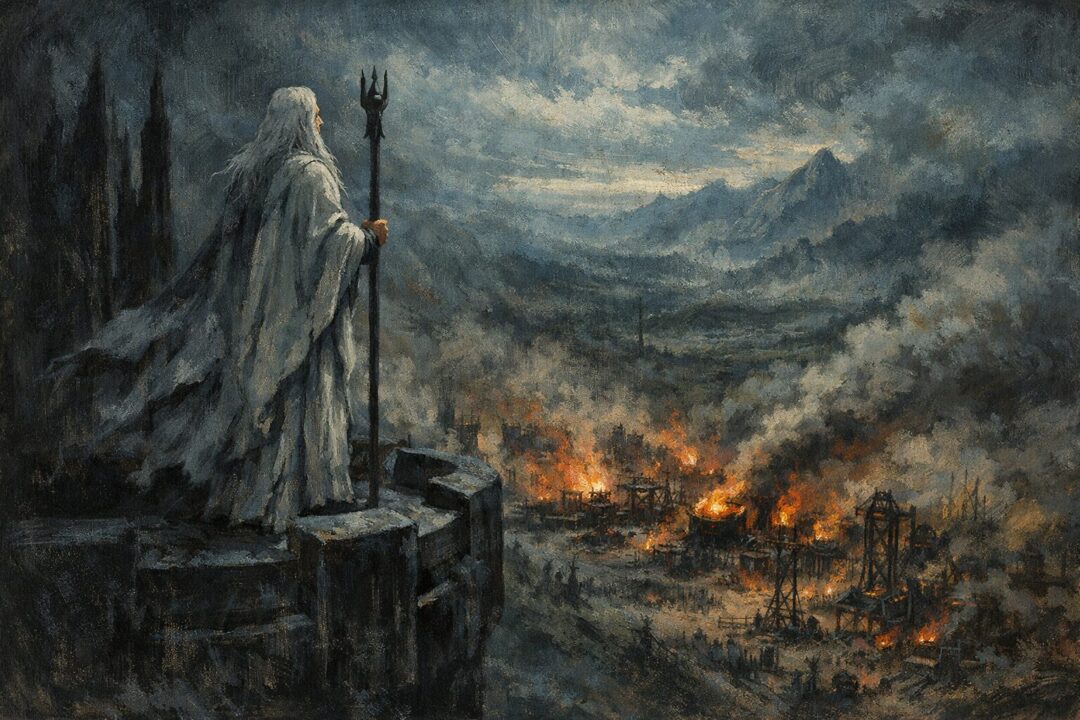
At first glance, Saruman’s absence from Mordor appears cowardly. If he truly sought power, why not confront Saurondirectly? Why remain sealed within Orthanc while the Dark Lord ruled openly from the East?
Tolkien’s answer is far more unsettling—and far more tragic.
Saruman did not fear Mordor.
He feared submission.
To go to Mordor would have required Saruman to define himself clearly in relation to Sauron. He would have had to kneel, or to challenge him outright. Saruman wanted neither. He wanted something far more dangerous: to remain independent while drawing ever closer to the Enemy’s way of thinking. In Tolkien’s world, that is often the point of no return.
Saruman’s Knowledge Was His Undoing
Of all the Istari sent to Middle-earth, Saruman studied the Enemy most closely. In Unfinished Tales, Tolkien tells us that Saruman “became enamoured of the devices of Sauron.” This is a crucial line. Saruman’s fall does not begin with open treachery, but with fascination.
This fascination was not ignorance—it was arrogance.
Saruman believed that knowledge equaled immunity. He convinced himself that by understanding Sauron’s methods, he could safely use them without being corrupted. Where Gandalf distrusted domination itself, Saruman believed domination was merely a tool—dangerous, yes, but manageable in the right hands.
This belief set Saruman apart from the other Wise. Gandalf rejected the Ring not because he lacked the strength to wield it, but because he understood that good intentions do not survive absolute power. Saruman, by contrast, believed his intellect made him an exception.
Tolkien is explicit about this. Saruman’s fall is rooted in self-deception—the belief that one can walk in the shadow without becoming part of it. He did not see himself as a servant of evil. He saw himself as its future master.
Why Mordor Was the Wrong Move
If Saruman’s goal was ultimate power, Mordor was paradoxically the worst place to seek it.
To go there would have forced Saruman into one of two roles: servant or enemy. Neither suited him.
Saruman did not want to overthrow Sauron by force. He knew he could not win a direct contest of power—not yet. Nor did he wish to kneel and become a lieutenant. Pride would not allow it.
Instead, Saruman imagined a third path.
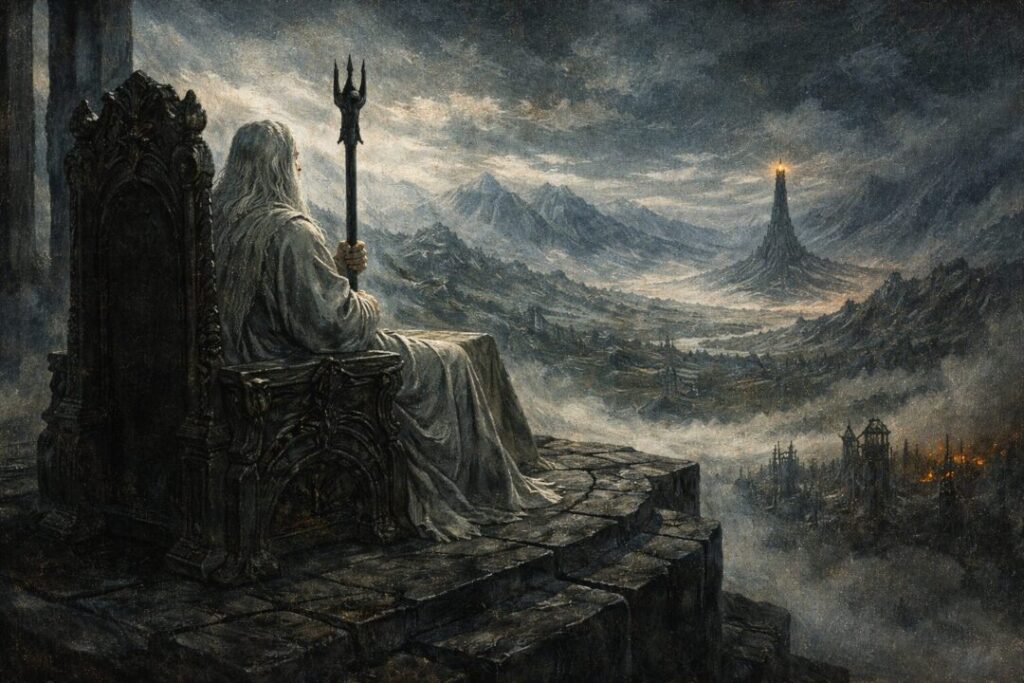
He would remain in Isengard, gather strength quietly, and wait for the right moment. He would let Sauron exhaust himself against Gondor and the West. Then, when the time was right—when the Ring was found—Saruman would step forward as the true master of Middle-earth.
This plan required distance.
Distance gave Saruman freedom to maneuver. It allowed him to build armies, strip the land, breed Orcs, and reshape Isengard into an industrial powerbase. Most importantly, it allowed him to believe he was still acting independently.
Saruman thought time favored the clever. He believed patience was his greatest weapon.
Ironically, this mirrors Sauron’s own strategy during much of the Third Age. Sauron waited, gathered strength, and let others move first. Saruman believed he understood this strategy better than its creator—and that belief would destroy him.
Playing the Enemy’s Game
Saruman’s transformation of Isengard is often viewed as proof that he had already allied himself with Mordor. But Tolkien presents it more subtly—as rivalry, not obedience.
Saruman imitates Sauron because he believes imitation is mastery.
He does not simply copy the Enemy’s methods; he refines them. He replaces ancient forests with furnaces. He values efficiency over harmony. He treats living beings as resources to be shaped and spent.
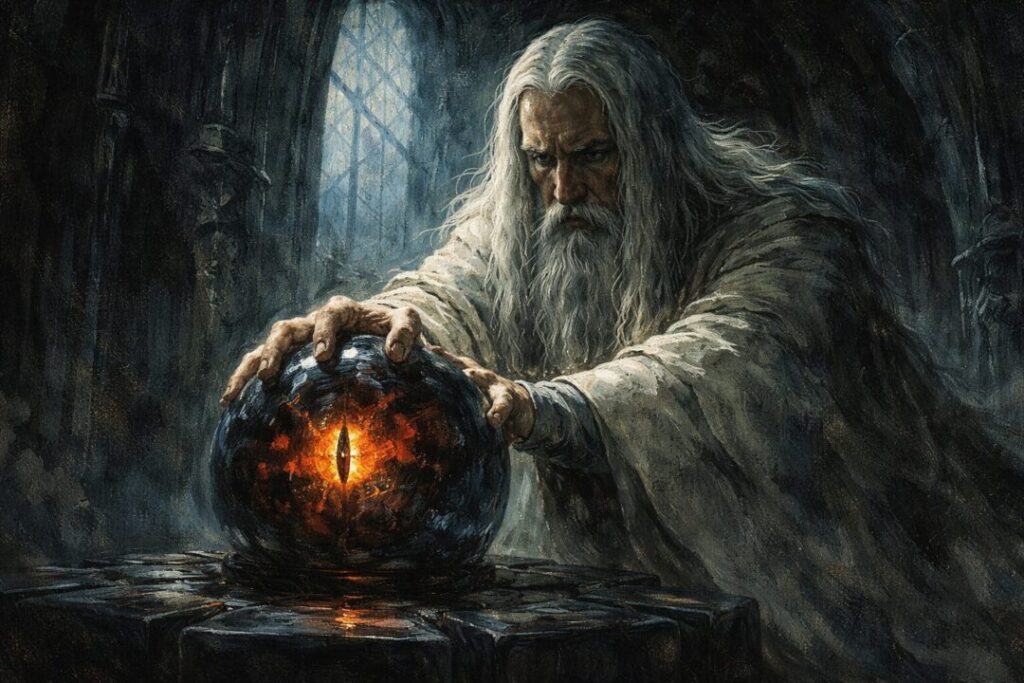
Most telling of all, Saruman uses the palantír.
This act reveals the core of his tragedy. Saruman believes himself clever enough to use the Seeing-stone without being dominated by it. He convinces himself that he is learning from Sauron, not submitting to him. In reality, the exchange is never equal. Sauron allows Saruman to see only what will push him further down the path of pride.
Saruman also manipulates Rohan, undermines Théoden, and studies the One Ring obsessively—not to destroy it, but to claim it. He begins to speak openly of “a new order” and “a power to match the power of Mordor.”
In doing so, Saruman commits the same sin seen repeatedly throughout Tolkien’s legendarium: attempting to use evil means for personal dominion while denying that those means have already defined the end.
Pride, Not Cowardice
It is tempting to interpret Saruman’s behavior as fear. Why else hide behind walls while Sauron marches openly?
But Tolkien makes clear that Saruman’s greatest flaw is not weakness—it is certainty.
Saruman is certain he can walk the edge.
Certain he can stop before it is too late.
Certain that Sauron needs him more than he needs Sauron.
This certainty blinds him.
Even as his voice still compels kings and his mind rivals the Wise, Saruman fails to notice the rot setting in. His plans grow narrower. His vision grows smaller. He becomes obsessed not with victory over Sauron, but with proving himself superior.
By the time Saruman realizes the truth—that he is no longer a rival, but a pawn—his power has already collapsed. Isengard falls. His armies scatter. His voice, once a weapon of awe, becomes hollow.
And yet, even then, pride remains.
Could Saruman Have Turned Back?
Tolkien offers Saruman one final mercy.
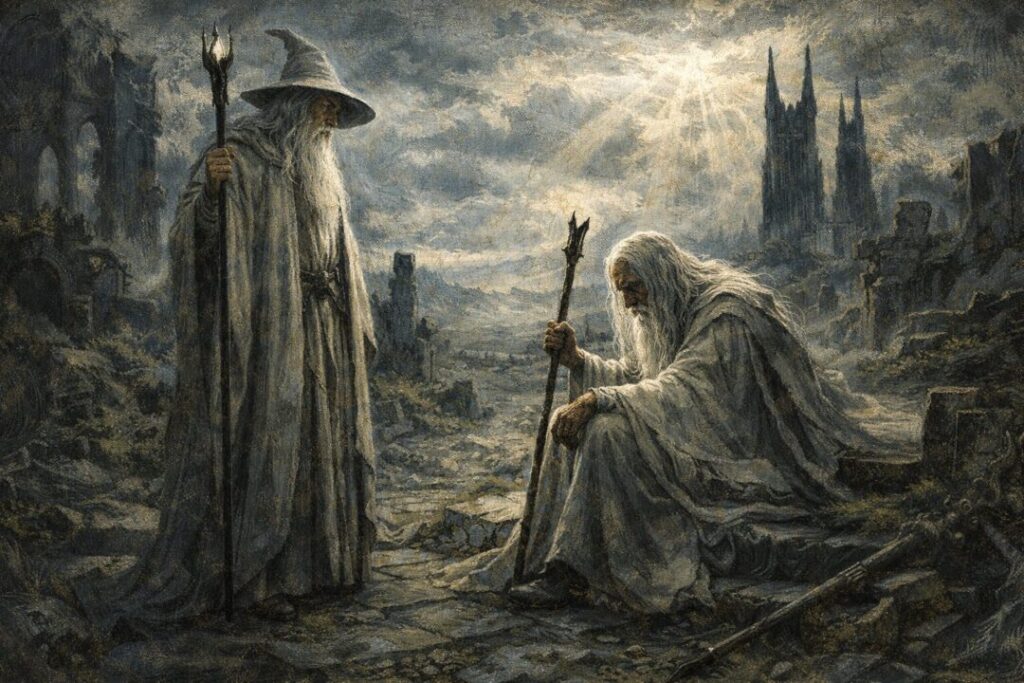
After the fall of Isengard, when Gandalf confronts him, repentance is offered—real repentance. Saruman is given a chance to step away from his pride, to acknowledge his failure, and to begin again.
This moment is crucial.
Saruman does not refuse because he cannot change.
He refuses because surrendering pride would cost him more than defeat.
To repent would mean admitting that Gandalf was right. That domination itself was the error. That all his cleverness led only to ruin.
Saruman cannot bear that truth.
And so the wizard who sought to outthink the Dark Lord ends not as a king, nor even as a servant, but as something far smaller—consumed by bitterness, stripped of power, and wandering in resentment.
Final Thought
Saruman did not fall because he went too far, too fast.
He fell because he believed he could go just far enough.
In Tolkien’s world, that belief is the most dangerous of all.
So the question remains:
Was Saruman doomed the moment he chose pride—or did he damn himself later, when mercy was still within reach?