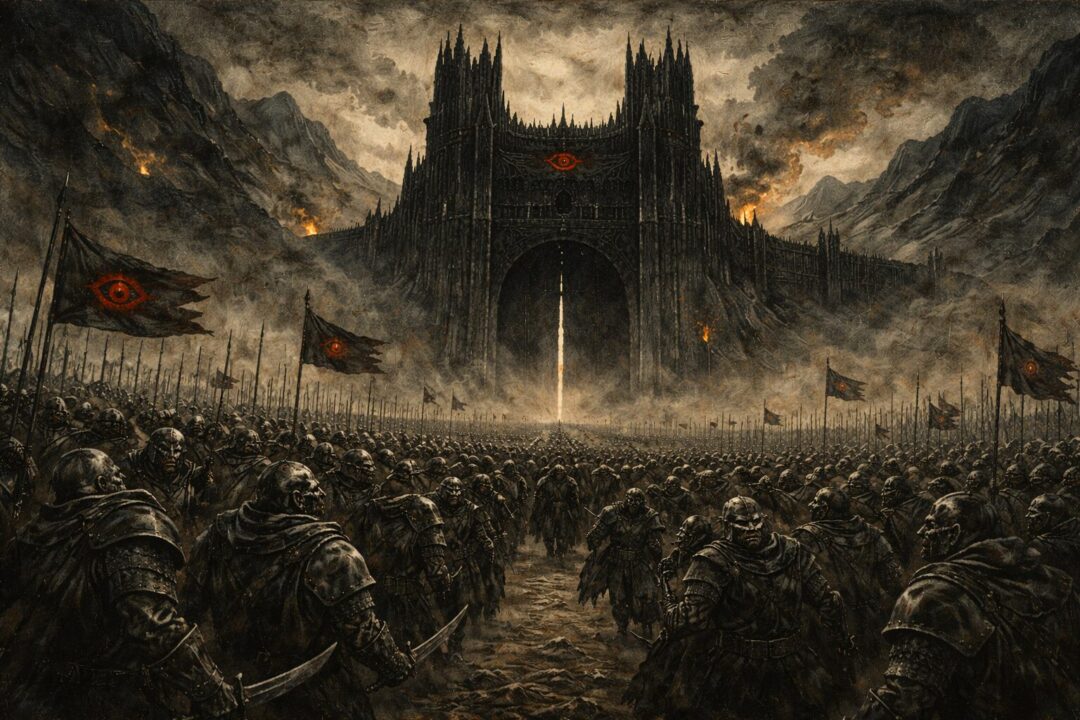
When Isengard falls, the War of the Ring shifts.
The Hornburg stands.
Helm’s Deep holds.
The Ents break the Ring of Isengard.
And Saruman’s army—his Uruk-hai—are destroyed or scattered.
For many readers, this raises a practical question: if Saruman created larger, disciplined Orc-soldiers who could endure the sun, why did Sauron never take them for himself?
On the surface, it seems like a missed opportunity.
But the texts do not present it that way.
They quietly show something else.
First: Sauron Already Had Uruks
The idea that Saruman invented the Uruk-hai is not supported by the primary narrative.
In The Lord of the Rings, we are told that “black Uruks of Mordor” issued from Minas Morgul. At the Battle of the Pelennor Fields and before the Black Gate, Uruks serve directly under Sauron’s command.
Appendix A notes that “in the last years of Denethor I the race of Uruks, black orcs of great strength, first appeared out of Mordor.”
This is significant.
Uruks did not originate in Isengard. They were already part of Sauron’s military structure centuries before the War of the Ring.
Saruman’s Uruk-hai are therefore not a superior invention replacing an inferior model.
They are a regional variation.
The Isengard Uruks are described as tall, broad, disciplined, and able to endure daylight. But Mordor’s Uruks are likewise formidable, and they appear in great number.
The difference is not existence.
It is loyalty.
Saruman’s Army Is Marked by Independence
The Uruk-hai at Amon Hen identify themselves clearly:
“We are the Uruk-hai. We do not stop the fight for night or day.”
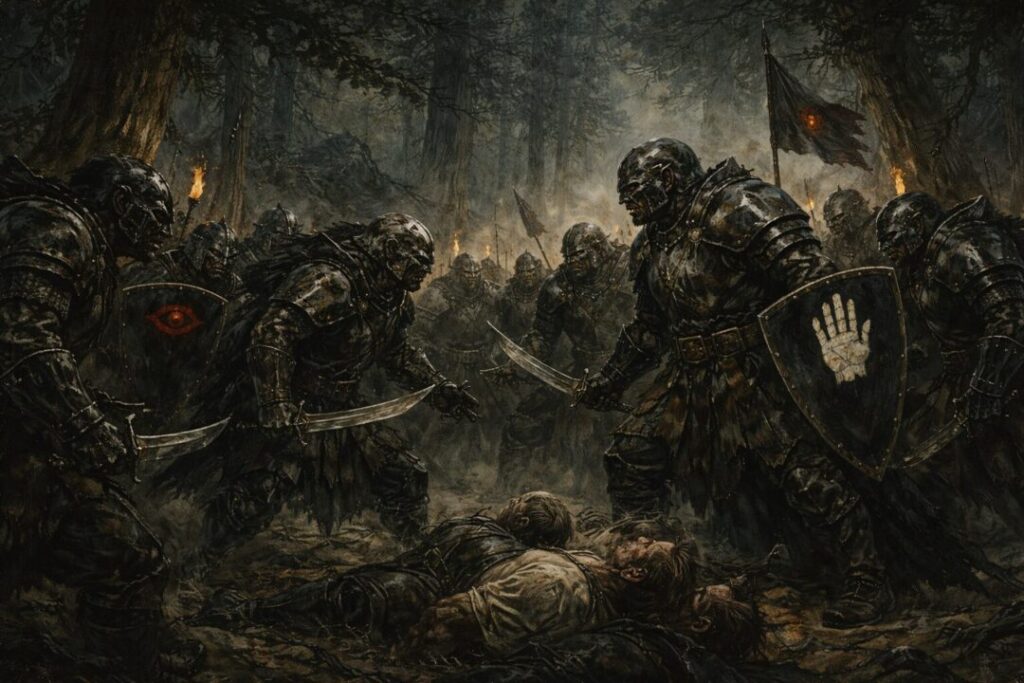
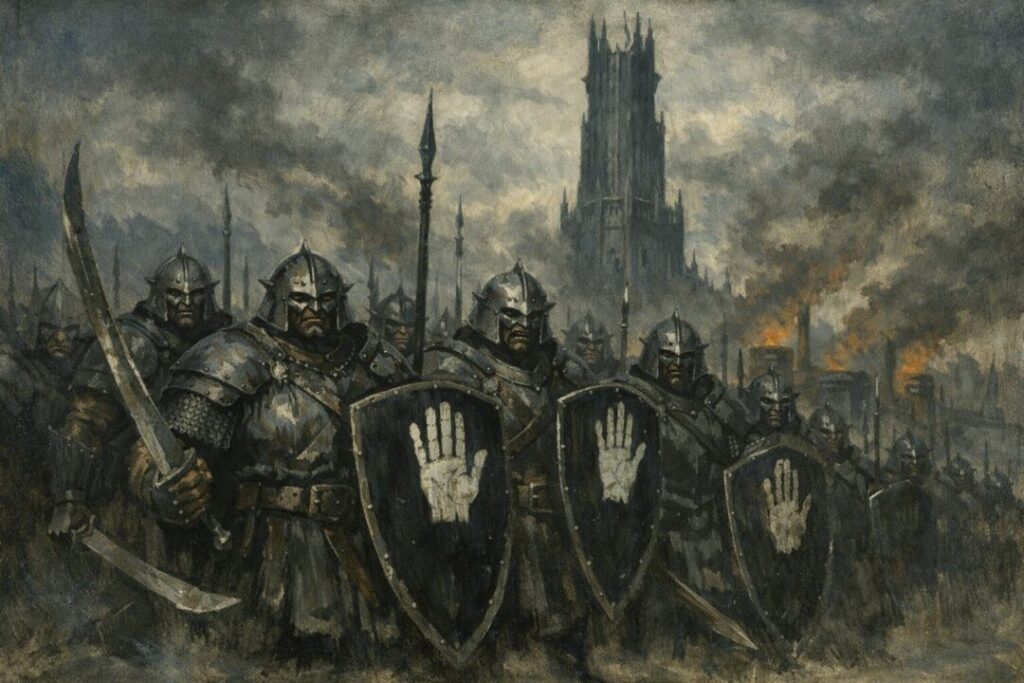
They bear the White Hand of Saruman.
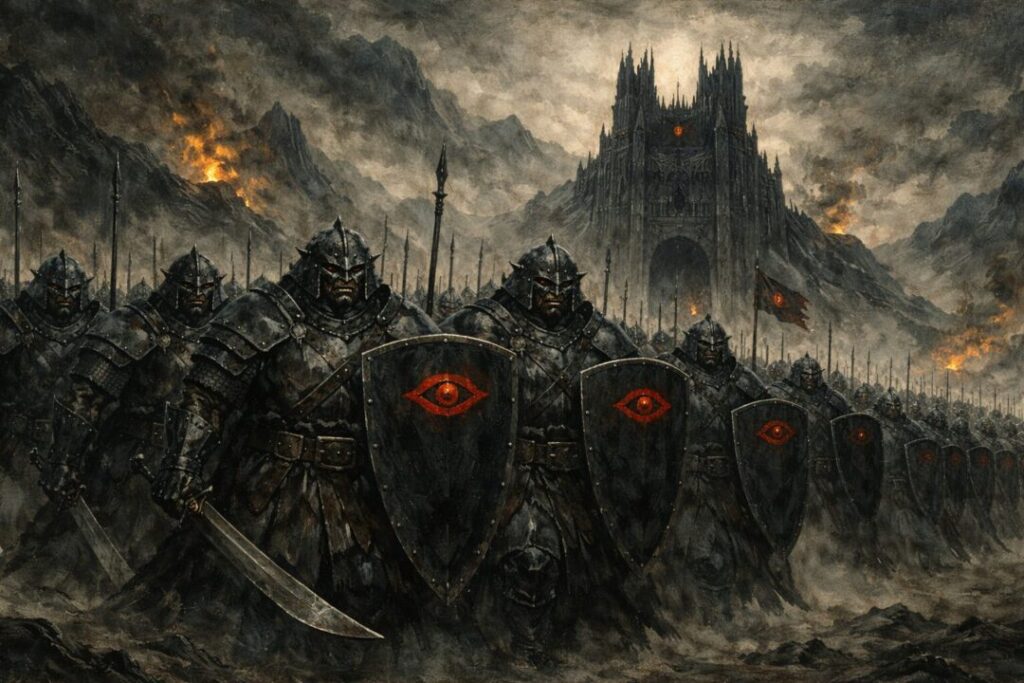
They do not march under the Red Eye.
That detail matters.
Saruman is no longer acting as Sauron’s servant. In The Two Towers, Gandalf explains that Saruman “has become a power” and seeks to rival Sauron, not merely serve him.
Treebeard describes him as having “a mind of metal and wheels,” a figure who desires order and domination in his own right.
Even in the parley at Orthanc, Saruman’s voice attempts manipulation, not submission.
By the time the War of the Ring begins in earnest, Saruman is not an extension of Sauron’s will.
He is a competitor.
To absorb Saruman’s forces would not simply be to recruit stronger Orcs.
It would be to legitimize a rival.
And Sauron does not share authority.
Control Is Sauron’s True Weapon
One of the defining traits of Sauron’s rule is centralized control.
His dominion operates through fear, hierarchy, and surveillance.
The Nazgûl do not act independently; they are bound to the Ring. The Orcs of Mordor fear punishment and torment. Even the Mouth of Sauron functions as a herald, not an equal.
When Frodo and Sam witness the Orcs near Cirith Ungol, internal quarrels break out—but always under the shadow of higher command.
Sauron’s strength lies not merely in numbers, but in structure.
Saruman’s Uruk-hai, by contrast, show signs of independent command culture. They operate with discipline, but they answer to Isengard. They do not defer to Mordor officers.
In fact, conflict between Mordor Orcs and Isengard Uruks is explicitly depicted in The Two Towers. At the edge of Fangorn, Mordor Orcs and Uruk-hai argue over orders and prisoners.
They are not a unified force.
This tension reflects something deeper: Saruman’s war machine is parallel to Sauron’s, not subordinate.
To merge them would require submission.
And Saruman never offers it.
After Isengard: Timing Matters
Another overlooked detail is timing.
Isengard falls in March of 3019. By that point, Sauron’s war plans are already fully deployed.
The assault on Gondor is underway. The Witch-king leads forces from Minas Morgul. Corsairs move from the south. Armies issue from the Morannon.
The scale is immense.
There is no textual indication that Sauron faced a shortage of troops. On the contrary, the forces described at the Black Gate are vast enough that the Captains of the West march knowing they cannot win by strength.
Sauron’s strategy is not to build a small elite corps.
It is to overwhelm.
Even if surviving Uruk-hai from Isengard had fled east—and the narrative gives no evidence that they did in organized fashion—they would represent a negligible addition compared to the armies already fielded.
The war was already at full burn.
There was no strategic vacuum to fill.
Saruman’s Work Is Imitation, Not Innovation
Treebeard makes a curious observation about Saruman’s Orcs:
“It is a mark of evil things that they cannot bear the Sun.”
But Saruman’s Uruks can.
The text implies deliberate breeding, perhaps intermingling of Orcs and Men. In The Two Towers, it is suggested that Saruman has “blended the races of Orcs and Men.”
However, the narrative never states that Sauron lacked the ability to create sun-enduring Orcs. Mordor’s Uruks operate in daylight during campaigns.
Saruman’s “improvement” may be refinement—but it is not a revolutionary advance beyond Sauron’s capability.
More importantly, Saruman’s experimentation reflects ambition.
He studies the arts of the Enemy. He seeks mastery.
This is not a gift offered upward.
It is a bid for parity.
And Sauron historically does not tolerate rivals.
His entire history—from the forging of the One Ring to his dealings with Númenor—shows a pattern: dominate, absorb, corrupt, but never coexist.
Saruman is useful only so long as he is subordinate.
Once he asserts independence, he becomes expendable.
The Nature of Sauron’s Confidence
There is one final detail worth considering.
At the climax of the war, when Aragorn marches to the Black Gate, Sauron empties Mordor to crush what he believes is the Ring-bearer’s challenge.
He is not cautious.
He is certain.
This confidence reveals something critical: Sauron does not believe he needs refinement or improvement. He believes victory is inevitable once the Ring is within reach.
The war, from his perspective, is already decided.
In that mindset, adopting Saruman’s distinctive forces is unnecessary.
It would imply deficiency.
Sauron does not operate from perceived weakness.
He operates from absolute conviction.
So Why Didn’t He Take the Uruk-hai?
Because he did not need them.
Because they were not truly his.
Because absorbing them would acknowledge a rival’s innovation.
And because Sauron’s strength was never about specialized troops—it was about control, scale, and terror.
The White Hand was a competing symbol.
The Red Eye does not share banners.
When Isengard falls, Sauron does not scramble to salvage its remnants.
He continues his campaign as if Saruman had already been written off.
And in truth, he had.
The War of the Ring was never a partnership between Dark Lords.
It was a hierarchy.
And hierarchies do not absorb challengers.
They replace them.
When you look closely at the texts, the question shifts.
It is not why Sauron failed to adopt Saruman’s Uruk-hai.
It is why we assume he needed to.
And that answer reveals something far more unsettling about how Sauron understood power.
Not as improvement.
But as domination.